
Introduction
#AgricultureIndustry is entering a period of significant transformation. Farmers and food producers are facing rising labor costs, workforce shortages, unpredictable weather conditions, changing consumer expectations, and increasing pressure to produce more food with fewer resources. At the same time, agriculture remains highly dependent on tasks that traditionally require substantial manual labor, including planting, harvesting, sorting, packaging, crop monitoring, and handling.
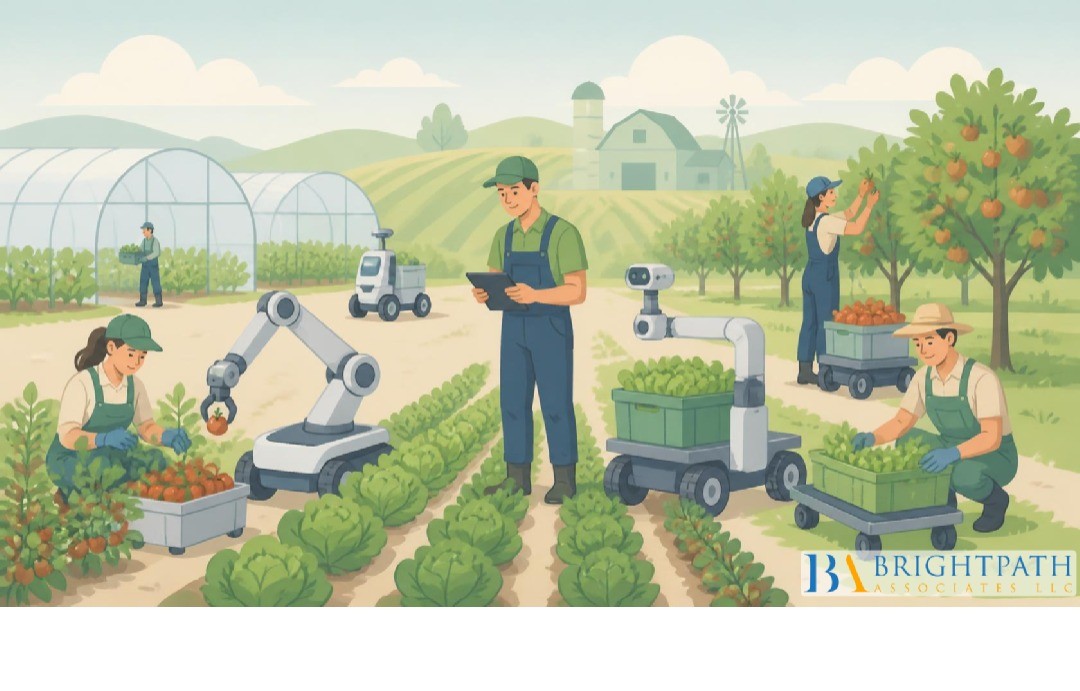
Collaborative robotics offers a potential solution to this growing challenge. Unlike traditional industrial robots that are typically separated from workers, collaborative robots are designed to operate alongside people in shared work environments. When appropriately implemented, these systems can support agricultural workers rather than simply attempting to replace them.
The development of Agricultural technology is making robotics increasingly accessible to farms and agricultural businesses of different sizes. Advances in sensors, artificial intelligence, machine vision, automation, and data analytics are creating opportunities to integrate collaborative robots into modern production systems. For organizations focused on Food production, the goal is to improve productivity while maintaining product quality, workforce safety, and long-term Agricultural sustainability.
Understanding the Agricultural Labor Crunch
Labor shortages have become a structural concern across many agricultural markets. Farming often involves physically demanding work, seasonal requirements, geographically dispersed operations, and highly variable workloads. Finding and retaining workers can therefore be challenging, particularly during peak planting and harvesting periods.
Rising labor costs can also affect farm profitability. When labor becomes more expensive or unavailable, crops may be left unharvested, production schedules may be delayed, and businesses may have difficulty meeting customer commitments.
Automation can address some of these challenges by supporting repetitive and physically demanding activities. Collaborative robotics does not necessarily eliminate the need for workers. Instead, it can allow employees to focus on tasks that require judgment, adaptability, communication, and specialized knowledge.
This distinction is important because the future of agriculture is likely to involve greater cooperation between people and machines rather than complete replacement of human labor.
Collaborative robotics involves machines designed to work in close proximity to human operators. In agricultural environments, these systems can potentially assist with crop inspection, harvesting support, material handling, packaging, sorting, and other repetitive processes.
The technology can be particularly valuable when tasks are predictable enough for automation but still require human intervention. A robot may transport harvested products while workers perform quality inspection, for example.
Machine vision and sensors allow collaborative systems to recognize objects, detect movement, and respond to changing conditions. As Agricultural innovation advances, robots are becoming more capable of operating in environments that are less structured than traditional factories.
However, agricultural robotics must account for challenging conditions such as uneven terrain, dust, moisture, variable lighting, biological materials, and changing crop characteristics. Systems designed for agricultural applications therefore require different engineering considerations from robots used in controlled industrial facilities.
Agricultural Technology and Workforce Productivity
Agricultural technology can improve workforce productivity by allowing employees to supervise automated systems rather than performing every repetitive task manually.
For example, workers may spend less time transporting materials and more time monitoring crop quality or managing equipment. A collaborative robot can perform repetitive movement while an employee provides oversight and handles exceptions.
This model can help address labor shortages without requiring farms to automate every process. Selective automation can target the tasks that create the greatest labor burden while preserving human involvement where it adds the most value.
For agricultural businesses, the economic objective should be measured through overall productivity rather than simply the number of workers replaced. Improvements in throughput, quality, worker safety, and consistency can all contribute to the return on investment.
The global demand for Food production continues to increase while agricultural resources face growing constraints. Producers need to improve productivity while managing land, water, energy, labor, and input costs.
#CollaborativeRobotics can contribute by supporting faster and more consistent operations. Automated systems can work for extended periods and maintain predictable performance during repetitive tasks.
In processing and packing environments, robots can help move, sort, package, and organize agricultural products. In field environments, robotics can support monitoring and selected harvesting or cultivation activities.
Automation can also reduce the impact of labor shortages during critical production windows. This can help farmers maintain schedules and reduce losses associated with delayed harvesting.
Precision Agriculture and Intelligent Robotics
Precision agriculture provides an important foundation for intelligent robotic systems. Instead of treating an entire field as a uniform environment, precision agriculture uses data to understand variations in soil, crop health, moisture, nutrients, and other conditions.
Robotics can combine this information with sensors and machine vision to perform targeted activities. A robotic system may identify specific areas requiring attention rather than applying the same treatment across an entire field.
This can improve resource efficiency and support more targeted farming practices. When robotics and precision agriculture are integrated, farms can potentially reduce unnecessary inputs while improving crop monitoring.
The value of this approach extends beyond productivity. Targeted resource use can contribute to Agricultural sustainability by reducing waste and improving the efficiency of land and water resources.
#SustainableFarming requires agricultural businesses to balance productivity with environmental responsibility. Automation can support this objective when it is used to improve resource efficiency rather than simply increase production volume.
Robots can perform precise applications, monitor crop conditions, and collect detailed field data. These capabilities can help farmers make more informed decisions about irrigation, fertilization, pest management, and harvesting.
Energy consumption must also be considered. A robotic system that improves labor efficiency but requires excessive energy may not provide a sustainable solution.
The best approach is to evaluate robotics as part of the entire production system. Farmers should consider equipment utilization, energy requirements, maintenance, lifespan, resource savings, and productivity improvements before making major investments.
Organic Farming and Automation
Organic farming presents unique opportunities and challenges for agricultural robotics. Organic producers often face restrictions concerning chemical inputs and may rely more heavily on mechanical and manual approaches for weed management and crop care.
Robotic systems can potentially support these operations through precision mechanical weeding, crop monitoring, targeted cultivation, and automated inspection.
Machine vision can help distinguish crops from unwanted plants, allowing robotic equipment to perform targeted interventions. This can reduce manual labor requirements while supporting organic production principles.
As technology becomes more sophisticated, automation could make certain organic farming practices more economically viable, particularly where labor-intensive processes currently limit scalability.
Agricultural innovation increasingly depends on the integration of physical equipment with digital systems. Robots generate data, sensors collect environmental information, and software platforms provide tools for managing operations.
Digital Farming brings these capabilities together. Farms can use connected equipment, remote monitoring, predictive analytics, and automated workflows to create more responsive production environments.
The challenge is avoiding disconnected technologies. A farm may own advanced equipment but gain limited value if each system operates independently.
Integration is therefore becoming a critical consideration. Robotics, farm-management platforms, sensors, and agricultural machinery should ideally exchange relevant information so that managers can make decisions using a more complete view of operations.
The Role of Farm Management Software
Farm management software can provide the digital infrastructure required to coordinate increasingly automated agricultural operations. These platforms can help farmers track fields, labor, equipment, inputs, crop conditions, schedules, and financial performance.
When integrated with robotics, farm management software can help managers understand where automated systems are operating and how effectively they are being utilized.
Data from robotic equipment can also contribute to performance analysis. Managers can identify bottlenecks, maintenance requirements, labor savings, and productivity trends.
The result is a more connected operating environment in which robotics becomes part of a broader management strategy rather than an isolated piece of equipment.
#SustainableAgricultureInvestment is increasingly influenced by technological development. Investors, agricultural businesses, food companies, and policymakers are looking for solutions that can improve productivity while reducing environmental pressure.
Collaborative robotics can become part of this investment landscape when systems demonstrate measurable benefits. Investors may evaluate labor savings, productivity improvements, resource efficiency, scalability, and potential market demand.
However, investment decisions should remain grounded in practical economics. Agricultural environments are diverse, and a robotic solution that works effectively for one crop or operation may not be appropriate for another.
Successful sustainable agriculture investment therefore requires careful evaluation of the technology, operating environment, workforce, and long-term business model.
Agricultural Sustainability and Resource Efficiency
Agricultural sustainability extends beyond environmental concerns. It also involves economic and social resilience. Farms must remain financially viable, workers need safe and productive working environments, and communities depend on agriculture for employment and economic activity.
Collaborative robotics can contribute to this broader definition of sustainability by reducing physically demanding work, improving productivity, and helping farms manage labor shortages.
When robots perform repetitive lifting or transportation tasks, workers may be able to focus on higher-value responsibilities. This can potentially improve workplace safety and make agricultural employment more attractive.
Technology should therefore be implemented with the workforce in mind. Employees need training, opportunities to develop new skills, and clear understanding of how automation will change their responsibilities.
The adoption of robotics is changing the skills required in agriculture. Modern agricultural workers may increasingly need to understand sensors, digital systems, equipment operation, data interpretation, and basic robotics maintenance.
This creates an opportunity to transform agricultural jobs rather than simply eliminate them. Workers can transition from highly repetitive physical tasks toward technology-supported roles involving supervision, maintenance, quality control, and decision-making.
Agricultural businesses should invest in training alongside equipment. A robotic system cannot deliver its full value if employees lack the skills required to operate, maintain, and interpret it.
Leadership and Executive Search Recruitment
Technology transformation requires capable leadership. Agricultural executives must understand farming operations while also evaluating technology investments, workforce development, sustainability goals, and financial performance.
#ExecutiveSearchRecruitment can help agricultural organizations identify leaders with experience across technology, operations, food production, sustainability, and agricultural innovation.
Leadership becomes particularly important during automation projects because organizational change can create uncertainty among employees. Executives must communicate the purpose of automation clearly and demonstrate how technology will support the long-term health of the business.
The strongest leaders will be able to connect technology investment with practical agricultural outcomes rather than treating robotics as an isolated innovation project.
Successful robotic adoption should begin with clearly defined operational problems. Agricultural businesses should identify tasks where labor shortages, safety concerns, repetitive workloads, or productivity limitations create significant challenges.
Once these priorities are established, companies can evaluate whether collaborative robotics provides an appropriate solution. Pilot projects can help organizations test performance under real operating conditions before making larger investments.
The implementation process should include employee training, maintenance planning, data integration, safety evaluation, and performance measurement.
Rather than attempting to automate an entire operation immediately, organizations can begin with targeted applications and expand as employees gain experience and the technology demonstrates measurable value.
Conclusion
The agricultural labor crunch is unlikely to be solved by a single technology or strategy. However, collaborative robotics offers an important opportunity to combine human expertise with automated capabilities.
Agricultural technology, Precision agriculture, Digital Farming, and Farm management software are creating an increasingly connected agricultural ecosystem. Within this ecosystem, robotics can support Food production by improving productivity, reducing repetitive labor, and enabling more precise operations.
Sustainable farming, Organic farming, and Agricultural innovation can also benefit from targeted automation when technology is designed around resource efficiency and practical farm requirements. At the same time, Sustainable agriculture investment can help accelerate the development and adoption of technologies capable of producing measurable economic and environmental value.
The future of agriculture will not simply be about replacing workers with machines. It will be about redesigning agricultural work so people and technology can perform complementary roles. Farmers, operators, engineers, and technology specialists will remain essential, while robots can take on repetitive, physically demanding, or highly precise activities.
With thoughtful planning, workforce development, appropriate technology, and strong leadership supported by Executive Search Recruitment, collaborative robotics can become a valuable component of modern Agricultural sustainability. The result can be a more productive, resilient, and technologically capable agricultural sector prepared to meet the challenges of the next generation of food production.
Find your next leadership role in Farming Industry today!