
Introduction
In construction and #IndustrialManufacturing, growth usually comes with a familiar price tag: bigger plants, heavier equipment, longer commissioning cycles, and capital decisions that can take years to pay back. But that old equation is being rewritten. Micro-modular fabrication is emerging as a practical way to expand capacity in smaller, repeatable increments, letting operators respond to demand while avoiding the all-in bet of a single, massive build.
At its core, this approach treats production like a set of deployable building blocks rather than a monolith. Whether the output is construction materials, specialized building supplies, or prefabricated assemblies, micro-modular systems enable new lines, new sites, and new throughput with a cadence that aligns more closely to real market signals. The shift touches everything from construction economics and supply chain design to sustainable construction goals and the talent strategies needed to keep distributed operations running smoothly.
Why Micro-Modular Fabrication Changes the Scaling Math
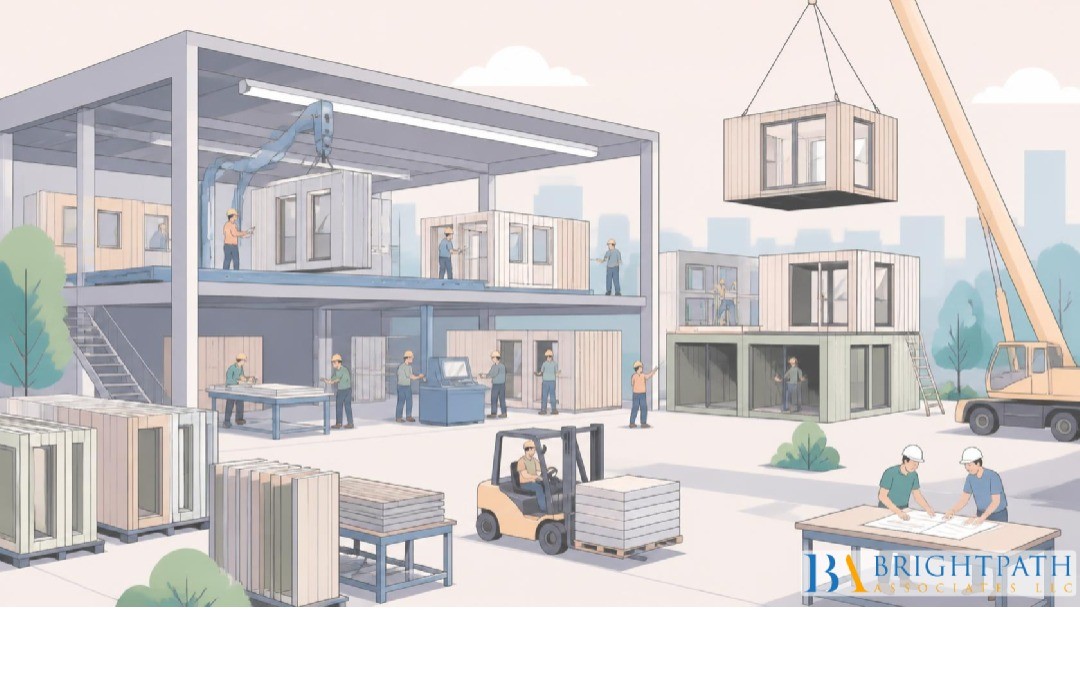
Micro-modular fabrication is best understood as a strategy for decomposing a production system into standardized, high-functioning modules that can be replicated and deployed with minimal re-engineering. Instead of building a single large facility sized for a five- or ten-year forecast, teams build a smaller “cell” that delivers meaningful output on day one, then add cells as constraints become visible. This changes expansion from a periodic shock to a planned rhythm, turning capacity into a portfolio of assets rather than a single point of exposure.
That difference matters because capex is not just money; it is also time, organizational attention, and risk. Large-scale projects lock in assumptions about labor availability, market demand, energy pricing, and logistics costs, even as those variables move. A micro-modular approach is more forgiving. If a region is short on construction jobs and skilled trades, a smaller footprint can be staffed and stabilized faster. If customer requirements evolve, the next module can be designed to incorporate changes without retrofitting a massive installed base.
This flexibility is particularly relevant across sectors tied to building technology and the industrialization of the jobsite. The more construction shifts toward engineered assemblies and performance-driven specs, the more manufacturers of construction materials and building supplies need to react quickly. Micro-modular fabrication supports that responsiveness with shorter commissioning windows, simpler validation, and the ability to pilot new products or variants without pausing an entire plant for changeovers.
Operational Efficiency and Supply Chains in a Modular World
Scaling through micro-modular fabrication forces a re-think of how supply chains are organized. Traditional mega-sites are built around consolidated inbound flows and long-run utilization. Micro-modular networks, by contrast, reward resilience and proximity. When capacity is distributed, operators can place production closer to demand centers, reducing freight exposure and improving service levels for contractors who increasingly expect predictable delivery windows for time-sensitive building supplies.
This distributed model can also reduce the hidden costs that often inflate #ConstructionEconomics. Transportation volatility, long lead times, and inventory buffers exist partly because the network cannot respond quickly when demand spikes. By adding modular capacity in smaller increments, firms can keep inventories tighter and match output to regional project starts. For products like construction materials, where weight-to-value ratios punish long-haul shipping, even modest reductions in distance traveled can meaningfully shift margin and reliability.
Operationally, micro-modular fabrication encourages standard work, instrumentation, and tighter feedback loops. A module that is designed to be repeated must be designed to be measurable. That tends to accelerate the adoption of building technology in the plant itself, including real-time performance monitoring, predictive maintenance, and quality systems that can be deployed consistently across sites. The practical payoff is not only higher uptime but also a more transferable operating playbook, where lessons learned in one module can be rolled into the next build rather than trapped in tribal knowledge.
There is an additional efficiency gain that comes from modular maintenance and upgrades. When production is organized into discrete units, teams can take one module offline for improvement without stopping the whole operation. That creates a pathway for continuous modernization, which is essential as automation, controls, and materials science evolve. In industries that intersect with the lumber industry or engineered wood products, for example, the ability to introduce new scanning, grading, or finishing capabilities incrementally can be more valuable than a single, disruptive plant overhaul.
Sustainable Construction, Material Reuse, and the Case for Circular Inputs
Micro-modular fabrication is not automatically sustainable, but it creates conditions that make sustainable construction easier to execute at industrial scale. Smaller, repeatable systems can be designed with energy intensity, waste streams, and water use in mind from the first module, then replicated without the dilution that often occurs when sustainability is treated as a bespoke add-on. In practical terms, it becomes easier to standardize low-waste batching, closed-loop process controls, and higher-yield packaging and palletization systems.
The opportunity becomes even more compelling when paired with material recycling and circular feedstocks. Many producers of construction materials are being asked to incorporate recycled aggregates, reclaimed fillers, and alternative binders, while maintaining consistent performance. In concrete production, that challenge often shows up as variability in recycled content and the need for tighter quality control on inputs. A micro-modular model can address this by dedicating specific modules to specific feedstock profiles, creating contained recipes and process parameters that protect consistency while still enabling higher recycled content where it makes technical and economic sense.
Similarly, in the lumber industry and broader wood products ecosystem, circularity is increasingly tied to how fiber is sourced, processed, and recovered. Micro-modular fabrication can support localized sourcing strategies that reduce transportation emissions while strengthening supply continuity. It can also make it easier to integrate secondary streams, such as recovered wood or engineered byproducts, because the risk of disrupting a massive continuous line is lower when changes can be isolated to a module built for controlled experimentation and scale-up.
Beyond inputs, modularity can reduce embodied waste in the manufacturing system itself. When a plant is built as repeatable units, expansion does not require overbuilding utilities, buildings, and supporting infrastructure “just in case.” That restraint can lower the total material footprint of growth and reduce the likelihood of stranded assets if demand shifts. In a market where sustainability claims are increasingly scrutinized, this kind of disciplined scaling can be as important as any single green material choice.
Building Regulations and the Compliance Reality of Distributed Capacity
If micro-modular fabrication makes scaling easier operationally, it can make governance more complex. A single large facility typically deals with one set of permits, one inspector ecosystem, and one compliance framework. A distributed network of modules multiplies interfaces with building regulations, environmental permitting, workplace safety regimes, and local zoning expectations. The regulatory burden does not necessarily grow linearly, but it does become more variable, and variability is where schedules slip and costs compound.
The most effective operators treat compliance as a design input, not an administrative afterthought. Modules that can be repeated should also be pre-engineered to satisfy common regulatory expectations, with documentation packages that travel with the design. That includes standardized hazard analyses, emissions profiles, noise and traffic assumptions, and clear boundaries around what changes are allowed without triggering a re-permit. In practical terms, the goal is to make each new deployment feel less like a new project and more like a controlled replication with known parameters.
There is also a product-facing dimension to regulation that is easy to miss. Many construction materials and building supplies are governed by performance standards and certification regimes that specify not only what the product must do, but how it must be made and documented. When production expands across modules and sites, quality systems must prove equivalence. That puts pressure on traceability, calibration, operator training, and the digital backbone that connects process data across the network. Building technology becomes the enabler here, not as a buzzword, but as the mechanism that makes distributed manufacturing auditable and repeatable.
Finally, modular scaling changes the stakeholder map. #LocalCommunities may be more supportive of smaller facilities than mega-plants, but they still care about jobs, traffic, and environmental impact. A micro-modular strategy can be a strong story for creating construction jobs and stable industrial employment without overwhelming local infrastructure, but only if the operator engages early and shows credible controls. In many regions, trust is built on transparency and responsiveness, and smaller facilities are often judged less by corporate promises and more by day-to-day operational behavior.
The Talent Required to Make Micro-Modular Work at Scale
Micro-modular fabrication does not eliminate complexity; it redistributes it. Instead of concentrating expertise in one flagship site, operators must build repeatable competence across a network. That raises the bar for operating systems, but it also raises the bar for people. The organizations that succeed tend to combine strong process engineering with pragmatic site leadership, and they invest early in training and knowledge transfer so each module does not become a reinvention.
From a workforce perspective, the approach can be a lever in tight labor markets. Smaller sites can be located closer to talent pools, and roles can be designed with clearer career paths because modules share common equipment and routines. But distributed operations also demand more from frontline leaders. They must run a tight shift, manage quality discipline, and interface with local regulators and suppliers, often with less central support than a large plant would provide. As construction jobs and industrial roles evolve, this blend of operational rigor and local agility becomes a differentiator.
At the technical level, micro-modular systems are deeply intertwined with building technology, controls, data systems, and reliability engineering. In concrete production, for instance, maintaining mix consistency across modules can require stronger automation, better sensor validation, and sharper process governance than many legacy plants were built to deliver. In sectors adjacent to the lumber industry, maintaining grading consistency and defect detection across smaller lines can require specialized skills in instrumentation and data interpretation. These are not problems solved by headcount alone; they are solved by hiring the right profiles and giving them authority to standardize the system.
This is where #ExecutiveSearchRecruitment becomes more than a staffing channel. Modular scaling often needs leaders who can build systems, not just run assets. They must be comfortable with replication, data-driven governance, and cross-site performance management, and they must also understand the commercial reality of construction economics, where service reliability can matter as much as unit cost. The right hires can turn micro-modular fabrication into a scalable operating model; the wrong hires can turn it into a patchwork of sites that look similar on paper but behave differently in the field.
Conclusion: A Practical Path to Growth with Less Financial Gravity
Micro-modular fabrication offers a different way to scale: build capacity in repeatable increments, keep investment aligned to demand, and standardize operations so performance improves as the network grows. Done well, it strengthens supply chains for construction materials and building supplies, supports sustainable construction through smarter resource use and material recycling, and creates a clearer roadmap for meeting building regulations without turning every expansion into a one-off negotiation.
The business case is ultimately about control. By reducing the size of each bet while increasing the repeatability of execution, micro-modular fabrication lets operators expand without the financial gravity of massive capex, while building an organization capable of sustained, disciplined growth.
Find your next leadership role in Building Materials Industry today!
Stay informed with the latest insights on Building Materials Industry!