
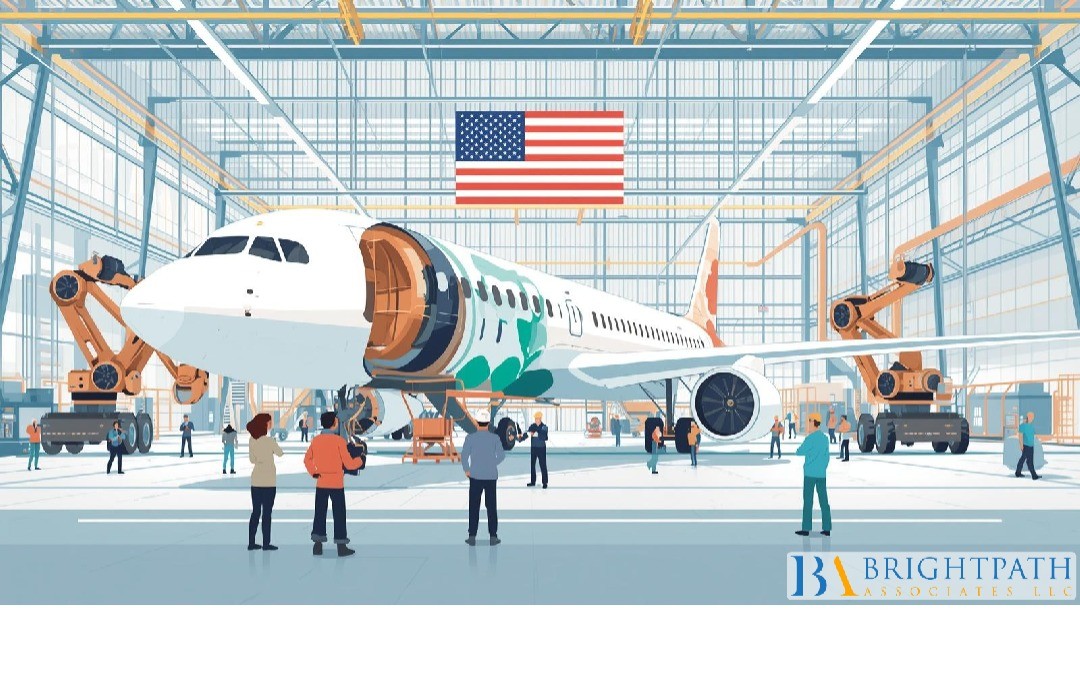
The United States continues to command a dominant position in global aviation, supported by a highly advanced industrial base, deep defense investments, strong commercial #AviationDemand, and a growing ecosystem of aerospace startups. Founders of small to mid-sized aviation enterprises, understanding the strategic direction of leading aircraft manufacturing companies in the USA is no longer optional—it is foundational to long-term competitiveness.
The modern aviation landscape is defined by rapid technological evolution, regulatory complexity, supply chain realignment, and an intensifying competition for leadership talent. As aircraft platforms become more digitally integrated and sustainability-focused, executive capabilities must evolve in parallel.
The Strategic Dominance of U.S. Aircraft Manufacturing
The U.S. aviation and aerospace sector remains one of the largest contributors to advanced manufacturing output globally. Aircraft manufacturing companies USA operate across commercial aviation, defense aviation industry programs, business jets, rotorcraft, and increasingly, space exploration technology.
Industry leaders such as Boeing, Lockheed Martin, Northrop Grumman, Raytheon Technologies, Gulfstream Aerospace, and Textron Aviation anchor a complex industrial network spanning thousands of suppliers and engineering firms. Collectively, the broader aerospace sector supports millions of jobs across manufacturing, engineering, maintenance, and aerospace supply chain management.
Commercial aviation market trends continue to reflect strong long-term passenger growth expectations, fleet modernization initiatives, and increasing demand for fuel-efficient aircraft. At the same time, geopolitical pressures are reshaping defense procurement priorities, increasing investment in advanced fighter programs, unmanned systems, and next-generation surveillance technologies.
For smaller aviation firms, aligning strategically with these macro dynamics—whether through subcontracting, niche aerospace engineering solutions, or specialized component manufacturing—is essential.
Commercial Aviation and the Push for Sustainability
#CommercialAviation remains a cornerstone of U.S. aircraft manufacturing. Fleet renewal strategies emphasize lighter materials, composite structures, improved aerodynamics, and next-generation propulsion systems. Airlines are under mounting pressure to reduce carbon emissions while improving operating margins, prompting demand for more efficient narrow-body and wide-body aircraft.
This technological pivot requires manufacturers to integrate sustainable aviation fuel compatibility, hybrid propulsion research, and digital performance monitoring into their design frameworks. Aerospace engineering solutions now intersect deeply with software, data analytics, and predictive maintenance systems.
At the executive level, this transformation demands leaders who understand both hardware engineering and digital integration. Traditional aerospace expertise alone is no longer sufficient. CEOs and founders must prioritize hiring executives capable of managing cross-disciplinary innovation while navigating complex FAA regulations for aviation.
Defense Aviation and Advanced Technology Integration
The defense aviation industry represents another critical pillar of U.S. aircraft manufacturing. Advanced fighter jets, missile defense systems, autonomous aerial vehicles, and space exploration technology platforms are reshaping strategic defense capabilities.
Programs led by companies such as General Dynamics and Sierra Nevada Corporation demonstrate the increasing convergence of aerospace, artificial intelligence, cybersecurity, and space systems.
Defense contracts often require rigorous compliance structures, classified program management, and highly specialized engineering teams. Executives operating in this segment must demonstrate deep regulatory expertise, operational discipline, and the ability to manage long procurement cycles. Leadership misalignment in such environments can stall multimillion-dollar contracts and damage long-standing government relationships.
For mid-sized defense aviation suppliers, succession planning and strategic hiring become especially critical as program complexity grows.
The Rise of Aerospace Startups and Space Innovation
Beyond legacy manufacturers, aerospace startups are reshaping the competitive landscape. Private investment in urban air mobility, electric vertical takeoff and landing aircraft, satellite launch systems, and reusable spacecraft is accelerating.
Companies like SpaceX and Blue Origin have demonstrated how innovation-driven organizations can disrupt traditional aerospace development cycles. Their agile engineering methodologies, vertically integrated supply chains, and rapid prototyping approaches are influencing broader industry standards.
For founders of smaller aviation companies, the rise of aerospace startups presents both opportunity and risk. On one hand, partnership ecosystems are expanding. On the other, competition for engineering and #ExecutiveTalent is intensifying dramatically.
Leadership candidates with expertise in space exploration technology, advanced propulsion, or integrated avionics are now highly sought after, making aviation industry recruitment more complex than ever.
Supply Chain Pressures and Operational Resilience
Aerospace supply chain management has emerged as one of the most pressing challenges for aircraft manufacturing companies USA. Disruptions in raw materials, semiconductor components, and precision-machined parts have highlighted structural vulnerabilities in global sourcing models.
Executives must now balance cost optimization with resilience. Many manufacturers are diversifying supplier bases, investing in domestic production capabilities, and leveraging digital supply chain monitoring tools to reduce risk exposure.
However, implementing these strategies requires leaders skilled in operational transformation, risk modeling, and regulatory compliance. Without the right executive oversight, supply chain instability can cascade into production delays, certification setbacks, and reputational damage.
Regulatory Complexity and Safety Imperatives
The aviation sector operates under some of the most stringent regulatory frameworks in the world. FAA regulations for aviation govern aircraft certification, maintenance standards, pilot training protocols, and manufacturing compliance.
Simultaneously, #AviationSafetyManagementSystems have become integral to operational governance. These systems demand proactive risk identification, safety performance monitoring, and continuous improvement practices.
Executives must ensure that safety culture is embedded at every organizational level. This requires not only technical knowledge but also cultural leadership. Inadequate executive oversight in safety management can lead to regulatory scrutiny, financial penalties, and brand erosion.
As aircraft systems grow more technologically sophisticated, regulatory alignment becomes even more complex. Leaders must interpret evolving standards while maintaining innovation momentum—a delicate balance that demands seasoned executive judgment.
The Leadership Talent Shortage in Aviation
Despite the industry’s technological strength, aviation faces a mounting leadership talent shortage. A significant portion of senior aerospace executives are approaching retirement, while the pipeline of experienced successors remains limited.
Simultaneously, role expectations are shifting. Modern aviation executives must combine engineering literacy, digital fluency, financial acumen, sustainability awareness, and global supply chain expertise. Few candidates possess this full spectrum of competencies.
This gap has intensified competition for high-caliber leaders across commercial aviation, defense aviation industry programs, and aerospace startups. Smaller firms, in particular, struggle to compete with large defense contractors and multinational manufacturers offering expansive compensation packages and global visibility.
Without strategic Aviation industry recruitment strategies, these firms risk stagnation, delayed innovation, and weakened competitive positioning.
The Evolution of Executive Hiring Practices
Executive hiring in aviation has evolved significantly. Traditional recruitment models that rely on passive job postings or limited professional networks are no longer sufficient.
Forward-thinking organizations are adopting #ExecutiveSearchRecruitment methodologies that proactively identify, assess, and engage top-tier talent—often before those individuals enter the open market. These approaches emphasize confidential outreach, competency mapping, leadership benchmarking, and cultural alignment analysis.
In highly specialized areas such as aerospace engineering solutions or space exploration technology, executive search firms provide access to niche talent pools that internal HR teams may struggle to reach.
Additionally, C-suite hiring now frequently involves evaluating candidates’ ability to lead digital transformation initiatives, strengthen Aviation Safety Management Systems, and navigate complex FAA regulations for aviation. The selection process has become more rigorous, data-driven, and strategically aligned with long-term growth objectives.
Why Executive Search Has Become a Strategic Imperative
For founders and C-suite leaders in small to mid-sized aviation companies, leadership decisions directly influence valuation, investor confidence, and operational scalability. Executive misalignment can delay product launches, disrupt aerospace supply chain management, and weaken partnerships with major aircraft manufacturing companies USA.
Specialized executive search recruitment firms play a vital role in mitigating these risks. By combining deep industry insight with structured evaluation frameworks, they ensure that leadership hires are not only technically qualified but also strategically aligned.
Brightpath Associates exemplifies this focused approach. As a firm specializing in executive search recruitment across aviation and advanced manufacturing sectors, it supports organizations in identifying transformative leaders capable of driving innovation, regulatory compliance, and sustainable growth.
In a market shaped by commercial aviation market trends, expanding defense aviation industry investments, and the rapid rise of aerospace startups, executive capability is the ultimate differentiator. Companies that treat leadership hiring as a strategic investment rather than a transactional process position themselves to thrive amid complexity.
The U.S. aviation sector will continue evolving—technologically, operationally, and competitively. For decision-makers at the helm of growing aviation enterprises, the path forward is clear: align with industry trends, strengthen operational resilience, and secure visionary leadership through disciplined executive search recruitment. The future of aircraft manufacturing belongs to organizations that combine engineering excellence with strategic leadership foresight.
Find your next leadership role in Aviation and Aerospace Industry today!
Stay informed with the latest insights on Aviation and Aerospace Industry!