
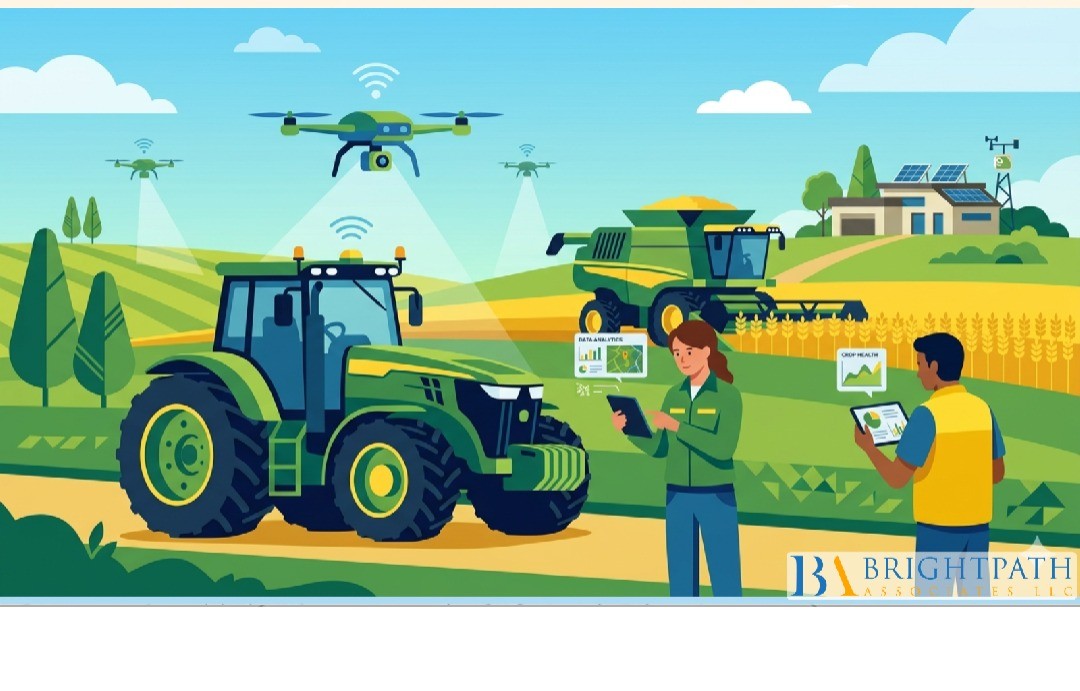
Introduction: An Industrial Evolution in the Fields
#FarmEquipment is undergoing a pivotal transformation as machinery becomes intelligent, connected, and increasingly autonomous. The convergence of Agricultural technology, data analytics, and advanced powertrains is redefining how work is planned, executed, and measured in the field. This shift arises from structural pressures—tight labor markets, volatile input costs, climate variability, and market demands for traceability and stewardship—that collectively demand more output per acre, per hour, and per unit of input. For producers, manufacturers, and financiers, the coming decade offers extraordinary opportunities to invest in platforms that expand capacity and resilience while improving returns on capital and time. The future of Food production will be shaped by how effectively the industry aligns hardware innovation with software intelligence, agronomic insights, and sustainable farming outcomes.
Structural Drivers: Labor, Inputs, and the Push for Efficiency
The first driver of change is labor. In many agricultural economies, the farm workforce is aging and increasingly scarce during peak seasons. This demographic reality challenges traditional operating models that rely on long days in the cab and large seasonal crews. Autonomous guidance, machine vision, and remote monitoring have shifted from optional enhancements to operational necessities, absorbing repetitive tasks and extending the effective working day without adding headcount. Precision agriculture, already proven in guidance and section control, now moves deeper into autonomous operations such as tillage, targeted spraying, and mowing, with remote oversight from mobile devices.
Input pressure is the second driver. Fertilizers, fuel, crop protection products, and spare parts have escalated in cost and volatility. Precision agriculture responds by synchronizing application with need, reducing overlap and misses, and delivering plant- or zone-level decisions that conserve inputs while protecting yields. Data-driven optimization—from variable-rate prescriptions to advanced nozzle control—reduces waste and improves margins, anchoring a measurable return on digital tools. This is where Digital Farming and Farm management software move from back-office utilities to frontline productivity engines, unifying equipment telemetry, yield maps, and agronomic models into decisions executed with centimeter accuracy.
Sustainability is the third driver and increasingly a source of competitive advantage. Agricultural sustainability is no longer only compliance or branding; it is a set of practices that reduce risk, lower costs, and open premium markets. Variable-rate fertility lowers runoff risk, targeted spraying mitigates resistance and reduces chemical loads, and lighter, electrified equipment can cut on-farm emissions and noise while simplifying maintenance. As value chains request documented practices, traceability and verification align with the same data streams that already power operational efficiency. Sustainable farming, in this sense, dovetails with profitability.
Autonomy: From Operator Assist to Driverless Workflows
Autonomy is advancing along a practical continuum. The earliest wave—auto-steer and automated implement control—removed fatigue and tightened accuracy. The emerging wave layers on machine vision, sensor fusion, and real-time path planning to enable supervised and, increasingly, unsupervised operations. In structured tasks such as tillage, mowing, or inter-row weeding, autonomy can operate with minimal intervention, escalating only when obstacles, job-quality deviations, or diagnostics trigger alerts. The business case is straightforward: more field hours with fewer operators, steadier job quality, and tighter timing in narrow agronomic windows.
The key to dependable autonomy is an industrial-grade perception stack and a robust command-and-control loop. Stereo or lidar-based imaging, low-latency edge compute, and conservative safety envelopes must be paired with serviceable hardware that can tolerate dust, vibration, and variable light. Integration with #FarmManagementSoftware is crucial. Operators need a single pane of glass to start, monitor, and adjust operations; agronomists need to overlay prescriptions and thresholds; and maintenance teams need predictive alerts tied to parts and service availability. Where autonomy replaces in-cab labor, uptime becomes a strategic lever. The best systems close the loop between the cab that is no longer staffed and the field that must still be perfectly finished.
Electrification: Matching Powertrains to Duty Cycles
Electrification in farm equipment will not arrive uniformly; it will proceed segment by segment according to power requirements and duty cycles. Low- to mid-power tractors and implements that work close to the yard and return regularly to a charging point are excellent candidates for battery-electric platforms. These machines benefit from instant torque, low noise, reduced maintenance, and the potential to charge from on-farm solar or microgrids, aligning operational savings with sustainability goals. For tasks like loader work, feeding, material handling, and light cultivation, electric drivetrains can improve control and responsiveness while lowering total cost of ownership.
At higher power levels and for multi-shift fieldwork, battery mass, charging time, and infrastructure complexity pose technical challenges that are being addressed through advances in energy density, power electronics, and hybrid architectures. In the near term, hybrid systems, efficient diesel with advanced aftertreatment, and alternative fuels may bridge the gap for heavy draft operations and harvest equipment. This pragmatic segmentation ensures that Sustainable farming can progress without compromising the unyielding cadence of the crop calendar. Investors and producers should therefore assess electrification readiness by real duty profiles, field-to-yard distances, and charging logistics, not by headline horsepower alone.
Precision and Robotics: Input Optimization at Plant Scale
The most profound gains in equipment performance now occur at the plant or micro-zone level. With high-resolution sensing—whether from booms, drones, or satellites—machinery can apply inputs only where needed and in the precise amounts required. Machine vision that distinguishes crop from weed in milliseconds enables targeted spraying that saves chemical costs while sustaining efficacy. Precision agriculture thus becomes both a productivity tool and a risk-management strategy, reducing exposure to volatile input markets and regulatory constraints.
Specialty-crop robotics adds another frontier. In orchards and vegetables, where hand labor is scarce and costly, autonomous or semi-autonomous platforms thin, prune, harvest, and transport with growing reliability. The economics favor services models, often priced per acre or per unit harvested, transforming machinery from a capital purchase to a variable cost aligned with output. This shift is emblematic of the broader transformation of #AgriculturalInnovation: hardware wrapped in software, services, and data, delivering outcomes rather than only mechanical capability.
Data, Software, and the Rise of the Services Stack
The tractor’s heart remains mechanical, but its mind is now digital. Telematics, over-the-air updates, and cloud analytics are moving the value frontier into persistent services that protect uptime and deepen agronomic insight. Farm management software aggregates machine logs, fuel or energy consumption, as-applied maps, and yield data into an actionable record of decisions and outcomes. As models improve with each season’s data, the same fields yield clearer prescriptions and tighter predictions, compounding benefits over time. Digital Farming is therefore not merely a technology category but a learning loop that makes equipment more accurate and more profitable the longer it runs.
Monetization follows this shift. Subscription bundles tie advanced guidance, autonomy features, predictive maintenance, and agronomic analytics into multi-year agreements. Robotics-as-a-service and equipment-as-a-service convert capital expenditure into operating expenditure, lowering adoption barriers and aligning cash flows to seasonal realities. Insurance and input financing, informed by verified machine and yield data, may further reduce borrowing costs and enhance liquidity. For both producers and investors, these service layers create durable relationships, recurring revenue, and differentiated margins, especially when tied to demonstrable outcome improvements.
Policy, Uptime, and the Importance of Serviceability
As software content rises in machinery, serviceability and downtime risk have become strategic concerns. Producers depend on prompt access to diagnostic tools, parts, and qualified technicians, especially during narrow planting and #HarvestWindows. The policy conversation around repair access and data rights underscores the need for transparent, reliable pathways to keep equipment operating. This is particularly urgent as autonomy scales; the operator no longer in the cab must be replaced by an equally capable support and alerting system. Investment in dealer capacity, remote diagnostics, and parts logistics is therefore as critical as investments in the machines themselves.
Producers evaluating next-generation platforms should stress-test service assumptions before purchase. They should verify remote support response times, availability of loaners during peak, access to updates and calibration files, and clarity of data ownership and portability. The operational value of cutting-edge features depends on the dependability of the entire ecosystem wrapped around the iron.
Financing, Business Models, and the Capital Stack
The capital blueprint for farm equipment is broadening. Traditional term loans and leases remain central, but new models are gaining traction. Service contracts that bundle autonomy features, uptime guarantees, and agronomic intelligence are increasingly popular, with payments anchored to acres, hours, or verified outcomes. Such contracts can be paired with input procurement and risk-management strategies to lock in margins. For investors, sustainable agriculture investment is no longer limited to land or carbon credits; it now includes stakes in software platforms, charging infrastructure, telematics ecosystems, and robotics services that all monetize the same field-level data in different, complementary ways.
Residual value will depend as much on software compatibility and upgrade paths as on engine hours. Platforms designed for modularity—both in hardware components and software features—will retain relevance longer and accommodate emerging implements or sensing packages. This, too, is an investable attribute, particularly for fleets seeking to future-proof purchases against rapid iteration in sensors and autonomy stacks.
Practical Adoption Playbook for Producers
A successful pathway into the future of farm equipment begins with clarity on return on investment and operational fit. Producers should map their acreage, crop mix, and work windows to specific technologies that yield immediate benefits. Guidance, section control, and variable-rate application often deliver quick wins, reducing overlap and input spend while increasing pass-to-pass accuracy. Plant-level spraying can unlock significant chemistry savings in herbicide-intensive systems. Where duty cycles and proximity allow, electrify low- to mid-power tasks first to capture energy and maintenance savings without infrastructure strain.
Data discipline is essential. #StandardizingBoundaries, naming conventions, calibration protocols, and data flows ensures that insights can be trusted and improved year over year. Choosing platforms that interoperate with preferred agronomy tools and that export data in widely used formats reduces lock-in and preserves flexibility. As autonomy expands, start with supervised operations in tasks where the risk envelope is well understood, and escalate gradually, ensuring that alerting and intervention workflows are practiced and reliable.
Finally, embed serviceability into procurement. Confirm diagnostic access, over-the-air update cadence, dealer bench strength, and parts logistics for peak-season contingencies. The best machine on paper can underperform if support falters when the window is open and weather is closing in.
Talent and Organizational Readiness
The machinery revolution is also a talent revolution. As farms adopt more sensing, analytics, and automation, competence in data interpretation, machine calibration, and digital workflows becomes as valuable as mechanical skill. Progressive operations are hiring or upskilling for roles that straddle agronomy, operations, and IT. In parallel, manufacturers and dealers are competing for engineers and field technologists who can maintain both code and components. #ExecutiveSearchRecruitment focused on agtech and industrial technology will play a larger role in matching specialized talent to farms, OEMs, and service providers. Building teams that understand both the agronomic “why” and the digital “how” will be a decisive advantage.
Organic and Conventional Systems: Converging on Precision
#OrganicFarming and conventional systems are often seen as opposites, yet both benefit from the same precision toolkit. In organic systems, machine vision and mechanical weeding robots reduce hand labor and expand workable acreage. In conventional systems, targeted spraying reduces chemical loads and slows resistance development. Both approaches depend on accurate sensing, durable platforms, and reliable data. As a result, investment in Agricultural innovation that improves detection, actuation, and decision support serves the full spectrum of production philosophies and broadens market potential for new technologies.
Outlook: Hardware Strength, Software Intelligence, Service Resilience
The next generation of farm equipment will be judged not only by horsepower or header width but by decision power—the ability of machines to convert data into precise actions that raise yields, reduce inputs, and protect soil and water. Autonomy will reshape labor economics. Electrification will rebalance energy and maintenance profiles wherever duty cycles allow. Precision technologies will keep squeezing waste from every pass. And software will knit everything together into a learning system that gets smarter—and more valuable—the longer it runs. The result is a new industrial stack in agriculture: durable hardware, intelligent software, and resilient service models aligned to uptime and outcomes.
For producers, this evolution promises expanded productive capacity per operator and steadier cost control in volatile markets. For manufacturers, it offers recurring service revenue and defensible differentiation. For financiers, it unlocks sustainable agriculture investment across machines, energy, and data infrastructure that all compound value together. The future of farm equipment is therefore not a single bet but a portfolio of interoperable capabilities—autonomy, electrification, precision, and analytics—working in concert to deliver profitable, resilient, and sustainable Food production.
Conclusion: Investing in an Integrated Future
Investing in growth in farm equipment now means backing integrated systems that are tough enough for the field and smart enough for the season. The most compelling platforms align mechanical reliability with digital clarity, making #SustainableFarmingPractical at scale and economically irresistible. As the sector accelerates, leaders will be those who treat equipment as a continual learning asset, where each acre of experience refines performance and deepens advantage. In that model, Agricultural technology is not a line item but the engine of Agricultural sustainability, and the machinery itself becomes a long-lived vessel for continuous improvement across agronomy, energy, and labor.
Find your next leadership role in Farming Industry today!