
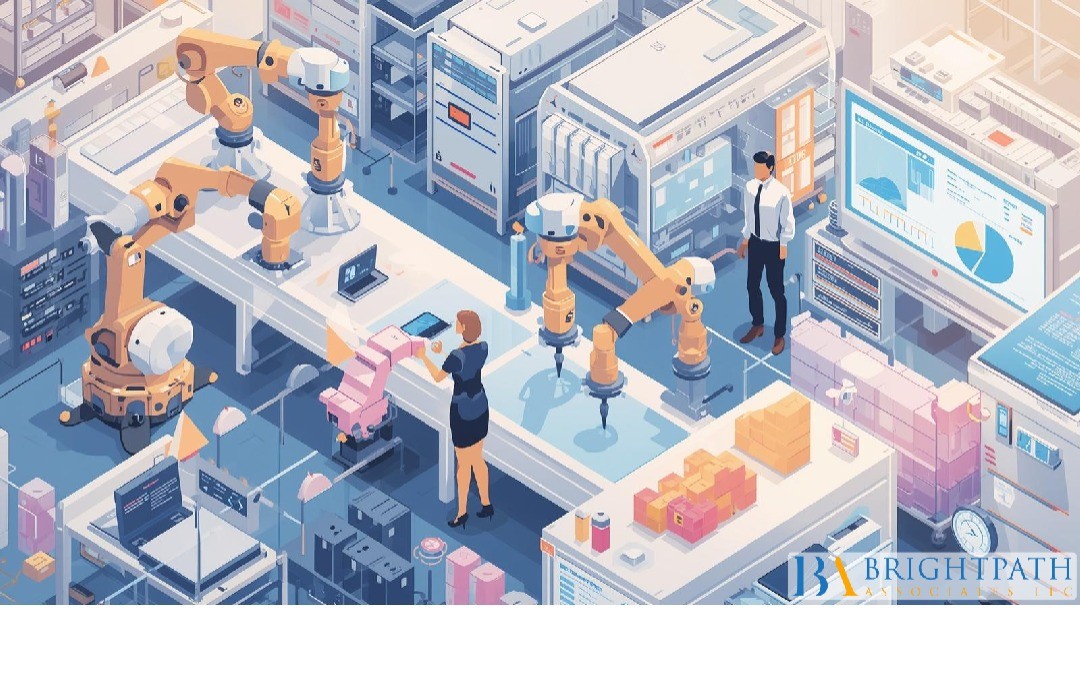
Automation as the New Competitive Baseline in Machinery Manufacturing
Between 2023 and 2025, #IndustrialAutomation has shifted from a performance enhancer to a baseline requirement for machinery manufacturers seeking sustainable growth. Rising labor costs, persistent skills shortages, and increasing demand for precision machining have forced companies to rethink traditional production models. Automation across CNC machining, robotics integration, and smart manufacturing systems is now central to achieving manufacturing efficiency while maintaining quality and scalability.
Market data indicates that machinery manufacturers investing in automation report productivity gains of 20–30%, alongside measurable improvements in machinery maintenance predictability and production consistency. However, automation alone does not deliver value without leadership capable of aligning technology investment with business strategy. This reality has placed unprecedented pressure on executive teams to evolve at the same pace as industrial automation manufacturing itself.
Efficiency Gains Mask a Growing Leadership Gap
While automation improves throughput and reduces dependency on manual labor, it also introduces complexity into manufacturing operations. Advanced industrial machinery requires executives who understand digital workflows, data-driven decision-making, and integrated production ecosystems. From 2023 onward, many machinery companies have discovered that efficiency bottlenecks are no longer mechanical but organizational.
Leadership talent shortages have become a defining constraint. Industry workforce reports estimate that nearly half of experienced manufacturing executives will exit the workforce within the next decade, while fewer leaders are being developed with expertise in automation, precision machining, and advanced manufacturing systems. For small to mid-sized firms, this shortage directly impacts the ability to scale automation initiatives and fully realize return on investment.
Shifting Executive Role Expectations in an Automated Environment
Executive roles within #MachineryManufacturing have expanded significantly. Operations leaders are now responsible not only for output and uptime but also for integrating automation platforms, managing cybersecurity risks, and optimizing data flows across production lines. Financial leaders must evaluate machinery financing decisions in the context of automation lifecycle costs rather than upfront capital alone.
Commercial and strategy executives are expected to anticipate customer demand for smarter, more reliable industrial machinery while managing pricing pressures in competitive global markets. This shift has redefined what “qualified leadership” looks like. Experience with used machinery markets or traditional maintenance models is no longer sufficient without fluency in automation-driven manufacturing environments.
Precision Machining and the Demand for Specialized Leadership
Precision machining has emerged as one of the most automation-intensive segments within machinery manufacturing. High-tolerance components, aerospace and automotive demand, and customization requirements have increased reliance on CNC machining and digitally controlled systems. These environments demand leaders who can synchronize engineering, production, and quality assurance at scale.
Yet, many organizations struggle to find executives who can bridge operational expertise with strategic oversight. This gap often leads to underutilized automation assets, fragmented decision-making, and slower time-to-market. Leadership misalignment, rather than technology limitations, frequently becomes the silent barrier to growth.
Automation’s Impact on Manufacturing Jobs and Workforce Strategy
Industrial automation has reshaped manufacturing jobs rather than eliminating them. Demand has shifted toward roles requiring technical oversight, systems integration, and data analysis. Executives must now balance workforce reskilling with automation deployment to maintain operational continuity.
Companies that fail to align #LeadershipStrategy with workforce transformation risk higher turnover and lower engagement. Executives are increasingly accountable for creating talent ecosystems that support automation adoption, from training programs to succession planning. This added responsibility has further intensified the need for leaders with holistic manufacturing and people-management capabilities.
The Strategic Evolution of Recruitment Practices
Traditional recruitment methods have struggled to keep pace with these evolving leadership requirements. Posting job descriptions and relying on active candidates often yields leaders with narrow experience profiles, unsuited to automation-driven environments. As a result, executive hiring has undergone a strategic shift between 2023 and 2025.
Executive search recruitment has become a preferred approach for machinery manufacturers seeking leaders who combine technical depth with strategic vision. This method enables access to passive candidates—executives currently driving automation initiatives within competitive firms—who are unlikely to respond to conventional recruitment channels.
Executive Search Recruitment as a Growth Enabler
#ExecutiveSearchRecruitment plays a critical role in aligning leadership capability with automation strategy. Rather than filling vacancies reactively, forward-looking machinery companies use executive search to anticipate future leadership needs tied to automation expansion, market entry, or operational transformation.
Organizations such as Brightpath Associates approach executive search recruitment as a strategic partnership. By understanding the nuances of industrial machinery, CNC machining environments, and automation investment cycles, they identify leaders equipped to manage complexity, drive efficiency, and sustain growth. This alignment significantly reduces the risk of costly mis-hires that can stall automation initiatives.
The Financial Cost of Leadership Misalignment
Leadership misalignment in automation-heavy environments carries significant financial risk. Studies suggest that a failed executive hire can cost up to three times the individual’s annual compensation when factoring in lost productivity, delayed projects, and organizational disruption. In capital-intensive machinery manufacturing, these costs are compounded by idle automation assets and missed market opportunities.
Conversely, companies with strong executive leadership demonstrate faster automation payback periods, improved machinery maintenance outcomes, and more resilient supply chains. Leadership quality directly influences how effectively automation translates into profitability.
Preparing for the Next Phase of Industrial Automation
Looking ahead, industrial automation will continue to evolve through #ArtificialIntelligence, predictive analytics, and fully connected manufacturing ecosystems. Machinery manufacturers that succeed in this environment will be those that treat leadership capability as a strategic asset rather than an operational afterthought.
C-suite executives and founders are increasingly reassessing leadership structures, succession plans, and recruitment strategies to ensure readiness for continued automation-driven change. Executive search recruitment supports this preparation by delivering leaders capable of balancing innovation with operational discipline.
Leadership as the Catalyst for Automation-Led Growth
Industrial automation solutions have transformed manufacturing processes, but technology alone cannot deliver sustained efficiency and growth. Leadership remains the decisive factor in translating automation investment into competitive advantage. Companies that proactively address leadership gaps position themselves to outperform peers, even amid market uncertainty.
For small to mid-sized machinery manufacturers, the path to manufacturing efficiency and growth runs through executive capability. Strategic executive search recruitment ensures that leadership evolves alongside automation, enabling organizations to navigate complexity, seize opportunity, and build long-term value in an increasingly automated industrial landscape.
Find your next leadership role in Machinery Industry today!
Stay informed with the latest insights on Machinery Industry!