
Introduction
The #CeramicIndustry has traditionally relied on processes such as pressing, casting, extrusion, molding, and kiln firing. These established methods have supported the production of tiles, sanitaryware, tableware, technical ceramics, refractories, and construction products for generations. However, growing demand for customized designs, improved material performance, lower waste, and greater production flexibility is encouraging manufacturers to explore new technologies.
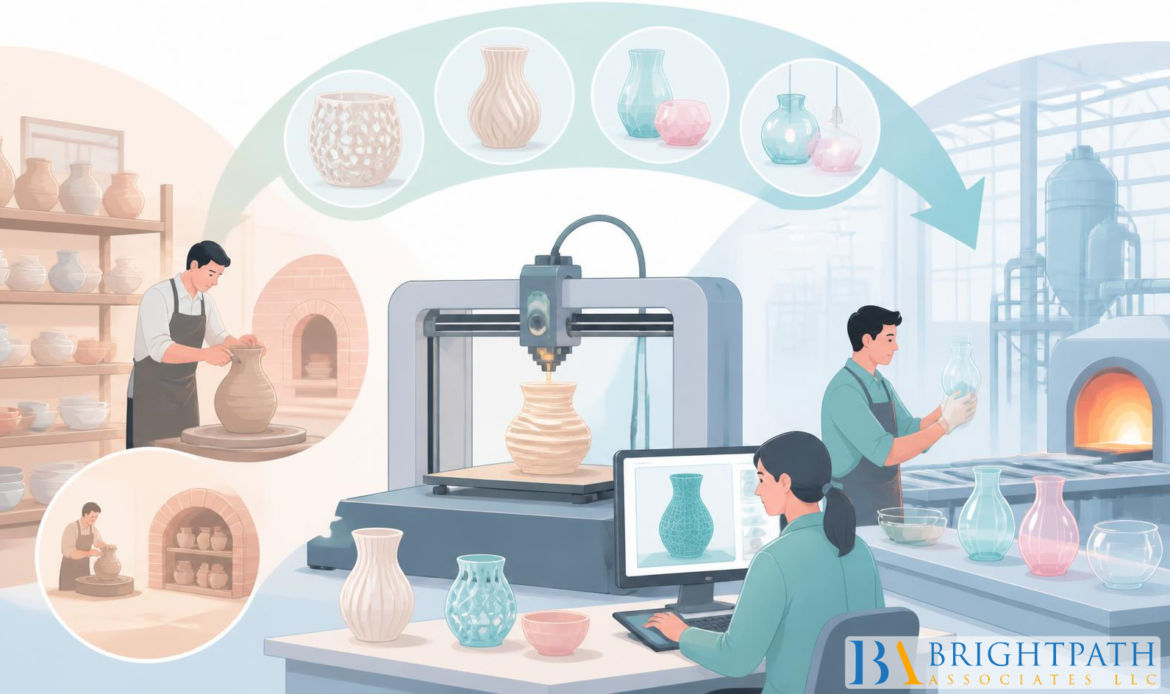
Three-dimensional printing is emerging as one of the most significant technologies influencing this transformation. Also known as additive manufacturing, 3D printing builds components layer by layer from digital designs rather than relying exclusively on molds or subtractive processes. For ceramic manufacturers, this creates opportunities to produce geometrically complex structures, reduce material waste, accelerate prototyping, and develop new product concepts.
The technology is also becoming relevant beyond ceramics. Developments in concrete, glass, and other construction materials are creating a broader ecosystem of digitally enabled manufacturing. As Ceramic industry growth increasingly intersects with automation, sustainability, and advanced engineering, 3D printing can become an important part of the industry’s future production architecture.
Traditional ceramic manufacturing is highly effective for large-scale production, but it can become less economical when manufacturers need customized or geometrically complex products. Creating molds and tooling can require significant time and investment, particularly for products that may only be produced in limited quantities.
3D printing changes this equation by allowing manufacturers to move directly from a digital model to physical production. Designs can be modified without necessarily creating entirely new tooling.
This capability is particularly valuable for research and development. Engineers can test new shapes, internal structures, and material combinations more quickly. Designers can also explore geometries that would be difficult or impossible to manufacture using conventional techniques.
As digital design becomes more integrated with production, ceramic manufacturing can become more responsive to specialized customer requirements.
Advanced Ceramic Manufacturing and Additive Processes
Advanced #CeramicManufacturing increasingly involves materials engineered for demanding applications. Technical ceramics can provide high temperature resistance, wear resistance, electrical insulation, chemical stability, and other specialized properties.
3D printing can expand the design possibilities for these materials. Complex channels, lattice structures, lightweight geometries, and customized components can be produced through carefully controlled additive processes.
The manufacturing process generally involves preparing a ceramic feedstock, depositing or forming it according to a digital design, and then completing processes such as drying, debinding, and sintering. Each stage must be carefully controlled because ceramic materials can shrink during firing.
Process control is therefore critical. The commercial value of additive manufacturing depends not only on printing the desired shape but also on achieving consistent density, dimensional accuracy, mechanical performance, and surface quality.
Material efficiency is becoming increasingly important across industrial manufacturing. Conventional ceramic production can generate waste through machining, trimming, rejected parts, excess material, and tooling.
Additive manufacturing can reduce some of these losses because material is deposited primarily where it is required. Although 3D printing is not inherently waste-free, its layer-by-layer approach can create more efficient material utilization for specific applications.
This has implications for both cost and sustainability. Reduced material consumption can lower the amount of raw material that must be purchased and processed.
For manufacturers pursuing Sustainable building materials, the ability to optimize material usage can become an important component of broader sustainability strategies.
Ceramic Design Becomes More Flexible
One of the defining advantages of 3D printing is design freedom. Ceramic manufacturers can use digital modeling to develop products with intricate surface patterns, internal cavities, organic geometries, and lightweight structures.
This can support both aesthetic and functional innovation. Architectural ceramics, for example, can incorporate customized textures or complex forms that would require expensive tooling using traditional methods.
Technical ceramics can benefit from internal geometries designed for thermal management, filtration, fluid flow, or structural optimization.
The ability to change designs digitally also supports rapid iteration. Engineers can modify a component, print a new prototype, evaluate its performance, and make another adjustment without rebuilding a conventional mold.
The evolution of ceramic additive manufacturing is occurring alongside developments in construction printing. Advanced concrete technology is enabling the automated deposition of cement-based materials to create walls, structures, components, and specialized architectural forms.
While concrete printing and ceramic printing involve different materials and production conditions, they share important principles. Both rely on digital designs, automated deposition, material rheology, process control, and computer-guided production.
These developments contribute to broader Concrete industry trends, particularly the movement toward automation, customization, reduced waste, and digitally managed construction.
Knowledge developed through additive manufacturing can therefore influence the wider construction-materials ecosystem.
Concrete Production Efficiency and Digital Manufacturing
#ConcreteManufacturers are also under pressure to improve production efficiency while reducing environmental impact. Digital systems can help optimize material recipes, monitor production conditions, and improve consistency.
The principles behind additive manufacturing can complement these efforts. Instead of producing standardized materials and components through entirely fixed processes, manufacturers can increasingly consider digitally controlled production models.
Concrete production efficiency can benefit from improved process monitoring, automated material handling, and optimized production schedules. While 3D printing will not replace conventional concrete production across all applications, it demonstrates how digital manufacturing can reshape the economics of construction materials.
The ceramic industry can draw similar lessons as it integrates additive technologies into established production environments.
Glass manufacturing is another area experiencing technological change. Glass production requires precise control over temperature, composition, forming, cooling, and finishing processes. Emerging digital technologies are supporting greater process optimization and product development.
Glass industry innovation increasingly includes advanced modeling, automation, sensor technologies, and digitally controlled manufacturing. Although 3D printing glass presents different technical challenges from ceramic printing, the underlying movement toward digitally designed and digitally controlled materials is similar.
Developments across ceramics and glass can create opportunities for knowledge transfer. Manufacturing techniques, simulation tools, digital design platforms, and automation technologies can be adapted across material sectors.
This broader industrial convergence is important because manufacturers are no longer competing only within traditional material categories. Customers increasingly evaluate materials according to performance, cost, sustainability, and design flexibility.
Glass Market Analysis and the Changing Construction Material Landscape
A detailed Glass market analysis must consider how changing construction requirements influence demand for glass products and competing materials. Energy efficiency, architectural design, insulation, durability, and sustainability are reshaping material selection.
Ceramic products face similar pressures. Manufacturers must develop solutions that meet changing expectations around energy performance, durability, aesthetics, and environmental impact.
3D printing can help ceramic manufacturers respond to these demands by enabling rapid product development and customized geometries. In some applications, digitally manufactured ceramics could complement or compete with traditional glass, concrete, or composite solutions.
The larger trend is toward materials that can be engineered according to specific performance requirements rather than simply selected from standardized product categories.
Cement production has long faced challenges related to energy consumption and greenhouse gas emissions. Cement industry sustainability initiatives increasingly focus on reducing emissions, improving energy efficiency, developing alternative fuels, and incorporating supplementary materials.
Ceramic manufacturers face their own sustainability challenges, particularly because firing processes can require substantial thermal energy.
3D printing does not automatically eliminate these environmental impacts. Printed ceramic products still require appropriate drying and firing processes, and the energy profile depends on material composition, equipment, production volume, and process design.
However, additive manufacturing can contribute to sustainability when it enables lightweight designs, reduced material waste, optimized geometries, and more efficient production for appropriate applications.
The technology should therefore be viewed as one component of a broader sustainability strategy.
3D Printing and Supply Chain Transformation
Additive manufacturing can also influence supply-chain structures. Traditional ceramic manufacturing often requires tooling, molds, large inventories, and centralized production facilities.
#DigitalManufacturing can reduce some of these dependencies. Designs can be stored digitally and produced closer to where demand exists, depending on the economics and technical requirements of the application.
This could eventually support more decentralized production models. Instead of maintaining large inventories of specialized components, manufacturers may be able to produce certain products when required.
Such models could reduce inventory costs and improve responsiveness, particularly for customized or low-volume products.
The commercial expansion of ceramic 3D printing will depend heavily on automation. Industrial printers must operate consistently, while material preparation, loading, drying, firing, inspection, and finishing processes need to be coordinated.
Automation can reduce variability and improve repeatability. Sensors and software can monitor printing parameters and identify deviations that may affect final product quality.
Advanced manufacturing environments may also integrate machine vision and data analytics to inspect printed components before and after firing.
This creates a connected production environment in which digital design, material processing, printing, quality control, and manufacturing data are linked together.
Talent and Construction Materials Recruitment
Technology transformation creates new workforce requirements across ceramics and construction materials. Engineers need knowledge of materials science, digital design, additive manufacturing, automation, process engineering, and data analysis.
Construction Materials Recruitment is consequently becoming more focused on multidisciplinary talent. Companies need professionals capable of understanding both traditional material processes and emerging technologies.
The challenge is particularly significant because additive manufacturing requires specialized expertise that may not be widely available within conventional ceramic organizations.
Training existing employees can help close some of the skills gap, while recruitment can bring new capabilities into the organization.
As digital manufacturing becomes more strategic, leadership teams must understand how technology connects with commercial objectives. #ExecutiveSearchRecruitment can help organizations identify senior professionals capable of managing this transition.
Leaders in advanced ceramics may need to evaluate investments in additive manufacturing, automation, digital systems, sustainability, and product development while maintaining existing production operations.
Effective leadership also requires understanding customer demand. Not every ceramic product is suited to 3D printing. The technology creates the greatest value when its advantages in customization, complexity, speed, or material efficiency justify the additional process requirements.
Strategic leaders must therefore determine where additive manufacturing provides genuine business value.
The Future of Ceramic Industry Growth
Ceramic industry growth is increasingly connected to technological differentiation. Traditional products will continue to represent an important part of the market, but advanced ceramics and digitally manufactured products can open new applications.
Medical components, electronics, aerospace systems, energy technologies, filtration systems, architectural products, and specialized industrial components all provide potential areas for advanced ceramic development.
3D printing can accelerate experimentation across these applications by allowing manufacturers to create prototypes and complex geometries without relying entirely on conventional tooling.
Over time, improvements in printing speed, material formulations, process control, and post-processing could expand the range of commercially viable applications.
Conclusion
3D printing is changing the ceramic industry by introducing greater design freedom, manufacturing flexibility, and opportunities for material optimization. Rather than replacing conventional ceramic production overnight, additive manufacturing is likely to complement existing processes in applications where its advantages create measurable value.
Its influence also extends beyond ceramics. #ConcreteIndustry trends, Advanced concrete technology, Glass industry innovation, and Cement industry sustainability all demonstrate the wider movement toward digitally enabled materials manufacturing.
For ceramic manufacturers, the opportunity lies in combining traditional materials expertise with digital engineering, automation, and advanced production technologies. Sustainable building materials will increasingly require not only better material formulations but also more efficient ways of designing and producing them.
The transition will require investment in technology, process development, workforce capabilities, and leadership. With the right combination of these elements, additive manufacturing can help the ceramic sector move from conventional production models toward a more flexible, digitally integrated, and innovation-driven industrial future.
Find your next leadership role in Glass, Ceramic, Concrete Industry today!
Stay informed with the latest insights on Glass, Ceramic, Concrete Industry!