
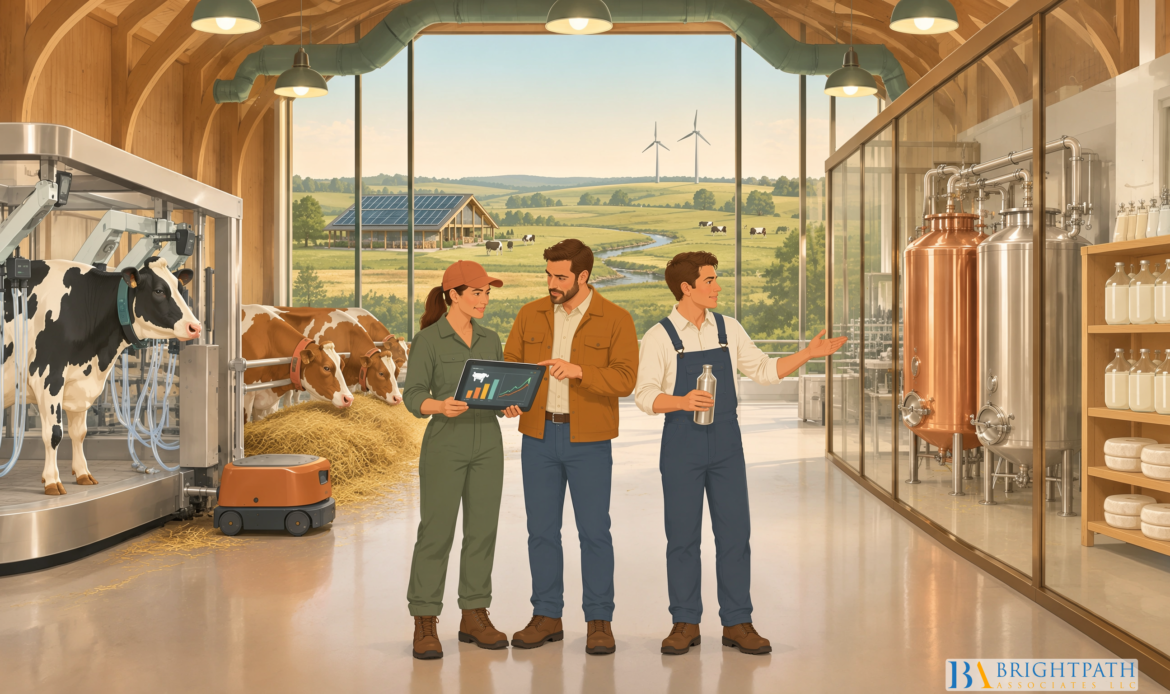
Future-Proofing Your Dairy Business Through Niche Innovation for Dairy Industry starts with a harder question than “What can we make?” The more useful question is: What product, customer, channel, and operating model can repeatedly create value without overextending the business? For #DairyCompanies, niche innovation can reduce dependence on commodity pricing, but only when product development, processing capacity, supply chain management, leadership, and customer demand are planned as one system.
Table of Contents
• Key Takeaways
• Choose A Niche Before Buying Equipment
• Design The Operating Model Around The Product
• Build Leadership Capacity For Dairy Innovation
• Frequently Asked Questions
• Resources And Citations
Key Takeaways
Niche Innovation Is A Business Model Decision
A niche dairy product is not simply a premium label attached to milk, cheese, yogurt, or ice cream. It is a focused offer built around a specific customer need, production capability, channel, and price point. A creamery may differentiate through goat or sheep milk, cultured products, fresh cheese curds, reduced waste, single serve formats, local retail, foodservice, or direct to consumer dairy e commerce.
The value lies in the fit. A highly distinctive product can still fail if it requires more skilled labor than the facility can support, has a shorter shelf life than the distribution network can manage, or reaches buyers who will not purchase often enough to support production.
Diversification Does Not Automatically Reduce Risk
Adding products can diversify revenue, but it does not necessarily diversify risk. Three products sold through the same regional retailer, using the same refrigerated carrier, and relying on the same production manager may still share the same weak points.
For example, a farmstead creamery selling fresh cheese at farmers markets may add wholesale accounts. That expands sales opportunities, but it also introduces retailer fees, tighter delivery schedules, invoice terms, and more demanding #PackagingRequirements. The decision may be sound, but it should be treated as a new operating model rather than an automatic safety net.
Choose A Niche Before Buying Equipment
Use A Niche Selection Scorecard
Before approving a cheese vat, pasteurizer, filling line, cold storage upgrade, or dairy automation technology, leadership should compare opportunities against the same criteria. This makes the decision less vulnerable to enthusiasm around a product idea or an available grant.
| Decision Factor | What Leadership Should Test | Warning Sign |
|---|---|---|
| Customer demand | Will customers reorder at the planned price? | Interest exists, but there are no paid trial orders |
| Margin logic | Does the price cover milk, labor, packaging, freight, waste, and selling costs? | The budget counts only ingredients and packaging |
| Shelf life | Can the product survive the real delivery and retail cycle? | The product has little time left when it reaches the shelf |
| Labor intensity | Is trained labor available for sanitation, batching, quality checks, and fulfillment? | One specialized employee holds the process together |
| Capital intensity | Can cash flow support equipment, installation, permits, and working capital? | Funding pays for equipment but not startup losses |
| Channel fit | Does the package and case size work for the intended buyer? | The product was designed before the channel was selected |
| Regulatory fit | Can the facility meet applicable inspection, labeling, and food safety requirements? | Compliance review begins after equipment is ordered |
This scorecard should be completed with finance, operations, sales, quality, and supply chain input. It is not a substitute for a detailed business plan. It is a way to identify where the business is assuming rather than proving.
The U.S. Department of Agriculture’s Dairy Business Innovation Initiatives program supports niche dairy products, value added processing, market diversification, and product development activities. That support can be valuable, but the availability of assistance should not determine the niche. A grant can lower capital pressure; it cannot create repeat demand.
Validate Product Market Fit Before Fixed Costs
#ProductMarket validation means testing whether customers will buy again at a price that supports the full cost of serving them. It should happen before the business commits to a large processing expansion whenever possible.
A practical sequence is:
- Define the customer and use occasion. A snack cheese for school foodservice, a premium aged cheese for specialty retail, and a cultured dairy product for local direct sales are different businesses.
- Create a small pilot with a licensed processor, shared commercial kitchen where permitted, or limited approved production run.
- Test paid demand through a narrow set of channels rather than a broad launch.
- Measure reorder behavior, returns, spoilage, delivery cost, production time, and gross margin after channel fees.
- Adjust the product, package, case configuration, or target customer before buying capacity.
This process may feel slower than purchasing equipment first. In practice, it can prevent a more expensive error: building a facility around a product with weak repeat sales.
The USDA’s FY26 notice describes eligible dairy innovation work that can include specialty products, byproduct use, product development, packaging, marketing, and process improvements. That breadth matters. Eligible dairy innovation activities recognize that the product and the route to market must be developed together.
Choose Processing Depth Deliberately
More processing can create more differentiation, but it also adds more control points. Fresh products may reach market more quickly, yet they can require tight cold chain execution and frequent production. Aged products can offer longer selling windows, but they tie up inventory and require disciplined aging, quality control, and cash planning.
| Product Path | Potential Advantage | Operating Tradeoff | When It May Fit |
|---|---|---|---|
| Fresh cultured products | Faster product cycle | Short shelf life and frequent production | Strong local retail or direct sales |
| Cheese curds or fresh cheese | Distinct local appeal | Time sensitive quality and distribution | Nearby consumers or foodservice buyers |
| Aged specialty cheese | Differentiation and longer selling window | Inventory carrying time and aging risk | Businesses with working capital and quality systems |
| Ice cream or frozen dairy | Strong retail and seasonal opportunities | Freezer logistics and seasonal demand swings | Operators with retail traffic or freezer distribution |
| Whey or coproduct products | Better use of input streams | Additional formulation and market work | Processors with sufficient, consistent volume |
There is no reliable industry wide evidence that one category is always more profitable than another. The right choice depends on local demand, milk supply, labor, facility capability, channel economics, and cash flow. A dairy business should build a product specific budget instead of relying on generalized margin claims.
Design The Operating Model Around The Product
Treat Packaging As Market Access
Packaging is often treated as a branding expense. It is better understood as a market access decision. Package size influences who can buy, where the product can be displayed, how quickly it can be packed, how much freight it carries, and whether it fits retail, foodservice, institutional, or direct #ConsumerNeeds.
USDA reported that Holland’s Family Cheese used Dairy Business Innovation support to begin packaging raw milk Gouda in single serve formats in response to market changes. The business reported it was on track to increase sales by 20 percent. USDA’s examples of supported dairy businesses show why format can be as important as the underlying recipe. That reported outcome is one company example, not a benchmark for expected sales growth.
A leadership team should ask practical questions early:
• Can a retailer stock the package efficiently?
• Does the portion size work for a buyer’s intended use?
• Does the package protect quality through the full cold chain?
• Can the facility produce it at the required pace?
• Does the packaging line create a labor bottleneck?
For more context on product strategy, innovation in dairy product development examines how differentiated dairy offerings connect product ideas with market needs.
Make Channel Economics Visible
A product can look profitable until distribution is included. Channel economics should capture the relationship between selling price, sales volume, delivery frequency, broker or retailer fees, refrigeration, packaging, spoilage, merchandising support, payment terms, and internal labor.
Direct sales can produce closer #CustomerRelationships and stronger gross revenue per unit, but they require time for events, retail operations, fulfillment, and customer service. Wholesale may create steadier volume, but it can reduce unit revenue and lengthen the cash conversion cycle. Foodservice can offer repeat demand, but buyers may require reliable case formats and tight delivery performance.
| Channel | Strength | Leadership Challenge |
|---|---|---|
| Farm retail | Direct feedback and brand control | Requires retail staffing and consistent traffic |
| Farmers markets | Low barrier for testing products | High labor per selling day and variable turnout |
| Specialty wholesale | Access to curated buyers | Lower margins and account management needs |
| Foodservice | Potential for repeat volume | Service consistency and delivery expectations |
| Dairy e commerce | Wider geographic reach | Shipping, insulation, customer acquisition, and spoilage risk |
The most attractive niche is usually the one that matches the company’s actual route to market. A business with a strong local following may be better served by limited, high frequency direct sales than by pursuing distant wholesale accounts too early.
Build Sustainability Into The Economics
Sustainable dairy farming practices can support differentiation, but sustainability claims should be specific, documented, and tied to operations. Waste reduction, energy efficiency, water management, responsible packaging choices, and coproduct use may improve both resource use and cost control. They should not be treated as broad marketing language.
Byproduct reprocessing is explicitly recognized within USDA dairy innovation activities. That creates a useful planning question: what happens to whey, surplus cream, off specification inventory, or other streams created by the product line? A coproduct plan may not be profitable at small volume, but ignoring the stream can distort the economics of the primary product.
A practical sustainability strategy also requires resilient input and distribution planning. Dairy sustainability balancing profit and social value explores the need to align environmental priorities with commercial discipline rather than treating them as separate agendas.
Build Leadership Capacity For Dairy Innovation
The Leadership Need Is Broader Than Production
Niche innovation changes what dairy executives must coordinate. Product development may require food technology knowledge. #DairySupplyChain decisions may require cold chain, packaging, procurement, and customer service expertise. Dairy industry digital transformation may introduce new needs in production data, inventory visibility, e commerce systems, and demand forecasting.
For a small or midsized company, one executive may be asked to bridge operations, commercial strategy, quality, and finance. That can work during an early pilot. It becomes risky when the business scales before responsibilities are clear.
A specialized leader does not need to personally own every function. The real requirement is the ability to make tradeoffs across functions. For example, a sales leader may secure a large retail order, but an operations leader must confirm that packaging speed, shelf life, and delivery capacity can support it. Without that coordination, growth can create higher waste, missed deliveries, or quality failures.
Define The Role Before Launching The Search
Dairy industry executive search is most useful when the organization has defined the operating problem, not merely the job title. “We need a chief operating officer” is vague. “We need a leader who can scale a pasteurized cultured dairy line, establish food safety discipline, and improve on time delivery without adding unsustainable overhead” is a search brief.
A rigorous leadership brief should identify:
• The business objective over the next 12 to 24 months
• The product and channel complexity the executive will manage
• Required experience in food manufacturing, dairy processing, quality, or commercial growth
• Decisions the role owns versus decisions retained by the owner or board
• Current capability gaps in production, finance, sales, technology, or supply chain
• Measures that indicate progress without encouraging unsafe shortcuts
Conventional recruitment methods can struggle when the role requires a narrow blend of dairy operations, food safety, commercial judgment, and change leadership. The candidate pool may be limited, and strong candidates may not be actively applying. Still, executive search is not automatically the answer. A company should first decide whether it needs a permanent executive, an interim operating leader, a technical consultant, or a stronger second layer below the owner.
Protect The Business During A Vacancy
A prolonged leadership vacancy can slow product launches, delay capital decisions, and leave frontline managers without clear priorities. The risk is greater when a company is changing its product mix, installing new equipment, or entering unfamiliar channels.
The recovery plan should separate immediate continuity from long term hiring. Assign decision rights, document critical vendor and #CustomerRelationships, set short term quality and cash metrics, and determine which decisions can wait. If the business cannot describe how it will operate for 90 days without the role, it is not ready to hire well.
Supply chain resilience should be part of this plan. Resilient supply chains strengthening of dairy industry addresses why supply, processing, and distribution dependencies must be considered together.
Frequently Asked Questions
What Does Niche Innovation Mean For A Dairy Business?
It means creating a targeted dairy offer and operating model for a defined market need. The niche may involve product type, milk source, packaging, production method, channel, sustainability practice, or customer segment. The goal is not simply to make more products. It is to make a product that the company can produce and sell repeatedly at a sustainable return.
Is Specialty Cheese More Profitable Than Commodity Milk?
It can retain more value per unit of milk, but profitability depends on full costs. Aging time, labor, packaging, quality control, freight, retail fees, waste, and working capital can materially change the result. Leaders should model a product specific break even point rather than assume specialty cheese will outperform commodity sales.
Should We Process Our Own Milk Or Use A Partner Processor?
Own processing may fit businesses with sufficient volume, a clear long term product strategy, capital access, and strong operational leadership. A processor partnership may be better for demand testing, limited runs, or businesses that want to avoid early facility and compliance complexity. Compare total cost, control, minimum order requirements, #QualityExpectations, and time to market.
How Can We Validate Demand Before Building A Creamery?
Start with paid pilot sales. Test a limited product line through a narrow customer group, measure reorder rates, track returns and spoilage, and calculate channel specific contribution after all selling and delivery costs. Interest at a tasting event is useful feedback, but it is not the same as repeat purchasing.
Which Dairy Products Are Most Realistic For Small Farms?
The most realistic product is the one matched to the farm’s milk supply, labor, local demand, facility capability, and distribution reach. Fresh products may suit close markets and frequent production. Aged products may suit businesses able to finance inventory and manage consistent quality. The right answer is operational, not fashionable.
Can Whey Or Other Byproducts Become A Revenue Source?
Possibly, especially when the volume is consistent and there is a clear buyer or product application. But coproduct monetization adds its own handling, formulation, packaging, and sales requirements. Start by quantifying the stream, disposal cost, and potential demand before assuming it will become profitable.
What Funding Can Support Dairy Product Development?
USDA programs can support eligible processing and marketing activities. The USDA’s value added producer guidance describes value added products as a way for farmers to reach new customers and retain more value from produced commodities. Funding should support a validated strategy, not replace one.
What Can A Specific Cheese Processing Project Look Like?
A focused project may be more practical than a broad diversification plan. The State of Indiana reported that Kuehnert Dairy Farm received a $100,000 award for a farm based cheese curd manufacturing facility intended to diversify on farm activity and create a value added product. The Kuehnert Dairy Farm award announcement illustrates a defined product format tied to a processing investment.
Resources And Citations
USDA Agricultural Marketing Service — Dairy Business Innovation Initiatives
https://www.ams.usda.gov/services/grants/dbi
USDA Agricultural Marketing Service — Dairy Business Innovation Initiatives: FY26 Notice of Funding Opportunity
https://www.ams.usda.gov/sites/default/files/media/2026DBI_Project_Narrative.pdf
USDA Agricultural Marketing Service — USDA Awards $22.9 Million to Support Dairy Initiatives
https://www.ams.usda.gov/press-release/usda-awards-229-million-support-dairy-initiatives
USDA — Farmers, Food Loss and Waste
https://www.usda.gov/about-food/food-safety/food-loss-and-waste/farmers
State of Indiana — $100,000 Awarded to Indiana’s Kuehnert Dairy Farm
https://events.in.gov/event/100000_awarded_to_indianas_kuehnert_dairy_farm
BrightPath Associates: Dairy market trends reshaping industry growth strategies
https://brightpathassociates.com/dairy-market-trends-reshape-industry-growth-strategies/
Find your next leadership role in Dairy Industry today!