
Introduction
The US #MachinerySector is entering a period of structural transformation. Manufacturers are facing simultaneous pressure from rising labor costs, supply-chain uncertainty, changing customer requirements, technological advancement, and the need to improve productivity. At the same time, demand for domestically produced machinery is being supported by investments in manufacturing capacity, industrial modernization, and supply-chain resilience.
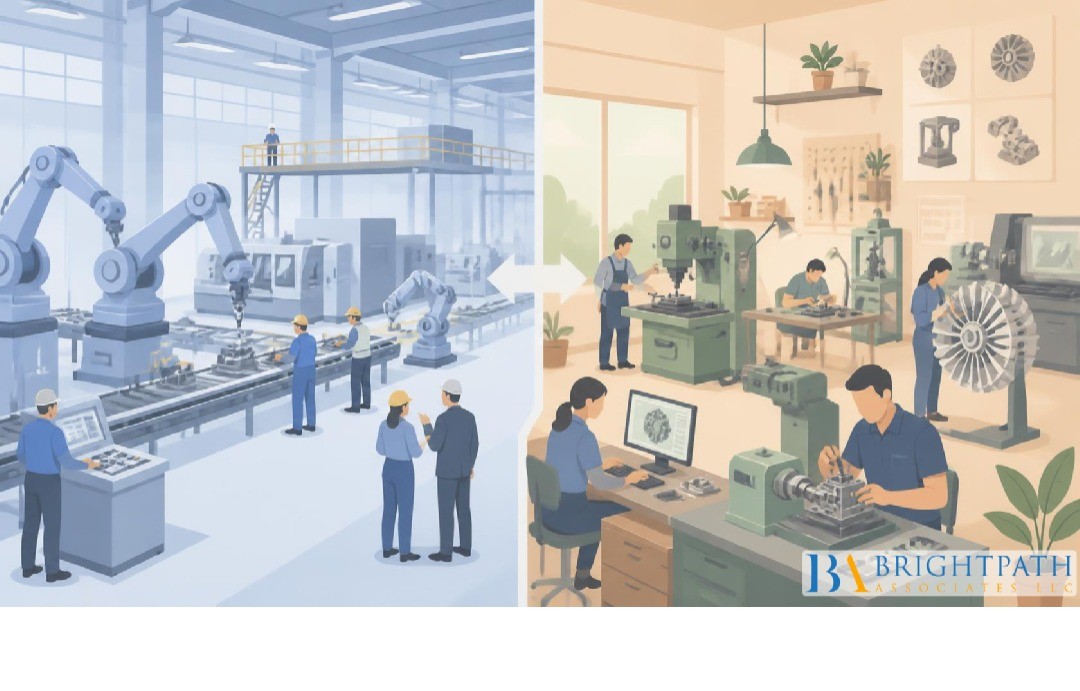
This environment is creating two competing strategic directions. On one side, consolidation is allowing larger companies to achieve scale, broaden product portfolios, strengthen distribution networks, and invest more aggressively in technology. On the other, niche specialization is enabling smaller manufacturers to compete by developing highly targeted expertise, customized equipment, and specialized services.
For the US machinery sector, the central question is no longer simply whether companies should grow. It is whether future competitiveness will come from becoming larger or becoming more specialized.
The Changing Structure of the US Machinery Market
The market for Industrial machinery encompasses a broad range of equipment used across manufacturing, construction, energy, transportation, agriculture, and other industrial applications. Within this diverse market, companies operate under very different economic conditions.
Large manufacturers can benefit from purchasing power, extensive engineering resources, established customer relationships, and greater access to capital. These advantages make consolidation attractive when companies seek to expand capabilities or enter new markets.
However, size can also create complexity. Large organizations may find it difficult to respond quickly to highly customized customer requirements or rapidly changing niche applications.
Smaller US Machinery manufacturers can often compete precisely because they are closer to their customers. Their ability to modify equipment, provide specialized engineering support, and respond quickly to unusual production requirements can create a competitive advantage that scale alone cannot replicate.
Consolidation can provide machinery companies with several strategic benefits. Acquisitions can expand geographic reach, increase production capacity, add complementary technologies, and provide access to new customer segments.
The economics of technology investment are also encouraging consolidation. Developing sophisticated machinery increasingly requires engineering expertise in software, sensors, controls, robotics, data analytics, and connectivity. These investments can be expensive, particularly for smaller manufacturers.
Larger organizations can distribute these costs across a broader revenue base.
Consolidation can also strengthen after-sales services. Machinery customers increasingly expect maintenance, upgrades, spare parts, training, and technical support throughout the equipment lifecycle. A larger company may have the resources to establish service networks that smaller competitors cannot easily replicate.
However, consolidation does not automatically produce greater efficiency. Integrating companies, systems, cultures, product portfolios, and customer relationships can be difficult. Poorly managed consolidation can create bureaucracy and weaken the responsiveness that originally made an acquired company successful.
Niche Specialization Offers an Alternative Growth Model
While consolidation is increasing, specialization remains a powerful competitive strategy.
A specialized machinery manufacturer may focus on one manufacturing process, material, industry, or technical application. Rather than competing across a broad equipment market, the company develops deep expertise in a specific customer problem.
This approach can create strong customer relationships because buyers often value application knowledge as much as equipment specifications.
For example, a manufacturer specializing in #PrecisionMachining equipment may develop detailed knowledge of tolerances, tooling requirements, materials, cycle times, and quality-control processes within a particular industry.
That expertise can become difficult for generalist competitors to reproduce.
Niche specialization can also support higher margins when customers are willing to pay for customized solutions that directly improve productivity or solve complex operational problems.
Precision machining is an excellent example of why specialization can remain competitive in an increasingly consolidated industry.
Manufacturers producing components for aerospace, medical devices, automotive applications, energy systems, and advanced industrial equipment often require extremely precise and repeatable manufacturing processes.
Equipment suppliers that understand these requirements can provide more than machinery. They can provide process expertise, integration support, tooling knowledge, software configuration, maintenance services, and application-specific engineering.
This creates a relationship based on technical capability rather than price alone.
As manufacturing becomes more sophisticated, the value of this specialized knowledge is likely to increase.
Industrial Automation Is Reshaping Competitive Advantage
One of the strongest forces influencing the machinery sector is the expansion of automation.
Modern customers increasingly expect machinery to integrate with digital production environments. #IndustrialAutomationSolutions can incorporate programmable controls, robotics, sensors, machine vision, data collection, and connected production systems.
This changes the competitive requirements for machinery manufacturers.
Companies that previously focused primarily on mechanical engineering now need capabilities in software, controls, connectivity, and systems integration.
The transition creates opportunities for both large and specialized manufacturers. Larger companies can invest heavily in comprehensive platforms, while smaller firms can specialize in particular automation applications.
The winners will be those that understand how automation can solve specific customer problems rather than simply adding technology to equipment.
Machinery Maintenance Becomes a Recurring Revenue Opportunity
The machinery business is increasingly moving beyond the initial equipment sale.
Customers depend on machinery for years, making Machinery maintenance an important component of the overall relationship between manufacturer and buyer. Preventive maintenance, remote monitoring, spare parts, upgrades, diagnostics, and technical support can generate recurring revenue while improving customer retention.
Digital connectivity can strengthen this opportunity.
Connected machinery can provide information about operating conditions, equipment performance, and potential maintenance requirements. This can allow service providers to move from reactive repairs toward predictive maintenance models.
For manufacturers, this creates a potential shift from selling equipment as a one-time transaction toward providing long-term equipment performance as a service.
The growth of advanced equipment does not eliminate demand for Used machinery. In many manufacturing environments, used equipment provides an important pathway for companies seeking to increase capacity while managing capital expenditure.
Small and mid-sized manufacturers may not always have the resources to purchase the latest machinery. Reliable used equipment can provide access to productive capacity at a lower initial cost.
This creates a secondary machinery market that can remain strategically relevant even as new equipment becomes more technologically advanced.
Manufacturers can also benefit by developing refurbishment, certification, upgrade, and resale programs. Adding modern controls or automation capabilities to older equipment can extend its useful life and create a lower-cost modernization pathway for customers.
Machinery Financing Influences Market Growth
Capital intensity remains one of the biggest barriers to machinery investment.
#MachineryFinancing can therefore have a direct influence on demand. Equipment leasing, loans, vendor financing, and other capital structures can make machinery purchases more accessible to manufacturers that cannot justify a large upfront expenditure.
This is particularly relevant for small and mid-sized businesses.
The ability to finance equipment can influence whether a manufacturer upgrades production capacity, adopts automation, replaces aging machinery, or continues operating older assets.
Machinery manufacturers that understand the financial constraints of their customers may therefore have an advantage when designing commercial strategies.
Manufacturing Efficiency Is the Core Objective
Regardless of whether a machinery company pursues consolidation or specialization, its ultimate value proposition is increasingly connected to Manufacturing efficiency.
Customers want equipment that can improve throughput, reduce waste, minimize downtime, increase quality, lower energy consumption, and optimize labor utilization.
This means machinery manufacturers need to demonstrate measurable outcomes.
A machine that operates faster but generates more defects may not create value. A highly automated system that is difficult to maintain may create new operational problems. A sophisticated piece of equipment that employees cannot effectively operate may fail to deliver its expected return.
Future machinery competitiveness will therefore depend on combining technical performance with usability, reliability, serviceability, and measurable economic value.
The transformation of the machinery industry is creating a significant workforce challenge.
Modern equipment requires professionals who understand mechanical engineering, electrical systems, software, automation, robotics, data, and advanced manufacturing processes. At the same time, experienced machinists, technicians, maintenance specialists, and skilled operators remain essential.
This is influencing the nature of Manufacturing jobs.
The sector is not simply moving toward fewer workers. Instead, many organizations are experiencing a shift toward more technically demanding roles.
Manufacturers need employees who can troubleshoot automated equipment, interpret machine data, configure control systems, integrate robotics, and maintain sophisticated machinery.
Companies that fail to develop this workforce may struggle to realize the benefits of their technology investments.
Leadership Will Determine Which Strategy Wins
Whether a machinery company chooses consolidation or specialization will ultimately depend on leadership.
Executives need to understand market structure, customer economics, technology development, capital requirements, workforce availability, and competitive positioning. A company pursuing acquisitions needs leaders capable of integrating businesses without destroying their strengths. A specialized manufacturer needs executives who can protect its niche while continuously expanding its technical capabilities.
This makes #ExecutiveSearchRecruitment increasingly important within the machinery sector.
The most valuable leaders will be those who can connect engineering decisions with commercial strategy. They need to understand not only how machinery works but why customers buy it, how equipment influences production economics, and how technology can create long-term customer relationships.
As machinery businesses become more technology-driven, leadership requirements will continue to evolve.
Consolidation and Specialization Are Not Mutually Exclusive
The future of the US machinery sector is unlikely to be a simple choice between large companies and small specialists.
A more likely outcome is the coexistence of both models.
Large machinery companies may acquire specialized businesses to obtain proprietary technology, engineering expertise, or customer relationships. Meanwhile, niche manufacturers may partner with larger organizations to gain access to financing, distribution, international markets, and production capacity.
This creates a hybrid model in which specialization becomes an asset within larger industrial organizations.
A highly specialized company can retain its technical identity while benefiting from the resources of a larger parent organization. Conversely, large manufacturers can use acquisitions to build portfolios of specialized capabilities rather than attempting to develop every technology internally.
Technology will increasingly influence which companies can compete effectively.
Artificial intelligence, robotics, connected equipment, advanced sensors, digital twins, predictive maintenance, and automated quality inspection are changing the expectations placed on machinery manufacturers.
The Industrial machinery industry is therefore becoming increasingly connected to software and data.
Companies that successfully integrate digital technologies into their equipment can create new sources of value through monitoring, optimization, predictive services, and continuous upgrades.
However, technological capability must remain connected to customer needs. The machinery companies most likely to succeed will be those that use technology to address specific operational problems rather than adopting innovation simply for its own sake.
Conclusion: The Future Will Reward Strategic Focus
The future of the US machinery sector will not be determined exclusively by market consolidation or niche specialization. Both strategies can succeed under the right conditions.
Large manufacturers can achieve scale, invest heavily in technology, expand service networks, and strengthen their ability to support complex customers. Specialized manufacturers can build deep expertise, respond rapidly to customer requirements, and compete through differentiated technical capabilities.
The key issue is strategic clarity.
Companies need to determine where they can create distinctive value and how they can build the capabilities necessary to defend that position. For some, that may mean acquiring complementary businesses. For others, it may mean becoming the leading specialist in a narrowly defined application.
The broader transformation of #IndustrialMachinery will continue to be driven by automation, digital connectivity, service-based business models, workforce changes, and customer demands for greater productivity.
As manufacturers evaluate new equipment, Used machinery, Machinery financing, and automation investments, suppliers will increasingly be judged by the measurable outcomes they deliver.
Ultimately, the most successful machinery companies will not necessarily be the largest. Nor will they necessarily be the smallest specialists. They will be the organizations that understand their customers deeply, invest intelligently in technology, develop the right talent, and continuously improve the productivity of the industries they serve.
In the next phase of the US machinery market, scale may create reach, but specialization and strategic execution will determine lasting competitive advantage.
Find your next leadership role in Machinery Industry today!
Stay informed with the latest insights on Machinery Industry!