
Introduction
#FeedManagement has always been one of the most important operational functions in dairy farming. Nutrition directly influences animal health, milk yield, reproduction, production costs, and overall farm profitability. Yet for many years, feeding decisions depended heavily on manual measurement, fixed schedules, visual observation, and the experience of farm operators.
As dairy operations become larger and more technologically sophisticated, these traditional approaches are increasingly being challenged. Feed costs represent a major component of dairy operating expenses, making even small improvements in feed utilization financially meaningful. At the same time, variations in animal appetite, environmental conditions, milk production, and herd composition make it difficult to achieve optimal feeding through fixed routines alone.
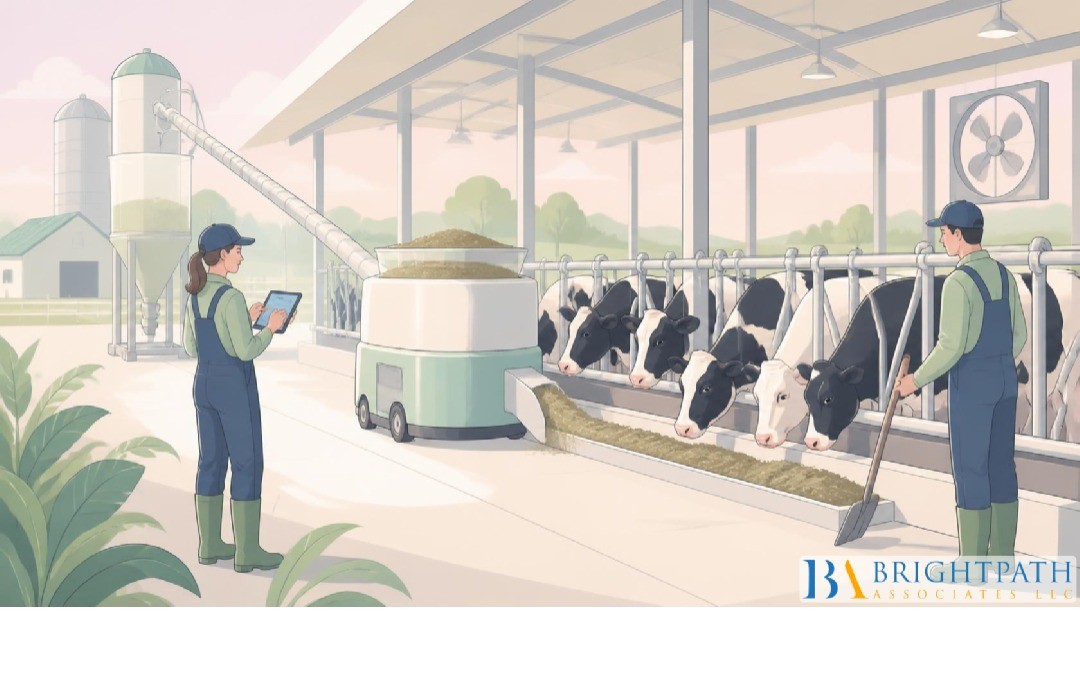
Automated feeding systems are changing this equation. By combining sensors, software, automated equipment, data analytics, and precision feeding technologies, modern dairy farms can deliver feed more consistently while adjusting management decisions according to real-time conditions.
This transformation is becoming an important component of Dairy industry digital transformation, connecting feeding operations with broader farm-management systems and creating new opportunities to improve productivity, sustainability, and profitability.
Why Feed Efficiency Matters to Dairy Economics
Feed efficiency is not simply about reducing the amount of feed used. The objective is to maximize the value generated from every unit of feed consumed.
A dairy operation can purchase high-quality feed and still experience poor efficiency if animals receive inconsistent quantities, feed is improperly mixed, feed is distributed unevenly, or large quantities are wasted. Similarly, overfeeding certain nutritional components can increase costs without producing proportional gains in milk output.
Automated feeding systems help address these challenges by improving consistency and precision. Accurate weighing, controlled mixing, scheduled delivery, and automated distribution reduce the variability associated with manual processes.
For dairy businesses operating under tight margins, this consistency can have significant economic value. Improving feed utilization can potentially increase milk output per unit of feed while reducing waste and unnecessary expenditure.
Traditional feeding requires employees to measure ingredients, prepare rations, operate equipment, distribute feed, and monitor consumption. Each step introduces opportunities for variation.
Automated systems can standardize these activities.
Modern feeding platforms can use programmed recipes and digital measurements to determine how much of each ingredient is required. Automated mixers can prepare consistent rations, while feeding equipment can distribute feed according to predefined schedules.
This level of precision is increasingly important as farms manage larger herds.
The larger the operation, the more difficult it becomes to maintain consistency through manual processes alone. Automation allows the same feeding protocols to be applied repeatedly while providing data that can be analyzed for continuous improvement.
The Role of Milk Production Technologies
Feeding automation becomes even more powerful when connected with #MilkProductionTechnologies.
Modern dairy operations can collect information about milk yield, animal activity, feed consumption, health indicators, and environmental conditions. When these datasets are integrated, feeding decisions can become more responsive to actual herd performance.
For example, changes in milk production can indicate that nutritional requirements or feeding strategies may need adjustment. Similarly, information about individual animals or groups can help managers identify differences in nutritional requirements.
This represents a transition from generalized feeding toward more data-informed nutrition management.
The objective is not necessarily to create a completely individualized ration for every animal. Instead, technology can help farms identify meaningful variations and adjust feeding strategies accordingly.
Dairy Automation Technologies Connect the Farm
Dairy automation technologies are increasingly extending beyond individual machines. Automated feeding can become part of a connected ecosystem that includes milking systems, herd-management platforms, environmental monitoring, health tracking, and inventory management.
This connectivity allows information to move between operational areas.
A farm manager can potentially evaluate whether changes in feeding are associated with changes in milk production. Inventory systems can provide visibility into feed availability. Environmental sensors can identify heat conditions that may affect animal behavior and consumption.
The more connected these systems become, the greater the opportunity to manage the dairy operation as an integrated production environment rather than as a collection of independent tasks.
Feed waste represents a significant opportunity for efficiency improvement.
Manual feeding can result in over-delivery, uneven distribution, spillage, leftover feed, and inconsistencies in ration preparation. Even small amounts of daily waste can accumulate into substantial annual costs across a large operation.
Automated systems can improve accuracy in both preparation and delivery.
Sensors and weighing technologies can help ensure that the correct quantities are loaded and distributed. Automated schedules can help align feeding with herd requirements and operational routines.
Reducing waste also supports environmental objectives because producing feed requires land, water, energy, transportation, and other resources.
Consequently, feed efficiency has implications beyond farm economics.
Sustainable Dairy Farming Practices Depend on Resource Efficiency
The relationship between automation and Sustainable dairy farming practices is becoming increasingly important.
Sustainability in #DairyProduction involves more than reducing emissions. It includes improving resource efficiency, minimizing waste, optimizing land and water use, and maintaining healthy animals.
When a farm improves feed efficiency, it can potentially produce the same amount of milk using fewer resources. Better ration management can reduce wasted feed while improving nutrient utilization.
Automated feeding systems therefore have the potential to support both economic and environmental objectives.
This is particularly relevant as customers, investors, regulators, and supply-chain partners increasingly expect measurable sustainability improvements from agricultural producers.
Data Analytics Turns Feeding Into a Management System
The true value of feeding automation comes from the data generated by the system.
Automated equipment can record quantities delivered, feeding times, ration compositions, inventory consumption, and other operational variables. When combined with herd and milk-production information, these records can provide a much more detailed understanding of feeding performance.
This creates opportunities for data-driven decision-making.
Farm managers can compare feeding patterns with production outcomes, identify unusual consumption trends, and investigate potential inefficiencies.
Over time, historical data can also support more accurate planning.
Instead of asking whether a feeding strategy appears to be working, managers can increasingly evaluate measurable relationships between feed inputs, animal performance, waste, and financial outcomes.
Feed efficiency does not begin when feed reaches the animal. It begins with procurement and supply-chain planning.
Dairy supply chain management increasingly depends on accurate information about ingredient availability, prices, storage capacity, transportation, and consumption rates.
Automated feeding systems can provide more accurate information about how quickly feed inventories are being consumed. This can help managers plan purchases more effectively and reduce the risk of unexpected shortages.
Better inventory visibility can also support purchasing decisions. If consumption data indicates that a particular ingredient is being used faster than expected, procurement teams can respond earlier.
This connection between feeding automation and supply-chain management illustrates why digital transformation should be considered across the entire dairy operation.
Automation Supports Dairy Industry Growth Strategies
For growing #DairyOperations, automation can become an important component of long-term Dairy industry growth strategies.
Expanding herd size without improving operational systems can increase labor requirements and management complexity. Automated feeding can help farms increase capacity without increasing manual work at the same rate.
This scalability can be particularly valuable for large commercial farms.
However, growth should not be measured simply by the number of animals or liters of milk produced. Sustainable growth requires maintaining quality, animal welfare, operational efficiency, and financial performance.
Automation can provide infrastructure for that growth by making processes more standardized and measurable.
Dairy E-Commerce and the Digitization of the Industry
The transformation of dairy operations is also occurring alongside the expansion of Dairy e-commerce and digitally connected supply chains.
Farmers and dairy businesses increasingly operate in markets where procurement, sales, equipment servicing, feed purchasing, and supply-chain relationships can be managed through digital platforms.
As more commercial activity moves online, the value of accurate farm data increases.
Automated systems can provide reliable operational information that supports purchasing, planning, supplier negotiations, and performance analysis.
The farm of the future will therefore be connected not only internally but also with external suppliers, technology providers, processors, and customers.
Automation does not eliminate the importance of agricultural workers. Instead, it changes the skills required to manage modern dairy operations.
Employees increasingly need to understand automated equipment, digital interfaces, data interpretation, maintenance requirements, and process optimization.
This creates a workforce transition.
A feeding operator may increasingly become a technology-enabled farm technician who monitors automated equipment and responds to exceptions rather than performing every task manually.
The change can also improve working conditions by reducing repetitive physical activities and allowing employees to focus on animal care, equipment monitoring, and higher-value management responsibilities.
Leadership Becomes Critical to Digital Transformation
Technology investments require effective leadership to deliver meaningful returns.
A dairy business may purchase sophisticated equipment but fail to achieve expected benefits if employees are not trained, data is not used effectively, or the technology is not integrated with existing operational processes.
This makes leadership an important component of Dairy industry digital transformation.
Executives need to evaluate technology based on business objectives rather than technological novelty. They must understand capital requirements, operational benefits, workforce implications, maintenance needs, and long-term scalability.
As dairy businesses become increasingly technology-driven, leadership teams will need a broader combination of agricultural expertise and digital management capability.
The changing operating environment is also influencing talent requirements across the sector.
Dairy industry executive search is increasingly relevant as businesses seek leaders capable of managing modernization, automation, supply-chain complexity, sustainability initiatives, and commercial growth.
The ideal executive may need experience across multiple areas, including farm operations, technology adoption, financial management, workforce development, and strategic planning.
This is where #ExecutiveSearchRecruitment can support organizations undergoing major operational transformation. Finding leaders who can connect technology investments with business outcomes can determine whether automation becomes a competitive advantage or simply another capital expense.
Strong leadership is particularly important during periods of rapid expansion, mergers, modernization programs, and digital transformation.
The Business Case for Automated Feeding
The business case for automated feeding systems extends beyond labor savings.
Improved feed accuracy can reduce waste. Better consistency can support animal performance. Digital records can improve decision-making. Automated scheduling can increase operational reliability. Inventory data can strengthen procurement planning.
When these benefits are combined, the overall impact can be significantly greater than the value of any individual improvement.
The return on investment will vary depending on herd size, labor costs, existing infrastructure, feed prices, equipment costs, and operational practices. For this reason, dairy businesses should evaluate automation according to their own production economics.
The most successful implementations are likely to be those where technology is introduced to solve specific operational challenges rather than adopted simply because automation is becoming more common.
Conclusion
Automated feeding systems are redefining feed efficiency by transforming feeding from a repetitive manual activity into a measurable and increasingly intelligent production process.
The integration of Milk production technologies, Dairy automation technologies, data analytics, and automated feeding equipment enables dairy businesses to improve consistency, reduce waste, strengthen inventory management, and connect nutritional decisions with broader production outcomes.
The significance of this transformation extends beyond individual farms. It contributes to the modernization of the broader dairy sector, supporting more efficient resource utilization and creating stronger foundations for sustainable growth.
As Sustainable dairy farming practices become increasingly important, the ability to measure and improve resource efficiency will become a critical competitive factor. At the same time, expanding digital ecosystems will connect farms more closely with suppliers, processors, technology providers, and markets.
The future of dairy feeding will therefore not be defined simply by how much feed is delivered. It will be defined by how precisely farms understand the relationship between feed, animal performance, cost, waste, and output.
Ultimately, automated feeding represents a broader shift in agricultural management: the most efficient dairy operations will increasingly use data to make every unit of feed, labor, equipment, and capital work harder.
Find your next leadership role in Dairy Industry today!