
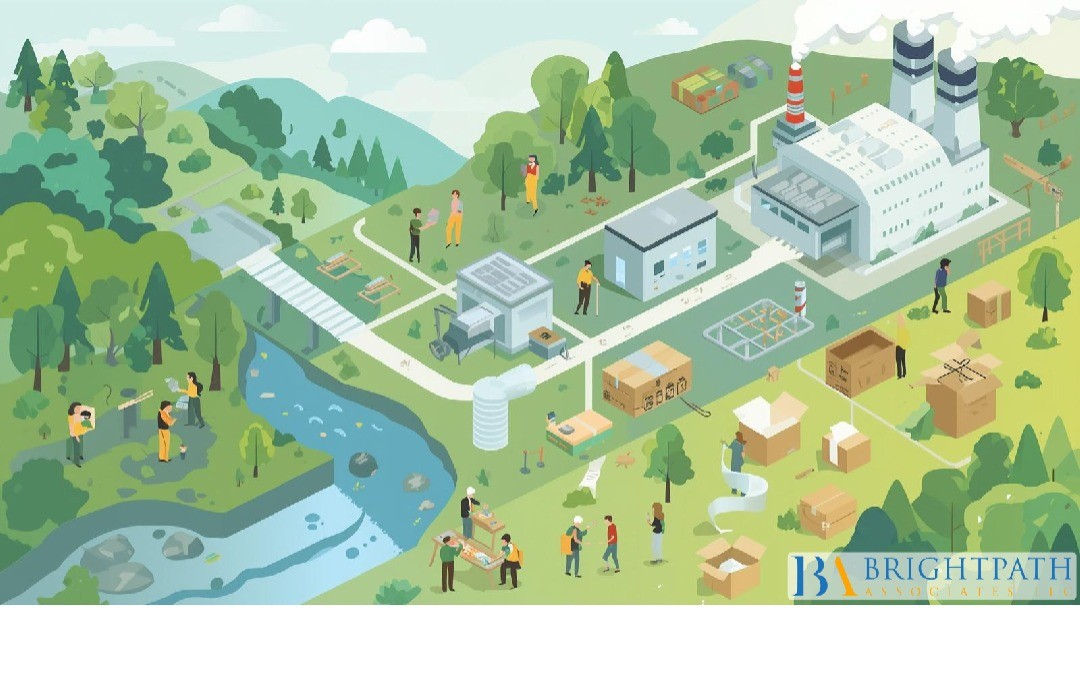
Introduction: A Fiber-Based Future Within Planetary Limits
The paper and fiber-based #PackagingSector stands at the intersection of climate action, circularity, and responsible material substitution. As brands and regulators accelerate the shift away from fossil-based, hard-to-recycle formats, paper is increasingly positioned as a core enabler of low-carbon, circular systems. Real leadership, however, depends on decarbonizing mill energy, safeguarding forests, raising the quality and yield of fiber loops, and eliminating persistent chemistries that complicate recovery or endanger health. The coming decade will determine whether paper genuinely leads with sustainability by embedding science-based performance into every product and process.
Market Dynamics: From Graphic Contraction to Circular Packaging Growth
Demand patterns across global grades continue to evolve. Graphic papers have faced structural decline for over a decade, yet packaging and tissue grades have demonstrated resilience and strategic importance as e-commerce and retail pivot toward fiber-based solutions. European statistics highlight packaging and tissue leading rebounds while the sector advances efficiency and decarbonization. In North America, containerboard capacity remains near historical highs despite cyclical softness, and unbleached packaging papers have expanded. The critical sustainability question is no longer whether fiber can replace some plastics but how to ensure these substitutions deliver verifiable climate, biodiversity, and toxicology benefits across the full value chain.
Forest-Positive Sourcing: From “No Deforestation” to Nature Outcomes
Credible #ForestStewardship is the sector’s license to grow. Deforestation-free and conversion-free supply chains are becoming a baseline expectation as major markets tighten due diligence and geolocation requirements for wood, pulp, and paper placed on the market. European industry figures indicate that the majority of natural fibers used are sourced domestically from sustainably managed forests, reinforcing both strategic autonomy and high traceability. Industry leaders should expand certified forest management and chain-of-custody coverage, strengthen landscape-level biodiversity and water performance, and scale alternative fibers—such as agricultural residues—only where life-cycle assessments confirm positive ecological and logistical outcomes. The aim is to move beyond compliance and into demonstrable nature-positive contributions.
Circularity and Fiber Quality: Designing for Multiple Lives
Paper’s chief sustainability advantage is its compatibility with high-yield, repeated recycling. In the United States, the 2024 paper recycling rate reached approximately the low sixties by percentage, and cardboard approached the low seventies, with around 46 million tons of paper recycled. A large majority of mills incorporate recovered fiber into new products, showing the practical maturity of fiber loops. Europe similarly manages tens of millions of tonnes of paper for recycling each year. The next frontier is fiber quality and system compatibility. Designers must privilege repulpable, de-inkable constructions that do not degrade yield through incompatible laminates, adhesives, or poorly soluble barrier systems. Material recovery facilities and mills must align on sorting and cleaning standards that elevate yield from mixed paper streams. Reuse models in transport and selected food segments can complement recycling where life-cycle evaluations confirm net benefits across washing, logistics, and reverse supply chains.
Decarbonizing Mills: Biomass, Electrification, and Breakthrough Heat
Pulp and #PaperMills have a long history of using biomass residuals, particularly black liquor, to generate process energy and electricity. In the United States, a majority share of sector energy for leading associations comes from carbon-neutral biomass, while technical analyses show substantial fractions of energy demand met by black liquor and other biomass residuals. In Europe, direct CO2 emissions per tonne have been cut roughly in half since the early 1990s, with total sector emissions falling dramatically since the mid-2000s. The forward pathway integrates energy efficiency and combined heat and power, ongoing fuel shifts away from coal and oil, and accelerated electrification of process heat as grids decarbonize. Emerging solutions include high-solids and impulse drying, industrial heat pumps for medium-temperature processes, and breakthrough solvent pulping that reduces thermal load. Lignin and hemicellulose valorization into fuels and chemicals can further displace fossil inputs, improving both climate performance and mill economics.
Water Stewardship: Doing More With Less—and Returning It Cleaner
Water is mission-critical for pulping, forming, and finishing, and it remains a key focus of industrial sustainability. Since the 1990s, the European sector has reduced average water intake per tonne by nearly half and now returns the vast majority of abstracted water to the environment after internal reuse and treatment. Best practice emphasizes tighter internal loops governed by real-time control of temperature, conductivity, and chemistry; advanced effluent treatment that minimizes COD, AOX, and nutrient loads; and basin-level engagement to ensure withdrawals and discharges align with catchment science. The next step is integrating water metrics with climate and biodiversity targets so that mills demonstrate absolute improvements within local planetary boundaries, not just relative efficiency gains.
Safer Chemistries and Functional Performance Without Regrets
Market and regulatory shifts are rapidly redefining acceptable barrier performance for food and consumer packaging. In the United States, manufacturers have completed a market phase-out of PFAS-based grease-proofing agents for paper and paperboard food-contact uses, eliminating a major authorized source of dietary exposure from these applications. Innovation is now focused on PFAS-free, fiber-compatible barrier systems that deliver adequate grease, water, and oxygen resistance without compromising repulpability or safety. Candidates include mineral-modified and bio-based coatings based on starches, proteins, alginates, chitosan, and waxes, as well as multilayer designs tuned for delamination and high-quality fiber recovery. Every substitution must be validated through toxicology, migration, and #RecyclabilityTesting to prevent regrettable substitutions and to preserve circular value.
Policy Tailwinds: The Circular Economy as Operating System
New regulatory frameworks are embedding circularity and climate performance into product and system design. In Europe, packaging legislation now sets stringent waste prevention and recyclability requirements, with ambitious recycling targets for paper and cardboard by 2030, reuse provisions in defined segments, and harmonized labeling and design-for-recycling criteria that will shape global supply chains interfacing with the EU market. Deforestation regulations require due diligence statements and geolocation evidence for wood, pulp, and paper, reshaping fiber sourcing norms. National and regional extended producer responsibility schemes are evolving fee structures tied to recyclability and recycled content, rewarding high-yield, low-contaminant paper formats and penalizing hard-to-recycle composites. These frameworks accelerate the convergence of commercial advantage and sustainability performance.
Digitization and the Mill of the Future: Precision, Flexibility, and Resilience
#DigitalTransformation is advancing from pilot projects to operational performance. Mills increasingly deploy digital twins, advanced sensors, and AI-supported control systems that stabilize formation and tensile properties at lower basis weights, minimize steam and electricity per tonne in real time, and predict maintenance needs for recovery boilers and paper machines. This digitized control enhances uptime, reduces safety incidents, cuts unplanned emissions, and supports agile grade transitions that reduce trim loss, fiber overuse, and inventories. As grids decarbonize, digital energy management becomes a strategic lever for integrating electrified processes and on-site renewables, while real-time assurance systems support compliance with forest, chemistry, and circularity regulations.
Innovation Pipeline: High-Barrier Papers, Residue Pulps, and Biorefinery Economics
Leadership will hinge on a portfolio of solutions that deliver performance with circular integrity. High-barrier, PFAS-free papers can combine nanocellulose or mineral-modified layers with waterborne or bio-based coatings to reach oxygen and grease targets suitable for many dry and semi-moist applications, all while remaining repulpable. Technical papers for filtration, battery separators, and electronics can exploit tunable porosity, dielectric properties, and thermal stability in advanced cellulose architectures. Alternative pulps from agricultural residues, such as wheat straw and bagasse, can be scaled where logistics and ash or contaminant control are solved and life-cycle analyses confirm benefits. Lignin valorization to adhesives, resins, and carbon materials can improve mill carbon profiles and economics, while next-generation bleaching using oxygen, ozone, peroxide, and enzyme-assisted steps can reduce chemical loads and AOX without compromising brightness and strength.
Measuring Leadership: Transparent Metrics That Matter
Stakeholders will recognize sustainability leadership through a small set of transparent, auditable metrics aligned with science-based targets. Climate performance should demonstrate absolute Scope 1 and 2 reductions consistent with a 1.5°C pathway, credible engagement on Scope 3 categories such as fiber, chemicals, and transport, and clear progress on electrification and thermal intensity. Circular metrics should include design-for-recycling scores, repulpability and de-inkability pass rates, post-consumer recycled fiber content by grade where feasible, and yield and stickies indices at mills. Forest and nature indicators should report shares of certified fiber, deforestation- and conversion-free volumes, biodiversity outcomes, and water withdrawals and returns set against basin thresholds. #ChemistrySafety indicators should verify PFAS-free progress, food-contact compliance, and third-party hazard assessments for new functional materials.
Cross-Industry Insights: What Paper Can Learn From the Rail Industry
Industrial transformation rarely occurs in isolation, and there is value in studying adjacent sectors undergoing modernization. The Rail industry has navigated waves of digitalization, materials innovation, and energy transition that mirror paper’s journey in important ways. Rail industry innovations and Rail technology advancements, ranging from predictive maintenance and remote condition monitoring to lightweight materials and hybrid propulsion, parallel the paper sector’s drive for AI-enabled quality control, advanced coatings, and electrified heat. The Railroad manufacturing industry outlook illustrates how legacy infrastructure can be revitalized through targeted capital expenditure, modular upgrades, and data platforms that extend asset life, lessons that apply directly to paper machines and recovery islands preparing for electrification and new chemistries.
The dynamics within Railroad manufacturing and Locomotive manufacturing demonstrate how advanced manufacturing practices such as digital twins, additive manufacturing for components, and outcome-based service models can elevate reliability and sustainability. The competitive landscape among the Top railroad manufacturing companies US highlights how scale, supplier integration, and engineering depth create durable advantages, mirroring vertically integrated pulp and paper operators that coordinate fiber, energy, and conversion assets. Railroad equipment manufacturers have streamlined supply chains and instituted strict interoperability standards, echoing the paper sector’s need for harmonized design-for-recycling criteria and standardized repulpability testing across converters and mills.
The US manufacturing industry is again emphasizing domestic capacity, resilience, and technology leadership, a theme that resonates with pulp and paper investments in high-efficiency, lower-emission assets and in regional recycling infrastructure that secures high-quality recovered fiber. In both sectors, advanced manufacturing is a sustainability imperative, enabling lower energy and water intensities while improving product performance. As both industries compete for specialized talent, #ExecutiveSearchRecruitment plays a pivotal role in assembling cross-functional teams in process engineering, data science, energy systems, and product safety, ensuring that sustainability and profitability advance together.
Risk Landscape: Constraints and Trade-Offs to Manage
Constraints and trade-offs must be managed with rigor to sustain momentum. Fiber availability may tighten as packaging and tissue demand outpaces high-quality recovered fiber in some regions, requiring improved collection and sorting to elevate yield and quality. Electrifying high-temperature drying depends on grid decarbonization, substantial capital cycles, and interim strategies that avoid locking in high-carbon fuels. Ambitious barrier performance can undermine repulpability if materials are poorly chosen; the discipline of function that remains recyclable and safe will often outperform maximalist barrier stacks with problematic end-of-life profiles. #RegulatoryImplementation can be uneven or delayed, demanding agile compliance systems and deep supplier enablement across borders.
Conclusion: From Better to Best-in-Class, By Design
The future of paper is not simply about more fiber; it is about better fiber systems. The sector’s track record is real and measurable, with significant reductions in carbon intensity, expanded use of biomass residuals for process energy, and decisive movement away from persistent chemistries in sensitive applications. Leadership will now be defined by integration, designing products that recycle at high yield and quality, powering mills with cleaner heat and electricity, validating nature outcomes at landscape scale, and delivering functional performance without toxic trade-offs. In policy environments that reward circularity and penalize waste and risk, and in markets inspired by adjacent sectors such as the #RailIndustry and Railroad manufacturing that are modernizing through data and electrification, paper can lead with sustainability. By leveraging advanced manufacturing, digitization, and safer chemistries, and by embedding robust, transparent metrics into everyday decision-making, the industry can transform sustainability from a set of commitments into the operating system of every fiber, process, and package it brings to market.
Find your next leadership role in Paper & Forest Products Industry today!
Stay informed with the latest insights on Paper & Forest Products Industry!