
Introduction
#IndustrialMaintenance has traditionally been viewed as a necessary response to equipment failure. When a machine stopped working, maintenance teams were called to diagnose the problem, replace damaged components, and return the production line to operation. This reactive approach could be effective for simple equipment, but it becomes increasingly costly as manufacturing systems become more automated and interconnected.
Modern production environments depend on complex machinery, robotics, sensors, software, and connected control platforms. A failure in one component can interrupt an entire production process, creating downtime, quality problems, delayed deliveries, and increased operating costs. As a result, manufacturers are moving beyond reactive and preventive maintenance toward predictive and prescriptive models.
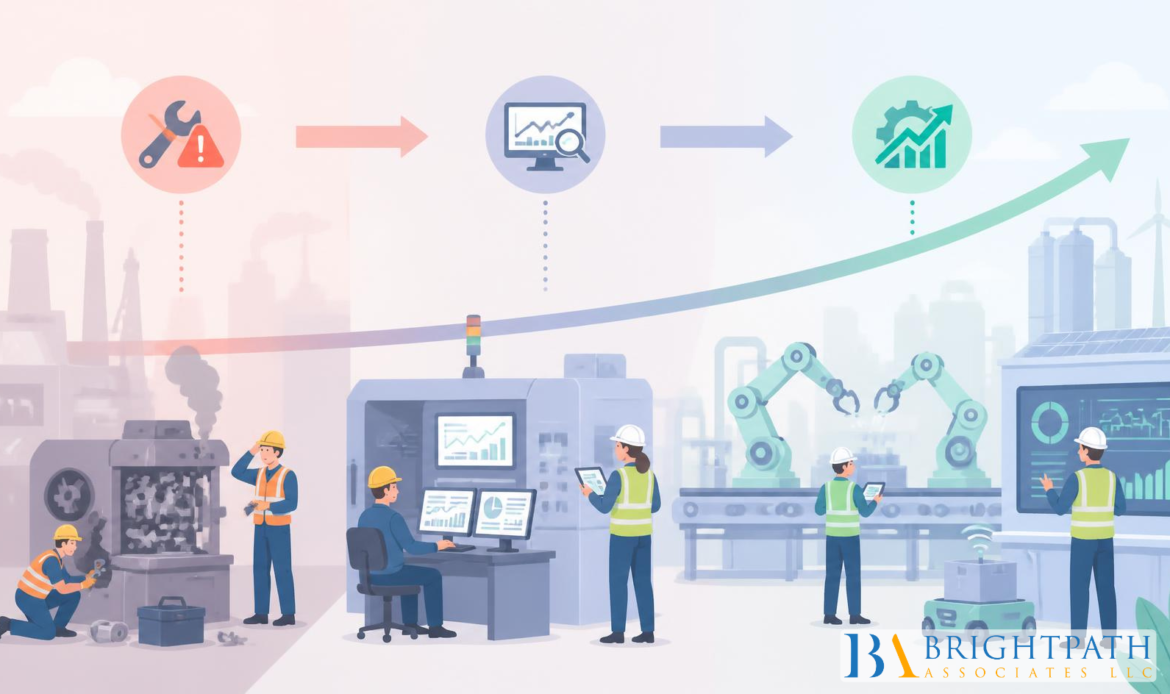
Prescriptive maintenance represents the next stage of this evolution. Instead of simply identifying what might fail, it combines operational data, analytics, automation, and engineering knowledge to determine what action should be taken and when. The objective is not merely to maintain equipment but to optimize maintenance decisions for maximum production output.
Why Reactive Maintenance Limits Production Performance
Reactive maintenance operates after a problem has already occurred. While this approach can be appropriate for low-risk or non-critical equipment, it can become expensive in highly automated facilities.
Unexpected failures can result in production stoppages, emergency labor requirements, spare-parts expenses, and missed delivery schedules. The impact can also extend beyond the failed machine. A breakdown in a critical component may stop upstream and downstream processes simultaneously.
Industrial automation increases the consequences of unplanned downtime because modern production systems often operate as interconnected networks. A small mechanical or electrical fault can therefore have a disproportionately large effect on overall productivity.
Moving toward data-driven maintenance allows manufacturers to identify developing problems before they become production failures.
Preventive maintenance typically relies on predefined schedules. Equipment may be inspected, lubricated, calibrated, or replaced after a specific number of operating hours.
The limitation is that equipment does not always deteriorate according to a fixed schedule. Two machines operating under similar conditions may experience different levels of wear because of variations in workload, temperature, vibration, operating patterns, or environmental conditions.
Predictive maintenance addresses this limitation by using operational data to identify patterns associated with equipment degradation. Sensors can monitor temperature, vibration, pressure, current, speed, and other variables.
The next step is prescriptive maintenance, where these insights are converted into recommended actions. The system can help determine whether equipment should be inspected, adjusted, repaired, or allowed to continue operating.
Industrial Automation Creates the Foundation for Smarter Maintenance
#IndustrialAutomation provides much of the infrastructure required for advanced maintenance strategies. Automated machinery already generates large amounts of operational information through sensors, controllers, drives, and monitoring systems.
Manufacturers can use this information to establish a digital picture of machine performance. Historical data can then be compared with current operating conditions to identify abnormal behavior.
The objective is not simply to collect more information. The real value comes from connecting machine data with maintenance decisions.
Modern Industrial automation therefore creates an opportunity to transform maintenance from a support function into a strategic component of production optimization.
Automation solutions manufacturing increasingly involves the integration of equipment, software, robotics, sensors, and industrial communication networks. Maintenance strategies must evolve alongside this complexity.
When maintenance teams understand how these systems interact, they can diagnose problems more efficiently. Instead of treating each machine as an isolated asset, teams can evaluate the relationships between components and production processes.
Integrated maintenance platforms can help identify whether a recurring problem originates from mechanical wear, electrical instability, control logic, operating conditions, or another part of the production system.
This broader perspective is essential for prescriptive maintenance because the recommended action needs to address the underlying cause rather than simply the visible symptom.
PLC Programming Service and Intelligent Maintenance
Programmable logic controllers remain central to automated manufacturing. A PLC programming service can support the development, modification, and optimization of machine control logic.
PLC data can also contribute to maintenance strategies. Machine states, alarms, cycle times, operating sequences, and fault conditions can provide valuable information about equipment behavior.
Maintenance engineers who understand PLC logic can often identify relationships between control events and physical equipment problems. This can shorten troubleshooting time and improve the accuracy of maintenance decisions.
As factories become more connected, PLC expertise is therefore becoming increasingly valuable to maintenance teams.
SCADA systems provide another important layer of industrial intelligence. They allow organizations to monitor and visualize equipment conditions, production parameters, alarms, and process information.
For maintenance operations, this visibility can help teams detect deviations before they become major failures. Historical SCADA information can also reveal recurring patterns that may not be obvious during manual inspections.
When combined with analytics, SCADA systems can become part of a broader maintenance intelligence architecture. Maintenance teams can use historical and real-time information to understand equipment behavior and prioritize interventions.
The result is a more informed maintenance process that connects machine conditions with production requirements.
Robotics Integration Raises the Importance of Maintenance Precision
#RoboticsIntegration has expanded the use of automated handling, assembly, welding, packaging, inspection, and material movement systems. Robots can deliver high levels of consistency and productivity, but they also introduce specialized maintenance requirements.
Robotic systems depend on mechanical components, motors, controllers, sensors, software, and communication networks. A fault in one element can affect the performance of an entire automated cell.
Prescriptive maintenance can help organizations monitor robot performance and identify deviations in movement, cycle time, temperature, or other operating characteristics.
The objective is to intervene at the right time rather than simply following a fixed maintenance calendar. This can help maximize equipment availability while minimizing unnecessary maintenance activity.
Industrial machine vision is increasingly used for automated inspection and quality control. Cameras and vision systems can identify defects, dimensional variations, alignment problems, and other production anomalies.
Machine vision data can also provide indirect information about equipment condition. A gradual increase in product defects may indicate tooling wear, vibration, misalignment, calibration issues, or other equipment problems.
Connecting quality information with maintenance data creates a more comprehensive view of production performance.
Instead of waiting for a machine to fail, manufacturers can investigate quality deviations as potential indicators of equipment degradation.
Control Systems and the Shift Toward Prescriptive Decisions
Control systems are at the center of automated manufacturing operations. They regulate processes, coordinate equipment, and maintain operating parameters.
As control systems become more sophisticated, they can generate valuable information for maintenance analytics. Monitoring changes in machine behavior can help identify conditions associated with potential failures.
Prescriptive maintenance takes this analysis further by connecting equipment conditions with recommended responses. For example, the system may indicate that a particular component should be inspected during the next planned production interruption rather than waiting for a failure.
This approach allows maintenance activity to be coordinated with production schedules.
Manufacturing automation is designed to increase productivity, consistency, and operational efficiency. However, automation investments can only deliver their expected value when equipment remains available and reliable.
Maintenance therefore becomes an important component of automation performance. High levels of automation combined with poor maintenance practices can create significant operational vulnerability.
Prescriptive maintenance helps address this challenge by connecting maintenance decisions with production priorities.
A critical machine supporting a high-value production line may require different maintenance treatment from a non-critical asset. Data-driven prioritization allows organizations to allocate maintenance resources according to operational impact.
The Human Expertise Behind Advanced Maintenance
Technology does not eliminate the need for experienced maintenance professionals. Instead, it changes the skills they require.
Modern maintenance teams increasingly need expertise in electrical systems, mechanical engineering, software, automation, data analysis, networking, and robotics.
Employees must be able to interpret machine information and understand how technological systems interact with physical equipment.
This is contributing to the growth of specialized Automation jobs. Technicians and engineers with experience in PLCs, robotics, SCADA, industrial networks, and control systems can play an increasingly important role in advanced manufacturing environments.
As maintenance becomes more strategic, organizations also need leaders capable of managing the convergence of engineering, automation, data, and operations.
Executive search industrial automation can help organizations identify senior professionals who understand the technical and commercial dimensions of modern manufacturing.
These leaders may be responsible for developing automation strategies, improving equipment reliability, managing digital transformation initiatives, and building multidisciplinary engineering teams.
Leadership is particularly important when organizations move from traditional maintenance toward prescriptive models because the transformation involves changes in technology, processes, workforce skills, and #OrganizationalCulture.
Executive Search Recruitment for the Future Factory
#ExecutiveSearchRecruitment can support manufacturers as they build leadership teams capable of managing increasingly sophisticated industrial environments.
The ideal leadership profile is changing. Manufacturing executives may now need experience with automation platforms, analytics, robotics, connected equipment, predictive maintenance, and digital transformation.
They also need to understand how technology investments affect productivity, workforce requirements, maintenance costs, and long-term operational resilience.
Finding these hybrid leaders can become a strategic priority as factories transition toward increasingly autonomous and data-driven operations.
Technology alone cannot create effective prescriptive maintenance. Organizations need a culture in which maintenance, engineering, production, IT, and management teams share information and work toward common performance objectives.
Maintenance data should be connected to production priorities rather than analyzed in isolation. When teams understand the financial and operational consequences of downtime, they can make more informed decisions about when and how to intervene.
Continuous improvement is equally important. Prescriptive maintenance systems should evolve as organizations collect more operational data and gain a better understanding of equipment behavior.
Conclusion
The shift from reactive to prescriptive maintenance represents a fundamental change in how manufacturers approach equipment reliability. Reactive maintenance responds to failure, while preventive maintenance follows predetermined schedules. Predictive maintenance identifies potential problems, and prescriptive maintenance adds another layer by helping determine the most appropriate response.
Industrial automation, Automation solutions manufacturing, PLC programming service capabilities, Robotics integration, SCADA systems, Industrial machine vision, and advanced Control systems are creating the technical foundation for this transformation.
At the same time, Manufacturing automation is increasing demand for skilled professionals capable of managing interconnected industrial environments. Automation jobs are increasingly moving toward multidisciplinary roles that combine engineering, software, data, and operational expertise.
For organizations, the objective is clear: maintenance should no longer be viewed simply as a cost of keeping machines operational. It can become a strategic capability for maximizing asset availability, improving production reliability, reducing unnecessary intervention, and protecting peak output.
The transition will require technology, process redesign, workforce development, and strong leadership. Through targeted Executive Search Recruitment and specialized executive hiring, manufacturers can build the leadership capabilities required to make advanced maintenance a core part of the modern industrial operating model.
Find your next leadership role in Industrial Automation Industry today!
Stay informed with the latest insights on Industrial Automation Industry!