
Introduction
The #DairyIndustry is entering a new phase of technological transformation. For years, dairy businesses invested in individual digital tools designed to solve specific operational challenges, from automated milking systems and temperature sensors to inventory software and connected refrigeration equipment. While these technologies delivered measurable improvements, many organizations now recognize that isolated devices cannot deliver the full potential of Industry 4.0.
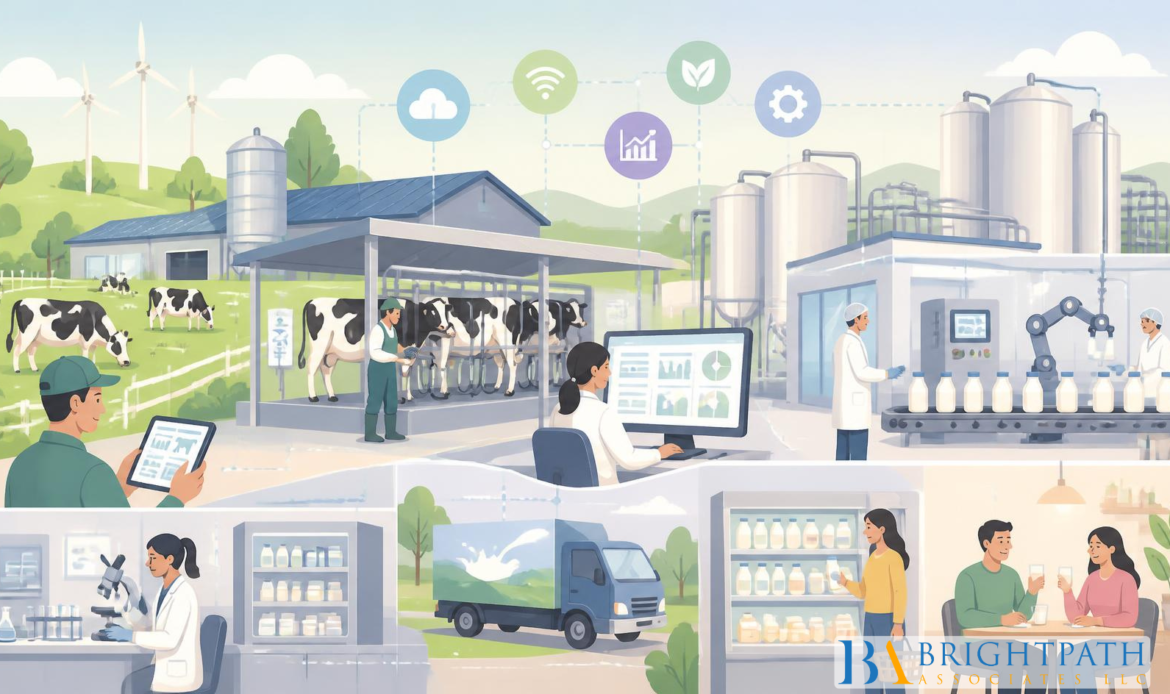
Dairy 4.0 represents a broader approach in which machines, people, data, processes, and supply chains operate as an interconnected ecosystem. Instead of simply collecting information from individual pieces of equipment, dairy companies can connect production facilities, farms, logistics networks, retailers, and customers through integrated digital infrastructure.
This transition is becoming increasingly important as companies face pressure to improve efficiency, strengthen traceability, reduce resource consumption, manage costs, and respond rapidly to changing consumer expectations. The combination of Dairy product development, Milk production technologies, Dairy automation technologies, and advanced analytics is creating a more intelligent operating model for modern dairy businesses.
Understanding the Dairy 4.0 Ecosystem
Dairy 4.0 is more than the installation of smart equipment. It is an integrated framework that connects operational technology with information technology. Sensors installed throughout farms and processing plants can generate continuous streams of data, while cloud platforms, artificial intelligence, machine learning, and analytics can transform that information into operational insights.
A dairy ecosystem may include connected milking equipment, automated feeding systems, smart refrigeration, processing sensors, laboratory systems, enterprise resource planning platforms, warehouse management applications, logistics tracking, and customer-facing digital channels. When these systems communicate effectively, organizations gain a unified view of operations.
The objective is to move from reactive management toward predictive and data-driven decision-making. Instead of discovering that a processing machine has failed after production has stopped, predictive systems can identify abnormal performance patterns and support maintenance before a major breakdown occurs. Similarly, supply chain data can help companies anticipate demand and adjust production and distribution accordingly.
At the foundation of Dairy 4.0 are modern Milk production technologies. Connected milking systems can monitor production volumes, milking patterns, equipment performance, and other operational parameters. Farm-level data can provide valuable information that extends beyond individual animals and becomes part of broader production planning.
The real value emerges when farm data connects with processing and business systems. Production forecasts can be integrated with processing schedules, inventory requirements, transportation planning, and customer demand. This creates a more coordinated production environment in which milk availability and processing capacity can be managed together.
Such integration can also support quality management. Data collected throughout the production process can help establish stronger traceability and provide businesses with greater visibility into the movement of raw materials. For companies operating across multiple facilities or sourcing milk from numerous farms, centralized data architecture can create greater consistency and transparency.
The Role of Dairy Automation Technologies
Automation is another essential component of a Dairy 4.0 infrastructure. #DairyAutomationTechnologies can support activities ranging from milking and feeding to pasteurization, packaging, cleaning, material handling, and warehouse operations.
Modern processing facilities increasingly rely on automated control systems to maintain precise operating conditions. Automated equipment can monitor variables such as temperature, pressure, flow rates, and processing times, helping operators maintain consistent production standards.
However, automation should not be viewed simply as a labor-reduction strategy. Its broader value lies in improving repeatability, data collection, safety, productivity, and process visibility. When automated systems are connected to enterprise platforms, operational data can be analyzed alongside financial, inventory, and supply chain information.
This creates a foundation for continuous improvement. Managers can identify production bottlenecks, compare facility performance, investigate deviations, and make decisions based on real operational evidence rather than assumptions.
A successful Dairy 4.0 ecosystem depends on reliable data infrastructure. Sensors and connected machines can generate enormous quantities of information, but data has limited business value if it remains trapped within individual systems.
Dairy companies therefore need architectures that allow information to move securely between operational equipment, cloud platforms, analytics applications, and business software. Application programming interfaces, industrial communication protocols, edge computing, and cloud infrastructure can help establish this connectivity.
Edge computing can be particularly valuable in processing environments where immediate responses are necessary. Certain information can be analyzed close to the equipment rather than being transmitted to a remote cloud environment before action is taken. Cloud platforms, meanwhile, can support broader analysis across farms, plants, warehouses, and distribution networks.
The objective is not to collect the maximum amount of data. Instead, organizations should identify which data is strategically important and determine how it can improve operational decisions.
Digital Transformation Across the Dairy Supply Chain
The impact of Dairy 4.0 extends well beyond the processing plant. Dairy supply chain management increasingly depends on real-time information about production, inventory, transportation, demand, and customer requirements.
Traditional dairy supply chains can face significant challenges because dairy products often have short shelf lives and require controlled temperatures throughout distribution. Integrated digital platforms can provide better visibility into inventory levels, transportation conditions, delivery schedules, and demand patterns.
Connected logistics systems can also support cold-chain monitoring. Temperature information gathered during transportation and storage can provide businesses with greater visibility into product handling. When integrated with quality and inventory systems, these technologies can help organizations identify potential risks and respond more quickly.
For dairy companies pursuing Dairy industry growth strategies, supply chain visibility can become an important competitive capability. Companies that can coordinate production and distribution more efficiently may be better positioned to manage changing demand and reduce operational waste.
Artificial intelligence is increasingly becoming an important layer of the Dairy 4.0 ecosystem. AI can analyze large datasets generated by farms, factories, logistics systems, and customer channels to identify patterns that may not be immediately visible to human operators.
Predictive maintenance is one potential application. Machine performance data can be analyzed to identify early indicators of equipment deterioration. Demand forecasting represents another opportunity, allowing companies to incorporate historical sales, seasonal patterns, market conditions, and other variables into production planning.
AI can also support quality control and Dairy product development. Data from laboratory systems, production processes, customer feedback, and market trends can help product teams identify opportunities for reformulation, new product categories, and packaging improvements.
The strategic value of AI depends heavily on data quality. Poorly integrated systems and inconsistent data can undermine even sophisticated analytical models. Therefore, data governance must develop alongside artificial intelligence capabilities.
Supporting Sustainable Dairy Farming Practices
Sustainability is becoming increasingly integrated with digital transformation. Sustainable dairy farming practices can benefit from technologies that provide better visibility into resource consumption and operational performance.
Digital monitoring can help farms understand patterns in water usage, feed utilization, energy consumption, and other resource requirements. Processing facilities can similarly monitor energy and water consumption across different production stages.
When sustainability information is integrated across the value chain, organizations can move beyond broad environmental goals toward measurable operational management. Digital systems can help establish benchmarks, identify inefficiencies, and monitor progress over time.
This connection between technology and sustainability is particularly relevant as dairy companies respond to growing expectations from customers, retailers, investors, and regulators. Sustainability can increasingly become part of operational decision-making rather than a separate corporate initiative.
Advances in #FoodTechnology are creating new possibilities for the dairy sector. Consumers are increasingly seeking products that offer convenience, nutritional benefits, functionality, and differentiated experiences. At the same time, companies are exploring new processing methods, formulations, packaging solutions, and product categories.
Dairy 4.0 infrastructure can support this innovation by connecting market intelligence with production capabilities. Digital feedback from consumers and retailers can inform product development teams about changing preferences. Manufacturing data can then help determine whether new products can be produced efficiently and consistently at scale.
The integration of food technology with digital manufacturing can shorten the distance between product experimentation and commercial production. Companies can use data to evaluate processes, identify quality variations, and optimize production parameters before expanding new products across multiple facilities.
Dairy E-Commerce and the Digitally Connected Consumer
The rise of Dairy e-commerce is also changing how dairy businesses interact with consumers. Digital channels can provide companies with direct access to purchasing behavior, product preferences, geographic demand patterns, and customer feedback.
E-commerce data can become another component of the Dairy 4.0 ecosystem. When connected with inventory and production systems, digital sales information can contribute to demand forecasting and replenishment decisions.
The relationship between digital commerce and physical operations is particularly important for businesses offering fresh or temperature-sensitive products. Successful digital strategies require coordination between online ordering, inventory availability, fulfillment, cold-chain logistics, and customer service.
Greater connectivity also introduces greater cybersecurity responsibilities. As dairy facilities connect industrial control systems, cloud platforms, enterprise applications, and external networks, the potential attack surface expands.
A comprehensive Dairy 4.0 strategy therefore needs cybersecurity to be incorporated into infrastructure planning from the beginning. Access controls, network segmentation, system monitoring, secure authentication, data governance, and employee awareness can all contribute to stronger digital resilience.
Cybersecurity should not be treated solely as an IT responsibility. Because connected technologies increasingly influence physical production environments, operational leaders, engineering teams, IT professionals, and executives need to collaborate on risk management.
Talent as a Critical Component of Dairy Industry Digital Transformation
Technology alone cannot create a successful digital ecosystem. Organizations need professionals who understand both dairy operations and emerging technologies. This is where Dairy industry digital transformation increasingly intersects with strategic talent management.
Dairy companies may require leaders with experience in automation, data analytics, industrial engineering, cybersecurity, artificial intelligence, supply chain technology, and digital commerce. Finding executives who can connect these disciplines with traditional dairy operations can be challenging.
Consequently, Dairy industry executive search is becoming increasingly relevant as companies build their technology leadership teams. #ExecutiveSearchRecruitment can help organizations identify leaders with the combination of industry knowledge, technology expertise, strategic thinking, and transformation experience required to manage complex digital initiatives.
The future dairy executive may need to understand manufacturing systems, data architecture, sustainability objectives, consumer behavior, and supply chain economics simultaneously. Building this leadership capability is essential for turning technological investments into long-term business value.
Successful transformation does not require every dairy company to digitize everything simultaneously. A more practical approach is to establish a clear roadmap based on business priorities.
Organizations can begin by identifying operational areas where better data and connectivity could produce measurable improvements. They can then integrate systems gradually, establish common data standards, strengthen cybersecurity, and develop analytical capabilities.
Pilot projects can provide a controlled environment for testing technologies before wider implementation. Once successful use cases demonstrate measurable value, companies can scale them across facilities and business functions.
The most effective Dairy 4.0 strategies ultimately connect technology investments to business objectives. Automation should support productivity. Analytics should improve decision-making. Digital supply chains should strengthen responsiveness. Food technology should support innovation. Sustainability systems should improve resource efficiency.
Conclusion
The future of dairy technology is not defined by individual gadgets or isolated automation projects. It is defined by how effectively companies connect machines, people, data, processes, and customers into a unified operating ecosystem.
Dairy 4.0 provides the framework for this transition. Through connected Milk production technologies, advanced Dairy automation technologies, intelligent Dairy supply chain management, modern Food technology, and digital commerce, dairy businesses can create more responsive and data-driven operations.
The organizations capable of integrating these capabilities will be better positioned to manage complexity, support innovation, strengthen operational visibility, and pursue sustainable growth. At the same time, technology transformation will require a new generation of leadership capable of bridging dairy expertise with digital capabilities.
Ultimately, the transition from gadgets to ecosystems represents a fundamental change in how dairy businesses operate. The competitive opportunity is no longer simply adopting the newest technology. It is creating an integrated infrastructure in which every technology contributes to a larger, connected business system.
Find your next leadership role in Dairy Industry today!