
Introduction
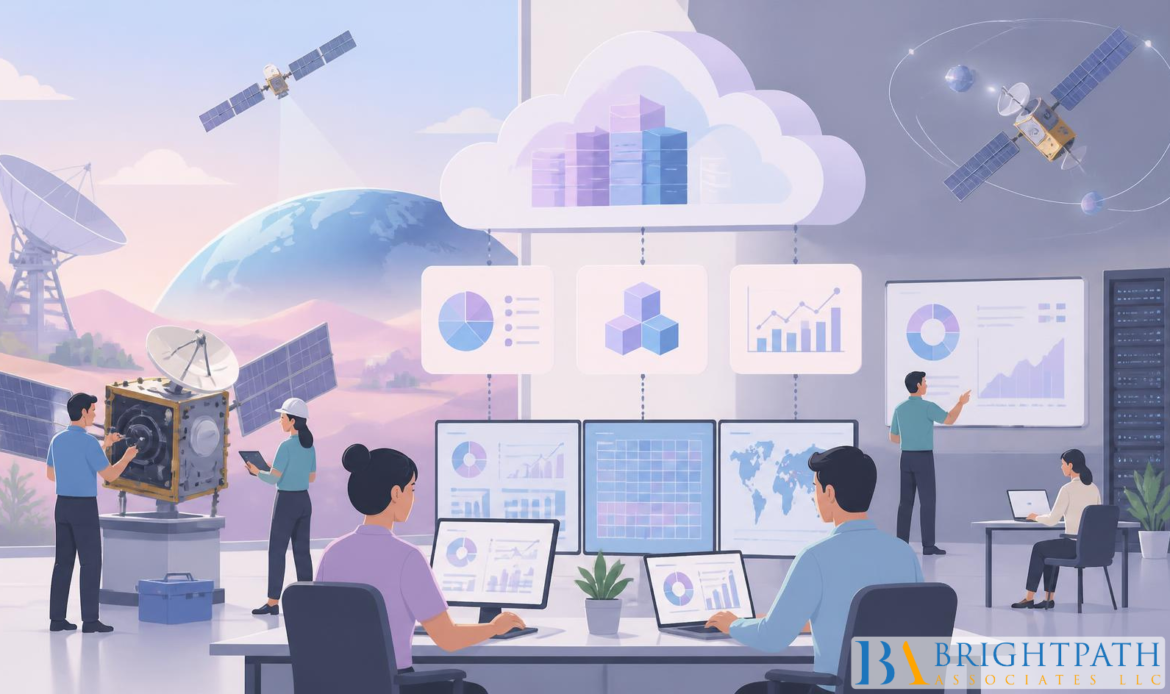
The #AerospaceIndustry is increasingly dependent on cloud computing to process satellite imagery, manage telemetry, support mission planning, run simulations, and analyze enormous volumes of operational data. As satellite constellations expand and mission architectures become more sophisticated, organizations must balance computing performance, data security, operational reliability, and financial discipline. For satellite operators, aerospace manufacturers, defense contractors, and space technology startups, cloud expenditure has become a strategic consideration rather than a routine IT expense.
Financial Operations, commonly known as FinOps, provides a structured approach to managing cloud spending through collaboration between engineering, finance, procurement, and operational teams. Instead of treating cloud costs as an unpredictable monthly bill, FinOps connects technology consumption with business objectives, mission requirements, and measurable outcomes. This approach is particularly valuable in aerospace, where data-intensive workloads can fluctuate significantly according to launch schedules, orbital activity, ground station availability, image processing requirements, and simulation cycles.
Unlike conventional software businesses, aerospace organizations frequently operate under demanding security, regulatory, and performance requirements. Satellite data may need to remain accessible across geographically distributed facilities, while mission-critical applications must satisfy strict latency and availability expectations. These conditions make cost reduction more complex than simply selecting the cheapest cloud service.
An effective FinOps strategy helps organizations understand which workloads generate value, where resources are being wasted, and how cloud infrastructure can scale without undermining mission performance. As aerospace industry trends increasingly emphasize digital engineering, autonomous operations, and commercial space infrastructure, disciplined cloud financial management is becoming essential for sustainable growth.
Satellite projects generate data throughout their operational lifecycle. Earth observation satellites collect high-resolution imagery, communications satellites support large-scale data transmission, and scientific missions produce telemetry and experimental measurements. Additional data originates from spacecraft health monitoring, ground station operations, digital engineering environments, and mission simulations.
Cloud costs arise from several interconnected sources. Compute resources process imagery, run analytical models, transform telemetry, and execute mission software. Storage services retain raw observations, processed datasets, engineering records, and historical mission information. Network charges may increase when large datasets move between cloud regions, ground stations, partner organizations, or specialized processing environments.
Data-heavy workloads can also create unpredictable spending patterns. A satellite imaging provider may experience a surge in processing demand after a major observation campaign, while a defense simulation team may require substantial computing capacity during a limited testing window. If resources remain active after the workload finishes, organizations continue paying for capacity that delivers little additional value.
The challenge becomes more significant when departments use separate cloud accounts, inconsistent tagging practices, or different purchasing arrangements. Finance teams may see aggregate expenditure without understanding which mission, application, or engineering program generated the costs. FinOps addresses this problem by connecting cloud consumption to operational ownership and business outcomes.
Establishing Financial Visibility Across Cloud Infrastructure
Cost visibility is the foundation of effective FinOps. Aerospace organizations need to understand how much they spend, which activities consume resources, and how those costs change as mission requirements evolve. A consolidated view of cloud expenditure helps finance and engineering teams identify unexpected increases before they become significant budget problems.
#ResourceTagging is an important starting point. Each cloud resource should be associated with relevant identifiers, such as mission, project, department, environment, application, and cost center. Standardized naming conventions and account structures make it easier to distinguish experimental workloads from production systems and operational mission infrastructure.
For example, a satellite operator could separate expenditure for telemetry processing, imagery analytics, mission planning, software development, and long-term archival storage. This structure allows managers to evaluate the financial performance of individual workloads instead of relying exclusively on organization-wide cloud totals.
Dashboards should present financial information alongside engineering metrics. Cost per processed image, cost per terabyte analyzed, expenditure per simulation run, and cloud cost per active satellite can provide more useful insights than monthly spending alone. These indicators should be interpreted in the context of mission complexity, data quality, and service requirements.
Visibility also improves accountability. When engineering teams can see the financial consequences of architectural decisions, they are better positioned to compare alternative approaches. Finance teams, in turn, gain a clearer understanding of why certain expenses are necessary and where efficiency improvements are possible.
Compute optimization is one of the most direct ways to control cloud expenditure in satellite projects. Many aerospace workloads have variable resource requirements, making it possible to reduce costs through more appropriate instance selection, scheduling, and automated scaling.
Image processing pipelines may require substantial compute capacity during intensive processing periods but considerably less capacity between observation campaigns. Elastic infrastructure can increase resources when demand rises and release them when workloads finish. Development environments, testing systems, and noncritical analytical jobs can often be scheduled to avoid unnecessary continuous operation.
Different workloads also benefit from different computing architectures. General-purpose processors may be suitable for routine data transformations, while graphics processing units can accelerate particular image-processing and machine-learning tasks. High-performance computing environments may be necessary for computationally demanding scientific analysis or engineering simulations.
However, the fastest configuration is not always the most cost-effective. Aerospace organizations should evaluate total workload economics, including processing duration, energy-related service charges where applicable, software licensing, data transfer, and operational overhead. A more expensive compute configuration may reduce total expenditure if it completes a workload substantially faster and releases resources earlier.
Automated policies can identify oversized instances, unused storage volumes, inactive development environments, and abandoned test clusters. Nevertheless, optimization controls must distinguish between disposable resources and mission-critical infrastructure. Any automated shutdown or resizing policy should respect operational schedules, recovery requirements, and engineering approval procedures.
Managing Storage Costs Across the Satellite Data Lifecycle
#SatelliteProjects often retain multiple generations of data, including raw sensor outputs, calibrated imagery, processed products, telemetry, simulation results, and compliance records. Keeping all information in high-performance storage indefinitely can generate substantial costs without providing proportional operational value.
A data lifecycle strategy classifies information according to access frequency, retention requirements, performance needs, and long-term mission value. Recently collected imagery or active telemetry may require rapid access, while older observations may be accessed less frequently and can potentially move to lower-cost storage tiers.
Automated lifecycle policies can transition eligible datasets to appropriate storage classes after predefined periods. Organizations should establish retention schedules for temporary processing files, duplicate datasets, intermediate analytical outputs, and obsolete development artifacts. These policies can reduce storage growth while preserving information required for scientific analysis, mission reconstruction, or regulatory purposes.
Deletion requires particular care. Some aerospace records may be necessary for contractual obligations, investigation, intellectual property protection, or long-term mission analysis. Defense-related programs may impose additional retention and access requirements. Before removing data, organizations should confirm that the information is no longer required and that authorized retention policies permit its disposal.
Data compression, deduplication, and more efficient file formats may also reduce storage demand. However, the potential benefits depend on the characteristics of the data and the computational cost of applying these techniques. Storage optimization should therefore be evaluated across the complete workflow rather than as an isolated infrastructure decision.
Data movement can become a major cost driver when satellite projects distribute information across cloud regions, ground stations, analytics platforms, and external partners. High-resolution imagery and scientific datasets can be particularly expensive to transfer repeatedly when processing architectures are poorly designed.
A practical strategy is to move computation closer to the data whenever security and performance requirements allow. Instead of transferring large datasets between several environments, teams can process information within the same region or storage environment and transmit only the necessary outputs. This reduces redundant transfers and may improve processing efficiency.
Caching can also help when applications repeatedly access the same datasets. Similarly, data pipelines should avoid unnecessary duplication by establishing clear ownership of authoritative records and shared analytical products. Where cloud providers charge for outbound data transfer, teams should include those charges in architecture assessments and project forecasts.
Edge computing may be useful for certain satellite applications. Processing data at ground stations or other suitable local facilities can reduce the amount of information transmitted to centralized environments. However, edge infrastructure introduces its own hardware, maintenance, security, and staffing costs. The decision should consider total lifecycle expenditure, bandwidth availability, latency, and mission requirements.
For defense and commercial operators alike, network optimization must never compromise authorized access, data integrity, or mission continuity. Cost efficiency is most valuable when it improves the economics of a reliable and secure data architecture.
Integrating FinOps with Space Cybersecurity and Defense Requirements
Aerospace cloud environments often handle sensitive engineering information, satellite telemetry, operational schedules, and mission-related datasets. Cost optimization must therefore operate within a clearly defined security framework.
Space Cybersecurity requires organizations to evaluate identity management, encryption, network segmentation, vulnerability management, monitoring, and incident response across connected systems. Financial efficiency should not become a reason to weaken protective controls or place sensitive information in unsuitable environments.
Defense Space Systems may operate under specific contractual, sovereignty, accreditation, and data-handling requirements. Defense Space Policy and Space Regulatory obligations can influence which cloud environments are permitted, where data may be stored, how information can be transferred, and which providers can support particular workloads. Organizations must verify applicable requirements for each program rather than assume that every commercial cloud service is suitable.
Security costs should be treated as part of the mission’s total operating model. Encryption services, security monitoring, backup infrastructure, access controls, and compliance reporting can generate expenditure, but they also protect assets that may be expensive or impossible to replace. The objective is to remove waste from the security architecture without undermining necessary safeguards.
FinOps teams should collaborate with cybersecurity specialists and program compliance leaders when evaluating new services, changing data locations, or consolidating cloud environments. This joint review ensures that proposed savings remain consistent with technical and contractual obligations.
Cloud computing supports many activities beyond satellite data processing. Defense Simulation programs use computing infrastructure to evaluate mission scenarios, test system behavior, model threats, and support training. These workloads may be intensive but intermittent, making them suitable candidates for scheduling, resource optimization, and automated shutdown policies where permitted.
Simulation teams should track cost per run, resource utilization, completion time, and the number of experiments required to reach useful results. These measures can help identify inefficient models, oversized computing environments, and duplicated experiments. Shared scheduling systems may also improve utilization when multiple teams require high-performance computing resources at different times.
Defense manufacturing organizations can apply similar principles to digital engineering, product lifecycle management, testing, and supply chain analytics. Cloud-based design environments may support collaboration across facilities, while data analytics can help identify production bottlenecks and quality issues. Space Electronics manufacturers may use cloud resources to analyze test results, maintain traceability records, and support engineering workflows.
Space Robotics programs can also generate substantial data through sensor analysis, control-system testing, digital twins, and autonomous navigation development. FinOps practices help teams understand the cost of these workloads and compare cloud-based testing with local computing alternatives.
The appropriate model depends on workload sensitivity, performance requirements, data classification, and software licensing. A hybrid architecture may provide the best balance between cloud flexibility and specialized on-premises infrastructure.
Building Governance, Accountability, and Financial Forecasting
#SustainableFinOps requires clear ownership and repeatable governance. Aerospace organizations should establish a cross-functional working group involving engineering, finance, procurement, security, and program management. Its responsibilities should include reviewing expenditure trends, maintaining tagging standards, approving optimization priorities, and monitoring the financial impact of architectural decisions.
Budgets should be connected to realistic workload forecasts rather than static annual estimates alone. Forecasts can incorporate launch schedules, planned observation campaigns, simulation activity, expected data growth, and changes in satellite operations. Scenario planning can help leaders estimate the financial effects of increased data volume, unexpected mission activity, or changes in cloud pricing.
Cloud purchasing arrangements should also be evaluated carefully. Reserved capacity or commitment-based discounts may reduce costs for predictable workloads, while on-demand resources provide flexibility for uncertain demand. Commitments should reflect credible usage forecasts because unused contracted capacity can undermine expected savings.
Performance reviews should balance financial outcomes with engineering requirements. Useful measures include forecast accuracy, resource utilization, storage growth, unit processing cost, and compliance with service-level objectives. Management should also assess whether cost reductions introduce additional operational risk or delay mission delivery.
Developing Talent for Aerospace FinOps
FinOps depends on professionals who understand both technology and financial decision-making. Aerospace companies may need cloud architects, financial analysts, data engineers, cybersecurity specialists, procurement professionals, and program managers who can translate infrastructure usage into business outcomes.
#ExecutiveSearchRecruitment can help organizations identify senior leaders with experience in cloud economics, aerospace operations, digital transformation, and regulated technology environments. The most effective candidates combine financial discipline with an understanding of engineering trade-offs and mission-critical requirements.
Companies should also develop internal capabilities through cross-functional training. Engineers need practical knowledge of cost attribution and resource efficiency, while finance teams need enough technical understanding to interpret cloud usage reports and challenge assumptions constructively. Shared accountability encourages decisions that improve overall mission economics rather than simply shifting costs between departments.
Conclusion
FinOps provides aerospace organizations with a disciplined framework for managing the growing financial complexity of data-heavy satellite projects. By improving cost visibility, optimizing compute and storage, reducing unnecessary data movement, and integrating financial governance with security requirements, businesses can make cloud infrastructure more predictable and efficient.
The greatest benefits emerge when cost management becomes part of engineering and program planning rather than a corrective exercise performed after monthly bills arrive. Aerospace leaders should establish reliable cost attribution, define workload-specific performance measures, and introduce optimization policies that preserve mission availability and regulatory compliance.
As aerospace industry trends continue to emphasize connected satellite networks, advanced analytics, autonomous systems, and digital engineering, cloud consumption will remain an important operational consideration. Organizations that combine technical innovation with financial accountability will be better positioned to control expenditure, support mission growth, and protect long-term program value.
Ultimately, effective FinOps is not about minimizing every cloud expense. It is about ensuring that every investment in computing, storage, and data infrastructure contributes measurable value to the mission it supports.
Find your next leadership role in Defense and Space Industry today!
Stay informed with the latest insights on Defense and Space Industry!