
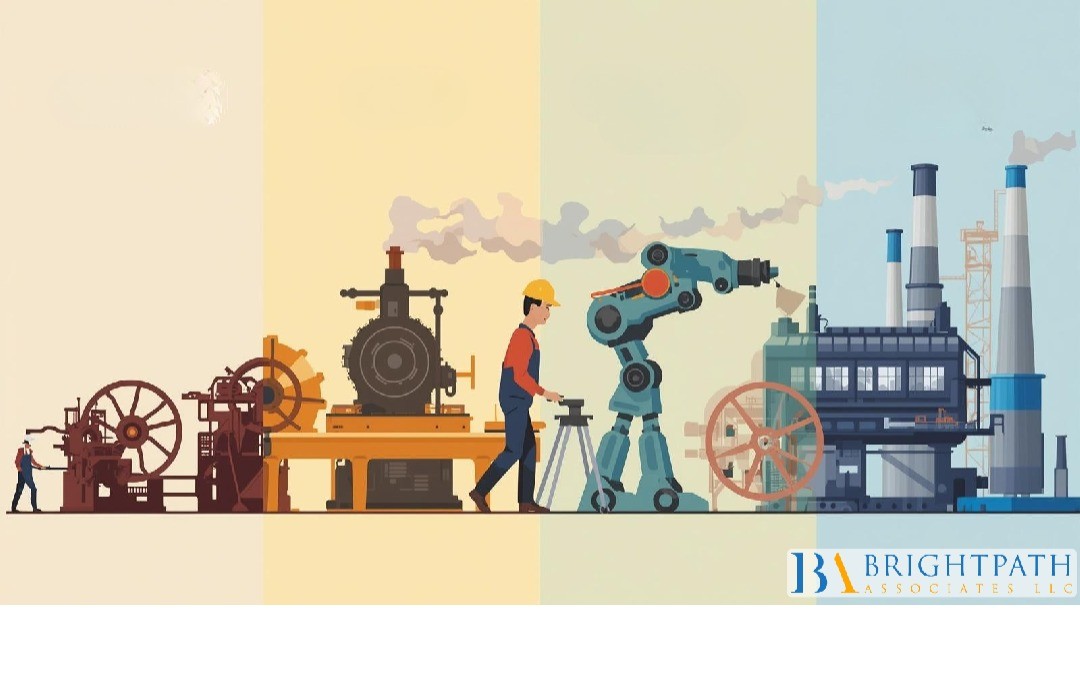
Introduction: Manufacturing as the Engine of Modern Economies
#IndustrialManufacturing has shaped modern economies by transforming how societies convert ideas and materials into reliable, scalable products. Its history is a continuum of power sources, machine capabilities, organizational models, and knowledge systems that steadily expanded productivity and variety while altering the nature of work. From waterwheels and guild workshops to electrified assembly lines and cyber-physical factories, each epoch introduced new engineering solutions and managerial frameworks that redefined the frontier of efficiency and quality. Today, the trajectory of manufacturing innovation is inseparable from the rise of digital transformation manufacturing, the reconfiguration of the electronics industry supply chain, and convergences between electrical engineering and electronic engineering in intelligent, connected systems.
From Craft Production to Proto-Industry: Foundations of the Factory Age
Before the advent of mechanization, production was rooted in craft traditions and small workshops. Artisans relied on hand tools, personal skill, and local resources, resulting in limited throughput and variable quality. The emergence of the putting-out system created rudimentary supply chains in which merchants coordinated dispersed households for spinning, weaving, or assembling tasks. While such arrangements expanded market reach, they magnified coordination challenges and constrained scale. Preconditions for the factory system were thus established: sustained power sources, precision tools, standardized parts, and managerial oversight capable of integrating tasks into continuous flows of work that would later define industrial manufacturing.
The First Industrial Revolution: Mechanization, Steam Power, and the Factory System
The First #IndustrialRevolution in late eighteenth-century Britain introduced a decisive break with prior modes of production. Steam engines, with improvements that increased efficiency and reliability, liberated factories from river sites and seasonal rhythms. Mechanized textile equipment such as the spinning mule and power loom replaced hand dexterity with machine regularity, creating unprecedented productivity in yarn and cloth. Advances in iron production and early machine tools supported interchangeability and repair, allowing factories to sustain complex, integrated operations. The factory system emerged as a social technology, organizing labor, scheduling time, and centralizing capital-intensive machinery. While the new order generated social strains through long hours and deskilling in certain trades, it also catalyzed price declines, expanded markets, and the diffusion of capabilities that fueled further manufacturing innovation.
The Second Industrial Revolution: Materials, Electricity, and Systems Integration
From the 1870s to the early twentieth century, manufacturing crossed a threshold into integrated, science-based production. Steelmaking innovations provided abundant, consistent material for rails, bridges, and heavy machinery. The rise of chemical processes yielded dyes, fertilizers, and ultimately polymers, extending the reach of industrial chemistry. Electrification was the pivotal enabler within plants. By distributing power through electric motors rather than line shafts, factories could reorganize layouts for optimal flow, improve reliability, and support continuous-process industries such as glass, paper, and chemicals. Systematized management and precision tooling matured into a distinctive regime of industrial manufacturing in which materials science, process engineering, and coordinated workflows produced scale economies and quality consistency beyond earlier eras.
Scientific Management and Mass Production: The Discipline of Flow
Early twentieth-century management thought translated engineering logic into the workplace. Time-and-motion analysis and standardized work aimed to harmonize tasks with machine cycles. Henry Ford’s moving assembly line at Highland Park decomposed complex assemblies into choreographed, repetitive operations, achieving high throughput at radically lower unit costs. The resulting #FordistModel emphasized limited variety for mass markets, stable routings, and rigid job demarcations. The managerial revolution that followed created layers of planning, scheduling, and cost control to orchestrate material and information. While this regime delivered formidable productivity, it also heightened the tension between efficiency and flexibility, a conflict that subsequent waves of manufacturing innovation sought to resolve through new technologies and organizational practices.
Electrification to Automation: Control, Precision, and Programmability
Mid-century factories intensified automation through electromechanical systems, transfer lines, and feedback control. The development of numerical control and later computer numerical control brought programmability to metal cutting, enabling the production of complex geometries at precision levels required by aerospace and advanced machinery. Industrial robots began automating welding, painting, and material handling, especially in automotive assembly, improving consistency and worker safety in hazardous tasks. Alongside these technical advances, operations research, scheduling algorithms, and early material requirements planning formalized how managers matched capacity, inventories, and demand. This era linked electrical engineering and mechanical design in a unified pursuit of controllable variation, tighter tolerances, and shortened cycle times.
Lean Production and the Quality Revolution: Flow, Pull, and Learning
From the 1970s onward, a new paradigm emphasized waste elimination, flow, and built-in quality. The Toyota Production System reframed productivity through just-in-time replenishment, setup time reduction, standardized work, and worker-led problem-solving. Statistical process control and total quality management shifted focus from after-the-fact inspection to process capability and variability reduction. The results were shorter lead times, higher first-pass yields, and improved responsiveness. This quality turn refracted across sectors, influencing #ElectricalManufacturing companies and suppliers of precision components, and preparing the groundwork for the modularity and flexibility that would become essential in the electronics industry supply chain during the globalization wave that followed.
The Digital Turn: CAD/CAM, Enterprise Systems, and Flexible Automation
The late twentieth century digitized the knowledge core of manufacturing. Computer-aided design and computer-aided manufacturing connected design intent with machine instructions, reducing prototype cycles and engineering change latency. Simulation and analysis tools supported robust design, while programmable logic controllers and SCADA systems synchronized machine cells and process plants. Enterprise resource planning unified data across finance, procurement, production, and logistics, enabling end-to-end visibility and standardized workflows. Flexible manufacturing systems combined CNC equipment with automated material handling to switch between variants with minimal downtime. As electronic design data and production recipes migrated into software, factories began to function as information systems as much as physical ones, transforming the skills required on the shop floor and in engineering offices alike.
Globalization and Modularity: The Reconfigured Value Chain
Containerization, trade liberalization, and #DigitalCommunication restructured where and how goods were made. Firms unbundled value chains, offshoring labor-intensive tasks while concentrating design, process engineering, and high-value modules near innovation hubs. Contract manufacturers and electronics manufacturing services became central actors in the electronics industry supply chain, offering scale, speed, and specialized process know-how. Modular product architectures allowed components to be sourced from global specialists while maintaining platform coherence. These dynamics improved cost and time-to-market but introduced vulnerabilities to currency shifts, geopolitical tensions, and logistics disruptions. Manufacturers responded by balancing lean efficiency with resilience strategies such as dual sourcing, buffer inventories for critical parts, and improved risk sensing across multi-tier networks.
Industry 4.0: Cyber-Physical Systems, Analytics, and Intelligent Factories
The present era is defined by cyber-physical integration in which sensors, connectivity, and computation transform production assets into data-generating systems. Industrial Internet of Things deployments embed instrumentation into machines and lines, creating a foundation for predictive maintenance, energy optimization, and real-time quality analytics. Machine learning models optimize process parameters, detect anomalies, and support adaptive control loops. Additive manufacturing enables rapid iteration, complex internal geometries, and localized fabrication for tooling and spares, complementing rather than replacing subtractive methods. Digital twins mirror products and production lines, allowing virtual commissioning and scenario testing before physical changes occur. Collaborative robots support human-machine teamwork in assembly and intralogistics, expanding automation into tasks that benefit from dexterity and judgment. This constellation of technologies marks the practical ascent of digital transformation manufacturing, in which data becomes a primary production factor and software-defined processes accelerate continuous improvement.
Electronics as Bellwether: Convergence of Design, Production, and Services
Electronics exemplifies the latest manufacturing frontier because it fuses rapid innovation cycles with extreme precision and #GlobalCoordination. Electronic engineering and electrical engineering underwrite advances in semiconductors, power electronics, and embedded systems, while electronic design automation tools compress development timelines. The electronics industry supply chain now spans wafer fabrication, packaging and test, printed circuit board fabrication, surface-mount assembly, final integration, and after-sales service. Electronics manufacturing services play a pivotal role by offering design-for-manufacture input, new product introduction support, rapid ramp capabilities, and lifecycle management. Electrical manufacturing companies that once focused on electromechanical products increasingly integrate sensors, microcontrollers, and connectivity, blurring distinctions between traditional electrical goods and smart electronics. In this sector, manufacturing innovation is inseparable from design architecture decisions, with choices about modular interfaces and component commonality reverberating through yield, test coverage, repairability, and supply risk.
Talent, Skills, and Organizational Capability: The Human Dimension
Across eras, technology changed the task content of work rather than eliminating the centrality of people. Mechanization reduced artisan handwork but created roles in machine setup, maintenance, and toolmaking. Mass production elevated standardized work and supervisory coordination. Lean and the quality revolution raised the premium on problem-solving, statistical literacy, and cross-functional collaboration. Today’s factories need technicians who can diagnose sensors, interpret dashboards, program cobots, and adjust CNC parameters based on analytics. Engineers must be conversant in control theory, data engineering, and reliability-centered maintenance, while managers orchestrate digital roadmaps and change management. As competition for hybrid skill sets intensifies, firms increasingly turn to #ExecutiveSearchRecruitment to attract leaders who can integrate operations, data, and design into coherent strategies. Talent systems that emphasize upskilling, apprenticeship, and interdisciplinary learning become as crucial to sustained advantage as capital investment in equipment.
Sustainability and Resilience: New Performance Frontiers
The manufacturing frontier now encompasses decarbonization, circularity, and robustness to shocks. Electrification of processes where feasible, switching to low-carbon power, and adopting green hydrogen for high-temperature applications are reshaping process choices and capital plans. Design-for-disassembly and closed-loop materials strategies address waste and regulatory pressures while creating new #BusinessModels for remanufacturing and service. In parallel, resilience has become a first-order performance metric. Firms re-evaluate just-in-time doctrines against exposure to natural disasters, pandemics, and geopolitical disruptions. Scenario planning, inventory segmentation, and network redundancy join line balancing and takt time as routine managerial concerns. Data-driven visibility across suppliers and logistics providers allows early warning and dynamic re-planning. The most advanced operations integrate these objectives so that energy efficiency, material productivity, and risk reduction reinforce each other within unified operational dashboards.
Standards, Interoperability, and the Architecture of Integration
Throughout manufacturing history, standards have been silent engines of progress. Interchangeable parts required gauge systems; quality systems needed shared definitions of capability; today’s connected factories depend on interoperable data models and secure communication protocols. As plants layer new analytics atop legacy equipment, the ability to normalize data, instrument critical assets, and maintain cybersecurity becomes a strategic capability. The architecture of integration now spans manufacturing execution systems, advanced planning and scheduling, product lifecycle management, and edge-cloud computing hybrids. Success hinges not only on selecting technologies but on sequencing adoption, managing change on the shop floor, and embedding learning loops that turn data into improved methods. In this sense, engineering solutions are as organizational as they are technical, linking process disciplines, information governance, and cultural norms in a durable operating system.
The Persistent Logic of Progress: Power, Control, and Knowledge
A long view reveals recurring principles. General-purpose technologies—steam, electricity, computing—reshape factories by introducing new sources of controllable power and new forms of coordination. Process control advances, from mechanical governors to statistical methods to AI-driven optimization, narrow variation and stabilize flow. Organizational forms evolve to unlock technical potential, whether through factory discipline, mass production hierarchies, lean cells, or platform-based ecosystems. #HumanCapital co-evolves with machinery, and competitive advantage follows those who best align skills, tools, and routines. In electronics and beyond, the tight coupling of electronic design choices with production methods, supply chain risk, and lifecycle service illustrates how knowledge now moves through digital threads that bind conception, realization, and use.
Conclusion: Integrating Technology, People, and Networks
The evolution of industrial manufacturing is a story of integration. Steam brought centralized power, electricity decentralized it within plants, and digital networks now distribute intelligence across equipment, teams, and geographies. Leaders in the current era distinguish themselves not by isolated technologies but by the coherence of their systems: how digital transformation manufacturing initiatives connect to day-to-day problem-solving; how electrical engineering and electronic engineering expertise feeds back into design-for-assembly and test coverage; how electronics manufacturing services and electrical manufacturing companies are woven into resilient, transparent networks; and how Executive Search Recruitment and internal development pipelines build the multidisciplinary talent required to sustain improvement. As the performance frontier expands to include sustainability and resilience alongside cost, quality, and delivery, the enterprises that thrive will be those that treat data as a production factor, standards as strategic assets, and people as the integrators of complex, evolving systems. In that synthesis lies the enduring promise of manufacturing innovation and the durable competitiveness of industrial manufacturing in the decades ahead.
Find your next leadership role in Electrical and Electronics Industry today!
Stay informed with the latest insights on Electrical and Electronics Industry!