
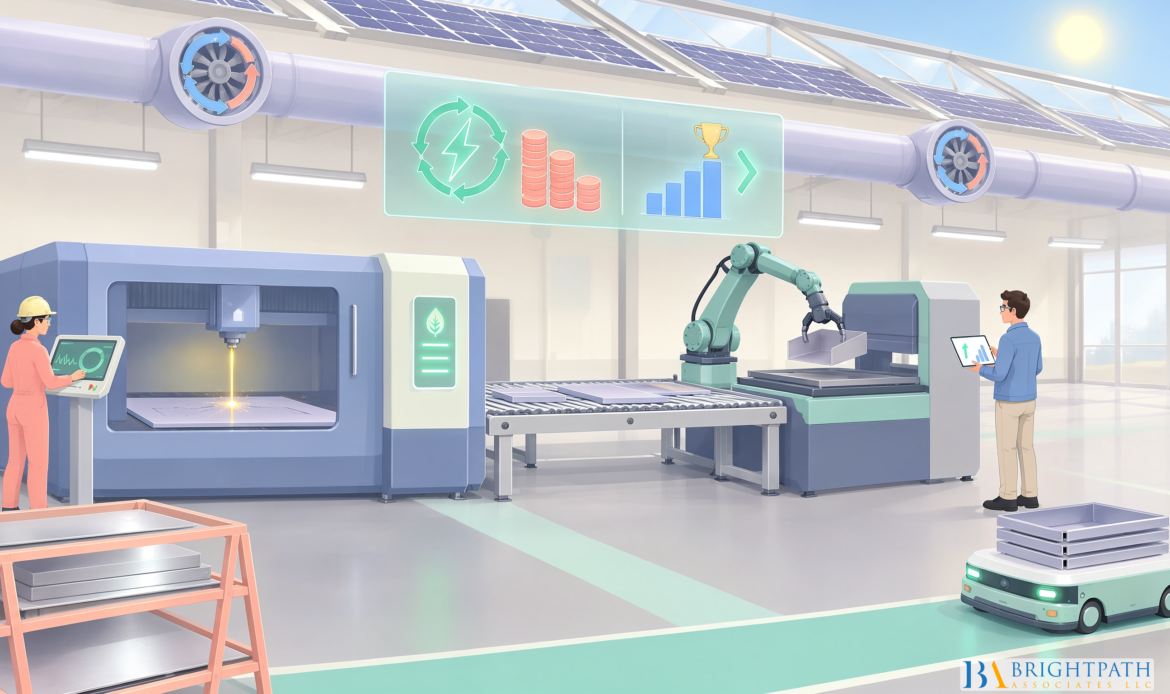
#EnergyEfficiency as a Competitive Edge: Reducing Operational Costs in Metalworking for Machinery Industry is not mainly about lowering utility bills. For U.S. machinery manufacturers, the stronger business case is often better cost control per good part, fewer wasteful machine hours, more reliable production planning, and improved margin discipline.
Energy savings matter, but percentage reductions alone can mislead. A project that cuts a machine’s electricity use by 15% may still have limited financial value if the machine runs infrequently or electricity is a small share of the total cost of precision machining. The practical question is not, “How much energy can we save?” It is, “Will this change total operating cost enough to justify capital, labor, downtime, and production risk?”
Table Of Contents
• Where Metalworking Energy Costs Actually Matter
• Measure Cost Per Good Part Before Buying Technology
• Prioritize Projects by Financial Impact and Production Risk
• Key Takeaways
• Frequently Asked Questions
• Resources And Citations
Where Metalworking Energy Costs Actually Matter
Separate Machine Energy From Total Manufacturing Cost
#CNCMachining, stamping, forging, grinding, welding, and heat related operations do not share the same energy profile. That distinction matters when leaders decide where to invest.
In precision machining, a spindle may receive the most attention, yet cutting is only one part of the load. Pumps, coolant circulation, chip conveyance, hydraulic systems, controls, cooling equipment, and idle states can consume electricity before a tool touches material and after cutting ends. Research on machine tools notes that cooling, coolant, and hydraulic systems can be major energy consumers; one optimized machine configuration was modeled to save up to 50% under stated operating assumptions, not as a universal plant benchmark. The Twin-Control machine-tool study is useful precisely because it directs attention to auxiliary loads rather than promising that every machine can achieve the same result.
For metal-forming operations, the bigger opportunities may sit outside an individual machine. Furnace operation, compressed air, water systems, material handling, scrap, maintenance, and inventory practices can have more financial weight than a small improvement in spindle power. That is why leaders should avoid treating “metalworking” as one energy problem.
| Operation Type | Likely Cost Focus | Common Efficiency Question | Main Risk If Misjudged |
|---|---|---|---|
| CNC machining | Idle loads, coolant, hydraulics, cycle time | Which subsystem raises cost per part? | Spending on monitoring that cannot pay back |
| Forging and forming | Thermal systems, compressed air, material flow | Can process and utility savings be combined? | Missing large plant-wide opportunities |
| Stamping | Press utilization, air, lubrication, scheduling | Is downtime creating avoidable energy use? | Reducing availability in pursuit of savings |
| Additive metal production | Build strategy, powder handling, post-processing | Does energy reduction also reduce rework? | Ignoring quality and finishing costs |
For a broader view of manufacturing technology choices, executives may also consider how innovations transforming the metal processing sector affect material yield, automation, maintenance needs, and workforce requirements.
The Competitive Metric Is Energy Per Good Part
Facility level utility data can show that total consumption rose or fell. It cannot explain whether a specific job became more competitive. A better operating metric is energy per good part:
Energy per good part = energy used for the job ÷ conforming parts produced
This measurement should be segmented by material, machine family, batch size, part complexity, tolerance, and shift where practical. A titanium aerospace component and a mild steel production part should not be compared as though they have the same cutting load or inspection burden.
Energy per good part also prevents a common mistake: celebrating lower machine energy while scrap rises. If a parameter change cuts power consumption but increases defects, extra setup time, or tool wear, the plant may use less electricity and still lose money. Automated production planning research shows that energy reduction between operations can interact with accuracy and defect risk. The AAAI analysis of automated planning supports treating scheduling as a quality and production-control decision, not merely an energy tactic.
Why Percentage Savings Can Be a Trap
A stated 10% or 20% reduction sounds compelling until it is translated into dollars. NIST reported that, in two CNC machining case studies, potential monetary savings were too small to justify real-time energy tracking under the conditions tested. NIST’s CNC energy-monitoring proceedings paper is an important corrective to the assumption that more data is always economically valuable.
That does not make monitoring unhelpful. It means the metering cost, software cost, implementation time, analytical labor, and expected response must be sized to the opportunity. A high-utilization machine cell with costly auxiliary loads may justify detailed monitoring. A lightly used machine with low annual electricity spend may not.
Measure Cost Per Good Part Before Buying Technology
Start With a Decision-Sized Baseline
We recommend starting with enough measurement to answer a capital question, not collecting data simply because #IndustrialAutomationSolutions make it possible. The baseline should cover representative production periods, including setup, warm-up, cutting, idle time, cleaning, and planned stops.
A useful baseline includes the following:
• Machine runtime, idle time, and powered-off time
• Kilowatt-hours by machine or cell where financially material
• Output, scrap, rework, cycle time, and tool changes
• Electricity tariff, including demand charges or time-sensitive rates where applicable
• Maintenance events, warm-up requirements, and quality exceptions
• Labor, tooling, material, and downtime costs affected by the proposed change
The aim is to identify a controllable loss. For example, a CNC cell may appear energy intensive because it operates long hours. Submetering may instead show that a coolant pump runs at full load during idle periods, or that compressed-air leakage keeps compressors cycling overnight. Those are different problems with different remedies.
Use a Threshold-Based Investment Screen
A credible business case should calculate annual savings in dollars, not just kilowatt-hours. It should also identify what must be true for those savings to occur.
| Decision Factor | What To Calculate | When It Supports Investment | When To Pause |
|---|---|---|---|
| Annual energy savings | Reduced kWh × applicable electricity cost | Savings are material relative to capital cost | Energy spend is too low to move margins |
| Implementation cost | Equipment, installation, integration, training | Costs are known and operational disruption is limited | Vendor estimate excludes plant labor or downtime |
| Production impact | Cycle time, uptime, quality, tool life | Pilot confirms output and quality are stable | Change creates repeatability or warm-up problems |
| Measurement cost | Meters, software, data support, engineering time | Data will drive repeated decisions across many assets | Data will only document an obvious low-value issue |
| Lifecycle cost | Maintenance, replacement parts, service needs | Efficient equipment remains reliable over time | Savings disappear under maintenance burden |
A simple screen is:
Annual net benefit = energy savings + avoided operating cost − annualized project, maintenance, and production-risk costs
Then compare the result with the full installed cost and your required return on investment. Fair warning: a short modeled payback can become weak if a project requires a long shutdown, a control-system retrofit, or retraining that interrupts production.
Know When Real-Time Monitoring Is Worth It
Real-time monitoring is strongest when operators and engineers can act on the data. It can support alarm limits, machine-state analysis, preventive maintenance, load balancing, production scheduling, and verification of savings after a retrofit.
It is less compelling when the response is unclear. If a plant already knows that a machine should be shut down after a shift, expensive second-by-second monitoring may not add much value. A lower-cost temporary meter study may be enough to confirm the opportunity.
A sensible sequence is:
- Review utility bills, operating hours, and the largest energy-consuming processes.
- Conduct temporary machine or cell measurements to isolate significant loads.
- Test operating changes before buying permanent controls or analytics software.
- Install continuous monitoring only where the plant can sustain decisions and actions from the data.
- Verify savings using the same production and tariff assumptions used in the original business case.
This staged approach is especially relevant for small and mid-sized manufacturers, where engineering capacity is limited and every improvement project competes with customer delivery priorities.
Prioritize Projects By Financial Impact And Production Risk
Address Auxiliary Loads Before Chasing Fine-Tuned Cutting Gains
Cutting parameters matter, but they are not automatically the first place to invest. Adjusting speed, feed, depth of cut, or toolpath may reduce energy per cycle, yet it can also affect tool life, surface finish, chip control, and cycle time. The right setting is the one that improves total cost per good part, not the one that produces the lowest instantaneous power reading.
Auxiliary loads often provide a less disruptive path. Consider coolant pumps with fixed speed operation, #HydraulicSystems that stay energized during long idle periods, poorly maintained chiller controls, or compressed-air systems operated above necessary pressure. These projects can reduce non-processing energy without changing the validated machining recipe.
The project should still be tested. Turning off a machine between short jobs may save electricity but create warm-up delays, dimensional drift, or accelerated component wear. The correct policy may be a defined idle mode, not an automatic shutdown rule.
Look Beyond Individual Machines
A plant-wide assessment can reveal savings that machine-level projects miss. At Metaldyne’s Royal Oak facility, the U.S. Department of Energy Industrial Technologies Program identified more than 11 million kWh in potential annual electricity savings and more than $12.6 million in potential annual energy and operating-cost savings. The Metaldyne plant-wide assessment identified 21 recommendations, including compressed-air measures, while also considering process and operating-cost opportunities.
That case should not be used as a benchmark for a typical CNC job shop. It was a specific forging-related facility assessment. Its real lesson is strategic: energy, water, waste, process flow, inventory, maintenance, and labor decisions often overlap. Leaders who examine each budget in isolation may miss the larger savings case.
Edge devices can help capture machine-state and process data closer to equipment, but technology should follow the operating question. The discussion of how edge computing helps reduce mill energy waste is relevant when plants need faster visibility into machine conditions and utility waste, not merely another dashboard.
Procurement, Talent, And Operating Discipline
Energy efficiency also changes leadership requirements in the industrial machinery industry. The best improvement programs usually require coordination among operations, maintenance, manufacturing engineering, finance, procurement, and plant leadership. A machine purchase decision should include expected duty cycle, auxiliary-load design, service access, controls compatibility, operator needs, and lifecycle cost.
This is where hiring and leadership planning intersect with manufacturing efficiency. A maintenance leader who understands machine reliability but not energy data may overlook controllable loads. An automation leader who understands data systems but not machining constraints may recommend controls that interfere with production. The goal is not to find a single “energy executive.” It is to build a leadership team that can connect capital decisions to shop-floor realities.
Additive methods can also alter the equation by changing material use, tooling needs, and post-processing work. The implications of 3D printing in metal manufacturing should be assessed through total production economics rather than electricity consumption alone.
Key Takeaways
• Treat energy efficiency as a margin and production-control issue, not just a sustainability initiative.
• Measure energy per good part alongside scrap, cycle time, uptime, tooling, and labor.
• Translate percentage savings into annual dollars before approving a project.
• Prioritize auxiliary systems and plant-wide opportunities when they offer lower production risk than cutting-parameter changes.
• Use temporary measurement first when the value of permanent monitoring is uncertain.
• Test shutdown and idle strategies against warm-up, maintenance, dimensional control, and delivery commitments.
• Build cross-functional accountability across operations, maintenance, engineering, finance, and procurement.
Frequently Asked Questions
How Much Energy Does A CNC Machine Use While Cutting Versus Idling?
It depends on the #MachineArchitecture, spindle load, coolant system, hydraulics, operating schedule, and auxiliary equipment. A machine can use substantial energy while idle because controls, pumps, cooling, and hydraulic functions may remain active. Measure representative machine states rather than relying on a generic estimate.
Which Metalworking Systems Usually Offer The Fastest Payback?
Compressed-air leaks, unnecessary pressure, long idle operation, oversized auxiliary systems, and poorly controlled coolant or hydraulic loads may offer attractive opportunities because they can often be improved without changing the core production process. Actual payback depends on usage, electricity rates, installation cost, and operating risk.
Is Cutting-Parameter Optimization More Valuable Than Coolant Or Hydraulic Improvements?
Not always. Cutting optimization can improve energy use and cycle time, but it may affect quality and tool life. Coolant or hydraulic improvements may be more attractive when auxiliary loads run for long periods and can be reduced without altering validated machining parameters.
How Should A Manufacturer Calculate Energy Cost Per Good Part?
Divide the energy used for a defined job or production window by the number of conforming parts produced. Include setup, idle, and support energy if those loads are within the decision boundary. Track scrap and rework separately so low energy use does not hide poor #ProductionEconomics.
When Does Real-Time Energy Monitoring Pay For Itself?
It pays when the data identifies repeatable actions that produce savings greater than the cost of meters, software, engineering time, and maintenance. It may not pay when machine electricity spend is small or when the plant already knows the operational fix. NIST’s case studies show why this decision needs dollar-based screening.
Should Machines Be Shut Down Between Jobs?
Only after testing the effect on restart time, temperature stability, maintenance, control reliability, and delivery performance. For brief gaps, a managed idle state may be safer than full shutdown. For long nonproduction periods, shutdown may be appropriate if procedures protect machine health and job readiness.
How Can Energy Savings Be Achieved Without Reducing Throughput?
Focus first on waste that does not create customer value: idle auxiliary loads, leaks, avoidable warm-up time, inefficient sequencing, and equipment running outside required operating conditions. Pilot changes against cycle time, quality, tool wear, and uptime before standardizing them.
Resources And Citations
• NIST — Proceedings paper on energy monitoring in CNC machining
• BrightPath Associates: Innovations Transforming the Metal Processing Sector
Find your next leadership role in Machinery Industry today!
Stay informed with the latest insights on Machinery Industry!