
Introduction
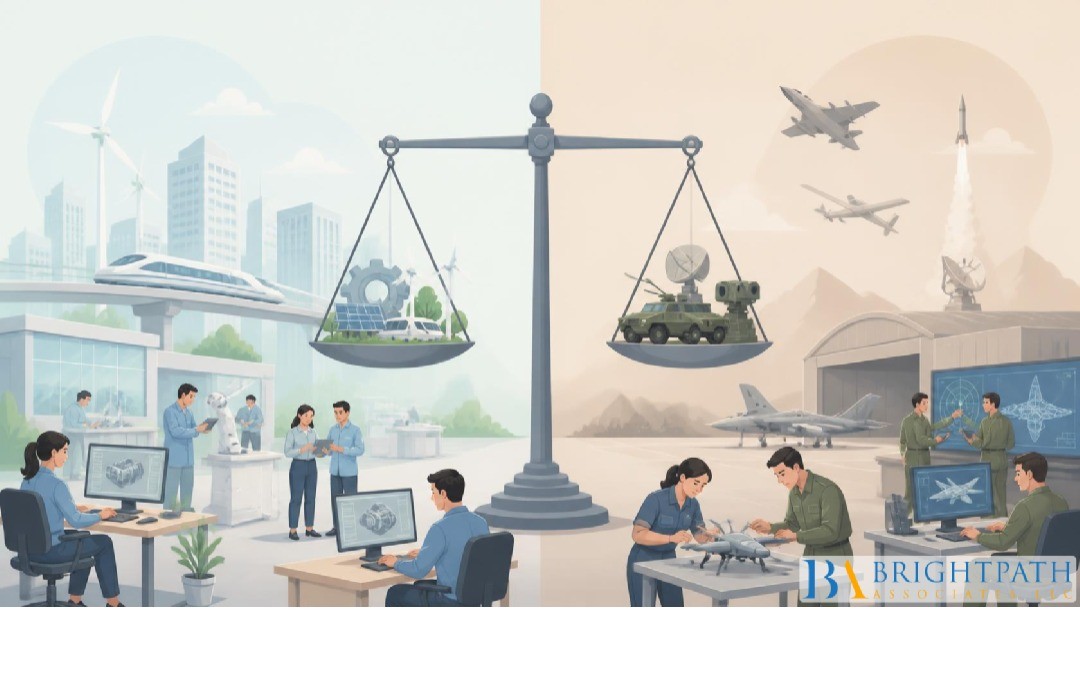
The boundary between commercial aerospace and #DefenseTechnology is becoming increasingly difficult to define. Technologies originally developed for military applications are finding their way into commercial markets, while innovations created for civilian industries are increasingly being adapted for national security and defense requirements. This convergence has created a powerful opportunity for manufacturers, technology companies, engineering firms, and investors, but it has also introduced a complex strategic dilemma: how can organizations successfully serve both commercial and defense markets without compromising their priorities, compliance obligations, or long-term competitiveness?
The dual-use model is particularly significant across aerospace, space technology, electronics, robotics, cybersecurity, simulation, and advanced manufacturing. Companies that can develop technologies with applications across multiple markets can potentially diversify revenue, accelerate innovation, and increase resilience against fluctuations in individual sectors. However, commercial and defense customers operate under fundamentally different purchasing models, regulatory expectations, risk profiles, and decision-making structures.
As aerospace industry trends continue to evolve, companies must therefore develop strategies that recognize the opportunities of dual-use technology while managing its operational and regulatory complexity.
Dual-use technology refers to products, systems, software, components, or capabilities that can serve both civilian and military purposes. The concept is not new, but its importance has increased as technological boundaries have blurred. Artificial intelligence, satellite communications, autonomous systems, advanced materials, sensors, robotics, and high-performance computing can all support commercial applications while also providing significant defense capabilities.
For manufacturers, the attraction is clear. Developing a platform that can serve multiple markets allows companies to spread research and development costs across a broader customer base. Commercial revenues can support technology development while defense contracts provide opportunities for specialized applications and long-term government relationships.
The challenge is that the two markets often demand different approaches. Commercial customers typically prioritize cost, scalability, speed, customer experience, and return on investment. Defense customers place greater emphasis on security, reliability, mission assurance, regulatory compliance, resilience, and strategic capability. Successfully serving both requires an operating model capable of accommodating these differences without creating unnecessary complexity.
Defense Space Policy and the Changing Market Environment
The growing importance of space infrastructure has made Defense Space Policy a critical consideration for companies operating in the aerospace and space sectors. Governments increasingly view space capabilities as essential to communications, navigation, intelligence, surveillance, weather monitoring, and national security.
This changing environment is creating opportunities for companies that can provide technologies with both civilian and defense applications. Commercial satellite platforms, launch technologies, communications infrastructure, Earth observation systems, and space-based data services may increasingly become part of broader national security ecosystems.
At the same time, organizations must understand that participation in defense-related markets can introduce additional regulatory, security, procurement, and export-control requirements. A company that begins as a commercial technology provider may discover that entering defense markets requires substantial changes to governance, documentation, cybersecurity, supplier management, and product architecture.
Strategic leadership must therefore evaluate defense opportunities not simply according to revenue potential, but according to their implications for the entire organization.
The development of Defense Space Systems illustrates how commercial innovation is reshaping defense capabilities. Smaller satellites, reusable launch technologies, advanced sensors, cloud computing, and commercially developed communications platforms are changing the economics and speed of space programs.
Commercial companies can often innovate faster than traditional government contractors because they operate with shorter development cycles and more flexible investment structures. This has encouraged defense organizations to engage with startups and commercial technology providers rather than relying exclusively on traditional defense manufacturing models.
For companies entering this market, however, scalability becomes essential. A technology that performs effectively in a commercial environment may need substantial modification to satisfy defense requirements. Reliability under extreme conditions, secure communications, redundancy, supply-chain assurance, and long-term support can become essential components of the product.
The most successful dual-use companies therefore design commercial products with future defense requirements in mind rather than attempting to retrofit defense capabilities after commercialization.
Space Cybersecurity as a Strategic Requirement
Cybersecurity has become one of the most important considerations in the dual-use technology ecosystem. As satellites, spacecraft, ground stations, manufacturing systems, and communications networks become increasingly connected, the potential attack surface expands.
#SpaceCybersecurity must address not only software vulnerabilities but also communication links, onboard systems, ground infrastructure, supply chains, and operational processes. A commercial company entering the defense market may face cybersecurity expectations significantly beyond those encountered in ordinary commercial contracts.
This creates both a challenge and an opportunity. Companies that incorporate security into product development from the beginning can differentiate themselves from competitors. Secure-by-design architectures, resilient communications, identity management, data protection, and continuous monitoring can become commercial advantages as customers across industries become more concerned about cyber risk.
For dual-use companies, cybersecurity should therefore be treated as a business capability rather than simply an IT function.
Robotics represents another major area of convergence. Space Robotics can support satellite servicing, inspection, assembly, exploration, logistics, and maintenance. Similar technologies can also be adapted for industrial automation, hazardous environments, logistics, and defense operations.
The commercial development of autonomous robotic systems can help reduce the cost of developing advanced defense capabilities. At the same time, defense requirements can push robotics companies toward greater reliability, autonomy, and resilience.
The challenge lies in determining how much customization is appropriate. Excessive defense-specific customization can increase engineering costs and make commercial products less scalable. Conversely, designing solely for commercial applications may limit the technology’s ability to meet defense requirements.
A modular architecture can provide a strategic middle ground, allowing companies to maintain a common technology platform while adapting specific capabilities for different customers.
Space Electronics and the Importance of Supply-Chain Resilience
Space Electronics form the technological foundation of many modern aerospace systems. Sensors, processors, communications equipment, power systems, control electronics, and other components must perform reliably in demanding environments.
The strategic importance of these components has increased because global supply chains can create vulnerabilities. Dependence on limited suppliers or geographically concentrated production can create risks for both commercial and defense customers.
Companies operating in this space need to consider supplier diversification, component traceability, quality control, domestic manufacturing capabilities, and long-term availability. Defense customers may place particularly strong requirements on sourcing and supply-chain assurance.
This is where defense manufacturing capabilities can complement commercial production. Investments in advanced manufacturing, quality systems, testing, and traceability can strengthen a company’s position across both markets.
Several Aerospace industry trends are accelerating the dual-use business model. Commercial space activity is expanding, satellite constellations are becoming more sophisticated, autonomous systems are advancing, and data generated from space assets is becoming increasingly valuable.
At the same time, governments are seeking faster access to emerging technologies. Instead of developing every capability internally, defense organizations increasingly recognize the value of commercial innovation.
This convergence creates opportunities for companies that can operate between traditional aerospace and technology ecosystems. However, companies must avoid assuming that success in one market automatically translates into success in the other.
Commercial aerospace companies must understand government procurement cycles, defense contracting structures, compliance requirements, and security expectations. Defense-oriented organizations, meanwhile, may need to develop stronger commercial sales capabilities and customer-centric product strategies.
Space Venture Capital and the Funding Equation
Capital availability is another important factor influencing the dual-use ecosystem. #SpaceVentureCapital has increasingly supported startups developing launch systems, satellite platforms, propulsion technologies, communications, robotics, Earth observation, and space infrastructure.
For investors, dual-use companies can be attractive because they have the potential to access multiple markets. A commercial business model can provide near-term revenue opportunities while defense applications can create additional growth avenues.
However, investors increasingly need to understand the strategic implications of government dependence. A company that relies heavily on defense contracts may face long procurement cycles and concentration risk. Conversely, a company focused entirely on commercial customers may miss opportunities created by government demand.
The strongest investment strategies often favor companies with flexible technology platforms and diversified customer bases.
Regulation is one of the most important barriers to successful dual-use expansion. Space Regulatory requirements can affect licensing, technology transfers, exports, communications, data management, manufacturing, and international partnerships.
Companies operating across commercial and defense markets must build regulatory awareness into product development and corporate strategy. Compliance cannot be treated as an administrative activity that occurs after a product has been designed.
Early regulatory assessment can help companies determine which markets are accessible, which technologies require controls, and how products should be structured. It can also prevent expensive redesigns and delays later in the commercialization process.
Organizations that develop strong regulatory capabilities can turn compliance into a competitive advantage by demonstrating reliability and market readiness to customers and partners.
Defense Simulation and the Commercialization of Advanced Technologies
Simulation technologies provide another bridge between commercial and defense markets. Defense Simulation can support training, mission planning, system testing, operational analysis, and scenario development. Similar technologies are increasingly used in commercial aerospace, manufacturing, logistics, and engineering.
Digital twins, virtual environments, artificial intelligence, and high-performance computing allow organizations to test complex systems without relying entirely on physical prototypes.
For dual-use companies, simulation platforms can become highly scalable technology assets. A common software architecture can support different customer applications while reducing development costs.
The key is maintaining flexibility. Companies should develop simulation platforms that can be configured for specific use cases without requiring complete redevelopment for every customer.
The transition into defense markets often requires significant changes in manufacturing operations. Defense manufacturing places considerable emphasis on quality, traceability, documentation, security, and consistency.
Commercial manufacturers accustomed to high-volume production may need to adapt to lower-volume, highly customized programs. Conversely, defense manufacturers attempting to enter commercial markets may need to improve cost efficiency, production scalability, and customer responsiveness.
A flexible manufacturing strategy can bridge this gap. Digital production systems, automated inspection, advanced planning, modular manufacturing, and strong supplier relationships can help companies manage different customer requirements without creating fragmented operations.
The goal should be to build a manufacturing platform capable of supporting both market segments while maintaining consistent quality and economic discipline.
Leadership and Executive Search Recruitment in Dual-Use Industries
Technology alone cannot solve the dual-use dilemma. Leadership capability is equally important. Companies operating across commercial and defense markets need executives who understand technology, regulation, government procurement, manufacturing economics, and commercial growth.
This makes #ExecutiveSearchRecruitment particularly important for organizations navigating dual-use expansion. The right leadership team must be capable of balancing competing priorities while creating a unified strategic direction.
A defense executive may understand government procurement but lack commercial market experience. A commercial technology executive may excel at scaling products but have limited familiarity with defense regulations. Companies therefore need leaders who can bridge these worlds.
The ability to recruit executives with cross-sector experience can become a significant competitive advantage as aerospace and defense markets increasingly converge.
Successful dual-use companies should avoid treating commercial and defense markets as completely separate businesses. Instead, they should identify the technology, infrastructure, talent, and capabilities that can create value across both.
A shared technology foundation can reduce research and development costs. Modular product architectures can allow customization without excessive engineering. Common manufacturing platforms can improve asset utilization. Strong cybersecurity and regulatory systems can strengthen credibility across markets.
Most importantly, leadership should establish clear strategic boundaries. Not every defense opportunity is commercially attractive, and not every commercial opportunity aligns with a company’s long-term defense strategy.
The objective is not to pursue every available market. It is to identify where commercial and defense capabilities reinforce one another.
Conclusion
The convergence of commercial and defense markets is creating one of the most significant industrial opportunities across aerospace and advanced technology. From Defense Space Systems and Space Robotics to Space Electronics, cybersecurity, simulation, and advanced manufacturing, technologies increasingly have applications across multiple sectors.
Yet dual-use growth requires more than technical innovation. Companies must understand Defense Space Policy, manage Space Regulatory requirements, strengthen Space Cybersecurity, build resilient supply chains, and develop flexible manufacturing capabilities. They must also understand Aerospace industry trends and carefully evaluate funding opportunities through Space Venture Capital.
Ultimately, the companies best positioned for long-term success will be those that treat dual-use capability as a strategic operating model rather than simply a sales opportunity. With the right technology architecture, regulatory discipline, manufacturing flexibility, investment strategy, and leadership talent, organizations can serve commercial and defense customers without sacrificing scalability or innovation.
As the distinction between civilian and defense technology continues to narrow, the ability to operate successfully across both markets may become one of the defining competitive advantages of the next generation of aerospace and industrial companies.
Find your next leadership role in Defense and Space Industry today!
Stay informed with the latest insights on Defense and Space Industry!