
Introduction
For decades, measuring stacked logs and timber has depended on a familiar tool: the manual tape measure. While simple and inexpensive, this approach can become increasingly inefficient as #ForestryOperations, sawmills, and wood product manufacturers handle larger volumes of material. Manual measurement requires workers to physically access log stacks, take multiple measurements, record the results, and later convert those measurements into usable production or inventory data. Every additional step creates an opportunity for inconsistency, delay, or human error.
Digital log-stack measurement is changing this process by combining imaging systems, sensors, computer vision, and data analytics to estimate stack dimensions and calculate timber volumes more efficiently. Instead of relying entirely on physical measurement, modern systems can capture detailed digital information without requiring workers to climb, walk around, or repeatedly measure individual sections of a stack.
This shift is part of a broader movement toward Forest product innovation, where technology is being used to improve productivity, traceability, resource utilization, and sustainability across the forest-products value chain. As the industry adopts more connected equipment and automated workflows, digital measurement is becoming an important component of modern forestry and wood processing.
The Limitations of Manual Log Measurement
Manual tape measurement appears straightforward, but large-scale operations reveal its limitations quickly. Measuring a substantial log stack may require workers to access several points along the pile, determine its length, height, and depth, and account for irregularities within the stack. Logs are rarely positioned perfectly, meaning the resulting volume calculation often depends on estimates and assumptions.
Worker consistency is another challenge. Two employees may measure the same stack differently, particularly when the stack has uneven edges or contains logs of different diameters. Environmental conditions can also complicate the process. Rain, snow, poor lighting, unstable terrain, and restricted access can make manual measurement slower and less reliable.
The issue becomes more significant when measurements are used for inventory management, purchasing, production planning, or financial reporting. A small measurement discrepancy multiplied across hundreds of stacks can create substantial differences in reported timber volumes.
For companies monitoring Lumber industry trends, these inefficiencies are increasingly difficult to ignore. Greater demand for accurate inventory information, improved resource utilization, and faster production cycles is encouraging businesses to consider alternatives to traditional measurement practices.
How Digital Log-Stack Measurement Works
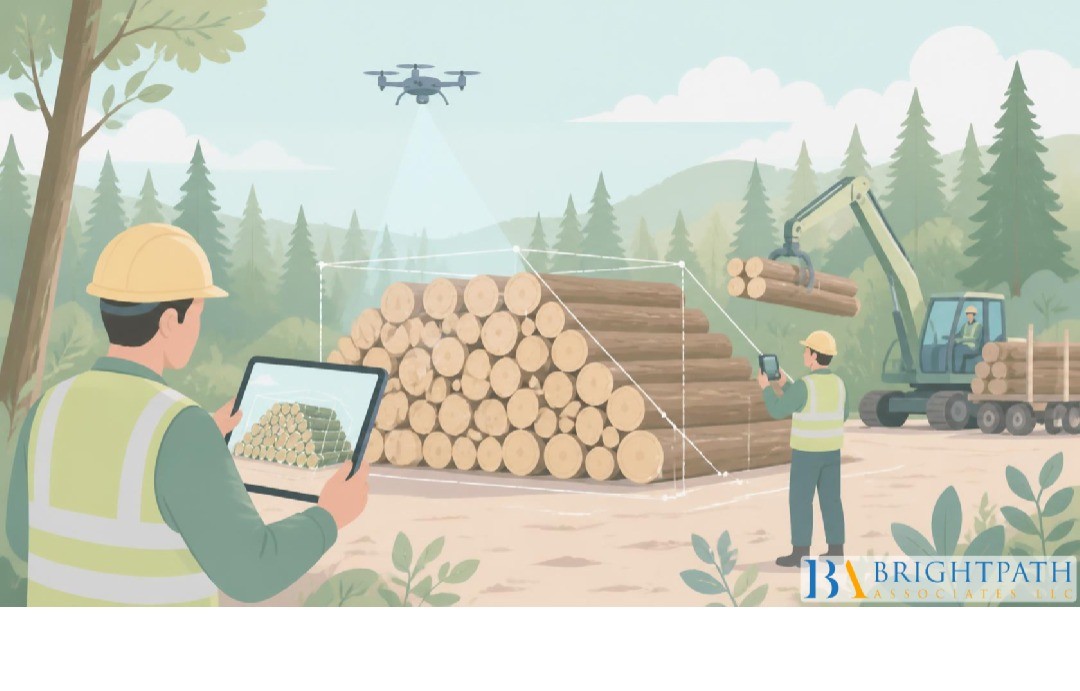
#DigitalMeasurementSystems generally use cameras, laser-based technologies, depth sensors, drones, or other imaging technologies to capture information about a log stack. Software then processes the collected data to determine dimensions, identify log boundaries, and estimate volume.
Computer vision is particularly important in this process. Advanced algorithms can analyze images to distinguish individual logs or recognize the overall structure of a stack. Depth information can provide additional context, allowing systems to understand the three-dimensional characteristics of the pile.
The objective is not simply to take a digital photograph of timber. The real value comes from converting visual information into measurable data. A digital system can potentially calculate stack length, height, estimated depth, visible log characteristics, and total volume while reducing the amount of manual intervention required.
The resulting data can also be integrated into inventory management and production systems. This creates a connection between physical timber and digital records, helping organizations develop more accurate and accessible information about their raw-material inventories.
Connecting Digital Measurement with Timber Harvesting
The benefits of digital measurement extend beyond the sawmill. Timber harvesting generates enormous amounts of information, including the location, quantity, type, and destination of harvested material. Capturing reliable volume information at different stages can help organizations improve planning and reduce discrepancies between expected and actual timber yields.
When digital measurement is incorporated into harvesting workflows, operators can create more consistent records of material entering the supply chain. This can support transportation planning by improving estimates of how much material needs to be moved. It can also help mills prepare for incoming timber by providing better visibility into available inventory.
Digital measurement may also contribute to more responsible resource utilization. When companies have clearer information about the quantity of timber being processed, they can better evaluate material losses, production efficiency, and recovery rates.
This is increasingly relevant as Forestry regulations place greater emphasis on responsible harvesting, documentation, traceability, and environmental accountability. Reliable digital records can help organizations demonstrate how timber moves through their operations while supporting internal compliance processes.
The Role of Automation in the Paper Industry
The move toward digital log measurement is part of a much larger transformation involving Automation in #PaperIndustry operations. Paper and pulp producers increasingly use sensors, machine vision, robotics, artificial intelligence, and industrial data platforms to improve production efficiency.
Raw-material measurement is an important starting point because inaccurate input information can affect downstream processes. If a facility does not have a clear understanding of its available wood inventory, planning production becomes more difficult. Digital measurement can provide more timely information, allowing procurement, production, and inventory teams to make decisions using current data rather than outdated manual records.
The development of Paper and pulp technology is also encouraging stronger integration between physical operations and digital systems. Modern mills are moving toward connected environments in which machines continuously generate information about production conditions, material flows, quality, and equipment performance.
Digital log-stack measurement fits naturally into this ecosystem. Instead of treating measurement as an isolated task, companies can incorporate it into a broader digital workflow.
Improving Paper Recycling Solutions Through Better Data
Although log-stack measurement primarily concerns virgin timber, its importance extends to the wider resource-efficiency conversation. Better measurement and inventory management can help companies understand how much raw material enters production and how efficiently that material is converted into finished products.
This data-driven approach complements the development of Paper recycling solutions, where manufacturers are seeking better ways to recover, process, and reuse fiber. Accurate information about virgin and recycled material flows can support more informed decisions about resource allocation.
The broader objective is to create production systems that minimize waste while maximizing the useful value obtained from every unit of raw material. Digital measurement does not solve the challenges of recycling on its own, but it contributes to the information infrastructure needed for more efficient material management.
Supporting Sustainable Materials and Resource Efficiency
The forest-products industry is under increasing pressure to demonstrate responsible resource use. Consumers, regulators, investors, and business customers are paying closer attention to sustainability, while manufacturers are looking for ways to reduce waste and improve operational efficiency.
Digital measurement can contribute to these objectives by reducing unnecessary physical inspections and improving inventory accuracy. When organizations know more precisely what material they have available, they can make better decisions about purchasing, processing, storage, and transportation.
This supports the wider adoption of #SustainableMaterials and more efficient manufacturing practices. Better data can also help companies identify where material losses occur and evaluate opportunities to improve recovery rates.
Sustainability in the forest-products sector is not simply about replacing one material with another. It also involves using existing resources more intelligently. Digital measurement provides one technological pathway toward that objective.
Digital Measurement and Wood Product Manufacturing
For organizations involved in Wood product manufacturing, accurate timber volume information can influence everything from procurement to production scheduling. Sawmills need to understand incoming log inventories before determining how material should be processed. Manufacturers producing lumber, panels, engineered wood, and other products depend on predictable raw-material flows.
Digital measurement can reduce the administrative burden associated with collecting this information. Instead of handwritten measurements being transferred between employees and databases, measurement results can potentially move directly into digital systems.
This can shorten reporting cycles and reduce opportunities for transcription errors. It can also make historical data easier to analyze, allowing managers to compare inventory levels, supplier deliveries, production consumption, and material recovery over time.
The result is a more connected operating environment in which measurement becomes part of decision-making rather than simply a compliance or administrative task.
Understanding the Economics Behind Digital Adoption
Technology adoption ultimately depends on economics. A digital measurement system requires investment in hardware, software, integration, training, and maintenance. Companies therefore need to determine whether the operational benefits justify the expense.
The answer can become clearer when viewed through the lens of #PaperIndustryEconomics and the economics of the broader forest-products sector. Labor availability, material costs, transportation expenses, inventory carrying costs, and production efficiency all influence profitability.
A measurement technology that saves only a few minutes per stack may not provide enough value for a small operation. However, when thousands of measurements are performed annually, improvements in speed and accuracy can become financially meaningful.
Digital measurement may also generate indirect benefits. Better inventory visibility can reduce unnecessary material purchases, improve transportation planning, support production scheduling, and identify discrepancies earlier. These cumulative improvements can strengthen the business case for automation.
What This Means for the Future of the Lumber Industry
The future of the lumber sector is likely to involve greater integration between physical operations and digital information. Sensors, artificial intelligence, machine vision, automated sorting, predictive analytics, and connected machinery are already changing how wood is harvested and processed.
Digital log-stack measurement represents a relatively practical entry point into this transformation. Companies do not necessarily need to automate their entire operation at once. Improving one repetitive, measurement-intensive process can provide a foundation for broader digitalization.
As Lumber industry trends continue toward automation and data-driven decision-making, measurement accuracy will become increasingly important. Companies that can establish reliable digital records of their raw materials will be better positioned to connect procurement, production, inventory, and sustainability reporting.
The Human Role in an Automated Measurement Environment
Automation does not eliminate the importance of #SkilledWorkers. Instead, it changes how their time is used. Employees who previously spent hours taking repetitive measurements can focus more heavily on quality control, equipment supervision, inventory analysis, maintenance, and operational decision-making.
Human oversight remains essential because digital systems can encounter unusual conditions. Irregular stacks, damaged logs, poor lighting, weather interference, or occluded surfaces can affect automated calculations. A strong system therefore combines technology with appropriate human verification rather than assuming that automation is infallible.
Training will also become increasingly important. Workers need to understand how measurement systems operate, how to identify questionable results, and how digital data should be incorporated into operational decisions.
Executive Search Recruitment for a Digital Forest-Products Workforce
Technology transformation also creates new workforce requirements. Forest-products companies adopting digital measurement may need professionals with experience in automation, computer vision, industrial software, data analytics, forestry operations, manufacturing engineering, and supply-chain management.
This is where #ExecutiveSearchRecruitment can become strategically relevant. Companies undergoing digital transformation need leaders who understand both traditional forest-product operations and emerging technologies. Finding professionals who can bridge these disciplines can be challenging because the required combination of industry knowledge and digital expertise is relatively specialized.
Strong leadership can determine whether a technology investment becomes a successful operational transformation or simply another disconnected software or hardware purchase. Executives who understand change management, workforce development, data governance, and industrial technology can help organizations build a sustainable digital strategy.
Conclusion
Digital log-stack measurement represents a significant departure from the traditional tape measure. By combining imaging, sensors, computer vision, and data analytics, it offers forest-product companies an opportunity to make timber measurement faster, more consistent, and better connected to wider operational systems.
Its value extends beyond simply replacing a manual task. Digital measurement can support timber harvesting, inventory management, wood product manufacturing, sustainability initiatives, and the broader modernization of paper and pulp operations. As forestry regulations evolve and businesses face growing pressure to improve resource efficiency, reliable digital data will become increasingly valuable.
The transition will require investment, employee training, technological integration, and thoughtful implementation. Yet the direction is clear. The forest-products industry is moving toward a future in which physical materials are increasingly represented by accurate digital information.
For companies seeking to remain competitive, the question may no longer be whether the manual tape measure works. It is whether relying on it alone makes sense in an industry increasingly defined by automation, sustainability, precision, and data-driven decision-making.
Find your next leadership role in Paper & Forest Products Industry today!
Stay informed with the latest insights on Paper & Forest Products Industry!