
Introduction
#PackagingIndustry is undergoing a fundamental transformation as manufacturers, brands, retailers, and consumers place greater emphasis on sustainability. The traditional approach of designing packaging primarily around cost, performance, appearance, and shelf life is increasingly being expanded to include end-of-life considerations. Products must now be designed with recycling systems, material recovery infrastructure, regulatory expectations, and circularity objectives in mind.
Designing for recyclability is particularly important as companies seek to reduce packaging waste and improve the value of recovered materials. Industry organizations such as the Association of Plastic Recyclers, commonly known as APR, and RecyClass have developed technical guidance to help companies understand how packaging design choices can influence recycling outcomes.
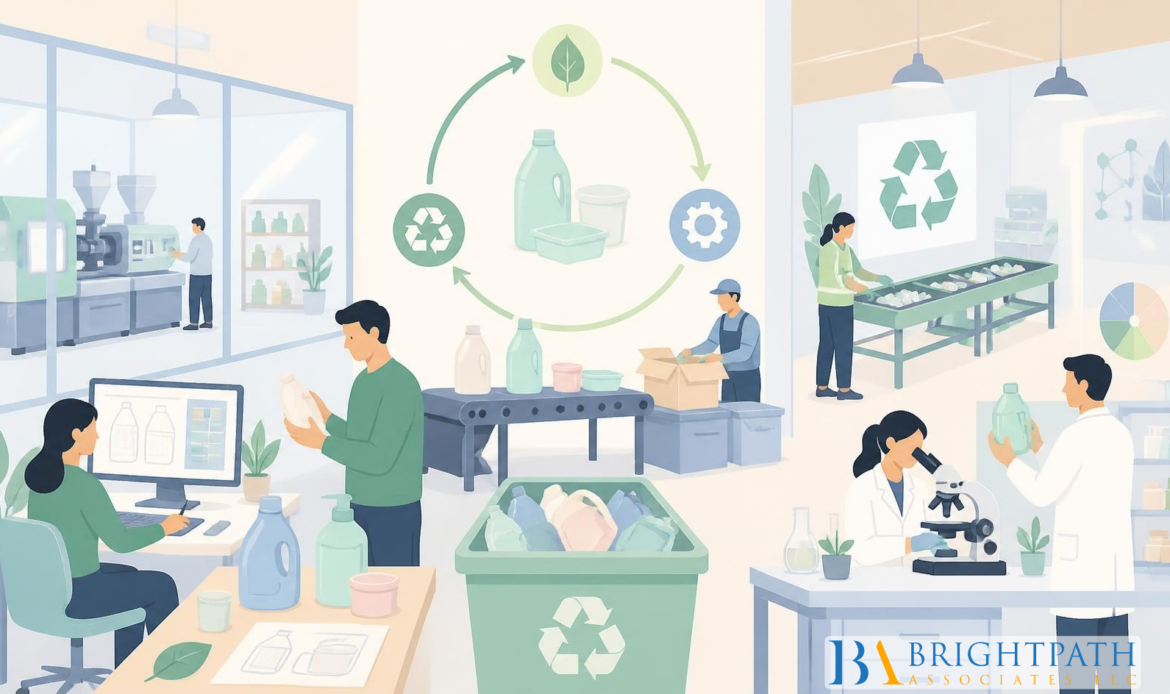
Aligning products with these principles requires more than selecting a recyclable resin. Packaging designers must consider the entire package, including polymers, additives, labels, closures, adhesives, inks, colors, barriers, and other components. This holistic approach is becoming an important part of Circular economy packaging, where materials are designed to remain useful within productive systems for as long as possible.
APR guidelines are widely used within the plastics recycling industry to evaluate packaging designs and their compatibility with established recycling processes. RecyClass similarly provides a framework for assessing the recyclability of plastic packaging, particularly within European recycling systems.
Although regional recycling infrastructure differs, both approaches emphasize a central principle: packaging should be designed in a way that minimizes negative impacts on sorting, washing, reprocessing, and the quality of recycled material.
A package can be technically recyclable while still creating challenges for recycling facilities. For example, certain combinations of materials, labels, adhesives, pigments, or additives may interfere with sorting or processing. Designing according to recognized technical guidance helps companies identify these issues before products reach large-scale production.
This shift makes Sustainable packaging certifications and recyclability assessments increasingly relevant to manufacturers seeking credible sustainability claims.
Designing Around the Primary Packaging Material
The first consideration in recyclable packaging design is the primary material. Designers need to understand whether the selected polymer is commonly collected, sorted, processed, and converted into new products within the intended market.
Material selection should therefore be based on the actual recycling ecosystem rather than theoretical recyclability alone. A material may have favorable laboratory characteristics but limited practical recovery infrastructure in a particular region.
Companies should evaluate how the package interacts with existing recycling streams and whether its structure supports efficient sorting and reprocessing. This is especially important when developing multilayer packaging or combining different polymers to achieve barrier, strength, flexibility, or shelf-life requirements.
A design that simplifies material composition can often make recycling systems easier to manage. However, simplification must be balanced against product protection, safety, functionality, and economic requirements.
Packaging recyclability extends beyond the main container. Labels, closures, adhesives, inks, coatings, and other components can influence how a package performs during recycling.
A container made from a widely recycled polymer may still create processing challenges if an attached component behaves differently during washing, sorting, or reprocessing.
Design teams should therefore assess the complete packaging system rather than evaluating individual components in isolation. Compatibility between the container and its associated components is particularly important when packaging is intended for high-volume consumer applications.
This holistic approach is a defining characteristic of modern Circular economy packaging strategies. Instead of focusing only on how a product performs before purchase, companies increasingly consider what happens after consumers discard it.
The Role of Predictive Analytics in Packaging Design
Digital technologies are helping packaging companies make better design decisions before committing to large-scale production. #PredictiveAnalyticsPackaging applications can analyze historical manufacturing data, material performance, customer requirements, and recycling-related variables to identify potential problems earlier.
Predictive models can support decisions involving material selection, package weight, production parameters, and quality performance. When combined with information about recycling systems, these technologies can help companies evaluate multiple design scenarios before physical prototypes are produced.
The benefit is particularly significant for manufacturers managing complex product portfolios. Digital simulations can reduce the number of physical trials required and help teams identify design trade-offs more efficiently.
As packaging companies pursue Packaging industry digital transformation, predictive analytics is becoming part of a broader ecosystem connecting product development, manufacturing, supply-chain management, and sustainability.
The development of alternative materials has created new opportunities as well as new technical questions. Bioplastic packaging development is attracting interest from companies looking for materials with different environmental characteristics.
However, bio-based content and recyclability are not interchangeable concepts. A material derived partly or entirely from biological sources does not automatically belong in conventional plastic recycling streams.
Packaging developers therefore need to understand the intended end-of-life pathway before selecting a bioplastic. Compatibility with existing collection and recycling infrastructure is an important consideration, particularly for products designed for large consumer markets.
The goal should be to select materials according to the complete environmental and operational requirements of the product rather than relying on a single sustainability characteristic.
Designing for Manufacturing Efficiency
Recyclability must also work within real-world production environments. A packaging design may meet sustainability objectives but create excessive manufacturing complexity if it requires specialized equipment, unusual processing conditions, or frequent production adjustments.
This makes #PackagingMachineryOptimization an important part of sustainable packaging development.
Modern packaging equipment can be configured to improve material efficiency, reduce production waste, increase throughput, and maintain consistent quality. Optimizing machinery around recyclable materials can help manufacturers transition toward more sustainable designs without compromising operational performance.
Digital monitoring can also identify changes in machine performance that affect material consumption or package quality. Integrating equipment data with production-management platforms creates opportunities for continuous improvement.
Packaging design decisions can influence supply-chain performance. Changes in material specifications may affect supplier availability, transportation requirements, production capacity, and costs.
For this reason, recyclability initiatives should be considered alongside Supply chain resilience packaging strategies.
Companies that rely heavily on a single material supplier or specialized packaging component may face disruptions when market conditions change. Designing products around widely available materials and flexible manufacturing processes can improve resilience while supporting sustainability objectives.
Supply-chain teams should collaborate with packaging engineers from the beginning of the design process. This cross-functional approach can help identify material risks before they become production constraints.
Addressing the Packaging Industry Labor Shortage
The transition toward recyclable and digitally optimized packaging also requires new technical capabilities. Companies need professionals who understand materials science, recycling processes, automation, regulatory requirements, sustainability, and manufacturing operations.
However, the Packaging industry labor shortage is making it more difficult for organizations to find professionals with this combination of expertise.
The skills required for modern packaging are becoming increasingly multidisciplinary. Packaging engineers may need to understand recycling compatibility, digital manufacturing, data analysis, and supply-chain considerations. Production managers may need greater knowledge of automation and sustainable material handling.
Companies are therefore investing more attention in workforce development while also seeking specialized talent through Packaging executive search and other executive recruitment strategies.
Leadership for Sustainable Packaging Transformation
Successful packaging transformation requires leadership capable of balancing sustainability objectives with commercial realities. Senior executives must determine how recyclability requirements affect product portfolios, manufacturing investments, supplier relationships, and long-term growth.
Specialized Packaging equipment executive search can help organizations identify leaders with experience in machinery, automation, operations, and packaging technology. These leaders can play an important role in modernizing facilities while maintaining production reliability.
More broadly, #ExecutiveSearchRecruitment is becoming relevant as packaging companies seek executives who can coordinate sustainability, innovation, manufacturing, and supply-chain priorities.
The leadership challenge is not simply to adopt new materials. It is to build organizational systems capable of continuously evaluating packaging performance as regulations, technologies, and recycling infrastructure evolve.
Packaging companies increasingly need reliable data to support sustainability decisions. Digital systems can track material specifications, manufacturing performance, supplier information, quality results, and product changes across the packaging lifecycle.
This is where Packaging industry digital transformation can provide strategic value. Connected systems can create a more complete view of packaging operations and help organizations identify opportunities for material reduction, process optimization, and waste prevention.
Digital traceability can also make sustainability reporting more credible by connecting claims to documented production and material information.
When companies combine digital data with recyclability assessments, they can move from broad sustainability objectives toward measurable packaging-design improvements.
Building a Long-Term Circular Packaging Strategy
Designing for recyclability should not be treated as a one-time compliance exercise. Recycling technologies, collection systems, consumer behavior, regulations, and market expectations continue to evolve.
Companies therefore need a long-term strategy that allows packaging designs to adapt as new information becomes available. Regularly reviewing material specifications, component compatibility, recycling performance, and manufacturing efficiency can help organizations remain aligned with industry expectations.
A strong circular strategy also requires collaboration across the value chain. Packaging producers, brand owners, recyclers, resin suppliers, equipment manufacturers, retailers, and policymakers all influence how effectively packaging moves through recovery systems.
This collaborative approach strengthens the broader circular economy by connecting product design decisions with real-world end-of-life outcomes.
Conclusion
Aligning packaging with APR and RecyClass principles requires a shift in how products are designed. Recyclability must be considered from the earliest stages of material selection and package development rather than added after production decisions have already been made.
Companies need to evaluate primary materials, labels, closures, adhesives, colors, coatings, manufacturing processes, and end-of-life pathways as part of one integrated system. At the same time, technologies such as #PredictiveAnalyticsPackaging, advanced automation, and digital manufacturing can help improve decision-making and operational efficiency.
The transition also depends on people. Addressing the Packaging industry labor shortage, developing technical expertise, and recruiting experienced leaders through Packaging executive search, Packaging equipment executive search, and Executive Search Recruitment can help organizations manage increasingly complex packaging requirements.
Ultimately, recyclable packaging is not simply about choosing a different material. It is about designing products with their entire lifecycle in mind. By combining recognized recyclability guidance with smart material selection, supply-chain planning, manufacturing optimization, digital technologies, and strong leadership, packaging companies can create solutions that are more compatible with recycling systems while remaining commercially and operationally viable.
Find your next leadership role in Packaging and Containers Industry today!
Stay informed with the latest insights on Packaging and Containers Industry!