
Introduction
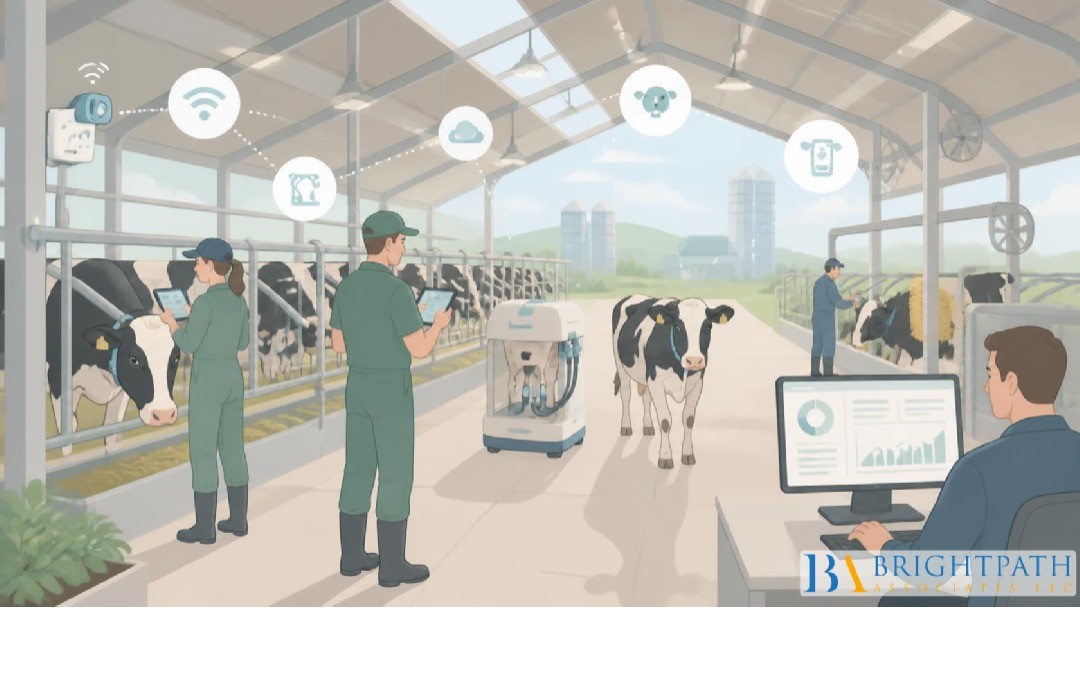
Connectivity has become the defining advantage in modern #DairyOperations, not because hardware is unimportant, but because hardware without data flow is an isolated asset. Many farms have invested in sensors, milking equipment, and automated feeders, yet still struggle to translate these purchases into consistent gains in labour efficiency, animal performance, and profitability. The shift to Dairy 4.0 reframes the barn as a connected system in which information moves as reliably as milk, enabling managers to coordinate people, animals, machines, and inputs with far greater precision.
In an industrial context, barn efficiency is no longer measured only by throughput or the newest machinery on the floor. It is increasingly defined by how quickly a farm can detect deviation, respond with confidence, and learn from outcomes across seasons. Connectivity makes those capabilities routine by integrating Milk production technologies, Dairy automation technologies, and operational records into a unified decision environment. This is also why the topic matters beyond the farm gate: dairy processors, retailers, and new Dairy e-commerce channels depend on predictable supply, consistent quality, and transparent practices that begin in the barn. Dairy products compete in a market where reliability and traceability are strategic, and connectivity is the infrastructure that supports both.
This article examines why the most effective modernization programs emphasize integration, data governance, and smart systems, and how that emphasis improves herd management, labour use, sustainability, and long-term competitiveness. It also considers the organizational implications of this shift, including the growing role of Food technology expertise and the increasing demand for specialized leadership and talent, from Dairy industry executive search to broader Executive Search Recruitment aligned to digital operations.
From Mechanization to Connected Operations
For decades, dairy modernization followed a predictable arc: mechanize a task, then automate it. Milking systems reduced manual labour; feeding systems increased consistency; barn climate controls stabilized animal comfort. These were foundational improvements, but they often created islands of automation. Each system generated its own data, tuned its own logic, and required a specialized routine to keep it running. The result was a barn filled with capable machines, yet limited situational awareness across the entire operation.
Dairy industry digital transformation changes the unit of improvement from the device to the workflow. Instead of asking whether a new robot increases milking capacity, managers increasingly ask whether data from that robot can be connected to health monitoring, ration formulation, reproduction planning, and inventory systems so that actions are coordinated. When connectivity is designed into the architecture, the farm reduces friction between tasks and departments, and the business can respond to variability in feed quality, weather, labour availability, and market demand with less waste and fewer surprises.
This transformation is not about turning the barn into a laboratory. It is about ensuring that daily operational signals are captured, standardized, and shared so that each decision is made with the full context of the system. In the same way that industrial plants rely on SCADA, historians, and integrated maintenance systems to stabilize performance, the connected dairy relies on integrated data pipelines to stabilize production and animal outcomes. The hardware remains essential, but connectivity defines whether that hardware delivers strategic returns.
Connectivity as the New Utility in the Barn
In practical terms, connectivity is the utility that allows dairy operations to treat information as a managed resource. It starts with reliable networks and extends to consistent interfaces between systems, standardized identifiers for animals and events, and operational rules about how data is validated and used. Without these fundamentals, farms risk producing large volumes of data that cannot be trusted or compared, which can be worse than having no data at all because it creates false confidence or decision paralysis.
When connectivity is robust, farms can create near-real-time visibility into animal status, equipment condition, and production performance. A manager can see not only yesterday’s yield, but also how changes in cow activity, rumination, feed intake proxies, and #EnvironmentalConditions are trending. These insights become actionable when they are integrated with workflows. A health alert that triggers a standardized check, an inventory threshold that adjusts a purchase order, or a maintenance signal that schedules service before a failure are all examples of connectivity turning information into controlled action.
This approach also supports resilience. Farms operate in environments where unexpected events, from heat stress spikes to equipment breakdowns, can cascade quickly. Connectivity reduces the time between detection and response, which reduces losses. It also creates institutional memory: the operation can track interventions and outcomes, enabling continuous improvement rather than repeating the same troubleshooting cycle each year.
Integration Beats Standalone Performance
It is easy to overestimate what any single device can accomplish on its own. A sensor can detect a condition; a robot can execute a task; a software dashboard can display metrics. But efficiency gains become durable when these elements are integrated into a system that supports decision-making at multiple levels, from the technician’s routine to the owner’s capital planning. Integration means that animal, equipment, and inventory data can be aligned by time and context, allowing farms to understand cause and effect rather than relying on intuition alone.
Consider the operational chain from feeding to milk yield. If feed deliveries, ration changes, and mixing accuracy are recorded and time-stamped, and those records can be linked to milk output and health indicators, the farm gains a clearer view of which changes improve performance and which introduce risk. That capability is a direct expression of connectivity. It is also a competitive advantage because it supports more stable production and better cost control, both of which influence margins in volatile input markets.
Integration also supports Dairy supply chain management by improving predictability and traceability. When production and quality signals are captured consistently, farms can coordinate more effectively with processors and transport partners. Over time, this alignment contributes to stronger commercial relationships and can open opportunities in premium programs that require documented practices. For farms looking at Dairy industry growth strategies, connectivity becomes a platform for scaling, because it allows a larger herd and more complex operations to be managed with controlled processes rather than heroic effort.
Data Flow and Decision-Making at Herd Scale
Herd management is fundamentally a problem of variability. Each cow is a production unit with biological complexity, and the herd is a portfolio of risk and opportunity. Connectivity improves herd management by ensuring that observations are captured consistently and shared across roles. Instead of one person noticing a trend and another person acting without full context, the connected system creates a shared operational picture that aligns decisions.
This is where modern Milk production technologies deliver their best value. Automated milking, activity monitoring, and inline #MilkAnalysis can provide high-frequency signals, but their impact depends on how the farm translates signals into prioritized actions. Connectivity allows these signals to be enriched with other data, such as lactation stage, health history, breeding plans, and environmental conditions. The result is better triage: the farm can focus labour on the animals that will benefit most from intervention, reducing unnecessary handling while improving welfare and productivity.
Decision-making improves further when farms move beyond simple alerts and adopt analytics that capture trends, correlations, and leading indicators. A connected environment makes it possible to compare cohorts, evaluate protocol changes, and identify operational bottlenecks. This is not about replacing experience; it is about supporting experience with evidence that is timely and specific. In industrial terms, connectivity turns herd management into a controlled process rather than a reactive one.
Labour Efficiency Through Coordination, Not Just Automation
Labour constraints are one of the most pressing realities in modern agriculture. Dairy automation technologies help reduce manual workload, but farms often discover that the labour challenge is less about the number of tasks and more about the coordination of tasks. Connectivity addresses this by organizing work around real operational needs rather than routine assumptions. When systems share data, the farm can schedule checks, treatments, and maintenance based on priority and timing, reducing wasted movement and duplicated effort.
A connected barn can also support clearer communication across shifts. When observations, interventions, and results are recorded in a shared environment, teams can hand off work without losing context. This reduces the reliance on informal knowledge transfer, which is fragile in high-turnover conditions. Over time, connectivity supports training and standardization, helping farms maintain performance even as staff changes.
There is also a safety and reliability dimension. When equipment condition data is connected to maintenance planning, farms can reduce emergency repairs and the associated disruptions. Predictive maintenance is not exclusive to large industrial plants; it becomes accessible in dairy when devices, service records, and usage patterns are connected. The labour benefit is not only fewer hours spent fixing breakdowns, but also fewer production interruptions and less stress on both people and animals.
Connectivity Enables Sustainable Performance, Not Just Compliance
Sustainability is increasingly central to dairy competitiveness, driven by customer expectations, processor programs, and regulatory pressure. Sustainable dairy farming practices depend on measurement and control, and connectivity is what makes measurement reliable at operational scale. When feed usage, energy consumption, water utilization, manure handling, and production outputs are connected, farms can calculate performance indicators with greater accuracy and act on them with clearer accountability.
Connectivity also improves the efficiency of resource use. Precision feeding supported by connected records can reduce overfeeding and nutrient excretion while maintaining production. #EnvironmentalMonitoring can reduce heat stress through targeted ventilation and cooling strategies, improving both welfare and output. These improvements are not cosmetic; they affect cost structure and risk exposure. They also strengthen a farm’s ability to participate in differentiated programs that reward documented improvements in emissions intensity or animal welfare outcomes.
From a Food technology perspective, connectivity strengthens the credibility of claims by improving traceability from barn practices to product outcomes. As dairy products diversify and consumers demand more transparency, connected operations can provide more robust documentation without creating an administrative burden that undermines productivity. The key is that sustainability becomes a performance program supported by operational data, not a separate reporting activity that competes with daily priorities.
Scaling Growth Strategies With Digital Foundations
Growth in dairy is rarely linear. Expanding herd size, adding sites, or diversifying products introduces complexity that can overwhelm traditional management methods. Dairy industry growth strategies that succeed over the long term typically rely on repeatable processes, reliable metrics, and a strong operating culture. Connectivity supports all three by creating a common operational language across assets and locations.
When systems are integrated, managers can benchmark performance across groups, identify where protocols diverge, and apply improvements systematically. This is particularly important for multi-site operations, where inconsistent data structures can prevent meaningful comparison. A connected foundation also supports capital planning by revealing which constraints are operational, which are biological, and which are equipment-related. That clarity leads to better investment decisions because farms can prioritize projects that eliminate true bottlenecks rather than simply adding capacity.
Connectivity also affects market strategy. As Dairy e-commerce expands and customer expectations evolve, the ability to support differentiated offerings, consistent quality, and transparent sourcing becomes increasingly relevant. Even when farms do not sell directly to consumers, they operate within a value chain that is becoming more digital and more data-driven. Farms with connected operations are better positioned to meet new requirements, respond to audits efficiently, and collaborate with partners in a more integrated Dairy supply chain management model.
Talent, Leadership, and the New Competitive Gap
Dairy 4.0 is as much a leadership challenge as a technology challenge. Connectivity requires decisions about standards, governance, and long-term architecture, and these decisions shape whether an operation becomes more agile or more fragmented over time. The most successful farms treat connectivity as a strategic capability with clear ownership, rather than as a collection of vendor installations. This creates demand for a hybrid skill set that combines operational credibility with digital fluency.
As a result, specialized hiring is becoming more common, especially in larger enterprises and progressive cooperatives. Roles that bridge operations, data, and technology are increasingly important, and the market for these profiles is tightening. This is one reason Dairy industry executive search has become more relevant to modern operations. Whether the goal is to hire a COO who can scale connected workflows or a technology leader who can integrate platforms without disrupting production, leadership selection becomes a strategic lever in digital transformation.
#ExecutiveSearchRecruitment in the dairy sector also reflects the broader convergence of agriculture and Food technology. As farms adopt integrated platforms, analytics, and automation, they require leadership that can manage vendors, oversee cybersecurity basics, and build operational discipline around data quality. The competitive gap will increasingly separate operations that can attract and retain this leadership from those that cannot, regardless of the quality of their physical assets.
The Path Forward: Designing for Interoperability and Trust
Connectivity delivers value when it is designed for interoperability and trust. Interoperability ensures that devices and software can exchange data without expensive custom work that breaks during upgrades. Trust ensures that the data is accurate, timely, and understood consistently by everyone who uses it. Farms that rush into purchases without a connectivity plan often end up with duplicated records, inconsistent identifiers, and dashboards that disagree. These problems can quietly erode confidence and push teams back to manual workarounds.
A more durable approach begins with mapping the workflows that matter most, such as health checks, feeding, reproduction management, milk quality monitoring, and maintenance. Once these workflows are clear, farms can define what data is needed, where it should originate, and how it should be validated and shared. Connectivity then becomes a disciplined infrastructure program. Over time, this discipline enables more advanced capabilities, including better forecasting, scenario planning for input changes, and more robust performance benchmarking across time and sites.
This design mindset also protects long-term flexibility. Technology will continue to evolve, and farms should expect to replace components over time. A connected architecture reduces switching costs because it decouples operational workflows from any single device. That is the strategic difference between owning equipment and owning capability. In volatile markets, capability is what allows operations to adapt without sacrificing stability.
Conclusion: Efficiency Is a System Property
Modern barn efficiency is no longer a function of owning the most advanced hardware. It is a system property created by connectivity, integration, and disciplined data flow. Milk production technologies and Dairy automation technologies remain essential building blocks, but their returns depend on whether the farm can connect signals to decisions and decisions to standardized action. Connectivity improves herd management by providing context and enabling timely intervention. It improves labour efficiency by coordinating work, strengthening shift continuity, and reducing disruptions through better maintenance planning. It supports Sustainable dairy farming practices by turning measurement into operational control rather than administrative overhead. And it strengthens competitiveness by enabling scalable Dairy industry growth strategies and more integrated Dairy supply chain management in a value chain that is rapidly digitizing, including the rise of Dairy e-commerce expectations and transparency requirements.
The shift to #DairyIndustry digital transformation also highlights a new truth: strategy, leadership, and talent are as important as equipment. Farms that invest in connectivity as a deliberate capability, and that secure the right leadership through approaches such as Dairy industry executive search and broader Executive Search Recruitment, will be better positioned to translate technology into consistent performance. In Dairy 4.0, the barn is no longer just a place where machines operate; it is an information-driven production system. The farms that win will be those that treat connectivity not as an accessory, but as the operating backbone of modern efficiency.
Find your next leadership role in Dairy industry today!