
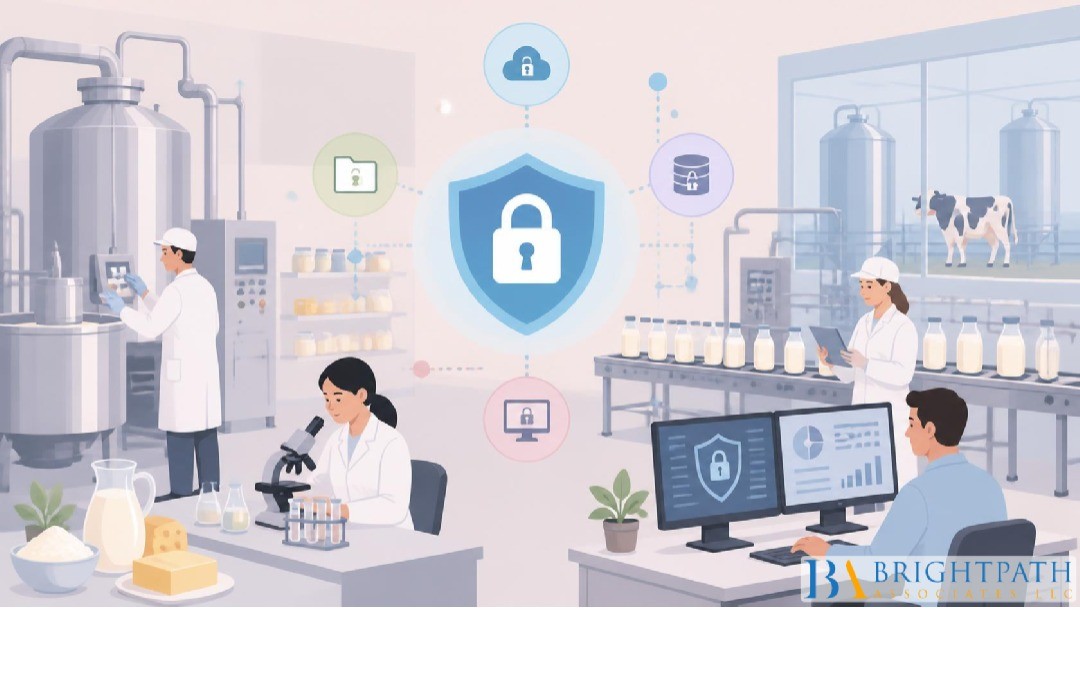
The modern #DairyProcessingFacility is no longer powered solely by stainless-steel tanks, refrigeration systems, filling lines, and skilled production teams. Behind today’s dairy operation is a growing digital infrastructure connecting manufacturing equipment, laboratory systems, enterprise software, supply-chain platforms, customer databases, production records, and cloud-based applications. This transformation has created new opportunities for efficiency and innovation, but it has also introduced a growing cybersecurity challenge.
Dairy processors increasingly hold valuable digital assets, including proprietary formulations, product specifications, supplier information, production schedules, quality-control records, pricing strategies, customer data, and intellectual property. A cyberattack that compromises these assets can create consequences extending far beyond an IT department. Production interruptions, intellectual-property theft, contaminated data, regulatory complications, and supply-chain disruptions can affect profitability and customer confidence.
As Dairy products become increasingly differentiated and technology-driven, protecting the information behind those products is becoming just as important as protecting the physical manufacturing process. Cybersecurity should therefore be considered a core component of operational resilience and long-term dairy industry strategy.
Why Dairy Processing Is Becoming a Cybersecurity Target
Food manufacturing facilities are attractive targets because they combine valuable commercial information with highly connected operational technology. A modern dairy processor may operate automated production lines, digital quality systems, warehouse-management platforms, refrigeration controls, laboratory software, and remote equipment-monitoring systems.
Each connected system potentially creates another pathway that must be secured.
For dairy businesses, the risk is not limited to someone stealing a recipe. Attackers may attempt to disrupt production, obtain employee credentials, access financial information, compromise supplier relationships, or interfere with operational systems. Even an attack that does not directly target production equipment can create delays if critical business applications become unavailable.
The increasing digitization of Dairy products manufacturing therefore requires executives to think about cybersecurity as part of overall business continuity.
Recipes and formulations can represent some of the most valuable intellectual property owned by a dairy company. Specialized yogurt formulations, cheese-processing methods, nutritional compositions, ingredient ratios, flavor profiles, and processing parameters may have been developed through years of research and investment.
If this information is stolen, the competitive impact can be significant.
Companies should identify where proprietary formulas are stored, who can access them, how information is transferred, and whether third-party partners have access to sensitive documentation. Access should be limited according to business requirements rather than convenience.
Digital recipe-management systems can improve consistency and production control, but they must also be properly protected. Strong authentication, role-based permissions, secure backups, and monitoring can help reduce the likelihood of unauthorized access.
Protecting intellectual property should be treated as an ongoing process rather than a one-time technology investment.
Digital Transformation Is Reshaping Dairy Operations
#DairyIndustry digital transformation is connecting previously separate areas of the business. Production information can flow into enterprise systems, inventory data can influence procurement, and customer demand can affect manufacturing schedules.
This connectivity can produce significant operational advantages.
However, it also means that a disruption in one digital system may affect several other processes. A compromised production-management platform, for example, could create consequences for inventory, scheduling, distribution, and customer fulfillment.
Executives should therefore understand how systems depend on one another. Cybersecurity assessments should consider not only individual applications but also the connections between them.
The objective is to build a digital environment that remains functional and recoverable even when individual systems experience problems.
Dairy Automation Technologies Create New Security Requirements
Dairy automation technologies are helping processors improve consistency, productivity, quality control, and resource utilization. Automated equipment can monitor temperatures, control processing conditions, manage filling and packaging, and collect production data.
Yet automation also increases the number of connected devices within a facility.
Older industrial systems may not have been designed with today’s cybersecurity threats in mind. Some equipment may depend on outdated software or require vendor access for maintenance.
Dairy processors should maintain an inventory of connected equipment and understand how these systems communicate. Remote access should be carefully controlled, particularly when external vendors can connect directly to production environments.
Automation should improve resilience, not create a single point of failure.
Cybersecurity considerations begin upstream of the processing facility. Milk production technologies are generating increasingly detailed information about production volumes, quality, herd performance, equipment conditions, environmental conditions, and logistics.
This information can help dairy organizations improve efficiency and make more informed decisions.
At the same time, the growing volume of digital information creates additional security responsibilities. Data moving between farms, processors, laboratories, distributors, and technology providers needs appropriate protection.
The connection between farm-level systems and processing facilities means cybersecurity should extend across the broader dairy ecosystem.
Companies should understand which external systems exchange information with their operations and determine whether those connections create material security risks.
Food Technology and the Digital Dairy Factory
#FoodTechnology is becoming increasingly sophisticated. Sensors, analytics, laboratory systems, machine learning, automated quality inspection, and connected manufacturing platforms are changing how dairy companies develop and produce food.
These technologies can provide better visibility into production and quality.
However, data integrity is essential. If production information is altered, deleted, or manipulated, employees may make decisions based on inaccurate information. In a food-processing environment, unreliable data can have consequences for quality assurance and operational decision-making.
Cybersecurity should therefore include measures that protect the integrity and availability of production data, not just the confidentiality of information.
Sustainable Dairy Farming Practices Depend on Reliable Data
Sustainability initiatives increasingly rely on accurate data. Sustainable dairy farming practices may involve monitoring energy use, water consumption, emissions, feed efficiency, waste, transportation, and resource utilization.
Dairy companies may use digital systems to collect and analyze this information.
If sustainability data is compromised, organizations could face reputational and reporting challenges. Customers, investors, and business partners increasingly expect companies to support environmental claims with credible information.
Protecting sustainability-related data can therefore strengthen both operational transparency and corporate credibility.
Cybersecurity and sustainability may appear to be separate priorities, but digital systems increasingly connect the two.
Dairy supply chain management involves a complex network of farmers, ingredient suppliers, packaging manufacturers, logistics providers, distributors, retailers, technology vendors, and other partners.
Digital connections between these organizations improve visibility and coordination but also introduce third-party risk.
A dairy processor may maintain strong internal security while remaining vulnerable through a compromised supplier account or external software platform.
Businesses should therefore evaluate the cybersecurity practices of strategically important suppliers. Vendors with access to sensitive data or operational systems deserve greater scrutiny than suppliers with limited digital interaction.
Contracts can also establish expectations regarding data protection, access controls, incident notification, and cybersecurity responsibilities.
Supply-chain resilience increasingly depends on digital resilience.
Protecting Dairy E-Commerce Platforms
Dairy e-commerce is creating new opportunities for brands to reach consumers directly. Online ordering, subscription models, digital loyalty programs, and direct-to-consumer channels can generate valuable customer insights.
They also involve sensitive information.
Customer names, addresses, payment-related information, purchasing histories, and preferences require appropriate protection. A data breach can damage consumer confidence and create significant financial and reputational consequences.
Dairy businesses expanding into digital commerce should therefore ensure that cybersecurity is incorporated into platform design and vendor selection.
Customer convenience should never come at the expense of #CustomerTrust.
Cybersecurity and Dairy Industry Growth Strategies
Dairy industry growth strategies increasingly involve technology. Companies may expand production capacity, introduce new products, enter new markets, develop direct-to-consumer channels, automate facilities, or acquire technology-enabled businesses.
Each growth initiative can change the organization’s cybersecurity profile.
A new manufacturing facility introduces new networks and equipment. An acquisition may bring legacy systems. International expansion may create new data and regulatory requirements. An e-commerce strategy may introduce customer-facing digital infrastructure.
Cybersecurity should therefore be incorporated into strategic planning before growth initiatives are implemented.
Executives who consider cybersecurity only after technology has been deployed may find it more expensive and disruptive to address vulnerabilities later.
Sophisticated technology cannot eliminate every cybersecurity risk. Employees remain an important part of an organization’s security environment.
Phishing emails, stolen passwords, social engineering, unauthorized software, and accidental disclosure can expose sensitive information.
Training should be practical and relevant to employees’ responsibilities. Production workers, office employees, engineers, laboratory teams, managers, and executives may face different types of cybersecurity risks.
A strong culture encourages employees to report suspicious activity quickly. Employees should understand that early reporting can prevent a small incident from becoming a major operational problem.
Cybersecurity is ultimately a shared responsibility.
Preparing for Operational Disruption
Even organizations with strong cybersecurity controls need a response plan. #DairyProcessors should know what happens if a critical production system becomes unavailable.
Business continuity planning should identify essential processes, recovery priorities, communication procedures, and alternative operating arrangements.
The goal is not necessarily to maintain normal production during every incident. Instead, the objective is to restore critical operations as safely and quickly as possible.
Backup systems are particularly important. However, backups must themselves be protected. If attackers can compromise production systems and their backups simultaneously, recovery becomes significantly more difficult.
Regular testing can help organizations determine whether their recovery plans actually work under realistic conditions.
Leadership Is Becoming a Cybersecurity Requirement
As dairy companies become more digitally connected, cybersecurity decisions increasingly involve executive leadership. Investments in automation, data systems, cloud technology, e-commerce, and production analytics can create business value while also creating new risks.
Leaders need to understand the balance.
This makes talent particularly important. Dairy businesses may need executives who understand manufacturing operations while also appreciating cybersecurity, digital transformation, data governance, supply-chain management, and technology investment.
Dairy industry executive search can help organizations identify leaders with this increasingly valuable combination of capabilities. Traditional dairy expertise remains essential, but future leadership teams may need stronger digital and risk-management competencies.
#ExecutiveSearchRecruitment can support this transition by helping companies identify senior professionals capable of connecting operational strategy with technology and organizational resilience.
One common misconception is that cybersecurity slows innovation. In reality, strong security can enable companies to adopt new technologies with greater confidence.
A dairy processor that has clear security standards can evaluate new automation systems, cloud platforms, analytics applications, and connected equipment more effectively.
Security requirements should therefore be incorporated into innovation processes from the beginning.
When companies consider cybersecurity during technology selection, they can avoid some of the costly problems associated with retrofitting security into systems that were never designed for it.
The goal should be secure innovation rather than innovation followed by security.
Building a More Resilient Dairy Industry
The #DairySector is entering an increasingly connected era. From farms and milk collection to processing, packaging, distribution, retail, and e-commerce, digital technologies are becoming part of nearly every stage of the value chain.
This transformation creates enormous opportunities for efficiency, product innovation, sustainability, and customer engagement.
It also creates new responsibilities.
Dairy companies must protect proprietary formulas, operational data, customer information, supplier relationships, and digital infrastructure. They must understand their technology dependencies and prepare for potential disruptions.
Cybersecurity should therefore become part of the broader conversation about dairy competitiveness.
The Strategic Future of Dairy Cybersecurity
The future of the dairy industry will be shaped by technology, consumer expectations, sustainability, automation, and increasingly data-driven decision-making. Companies that successfully combine these capabilities can improve productivity while developing stronger relationships with customers and business partners.
But digital growth must be accompanied by digital protection.
For dairy executives, the central question is no longer simply whether the organization has implemented modern technology. The more important question is whether that technology has been designed, managed, and protected in a way that supports long-term business resilience.
Protecting a proprietary formula is important, but modern dairy cybersecurity goes far beyond recipes. It means protecting the entire digital ecosystem that allows the business to produce, monitor, market, distribute, and improve its products.
As Dairy products manufacturers continue adopting advanced Food technology, Dairy automation technologies, connected Milk production technologies, and digital commerce platforms, cybersecurity will increasingly become a strategic business capability.
The companies that recognize this early will be better positioned to innovate confidently, protect their intellectual property, strengthen Dairy supply chain management, support sustainable operations, and pursue ambitious Dairy industry growth strategies.
Ultimately, cybersecurity is not simply about preventing an attack. It is about protecting the knowledge, systems, people, and relationships that allow a dairy business to compete in an increasingly digital marketplace.
Find your next leadership role in Dairy Industry today!