
Introduction
#ColdChain failure is rarely dramatic. It is usually a quiet drift: a dock door left open five minutes too long, a reefer unit cycling at the wrong setpoint, a pallet parked in the warmest corner of a trailer, or a compressor that is “mostly fine” until it is not. The result is the same—inventory that looks acceptable on arrival, then degrades rapidly in storage or on shelf, triggering write-offs, chargebacks, and brand damage that can take quarters to unwind.
Cold chain intelligence changes the economic equation by turning temperature-sensitive logistics into a measurable, controllable process. With IoT sensors feeding real-time visibility into product and equipment conditions, organizations can move from reactive claims management to proactive prevention—detecting excursions early, isolating root causes, and standardizing corrective actions across sites. Done well, this is not a gadget program; it is Industrial automation applied to quality and risk, built on data discipline and Control systems thinking.
The Spoilage Problem Is Operational, Not Theoretical
Most cold chain organizations already know the headline risks: temperature excursions, humidity exposure, dwell time, and handling practices. What they often lack is the ability to connect those risks to specific moments and decisions across a distributed network of warehouses, vehicles, and partner facilities. When records are periodic and manual, the story of a spoiled load becomes an argument about responsibility instead of a diagnosis about causality.
IoT sensors shift the discussion from blame to evidence. Continuous readings establish the actual thermal history of a shipment, including micro-events that never appear on a paper log. A short spike during cross-docking may not breach a contractual threshold, yet it can still accelerate quality loss in fresh food, biologics, or specialty chemicals. Cold chain intelligence is the capability to detect those patterns, quantify their impact, and tie them to operational conditions such as door cycles, airflow obstruction, and equipment performance.
This is where the industrial mindset matters. In Manufacturing automation, variability is the enemy of yield; in cold chains, variability is the enemy of shelf life. The goal is not to collect data for its own sake, but to reduce the gap between what your process is supposed to do and what it actually does under real-world constraints such as labor turnover, seasonal peaks, and multi-party handoffs.
At a practical level, “intelligence” means three things. First, visibility—knowing the condition of product and assets in near real time. Second, context—understanding where an event happened, what else was occurring, and which constraints applied. Third, actionability—having clear, repeatable responses that reduce the probability and cost of recurrence. Without that third element, sensor programs become expensive thermometers instead of Automation solutions manufacturing for supply chain quality.
From Sensor to Decision: The Architecture That Makes Data Useful
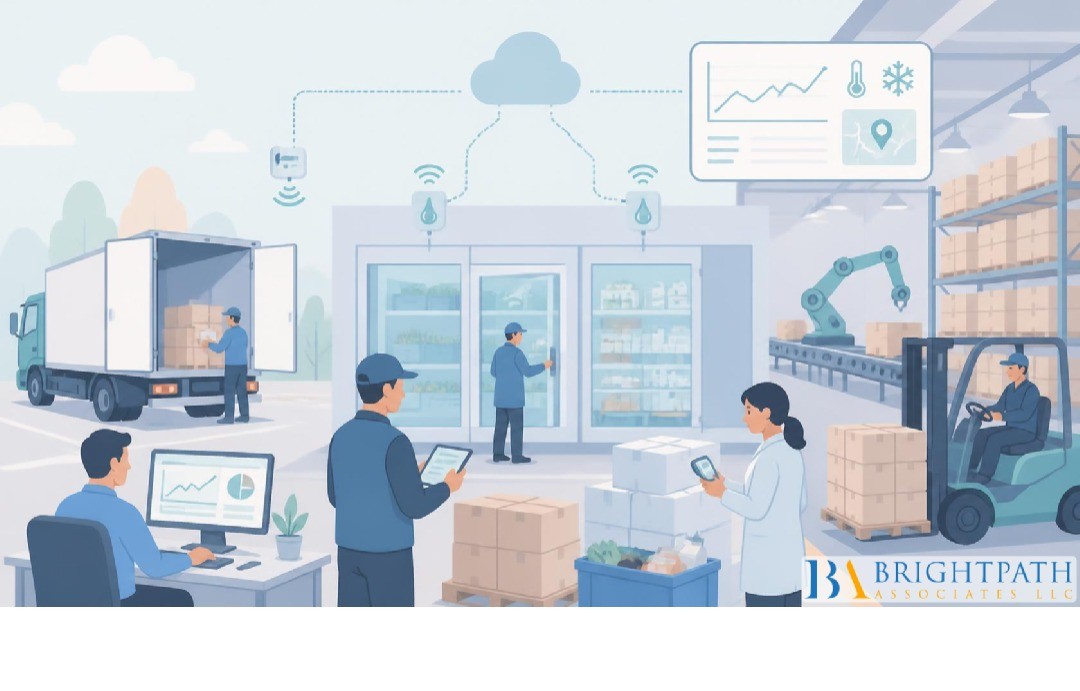
An IoT device in a box is not a system. Preventing spoilage at scale requires a well-designed flow from sensing to interpretation to intervention, aligned with the realities of industrial environments. Temperature and humidity sensors, door and vibration sensors, GPS modules, and power monitors generate a stream of signals. Those signals must be time-synchronized, validated, and translated into events that operations teams can trust.
In many facilities, the bridge between #PhysicalEquipment and digital oversight already exists in the form of SCADA systems. Refrigeration racks, evaporator fans, defrost cycles, and alarm states are typically managed by controllers that expose data points and accept setpoint changes. When IoT sensor insights are integrated with SCADA systems, the organization gains a unified view of both product condition and equipment behavior, allowing teams to distinguish between a “warm pallet” problem and a “failing compressor” problem rather than treating every issue as a customer service incident.
That integration often depends on the unglamorous discipline of Control systems engineering. Legacy controllers, vendor-specific protocols, and site-to-site variation can create data silos that prevent enterprise learning. A robust approach treats the cold chain like a distributed plant: define standard tags, standard event definitions, and standard response playbooks. In that context, a PLC programming service is not just a maintenance line item; it is a mechanism for normalizing how assets report status and how alarms trigger escalations across the network.
When sensor programs succeed, they align with operational thresholds that matter. Instead of a generic alert that “temperature is high,” teams need actionable criteria such as rate-of-rise, duration above limit, and location-specific tolerances based on product class. They also need rules that account for planned exceptions, like brief door openings during picking, so that alerts are meaningful rather than constant noise. This is an Industrial automation problem disguised as a logistics problem: signal-to-noise, human response capacity, and closed-loop control determine whether the data reduces losses or just increases dashboards.
Cold chain intelligence also benefits from interoperability with enterprise workflows. Quality, maintenance, and transportation teams need shared events with consistent IDs, timestamps, and context. When those events integrate into ticketing and CMMS processes, organizations can prove that an excursion was detected, triaged, and corrected, and they can measure the cycle time from detection to stabilization. This is how analytics becomes operational control rather than postmortem reporting.
Preventing Excursions With Automated Responses and Better Handling
Once the sensor-to-decision layer is established, the highest returns come from targeted interventions that prevent small deviations from becoming expensive spoilage. Some interventions are procedural: changing staging rules so pallets do not sit near dock doors, enforcing first-expiring-first-out logic, or standardizing pre-cool requirements before loading. Others are technical: tuning defrost schedules, adding airflow baffles, or replacing door seals that leak warm air into high-value zones. The advantage of IoT-backed operations is that you can prioritize these changes based on measured impact rather than intuition.
Increasingly, organizations are also applying Robotics integration to reduce dwell time and handling variability. Automated guided vehicles and pallet shuttles can move product through temperature-controlled zones with predictable timing, reducing exposure during peak labor constraints. In facilities where human picking is unavoidable, Industrial machine vision can verify that doors are closed, confirm that pallets are properly wrapped and labeled, and detect blocked evaporator airflow caused by incorrect stacking. These technologies are not about novelty; they are about stabilizing the process so product experiences fewer thermal shocks between inbound, storage, and outbound.
The most mature cold chain operations treat excursions as defects with root causes, not as unavoidable “acts of shipping.” They build a prevention loop: detect anomalies early, contain the affected inventory, identify the causal mechanism, and standardize the corrective action across sites. Over time, that loop reduces both the frequency and the severity of incidents. It also strengthens supplier and carrier performance management because the discussion can be grounded in measurable conditions rather than anecdotes.
This is where organizational capability becomes decisive. Cold chain intelligence sits at the intersection of instrumentation, networks, Control systems, and operations execution. Many companies discover that they need skills they did not previously emphasize: OT/IT integration, alarm rationalization, and site-level change management. That talent shift is fueling demand for Automation jobs that blend engineering discipline with operational pragmatism, as well as specialized hiring efforts such as Executive search industrial automation when organizations need leaders who can scale these programs across a footprint.
In parallel, #ExecutiveSearchRecruitment is showing up more frequently in cold chain and logistics organizations because the work resembles plant modernization. Leaders who understand Manufacturing automation can translate sensor insights into standard work, governance, and investment cases that finance teams recognize. They can also set realistic expectations: not every site needs the same hardware on day one, but every site needs the same definitions, thresholds, and accountability so the enterprise can learn as one system.
Conclusion: Spoilage Prevention Is a Control Problem You Can Engineer
IoT sensors prevent costly inventory spoilage when they are deployed as part of a coherent industrial system, not as a stand-alone visibility project. The value is created by connecting continuous condition data to SCADA systems, maintenance workflows, and operational playbooks that reduce variability and speed up response. In other words, cold chain intelligence works when it behaves like Industrial automation: measurable signals, clear thresholds, and disciplined corrective actions that compound over time.
Organizations that approach cold chain modernization with Control systems rigor can turn uncertainty into managed risk. They will invest in the integration layer—sometimes through a PLC programming service—to make data trustworthy, and they will use targeted Robotics integration and Industrial machine vision where it reduces exposure and handling errors. Just as importantly, they will build the people capability to sustain the system, from frontline response to leadership recruited through Executive search industrial automation. In a market where quality failures are expensive and reputational damage is fast, cold chain intelligence is not an optional upgrade; it is an operational advantage engineered into the process.
Find your next leadership role in Industrial Automation Industry today!
Stay informed with the latest insights on Industrial Automation Industry!