
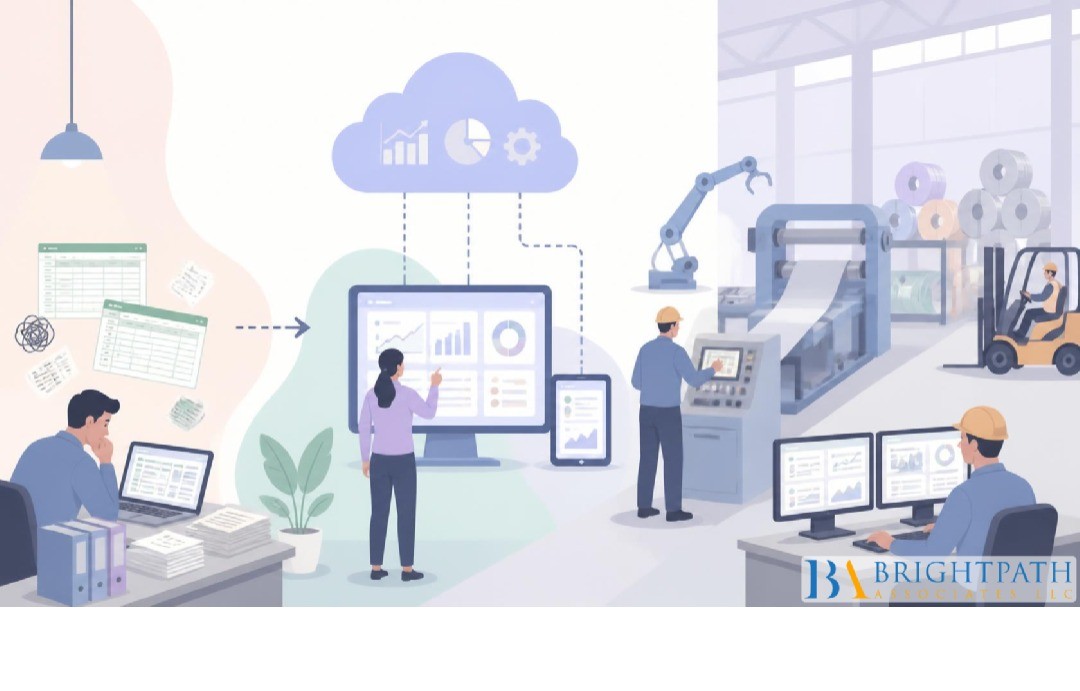
For many small and mid-sized manufacturers, the spreadsheet has been an indispensable business tool. It is inexpensive, familiar, flexible, and easy to modify. Production schedules, work orders, inventory records, downtime logs, quality information, maintenance activities, and even #OperatorPerformance may all find their way into Excel files.
But there comes a point when flexibility becomes fragility.
As production volumes increase, product portfolios expand, customers demand faster delivery, and manufacturing processes become more automated, spreadsheets can struggle to keep up. Multiple versions of the same file, delayed updates, manual data entry, and disconnected information can prevent managers from understanding what is actually happening on the shop floor.
This is one reason cloud-based Manufacturing Execution Systems, or MES, are gaining attention among smaller producers. Rather than requiring the infrastructure and complexity traditionally associated with enterprise manufacturing software, modern cloud MES platforms can provide a more scalable path toward digital production management. Recent industry research also indicates that paper and spreadsheet-based processes remain common among small and medium-sized plants, even as manufacturers increasingly pursue connected operations.
Why Spreadsheets Worked—and Why They Eventually Stop Working
Spreadsheets are not inherently bad manufacturing tools. In the early stages of a company’s growth, they can provide exactly the flexibility a production manager needs.
A small manufacturer might have only a handful of machines, a limited number of products, and one production supervisor who understands the entire operation. A spreadsheet can be created quickly and changed whenever requirements evolve.
The problem appears when the operation becomes more complicated.
A production manager may maintain one spreadsheet for scheduling, another for inventory, and another for downtime. Supervisors may maintain separate files for their shifts, while quality teams keep their own records. Meanwhile, accounting or ERP systems contain another version of important information.
The result is not necessarily a lack of data. It is a lack of trusted, connected data.
Modern manufacturing requires information to move between the enterprise and the factory floor. MES platforms are specifically designed to connect production execution with systems such as ERP, PLCs, SCADA, historians, and other operational technologies.
The apparent affordability of spreadsheets can make them difficult to replace. However, the software license is rarely the real cost.
The larger cost is the human time required to maintain them.
Employees may spend hours copying production figures from machines or paper forms into spreadsheets. Supervisors may reconcile different files before preparing daily reports. Managers may wait until the end of a shift—or even the end of a week—to understand production performance.
By then, the opportunity to correct a problem in real time may have disappeared.
Imagine a machine experiencing repeated short stoppages. Each individual stoppage may appear insignificant. But when those interruptions accumulate across multiple shifts, they can significantly affect production capacity.
Cloud MES Brings Manufacturing Data Together
A Manufacturing Execution System sits between business planning and shop-floor execution. Its purpose is to provide visibility into what is being produced, how it is being produced, and whether production is meeting operational requirements.
Cloud deployment changes the infrastructure model.
Instead of requiring manufacturers to maintain extensive on-site servers and software infrastructure, cloud MES can run on remote computing infrastructure and provide access through connected devices. Modern cloud MES architectures can also use APIs and modular services to connect with other manufacturing and business applications.
For a small producer, this can reduce some of the infrastructure barriers historically associated with MES adoption.
A plant manager may be able to review production information from a laptop, tablet, or other authorized device without being physically located beside a particular production line.
This does not eliminate the need for appropriate cybersecurity, connectivity, governance, or implementation planning. Instead, it changes how the technology can be deployed and scaled.
Connecting MES With Industrial Automation
Cloud MES becomes especially valuable when connected with #IndustrialAutomation.
Modern production environments may contain PLCs, sensors, robotics, machine vision equipment, drives, industrial networks, and other automated systems. These technologies generate information continuously.
The challenge is converting that machine-level information into business-level insight.
For example, a PLC may know that a machine stopped. A SCADA system may display the alarm. But management may need to know how that stoppage affected a work order, production target, delivery commitment, labor utilization, or overall equipment effectiveness.
MES can provide the production-management layer that connects these pieces.
This is why cloud MES should not be viewed as a replacement for automation. It should be considered part of a broader Automation solutions manufacturing strategy in which machines, production systems, and business applications work together.
The quality of information flowing into an MES depends heavily on the underlying automation architecture.
A properly configured PLC can provide reliable information about machine states, cycles, alarms, counts, temperatures, pressures, and other process variables. A poorly structured automation environment, however, can make data integration more difficult.
This makes a qualified PLC programming service increasingly valuable during digital transformation projects.
Manufacturers need engineers who understand both the physical behavior of machines and the information requirements of modern software systems. PLC programmers, controls engineers, and automation specialists can help establish the data structures required for higher-level production systems.
The objective is not simply to collect every possible signal. It is to collect the signals that support meaningful operational decisions.
Robotics Integration Creates New Data Opportunities
Robotics is another area where MES adoption can deliver greater value.
Robotics integration can automate repetitive operations, material handling, assembly, welding, packaging, inspection, and other production activities. But robots also generate valuable operational information.
When integrated with MES and other manufacturing systems, robotic production cells can contribute information about cycles, completed units, downtime, faults, utilization, and production performance.
This allows managers to move beyond simply asking whether a robot is operating.
They can begin asking whether the robotic cell is meeting production targets, whether downtime is increasing, whether changeovers are affecting throughput, and whether production capacity is being used effectively.
Manufacturers sometimes confuse MES with #SCADASystems, but the two technologies typically operate at different levels of the manufacturing environment.
SCADA focuses primarily on supervisory monitoring and control. It can display machine conditions, alarms, process variables, and equipment states.
MES focuses more directly on production execution. It can manage work orders, production progress, quality information, traceability, downtime, and manufacturing performance.
The two can work together.
A SCADA system might report that a machine stopped at 10:14 a.m. An MES can put that event into the context of the work order being processed, the shift, production target, and broader manufacturing performance.
That distinction becomes increasingly important as manufacturers build connected operations.
Industrial Machine Vision Adds Another Layer of Intelligence
Industrial machine vision is also changing how manufacturers collect production information.
Vision systems can inspect products for defects, verify dimensions, identify components, check labels, and monitor production processes. When vision systems are connected to broader manufacturing platforms, inspection results can become part of the production record.
This creates an opportunity to connect quality information directly with production activity.
Instead of discovering at the end of a shift that a quality problem occurred, manufacturers can potentially identify patterns earlier and investigate the associated machine, material, process, or work order.
The objective is not to automate human judgment completely. Rather, technology can provide the information necessary for faster and more consistent decision-making.
Control Systems Are Becoming Part of the Data Strategy
Historically, Control systems were primarily concerned with keeping machinery and processes operating safely and consistently.
Today, manufacturers increasingly recognize that control-system data can also support production intelligence.
When controls engineers design systems with connectivity and data accessibility in mind, manufacturers can build a stronger foundation for MES, analytics, predictive maintenance, and other Industry 4.0 initiatives.
This is why #DigitalTransformation should ideally begin before purchasing software.
Management should first determine which decisions need better information and then identify the automation and software architecture required to support those decisions.
A common mistake is to automate individual processes without considering how the resulting data will be used.
A company might install a new robotic cell, upgrade its PLCs, introduce machine vision, and deploy advanced control systems—but still rely on spreadsheets to understand production performance.
That creates a new form of digital fragmentation.
Manufacturing automation becomes more valuable when machine-level information can flow into production planning, quality management, maintenance, inventory, and business reporting.
Cloud MES can serve as one of the connecting layers in this architecture.
Why Cloud MES Is Attractive to Small Producers
Historically, MES implementations were often associated with large manufacturers that could afford substantial IT departments, dedicated infrastructure, and lengthy implementation projects.
Cloud technology has helped change that equation.
Small manufacturers can potentially adopt more modular systems, start with a limited production area, and expand over time. Cloud-based MES research and guidance emphasize scalability, flexibility, integration, and reduced infrastructure requirements as important advantages of modern approaches.
This creates a more realistic digital-transformation pathway for smaller producers.
Instead of attempting to transform the entire plant simultaneously, leadership can focus on one measurable problem, such as production tracking, downtime visibility, traceability, or quality reporting.
Once the business demonstrates value, additional capabilities can be introduced.
Technology adoption ultimately depends on people.
Small manufacturers need professionals who understand production processes, automation architecture, data systems, cybersecurity, quality, and operational improvement.
This creates growing demand for specialized Automation jobs involving PLC programming, robotics, SCADA, controls engineering, machine vision, industrial networking, and manufacturing software integration.
The challenge for many small and mid-sized manufacturers is that these professionals can be difficult to attract and retain.
Companies competing for automation specialists are often competing with much larger manufacturers, technology companies, engineering firms, and system integrators.
Consequently, talent strategy needs to become part of the digital-transformation conversation.
Executive Leadership Is Critical to Digital Manufacturing
Cloud MES adoption is ultimately a leadership decision.
Executives must determine whether the organization is ready to move away from spreadsheet-dependent processes, establish standardized data practices, invest in integration, and train employees to work with new systems.
The technology itself cannot solve organizational problems that have not been defined.
Strong leaders begin with business outcomes. They ask whether the objective is improving throughput, reducing scrap, increasing traceability, improving schedule adherence, reducing downtime, or gaining better visibility into production.
Only then should they determine which technologies are necessary.
This is also where #ExecutiveSearchRecruitment industrial automation becomes relevant. Companies undertaking automation and MES initiatives may need leaders who can connect engineering, production, IT, and commercial objectives.
The Future of Small-Plant Manufacturing
The future of manufacturing will not necessarily belong only to companies with the largest factories or the most expensive technology.
It may increasingly favor organizations capable of turning operational information into faster decisions.
Cloud MES can help small producers establish that capability without necessarily replicating the infrastructure model of a large enterprise. Combined with PLCs, robotics, SCADA, machine vision, control systems, and connected manufacturing equipment, it can create a foundation for more responsive operations.
The transition from spreadsheets should therefore not be viewed simply as a software upgrade.
It represents a shift from manually assembled information toward connected manufacturing intelligence.
Conclusion: From Spreadsheet Management to Manufacturing Intelligence
Spreadsheets will remain useful for many business activities. The problem begins when they become the primary system for managing a complex manufacturing operation.
As production environments become more automated, relying on manually updated files can create information gaps that slow decision-making and conceal operational problems.
Cloud MES offers small producers a pathway toward real-time production visibility, integrated data, stronger traceability, and scalable digital operations. When combined with the right automation architecture and skilled professionals, it can help manufacturers build a more connected and responsive factory.
The most important question for leadership is not whether the company needs another software platform. It is whether managers have the information they need to make the right production decisions at the right moment.
If your production team is still spending valuable hours updating spreadsheets, reconciling reports, and searching for the latest version of production data, perhaps the real question is no longer whether you can afford cloud MES—but whether you can afford to keep operating without it.
Find your next leadership role in Industrial Automation Industry today!
Stay informed with the latest insights on Industrial Automation Industry!