
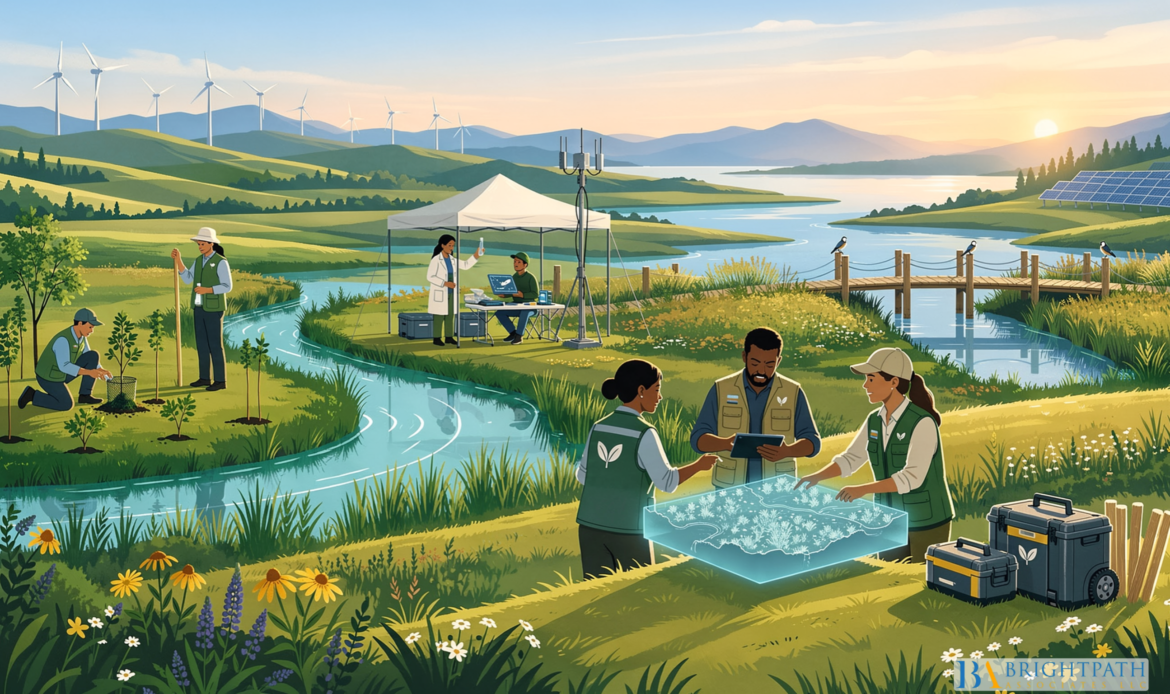
Building Legacy: How Mid-Sized Environmental Firms Can Lead the Global Market for Environmental Services Industry is not mainly a question of becoming the biggest firm. It is a question of becoming the provider clients trust when #EnvironmentalCompliance, climate resilience, water treatment, remediation, and environmental sustainability work cannot fail. Large competitors have scale. Mid-sized firms can still lead by making sharper choices about expertise, talent, data quality, and partnerships.
Table Of Contents
- The Market Rewards Scale, But Clients Buy Confidence
- Build An Operating Model That Makes Size An Advantage
- Turn Technical Delivery Into Repeatable Global Growth
- Key Takeaways
- Frequently Asked Questions
- Resources And Citations
The Market Rewards Scale, But Clients Buy Confidence
The Competitive Reality Is Concentration, Not Closure
The environmental services industry includes far more than environmental consulting. It covers engineering, air pollution control, water treatment, remediation, permitting, environmental monitoring, waste services, clean technology, and environmental data assurance. That breadth matters because market estimates vary depending on which of those activities are included.
The competitive pressure is real. Environment Analyst reported that large multidisciplinary firms grew faster than mid-sized multidisciplinary firms and pure-play environmental specialists as consolidation intensified. The implication is not that mid-sized firms are destined to lose. It is that competing on breadth alone is usually a weak strategy.
A large firm can staff a national proposal quickly, bundle environmental work with design or construction services, and absorb a slow procurement cycle. A mid-sized firm should not try to imitate every part of that model. Its stronger position is often built around a narrow set of high-consequence problems where senior judgment, speed, local regulatory fluency, and technical credibility change the client outcome.
For example, a company with deep groundwater remediation knowledge may be more valuable to an industrial client than a broad provider with a larger brand but limited site-specific expertise. The buyer is not purchasing a generic report. The buyer is purchasing confidence that the work will withstand regulator review, protect operations, and reduce future liability.
Legacy Means Commercial Durability And Verifiable Impact
A legacy is not a mission statement. For a mid-sized environmental firm, it is the ability to create durable commercial value while leaving clients, communities, ecosystems, and employees stronger than before.
That requires leaders to measure more than annual revenue. A practical legacy scorecard can connect technical outcomes with business performance.
| Dimension | Example Measure | Why It Matters |
|---|---|---|
| Environmental outcome | Acres remediated, water quality improvements, avoided emissions | Shows whether services produce measurable environmental benefit |
| Client outcome | Permit-cycle reduction, compliance milestones met, repeat engagements | Demonstrates practical business value |
| Workforce strength | Licensed-professional retention, mentoring participation, succession readiness | Protects technical continuity |
| Commercial resilience | Recurring revenue share, client concentration, backlog diversity | Reduces dependence on one project type or funding source |
| Community value | Local workforce participation, risk reduction, stakeholder engagement | Connects project success to long-term trust |
No universal formula proves that these measures guarantee profitability. They do, however, force better management conversations. A remediation practice can be profitable yet fragile if it relies on a few senior experts and one public funding stream. Conversely, a monitoring and compliance practice may have lower project margins but create predictable revenue and stronger client retention.
Leadership Hiring Is Now A Strategic Constraint
Environmental executive roles increasingly sit at the intersection of technical delivery, regulation, data, operations, and #CommercialGrowth. A vice president of remediation may need to lead field teams, price risk, manage client relationships, recruit technical specialists, and make defensible decisions when site conditions change. A sustainability or environmental innovation leader may need to understand disclosure requirements without overstating what environmental data can prove.
That combination is difficult to hire for through a broad job posting. The candidate pool is often small, currently employed, and distributed across consulting firms, utilities, manufacturers, infrastructure companies, and environmental technology providers.
The leadership issue is also a pipeline issue. Environmental services industry faces STEM talent shift examines why firms need to think beyond immediate vacancies when technical demand outpaces the supply of experienced professionals. An open executive seat can slow proposal decisions, weaken mentoring, delay client escalation, and place too much authority on a small number of remaining leaders.
Build An Operating Model That Makes Size An Advantage
Choose Services With A Clear Decision Filter
Mid-sized firms should not select service lines merely because demand appears strong. The better question is whether a service can become distinctive, repeatable, and defensible with the firm’s current capabilities.
Use five filters before entering a new market or expanding a practice:
- Regulatory urgency: Does the client face deadlines, permits, enforcement exposure, or recurring reporting requirements?
- Technical scarcity: Is success dependent on expertise that is genuinely difficult to replace?
- Revenue continuity: Can project work lead to monitoring, compliance support, data management, or advisory retainers?
- Capital intensity: Does expansion require expensive equipment, labs, fleet assets, or insurance capacity beyond a reasonable risk level?
- Exportability: Can the underlying method travel across regions with limited adaptation, or is it entirely dependent on local relationships and regulation?
Environmental permitting, water treatment advisory, air pollution control, remediation, and environmental data assurance may all score differently. A permitting practice can be highly valuable but difficult to export because regulations and agency relationships are local. A standardized environmental monitoring protocol may travel more easily, provided the firm understands local rules and sampling requirements.
The goal is not to become narrowly specialized forever. It is to establish a credible core before adding adjacent services. Expansion should answer a client need that the existing practice already exposes. A water-treatment advisory firm might add compliance monitoring because the same clients need ongoing performance documentation. It should not add unrelated clean technology implementation simply because the market is attracting attention.
Senior Access Must Be Designed Into Delivery
Agility is often described as a mid-sized advantage, but it only exists when leaders create systems that preserve it. If every complex decision waits for one founder or practice leader, the firm becomes slower as it grows.
A stronger model separates decisions into three levels:
| Decision Type | Appropriate Owner | Control Needed |
|---|---|---|
| Routine field and reporting decisions | Project manager or technical lead | Standard operating procedures and quality checks |
| Client-risk and scope decisions | Practice leader | Documented risk review and commercial approval |
| Major liability, acquisition, or claim decisions | Executive team or board | Legal, insurance, and governance review |
This structure gives clients access to senior judgment without forcing executives to control every task. It also reveals where leadership bench strength is thin. If a firm cannot delegate a technical review without weakening quality, it has a succession problem, not simply a capacity problem.
That is where executive search can be useful, but only after the role has been defined honestly. A search for a “growth leader” will underperform if the firm really needs a technically credible operator who can stabilize delivery before pursuing sales. The position specification should identify decision rights, revenue responsibility, technical authority, client mix, succession expectations, and the nonnegotiable credentials required for the work.
Build Talent Pipelines Before The Vacancy
#EnvironmentalFirms frequently need leaders who hold licenses, can manage field risk, understand environmental compliance, and can communicate with boards or public stakeholders. These are not skills that appear on demand.
The practical response is a workforce system that includes:
• Structured mentoring between senior technical leaders and emerging managers
• Paid time and protected workload capacity for licensure, certifications, and field development
• A clear path from subject-matter expert to project, client, and people leadership
• Succession maps for revenue-critical practices rather than only C-suite positions
• Regular assessment of who can assume client and technical responsibility within 12 to 24 months
Rethinking talent pipelines in environmental tech is relevant here because environmental innovation depends as much on workforce design as it does on tools. Hiring a data scientist without environmental context may not solve a monitoring problem. Hiring an environmental engineer with no exposure to data governance may not solve it either. The best leadership teams create bridges between those disciplines.
Turn Technical Delivery Into Repeatable Global Growth
Convert Projects Into Recurring Client Relationships
Project-based revenue can be substantial, but it is uneven. A legacy firm finds ethical and useful ways to remain relevant after the initial project is complete.
Consider a contaminated-site engagement. The initial scope may involve investigation, remediation design, regulator coordination, and cleanup oversight. Once the acute phase is complete, the firm can offer ongoing monitoring, reporting calendars, compliance dashboards, closure documentation, and periodic risk reviews. These services should not be forced onto clients. They should be offered when they reduce the client’s ongoing administrative burden or environmental risk.
The mechanism is simple: each project produces information, obligations, and operating lessons. If those records remain scattered across reports, the relationship ends with project closeout. If they are organized into a controlled data and compliance service, the firm can support the client through the next regulatory cycle.
Environmental data assurance is essential. Before a firm makes claims about emissions, water quality, remediation progress, or sustainability performance, it should establish who owns the data, how it was collected, how changes are tracked, what assumptions were used, and who approves final reporting. Weak evidence trails create liability for both the firm and client.
Compliance excellence in environmental regulations provides useful context for why compliance capability should be treated as an operating discipline, not a final review step.
Expand Across Borders Through Modules, Not Offices
International growth does not require opening offices everywhere. For many mid-sized firms, the lower-risk sequence is to export a repeatable service module first.
- Identify a service with a documented method, clear quality controls, and limited dependence on one jurisdiction.
- Select a local partner that understands permitting, language, labor requirements, and stakeholder expectations.
- Define who owns client communication, technical signoff, data storage, insurance obligations, and regulator interaction.
- Run a limited engagement and review margin, quality, client satisfaction, and delivery friction before committing capital.
- Establish a permanent presence only when recurring demand and local leadership justify it.
This approach will not work for every service. Local permitting, public-sector procurement, and site-specific remediation often require deeper in-country capability. But a water-quality analytics method, environmental management-system support, or controlled monitoring protocol may be more portable.
Fair warning: a partnership is not a shortcut around accountability. The client will still associate quality failures with the lead firm. Partner diligence should include technical competence, health and safety practices, insurance, conflicts of interest, data security, and reputation with #LocalAuthorities.
Use Acquisitions To Add Capability, Not Just Revenue
Acquisition activity remains meaningful in environmental services. Stout’s environmental services industry update identifies continuing strategic and sponsor interest, including tuck-in and mid-sized transactions. That makes acquisitions a realistic option, but not an automatic path to leadership.
A good acquisition adds something the firm cannot build quickly: a scarce technical practice, a trusted regional client base, a credible leadership bench, or a complementary service that creates recurring work. A weak deal adds revenue but introduces incompatible project controls, hidden liability, client concentration, or the departure of key technical leaders after closing.
Before signing, executives should test four questions:
• Would the acquired firm’s best clients stay if its founders left?
• Are technical review standards compatible, especially for remediation, compliance, and environmental claims?
• Does the deal strengthen a chosen market position or merely make the organization larger?
• Can both firms explain how careers, decision rights, and client relationships will work after integration?
Protecting culture means being specific. If a firm says it values technical independence but changes incentive plans to reward only short-term sales, employees will notice quickly. Integration plans should include shared quality standards, retention discussions with critical staff, client transition plans, and a clear method for escalating disagreements.
Build Resilience Against Policy And Funding Shifts
#PublicInvestment and regulation can create major demand, yet they can also produce volatile pipelines. Environment Analyst noted 8.5% growth in the 2024 U.S. environmental and sustainability consulting market and assessed 29 leading firms representing 78% of that market. Its earlier forecast also projected that the U.S. market could reach about $29.2 billion by 2028, a 5.5% compound annual growth rate, in an Environment Analyst market forecast.
These figures point to opportunity, not certainty. Policy changes, procurement delays, and shifting public priorities can change the timing and mix of work. A resilient firm balances public, private, municipal, industrial, and utility clients; avoids overreliance on a single program; and maintains a backlog view by service line, geography, client type, and funding source.
The largest firms still set a useful benchmark for scale. Engineering News-Record’s Top 200 environmental firms analysis demonstrates the substantial aggregate environmental-services revenue generated by leading competitors. Mid-sized firms do not need to match that revenue base. They need to know exactly where their expertise creates a better answer.
Key Takeaways
What Leaders Should Reconsider
• Do not confuse size with leadership. Market leadership can come from owning a high-trust technical niche, producing reliable outcomes, and retaining specialized leaders.
• Treat executive hiring as operating design. The right leader must fit the firm’s technical risk, client model, growth strategy, and succession needs.
• Build recurring revenue around genuine client needs. Monitoring, assurance, compliance calendars, and managed data services can extend valuable project relationships.
What To Do In The Next Planning Cycle
- Score every service line against urgency, scarcity, continuity, capital intensity, and exportability.
- Identify the three leadership roles whose absence would most threaten quality, client trust, or growth.
- Audit environmental data controls before expanding sustainability, carbon, or performance claims.
- Review whether partnerships or tuck-in acquisitions add a defined capability rather than undirected revenue.
- Track environmental, workforce, client, and commercial measures together.
Frequently Asked Questions
Can A Mid-Sized Environmental Firm Compete With Global Consultancies?
Yes, but it should not compete by trying to replicate a global consultancy’s entire service catalog. Mid-sized firms are better positioned when they focus on high-consequence work, provide senior access, and build systems that make their technical quality repeatable.
Which Environmental Services Have Strong Growth Potential?
Demand depends on local regulation, infrastructure needs, industrial investment, and client risk. Services with #RecurringCompliance, monitoring, remediation, water treatment, and environmental data needs may offer more durable revenue than isolated advisory assignments. Each firm should test market demand against its own technical depth and capital capacity.
Should A Firm Specialize Or Become Multidisciplinary?
Specialize first when your strongest advantage is scarce expertise or a trusted reputation in a defined problem. Add adjacent services when the same clients repeatedly need them and the firm can maintain quality. Broad expansion without an integration plan can weaken the brand and strain leadership.
How Can Environmental Firms Create Recurring Revenue?
Start with the obligations that remain after a project: monitoring, reporting, compliance documentation, inspections, permit renewals, and data assurance. The service must solve a continuing client problem, not simply extend a contract.
Is International Expansion Possible Without Opening Offices Everywhere?
Often, yes. Begin with a repeatable service module and a vetted local partner. This works best where technical methods are portable. It is less suitable for work that depends heavily on local permits, public procurement, or #RegulatorRelationships.
When Is An Acquisition Better Than Organic Growth?
An acquisition may be appropriate when it adds scarce expertise, a credible regional position, or leaders who fit the future operating model. Organic growth may be safer when the capability can be developed internally and integration risk outweighs speed.
How Can Leaders Prove Environmental Outcomes Without Creating Liability?
Use controlled methods for data collection, assumptions, version history, approvals, and client review. Avoid claims that exceed what the evidence supports. Environmental data assurance should be designed into delivery, not added just before publication.
Resources And Citations
Market And Industry Sources
- Environment Analyst — US E&S Consulting Market Hits Record Growth, but There’s a Bumpy Ride Ahead. https://environment-analyst.com/global/110950/us-es-consulting-market-hits-record-growth-but-theres-a-bumpy-ride-ahead
- Environment Analyst — US Environmental & Sustainability Consulting Market Assessment. https://environment-analyst.com/global/111473/us-environmental-sustainability-consulting-market-assessment-march-2026-edition
- Stout — Environmental Services Industry Update. https://www.stout.com/-/media/pdf/industry-update/environmental-sciences/stout-ib_september-2025-environmental-services-industry-update-vf.pdf
- Engineering News-Record — ENR Top 200 Environmental Firms: Assessing Market Give and Take. https://www.enr.com/articles/63802-enr-top-200-environmental-firms-assessing-market-give-and-take
- Environment Analyst — U.S. Market Assessment Press Release 2025. https://environment-analyst.com/global/us-market-assessment-press-release-2025/
- BrightPath Associates — Environmental services industry faces STEM talent shift.