
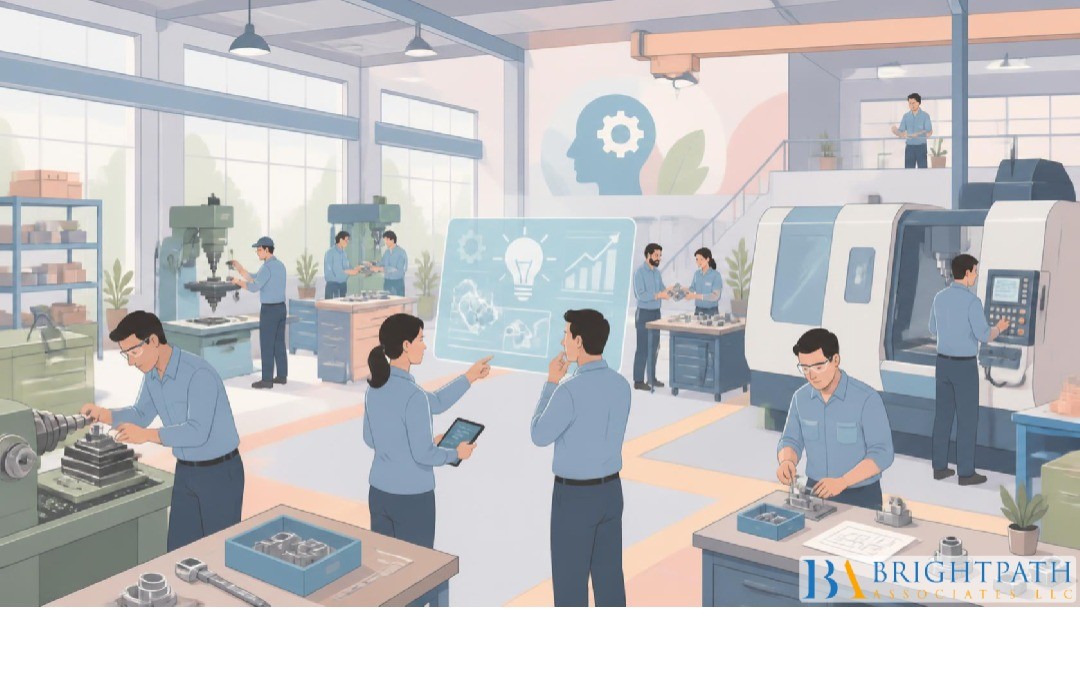
#TraditionalMachineShops have long been built around craftsmanship, precision, experience, and operational discipline. Skilled machinists understand how materials behave, how equipment performs under pressure, and how small adjustments can influence the quality of a finished component. These capabilities remain essential, but the competitive environment surrounding machine shops is changing rapidly. New technologies, shifting customer expectations, labor shortages, automation, digital manufacturing, and increasing pressure for greater productivity are changing what it means to operate a successful machine shop.
For traditional manufacturers, innovation does not necessarily mean replacing everything that already works. It means developing a culture where employees and leaders continuously look for better ways to improve quality, reduce waste, shorten production cycles, strengthen equipment reliability, and respond to customer needs. This mindset is becoming particularly important for US Machinery manufacturers as they compete in an environment where technological capability increasingly influences cost, speed, flexibility, and customer value. Manufacturing technology orders in the United States reached a record level during the first half of 2026, reflecting strong investment in advanced machinery and automation.
Why Continuous Innovation Matters in Traditional Machine Shops
A machine shop can operate successfully for years using familiar equipment and established processes. However, stability can sometimes create resistance to change. When a particular machining method has produced acceptable results for decades, employees may understandably question why it needs to be changed. The challenge is that customer expectations and competitive conditions rarely remain constant.
Customers increasingly expect shorter lead times, consistent quality, greater customization, digital visibility, and competitive pricing. At the same time, machine shops face pressure from rising operating costs and difficulties finding experienced technical employees. These pressures mean that manufacturing efficiency can no longer depend solely on employees working harder. Companies must find ways to make processes smarter, more reliable, and easier to scale.
Continuous innovation provides a framework for doing exactly that. Rather than waiting for a major crisis before investing in improvements, machine shops can create an ongoing process of identifying inefficiencies and testing practical solutions.
Innovation begins with culture. The most sophisticated equipment will not create meaningful improvement if employees are discouraged from questioning existing processes. Machine shop leaders should create an environment where employees can identify problems, suggest improvements, and participate in testing new approaches.
Machinists often understand production challenges better than anyone else because they experience those challenges every day. They know which machines create recurring problems, which setups consume unnecessary time, which tools wear too quickly, and where quality issues tend to emerge. When management actively listens to this knowledge, continuous improvement becomes a shared responsibility rather than an executive initiative.
A culture of innovation does not mean every idea needs to be implemented. It means ideas should be evaluated objectively. Some may produce significant savings, while others may reveal information that helps the company understand why a particular approach should not be adopted.
Modernizing Industrial Machinery Without Losing Expertise
Modernizing #IndustrialMachinery can provide substantial benefits, but technology investment should be connected to specific operational goals. A new CNC machine, automated inspection system, robotic loading system, or advanced manufacturing platform should solve a real business problem rather than simply provide access to the latest technology.
Traditional machine shops should evaluate whether new equipment can improve throughput, precision, flexibility, safety, energy efficiency, or repeatability. They should also consider how easily the equipment can be integrated with existing processes and whether employees can be trained to operate and maintain it effectively.
The goal is not to eliminate traditional expertise. Instead, modern equipment should amplify that expertise. An experienced machinist working with advanced machinery can often achieve significantly more than either technology or experience could accomplish independently.
Precision Machining Is Becoming More Data-Driven
Precision machining has always depended on accuracy, consistency, and technical skill. Increasingly, however, data is becoming another important component of machining performance. Modern equipment can collect information about tool wear, machine conditions, cycle times, temperature, vibration, and production quality.
This information can help machine shops identify patterns that might otherwise remain hidden. If a particular tool consistently produces quality issues after a certain number of cycles, data can help establish a more accurate replacement schedule. If a machine begins showing unusual vibration patterns, monitoring systems may provide an early warning of potential mechanical problems.
Data does not replace the machinist. It gives the machinist another source of information.
This combination of technical judgment and real-time operational data can strengthen decision-making while supporting more predictable production.
Industrial automation solutions are becoming more accessible to smaller manufacturers, but automation should not be treated as an all-or-nothing decision. A traditional machine shop does not need to transform its entire facility into a fully autonomous operation to benefit from automation.
Automation can begin with a specific bottleneck. A shop might automate material handling, machine loading, inspection, tool management, or repetitive finishing activities. A targeted project can demonstrate value while allowing employees and managers to become comfortable with new technology.
The most successful automation projects typically begin with a clear operational problem. If employees spend significant amounts of time performing repetitive movements, moving materials, or waiting for machines to complete cycles, those processes may present opportunities for automation.
The objective should be to use automation where it creates measurable value while allowing skilled employees to focus on activities that require judgment, problem-solving, and technical expertise.
Machinery Maintenance Must Evolve With Technology
As equipment becomes more sophisticated, #MachineryMaintenance becomes increasingly important. A modern machine represents a substantial capital investment, and unexpected downtime can quickly affect production schedules, customer commitments, and profitability.
Traditional preventive maintenance remains important, but machine shops can increasingly supplement scheduled maintenance with condition monitoring and predictive approaches. Sensors and machine data can provide information about vibration, temperature, performance, and other indicators that may signal developing problems.
A strong maintenance culture should also involve operators. Employees who work with machines every day are often the first to notice unusual sounds, changes in performance, or quality problems. Creating channels for operators to communicate these observations can help maintenance teams respond before small issues become major failures.
Innovation in maintenance is therefore not only about purchasing monitoring technology. It is also about improving communication, documentation, training, and accountability.
Used Machinery Can Support Incremental Innovation
Innovation does not always require purchasing brand-new equipment. Used machinery can provide traditional machine shops with a practical way to increase capacity or add capabilities while controlling capital expenditures.
However, used machinery should be evaluated carefully. Age, maintenance history, control systems, parts availability, energy consumption, accuracy, and compatibility with current production processes can all influence the long-term value of a machine.
For some machine shops, a well-maintained used machine may provide an effective bridge toward modernization. It can allow the business to test a new production capability without making the same level of investment required for a new system.
The important consideration is whether the equipment supports the company’s long-term strategy rather than simply solving an immediate capacity problem.
Capital availability is another important factor in continuous innovation. Even when a machine shop understands which technology could improve its operations, purchasing decisions can be delayed by concerns about cash flow and investment risk.
Machinery financing can provide businesses with additional flexibility when acquiring new equipment. Instead of treating modernization as a single large capital expense, companies can evaluate financing structures that align equipment investment with expected productivity and revenue improvements.
However, financing should not be used to justify technology purchases without a clear business case. Leaders should understand expected utilization, maintenance costs, training requirements, integration expenses, and potential return on investment before committing to a major equipment purchase.
Developing the Next Generation of Manufacturing Jobs
Technology is changing the nature of manufacturing jobs. As automation and digital systems become more common, machine shops may need fewer employees performing purely repetitive tasks while requiring more people capable of programming, maintaining, monitoring, troubleshooting, and optimizing advanced equipment.
This creates both a challenge and an opportunity.
Traditional machine shops possess valuable institutional knowledge, but that knowledge needs to be transferred to the next generation. Apprenticeships, #TechnicalTraining, cross-training, mentorship, and partnerships with educational institutions can help create a workforce capable of combining traditional machining skills with #Digital capabilities.
The goal should not be to choose between people and technology. It should be to develop people who can work effectively with technology.
Current manufacturing developments demonstrate why this matters. As AI-enabled automation becomes more sophisticated, manufacturers increasingly need workers who understand how to operate, maintain, supervise, and improve advanced systems.
Leadership Is the Foundation of Continuous Innovation
Technology investments can be expensive, but leadership mistakes can be even more costly. A machine shop may purchase advanced equipment without having the leadership structure necessary to integrate it effectively. Employees may resist new processes, maintenance requirements may be overlooked, or management may fail to measure whether the investment is delivering the expected results.
Strong leadership creates alignment between innovation and business strategy. Leaders need to understand where the company wants to compete, what customers value, which processes limit growth, and what capabilities will be required in the future.
This is where #ExecutiveSearchRecruitment can become strategically important. As machine shops evolve from traditional manufacturing businesses into technology-enabled operations, they may need executives and senior managers with broader capabilities across manufacturing, engineering, automation, finance, supply chain, workforce development, and digital transformation.
The right leader can help establish an environment where innovation becomes part of everyday decision-making rather than an occasional project.
A culture of innovation should ultimately produce measurable improvements. Machine shops need to determine whether their initiatives are improving manufacturing efficiency, reducing scrap, shortening cycle times, improving machine utilization, reducing downtime, strengthening quality, or increasing customer satisfaction.
Measurement also helps prevent innovation from becoming a collection of disconnected experiments. When management tracks results, employees can see which ideas create value and which approaches need to be reconsidered.
Over time, small improvements can accumulate. A faster setup here, fewer rejected parts there, reduced downtime on another machine, and better material utilization can collectively create a significant competitive advantage.
Continuous innovation is powerful precisely because it does not depend on one dramatic breakthrough.
Building a Future-Ready Machinery Industry
The #MachineryIndustry is entering an era in which traditional manufacturing expertise and advanced technology will increasingly operate together. AI, robotics, connected equipment, digital production systems, predictive maintenance, advanced analytics, and flexible automation are changing the competitive landscape.
For traditional machine shops, the answer is not necessarily to abandon established practices. The stronger strategy may be to preserve what works while continuously questioning what could work better.
That requires a culture in which employees are encouraged to identify problems, leaders are willing to test new ideas, technology investments are tied to business objectives, and workforce development is treated as seriously as equipment investment.
The future of US Machinery manufacturers will not be determined only by who owns the newest machine. It will also depend on who can create an organization capable of learning faster, adapting faster, and improving continuously.
Conclusion: Innovation Is a Habit, Not a Project
Traditional machine shops have an important advantage that many newer manufacturing businesses cannot easily replicate: decades of practical knowledge, technical expertise, customer relationships, and understanding of real-world production.
The opportunity now is to combine that foundation with modern technology.
Industrial machinery can improve capability. Precision machining can become more data-driven. Industrial automation solutions can reduce repetitive work. Machinery maintenance can become more predictive. Used machinery can support practical modernization. Machinery financing can make strategic investments more accessible. And workforce development can prepare employees for increasingly sophisticated manufacturing jobs.
But none of these changes will create lasting value without a culture that embraces continuous improvement.
Find your next leadership role in Machinery Industry today!
Stay informed with the latest insights on Machinery Industry!