
Introduction: From Gut-Feel to Data-Driven Excellence
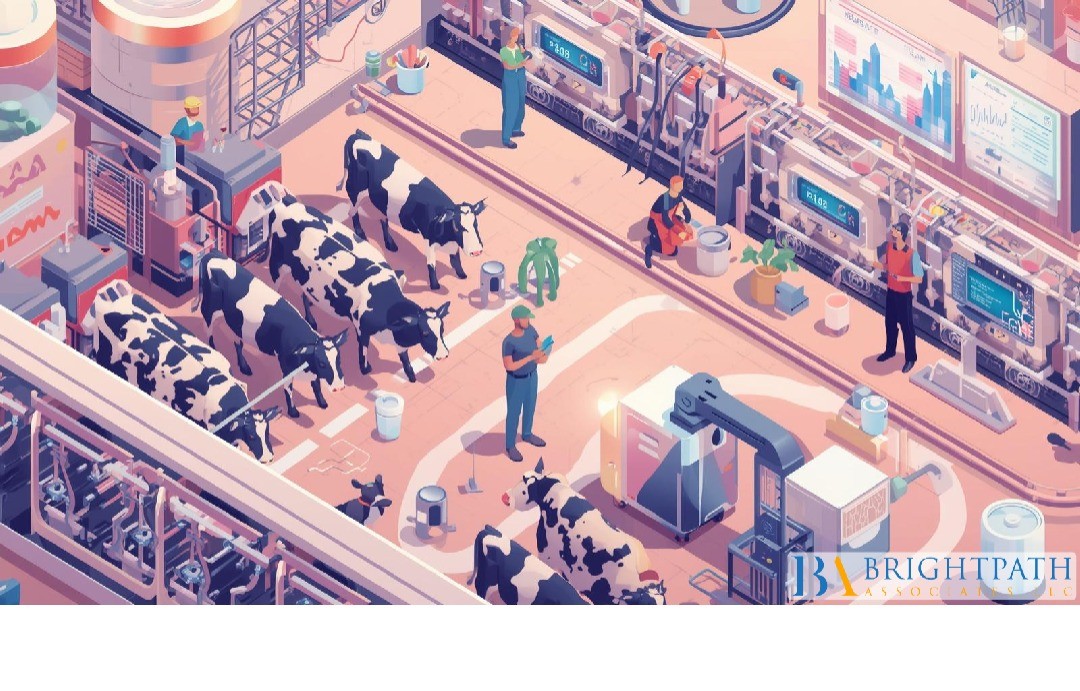
#ArtificialIntelligence is redefining how the dairy industry operates, decides, and grows. Across barns and processing plants, and through to retail and Dairy e-commerce, data streams that were once unstructured or ignored are now being transformed into precise, predictive guidance. In an environment of tight margins, fluctuating demand, and uncompromising food safety standards, AI is no longer experimental. It is an industrial discipline that improves Milk production, reduces losses, stabilizes quality, and fuels Dairy industry growth strategies. This essay maps how AI is reshaping herd management, Dairy automation in plants, and Dairy supply chain management, while outlining the people and process capabilities that ensure sustainable value creation.
Precision at the Source: AI on the Farm
Early Health Detection and Welfare Intelligence
On modern farms, AI fuses computer vision, wearables, and milking-line data to identify health risks before they become costly incidents. Systems trained on images and behavioral patterns can flag lameness, heat stress, and udder inflammation with a consistency that surpasses periodic manual checks. For Dairy products quality and Milk production reliability, earlier detection means fewer clinical cases, lower antibiotic usage, and fewer forced culls. Equally important, these insights enable individualized care decisions without scaling labor in lockstep with herd size, which is pivotal for Sustainable dairy farming practices.
Robotic Milking and Dairy Automation in the Barn
Automated milking systems are a keystone of #DairyAutomation. They rely on advanced sensing to identify cows, prepare teats correctly, and terminate milking at the optimal point. AI enhances these systems by learning traffic patterns, reducing fetch lists, and standardizing hygiene and attachment accuracy. Beyond labor flexibility, the data generated by robotic milking—flow rates, conductivity, quarter-level deviations—feeds machine learning models for mastitis prediction and milk composition forecasting. As farms adopt a “manage by exception” mindset, AI transforms the daily routine into monitoring dashboards where deviations trigger targeted interventions, rather than broad, time-consuming rounds.
Industrial AI in Processing: Yield, Uptime, and Quality
Predictive Maintenance and Reliability Leadership
Inside the processing plant, AI turns historian and PLC data into condition-based maintenance schedules. Vibration signatures, motor currents, and bearing temperatures reveal degradation long before a catastrophic event. By intervening at the right time on separators, fillers, and conveyors, plants cut unplanned downtime and preserve overall equipment effectiveness. For the Dairy industry, where product value is concentrated and shelf life is finite, averted breakdowns protect both revenue and brand reputation. Predictive maintenance also extends asset life and shifts maintenance from reactive firefighting to proactive planning, a critical pillar of Dairy industry digital transformation.
Cleaning-in-Place Optimization and Hygienic Assurance
Cleaning-in-place cycles are essential for microbial control, but their timing and duration often reflect conservative assumptions rather than actual fouling states. AI models trained on flow, temperature, pressure, and chemistry data can validate execution and predict the optimal moment to clean. The result is more run-time between cleans without compromising product integrity. Plants gain additional productive hours per cycle, reduce chemical and water consumption, and strengthen auditability through automated validation reports. In a sector where #FoodTechnology and compliance converge, intelligent CIP becomes a differentiating capability that aligns quality, sustainability, and cost.
Advanced Process Control, Quality Inference, and Energy Reduction
Model predictive control and inferential analytics drive measurable improvements in moisture control, pH stability, protein targeting, and dry solids in powders. By learning how upstream variability propagates through evaporators and spray dryers, AI maintains products closer to specification limits with less give-away. At the same time, energy intensity declines as fouling is detected earlier, operating points are stabilized, and cleaning schedules are synchronized with process needs. These gains support Sustainable dairy farming practices by lowering resource footprints and simultaneously enhance competitiveness through lower unit costs and fewer off-spec lots.
Intelligent Dairy Supply Chain Management: Forecast, Make, Move
Demand Sensing and Inventory Optimization
Perishability and promotion-driven swings make forecasting #DairyProducts uniquely challenging. Machine learning algorithms—trained on store-level sales, weather, holidays, and pricing—outperform traditional time-series models in capturing local and short-term signals. Better forecasts reduce write-offs, emergency changeovers, and lost sales, while improving service levels across chilled and ambient portfolios. Integrating these predictions into production planning and distribution schedules shrinks the bullwhip effect and stabilizes upstream Milk production commitments.
Cold Chain Integrity and Traceability
IoT sensors across transport and storage continuously monitor temperature and location, while anomaly detection anticipates excursion risks before they materialize into spoilage. AI-driven alerts trigger corrective actions such as route adjustments or cross-docking, preserving product quality and regulatory compliance. With heightened consumer scrutiny and stricter traceability requirements, data-driven cold chain assurance strengthens brand equity and shields working capital from preventable losses.
Governance, Talent, and the Human Factor
Data Foundations and Model Stewardship
Successful AI initiatives begin with data readiness. Harmonizing master data for cows, batches, and SKUs; aligning time stamps across sensors and systems; and implementing strong data governance are prerequisites for reliable models. Standard interfaces between barn systems, MES, LIMS, WMS, and ERP reduce integration overhead, while edge-cloud architectures #AlignLatency needs with computational workload. Just as importantly, model governance—versioning, drift monitoring, and performance auditing—ensures that AI recommendations remain trustworthy as processes evolve.
Workforce Enablement and Executive Search Recruitment
AI does not replace skilled people; it amplifies them. The biggest step-change in performance occurs when operators, herdsmen, and supervisors adopt AI outputs as part of standard work, from fetch lists in robotic milking to CIP release-to-run gates and predictive maintenance work orders. This shift demands targeted training and new roles that bridge operations and analytics. Executive Search Recruitment becomes strategic, focusing on leaders who can translate industrial realities into data models and who can embed AI into everyday decision-making. Building cross-functional talent—process engineers who speak data, data scientists who understand Food technology, and plant managers fluent in digital adoption—accelerates value capture and de-risks transformation.
Change Management and Alert Discipline
#AlertFatigue and false positives can undermine trust quickly. Tuning for specificity, setting clear escalation pathways, and piloting with small cohorts are essential practices. In the barn, clinician-in-the-loop confirmation can calibrate thresholds; in the plant, maintenance and quality teams should co-author acceptance criteria for PdM and CIP recommendations. Visible success stories, measured against pre-defined baselines, build momentum and sustain adoption.
Sustainability as a Design Constraint
AI enables Sustainable dairy farming practices by reducing energy, water, and chemical usage in plants and by minimizing antibiotic interventions and culling on farms. Optimized feed efficiency, stable herd health, and precise cleaning all lower the environmental footprint per liter of milk. As reporting frameworks tighten and customers demand transparency, AI provides the granular data needed to measure and improve emissions, water intensity, and waste. Embedding these sustainability metrics as first-class optimization objectives—rather than afterthoughts—aligns operational excellence with corporate commitments and market expectations.
Strategic Roadmap for Dairy Industry Digital Transformation
Start with High-Return Use Cases
Organizations should prioritize a small portfolio of use cases with tangible payback within 6 to 12 months. On farms, early disease detection, estrus prediction, and #AMSOptimization are proven entry points. In plants, predictive maintenance on critical assets, CIP validation, and advanced control on dryers and evaporators routinely deliver economic impact. In the supply chain, demand sensing for high-volume SKUs and exception-based cold chain monitoring are pragmatic first steps.
Build a Scalable Architecture
A modular data platform with standardized connectors allows new use cases to be added without rework. Edge processing near sensors and controls preserves response times, while cloud layers handle training, forecasting, and fleet benchmarking. Cybersecurity and access controls should be baked in from the start, particularly where AI influences process control or food safety decisions.
The Next Horizon: Digital Twins and Edge-Native Intelligence
As the industry matures digitally, multimodal digital twins will connect cow-level physiology with plant-level unit operations and distribution dynamics. This integration will coordinate ration adjustments with dryer capacity, reproduction plans with promotional calendars, and maintenance windows with logistics peaks. Progressively more inference will run at the edge—on barn cameras, AMS controllers, and utility skids—reducing latency and expanding autonomy. Together, these advances will allow the #DairyIndustry to manage variability proactively, turning once-unpredictable swings into controlled, optimized responses.
Conclusion: Compounding Advantage Through Industrial AI
AI is not a single technology; it is a management system that senses continuously, learns patterns, and acts with precision. On the farm, it safeguards welfare and stabilizes Milk production. In plants, it secures hygienic performance, increases throughput, and curbs energy intensity. Across the value chain, it refines forecasts and protects cold chain integrity. The organizations that lead will be those that approach AI as core infrastructure, invest in cross-functional talent through focused #ExecutiveSearchRecruitment, and embed data-driven decision-making into the fabric of operations. As these capabilities compound, the Dairy industry will not only produce better Dairy products more efficiently but will also advance Sustainable dairy farming practices and unlock new avenues for growth through resilient Dairy supply chain management and digitally enabled Dairy e-commerce.
Find your next leadership role in Dairy Industry today!