
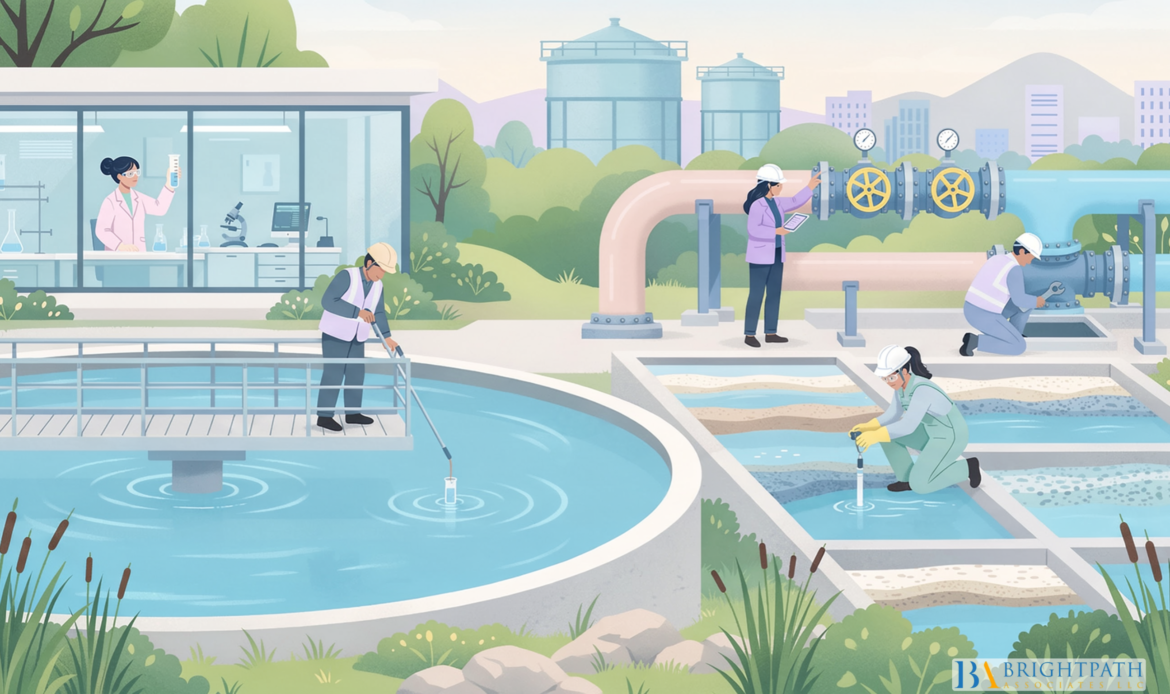
How are water and wastewater infrastructure needs affecting environmental hiring? The short answer is that they are increasing pressure on employers to fill both replacement roles and new technical positions at the same time. Utilities, engineering firms, #EnvironmentalServicesCompanies, and clean-technology providers must maintain aging systems while preparing for water reuse, automation, stronger regulatory compliance, and climate-related water risks.
The hiring challenge is not simply a shortage of applicants. It is a workforce planning problem involving retirement exposure, licensing, technical training, leadership succession, and competition for people who can manage complex infrastructure programs. For executives, the issue is operational: an unfilled role can slow capital projects, strain compliance teams, delay maintenance planning, or leave institutional knowledge at risk.
Table of Contents
- Why Infrastructure Needs Are Changing Environmental Hiring
- Which Roles And Skills Are Under the Most Pressure
- What Executives Should Change About Their Hiring Strategy
- Key Takeaways
- Frequently Asked Questions
- Resources And Citations
Why Infrastructure Needs Are Changing Environmental Hiring
Infrastructure Demand Is Adding To Replacement Demand
Water infrastructure is the network of treatment plants, pipes, pumping stations, storage facilities, laboratories, monitoring systems, and stormwater assets that deliver safe water and manage wastewater. Its workforce includes plant operators, engineers, electricians, mechanics, laboratory personnel, environmental compliance staff, construction specialists, and senior leaders.
The U.S. Environmental Protection Agency has identified shortages of qualified workers across drinking-water, wastewater, and stormwater systems, in part because many employees are nearing retirement. EPA has also stated that roughly one-third of the water-sector workforce was expected to become eligible for retirement within a 10-year period cited in its workforce initiative.
That creates two separate hiring needs that employers should not combine into one forecast.
| Hiring Driver | What It Means | Likely Employer Response |
|---|---|---|
| Retirement replacement | Experienced workers leave with operational knowledge and licenses | Succession plans, knowledge transfer, early replacement hiring |
| Asset renewal | Aging facilities require repair, upgrades, and capital-project oversight | Project managers, engineers, inspectors, construction partners |
| Technology modernization | New systems add controls, data, automation, and reuse requirements | Controls technicians, data staff, operators trained on new processes |
| Regulatory compliance | Environmental permits and reporting require sustained capability | Compliance leaders, environmental scientists, laboratory and quality staff |
| Climate resilience | Flooding, drought, water scarcity, and extreme weather affect planning | Resilience planners, hydraulic engineers, asset-management leaders |
That distinction matters. A wastewater treatment plant expansion may require construction managers, environmental permitting professionals, safety staff, inspectors, commissioning specialists, and engineering consultants for a defined period. Once the project is complete, the utility may need fewer permanent additions, but those roles can be highly specialized: certified operators, maintenance technicians, instrumentation professionals, and supervisors capable of operating the upgraded facility.
Executives should therefore ask a more precise question than, “How many people do we need?” The better question is, “Which capabilities are temporary, which are permanent, and what knowledge must remain after project contractors leave?”
Federal Funding Supports Pipelines, Not Automatic Hiring Outcomes
Government funding is helping strengthen water workforce development, but funding announcements should not be mistaken for proof that every program produces immediate hires. In 2024, EPA announced more than $20 million in water workforce development grants for 13 organizations supporting drinking-water and wastewater career pathways.
Those initiatives can support internships, apprenticeships, pre-apprenticeships, and postsecondary bridge programs. The value is clear: employers gain more ways to introduce people to technical careers before a vacancy becomes urgent. Still, available EPA announcements do not establish national outcomes for placement rates, retention, wage progression, or time to full competency.
That gap is important for leadership teams. A funded training partnership may be strategically useful, but it should be measured like any other workforce investment. Employers should track applicants, hires, certification progress, retention after 12 months, supervisor readiness, and vacancy duration.
EPA notes that water workforce programs can bring together utilities, state and local governments, higher-education institutions, apprenticeship programs, labor organizations, schools, and community-based organizations. For small and mid-sized employers, these partnerships can be more realistic than building a standalone training academy.
Small And Rural Systems Face Different Constraints
Large metropolitan utilities may have broader applicant pools, formal training budgets, and room for specialized roles. Small and rural systems often face a different equation. One licensed operator may cover a wider range of duties. A maintenance lead may also manage controls, emergency response, vendor coordination, and basic administrative functions.
A vacancy in a small system can therefore be more disruptive than the same vacancy in a large organization. The role may be difficult to define, pay bands may be constrained, and nearby employers may compete for the same technical talent. Regional partnerships can help, especially where multiple utilities need similar capabilities but cannot each support a full hiring pipeline.
This is also where executive judgment matters. A regional labor strategy should not be treated as a substitute for a retention strategy. Shared training can enlarge the talent pool, but an employer still needs clear management practices, realistic onboarding, competitive total rewards, and a credible path to advancement.
Which Roles And Skills Are Under The Most Pressure
The Water Workforce Is Broader Than Plant Operators
#TreatmentPlantOperators remain central because they help maintain safe, reliable service and environmental compliance. EPA describes water and wastewater treatment workers as essential to protecting public health and delivering reliable environmental services through its overview of water-sector workforce issues.
Yet executive teams should avoid treating the water workforce as one occupation. Infrastructure needs affect several talent markets at once.
| Role Group | Core Work | Hiring Pressure Created By Infrastructure Needs |
|---|---|---|
| Treatment operators | Run treatment processes, monitor systems, respond to process changes | Retirement replacement, certification requirements, upgraded facilities |
| Engineers | Design, improve, assess, and oversee systems | Capital projects, resilience planning, permitting, asset renewal |
| Maintenance and skilled trades | Repair pumps, motors, electrical systems, and mechanical assets | Deferred maintenance, aging equipment, reliability requirements |
| Instrumentation and controls staff | Maintain sensors, programmable controls, telemetry, and alarms | Automation, remote monitoring, cybersecurity coordination |
| Environmental compliance professionals | Manage permits, reporting, inspections, and risk controls | Regulatory compliance, enforcement exposure, project approvals |
| Laboratory and water-quality staff | Test samples and verify treatment performance | Monitoring needs, quality assurance, emerging contaminants concerns |
| Project and operations leaders | Coordinate capital, operations, budgets, teams, and vendors | Larger project portfolios and leadership succession |
Water-sector hiring is becoming more interdisciplinary. A modern treatment system needs process knowledge, mechanical reliability, data interpretation, and compliance judgment working together.
For example, automation can reduce repetitive manual checks, but it does not remove the need for qualified operators. It changes the work. Staff may spend more time interpreting alarms, validating data, troubleshooting sensors, coordinating with vendors, and responding when remote systems indicate an abnormal condition. A facility that installs more advanced controls without upgrading workforce capability can create a new form of operating risk.
EPA has specifically noted that advanced technologies such as water-reuse systems require workers with specialized technical skills. For employers, that means hiring plans should evaluate learning capacity as well as current credentials.
Licensing And Time To Competency Can Slow Hiring
#OperatorCertification is a practical constraint. Many water and wastewater operating roles require state or jurisdictional certification, and eligibility may depend on education, supervised experience, examinations, or facility classification. Requirements vary by state and are not always easily transferable across borders.
This means an employer may identify a strong candidate who cannot immediately serve as the responsible certified operator for a particular facility. That is not a recruiting failure. It is a workforce-design issue.
A useful distinction is between job-ready and fully credentialed talent:
• A job-ready candidate may have transferable mechanical, laboratory, electrical, or process skills but need time to complete local certification requirements.
• A fully credentialed candidate can meet a defined licensing requirement immediately, but may be harder to find and more expensive to hire.
• A succession candidate may know the facility well but need structured development before assuming leadership responsibility.
Employers should choose among these paths based on operational risk. If a regulatory requirement or key operator position must be covered immediately, hiring a fully credentialed professional may be necessary. If the organization has sufficient coverage and a strong training environment, a broader candidate pool can be practical.
This is one reason a guide to hiring water utility engineers is relevant beyond engineering roles. Effective hiring begins by defining which requirements are legally essential, which are teachable, and which are merely preferences inherited from an older job description.
Executive Roles Are Changing Too
Environmental leadership roles increasingly require a blend of operations, capital planning, risk management, talent development, and stakeholder communication. A wastewater operations director, utility general manager, environmental services executive, or engineering leader may need to make decisions across several competing priorities:
- Maintain daily service and regulatory compliance.
- Deliver capital improvements without losing control of operating costs.
- Retain licensed and technically experienced staff.
- Build succession depth before retirements create an emergency.
- Explain complex infrastructure needs to boards, regulators, communities, investors, or customers.
The strongest infrastructure leader is not simply the best technical expert. The role requires the ability to convert technical risk into clear operating decisions.
That changes executive search criteria. A candidate with a strong water-treatment background may not be the right fit if the organization needs turnaround leadership, labor planning, grant administration, merger integration, or a major capital-program buildout. Conversely, a broadly experienced executive may need deeper technical support if the organization faces immediate permit or process-performance concerns.
The right leadership profile depends on the business problem. That sounds obvious, but many searches start with a title rather than a diagnosis.
What Executives Should Change About Their Hiring Strategy
Start With A Workforce Risk Map
A conventional vacancy list is not enough. We recommend that leaders map positions by operational consequence, retirement exposure, credential dependency, and time to competency.
| Workforce Question | Why It Matters | Useful Decision Signal |
|---|---|---|
| Which roles are required for compliant operations? | A vacancy may create regulatory or service risk | Named backup coverage and credential status |
| Which employees may retire within 12 to 36 months? | Replacement hiring takes time | Documented succession candidates and knowledge-transfer plans |
| Which roles will change after a capital project? | New equipment may require new skills | Training plan before commissioning |
| Which jobs rely on one person’s knowledge? | Single-point dependency creates avoidable risk | Cross-training and documented procedures |
| Which capabilities can be built internally? | External hiring is not always the best answer | Clear development pathways and supervision capacity |
This approach separates urgent recruiting from structural #WorkforcePlanning. It also helps leaders decide when an external executive search or specialized recruiting process is justified. A confidential leadership transition, a narrow technical role, or a search requiring out-of-market candidates may warrant a more targeted process than a general job posting.
Define The Role Around Outcomes, Not Legacy Requirements
Job descriptions often contain degree requirements, years-of-experience thresholds, software preferences, and certifications that may not all be necessary. Excess requirements shrink the candidate pool. Removing genuinely essential requirements, however, can create compliance or safety risk.
The practical solution is to classify each requirement:
- Nonnegotiable: Required by law, licensing rules, safety policy, or immediate operating needs.
- Strongly preferred: Valuable because it reduces ramp-up time.
- Trainable: Can be developed through structured onboarding, mentoring, or formal education.
- Outdated: No longer connected to the actual work or future operating model.
This is particularly important when hiring environmental executives. A leadership role should state the business outcomes expected in the first 12 months. Examples may include stabilizing operator retention, preparing a succession plan, improving capital-project governance, strengthening environmental compliance, or building a better relationship between operations and engineering.
The broader issue is reflected in the environmental services industry faces a STEM talent shift. Employers are not only competing for credentials. They are competing for people who can combine technical judgment with leadership, communication, and change management.
Build The Pipeline Before The Vacancy
Reactive hiring is expensive because it forces employers to compete when they have the least time and the narrowest options. A more durable model combines external recruiting with internal development.
• Use internships and pre-apprenticeships to introduce candidates to real water-treatment and environmental services work.
• Create structured apprenticeships where skilled trades, operations, and classroom learning reinforce each other.
• Pair retirement-eligible employees with successors for documented knowledge transfer.
• Establish cross-training plans for critical systems, including controls, maintenance, laboratory processes, and emergency response.
• Maintain relationships with potential leaders before a senior vacancy becomes public.
Fair warning: a pipeline is not just a recruiting campaign. If supervisors lack time to mentor, or if new hires do not see a path to certification and advancement, the program may produce early exits rather than durable capability.
Employers should also be realistic about competition. Utilities may compete with engineering firms, industrial manufacturers, environmental consultants, construction contractors, and clean-technology companies for overlapping #TechnicalSkills. A candidate may choose private-sector consulting for project variety or compensation, while another may value the stability, mission, and local impact associated with utility work. Hiring messages should reflect the actual employment proposition rather than generic sustainability language.
For organizations reassessing their position in the market, trends in environmental services hiring offers related context on how environmental employers can communicate specialized opportunities more clearly.
Measure Whether The Strategy Works
A hiring strategy should be tested against operating results. Useful metrics include:
• Time required to fill credential-dependent roles.
• Percentage of critical roles with an identified successor.
• Certification progress and time to independent work.
• First-year retention for operators, technicians, engineers, and managers.
• Overtime, contractor reliance, and unplanned vacancy coverage.
• Internal promotion rates for supervisory and leadership positions.
• Project delays or compliance risks connected to workforce capacity.
A lower time-to-fill number is not always a better hiring result. A fast hire who cannot stay, certify, or lead safely may increase long-term risk.
Key Takeaways
What Decision-Makers Should Remember
• Water and wastewater infrastructure needs are affecting environmental hiring through both retirement replacement and new technical capability needs.
• EPA has identified retirement exposure, recruitment difficulty, training needs, technology change, and infrastructure investment as connected workforce pressures.
• Infrastructure projects create different talent needs across planning, design, permitting, construction, commissioning, and long-term operations.
• Certified operators and highly specialized technical employees may require longer hiring timelines because credential rules and #PracticalExperience matter.
• Automation and water reuse can change the skill mix rather than simply reduce headcount.
• Small and rural employers may need regional partnerships because they often have limited applicant pools and less capacity for standalone training programs.
• Executive hiring should begin with a business diagnosis: operating risk, capital-program scope, succession exposure, and required leadership outcomes.
• Workforce programs should be measured by retention, credentials, coverage, and readiness, not just by enrollment or applicant volume.
Frequently Asked Questions
Are Water Utilities Hiring More Environmental Scientists, Engineers, And Treatment-Plant Operators?
Infrastructure needs can increase demand across all three groups, but the exact mix depends on the organization’s assets and project portfolio. Utilities with major capital work may need more engineering and project oversight. Facilities managing daily treatment complexity may place greater urgency on operators, maintenance, laboratory, and compliance roles.
Are Infrastructure Projects Creating Permanent Jobs Or Mainly Temporary Construction Jobs?
They can create both. Construction, inspection, permitting, design, and commissioning work may be project-based. Upgraded facilities can also create lasting demand for operators, maintenance professionals, controls staff, and managers who can run more complex systems after commissioning.
Why Are Water Utilities Having Difficulty Finding Qualified Employees?
EPA identifies recruitment, training, and retention challenges across the water sector. In practice, difficulty can increase when employers need candidates with certifications, hands-on treatment experience, mechanical or electrical skills, and the ability to work in regulated operating environments.
Which Certifications Are Most Useful For Water Or Wastewater Careers?
The most useful certification depends on the state, job, and facility classification. Operator certification is central for many plant roles. Electrical, instrumentation, safety, laboratory, engineering, and environmental compliance credentials may also be valuable depending on the position. Employers should verify local requirements before setting #JobQualifications.
How Do Operator Licensing Requirements Affect Hiring Timelines?
Licensing can limit the immediate candidate pool. A candidate may have strong transferable skills but need local experience, examinations, or supervised time before meeting a facility’s operating requirements. Employers should decide early whether they need immediate credential coverage or can support a development path.
Are Rural Utilities Facing Greater Hiring Challenges Than Large Cities?
They may face different challenges, including smaller local labor pools, broad job responsibilities, and limited training capacity. Regional workforce collaboration can be especially useful where multiple small systems need similar skills but cannot independently support a full candidate pipeline.
Will Automation Reduce Water-Sector Jobs?
Available evidence does not support a simple yes-or-no answer. Automation may reduce some routine tasks while increasing the need for instrumentation, controls, data interpretation, cybersecurity coordination, and technical troubleshooting. The effect depends on the facility, technology, and workforce-development plan.
Resources And Citations
Verified External Sources
- epa.gov — Innovative Water Infrastructure Workforce Development Program
- epa.gov — Learn About Workforce Issues
- epa.gov — EPA Announces Initiative To Recruit And Retain The 21st Century Water Workforce
- BrightPath Associates, Roadmap for Environmental Sustainability Leadership: https://brightpathassociates.com/roadmap-for-environmental-sustainability-leadership/
Find your next leadership role in Environmental Services Industry today!
Stay informed with the latest insights on Environmental Services Industry!