
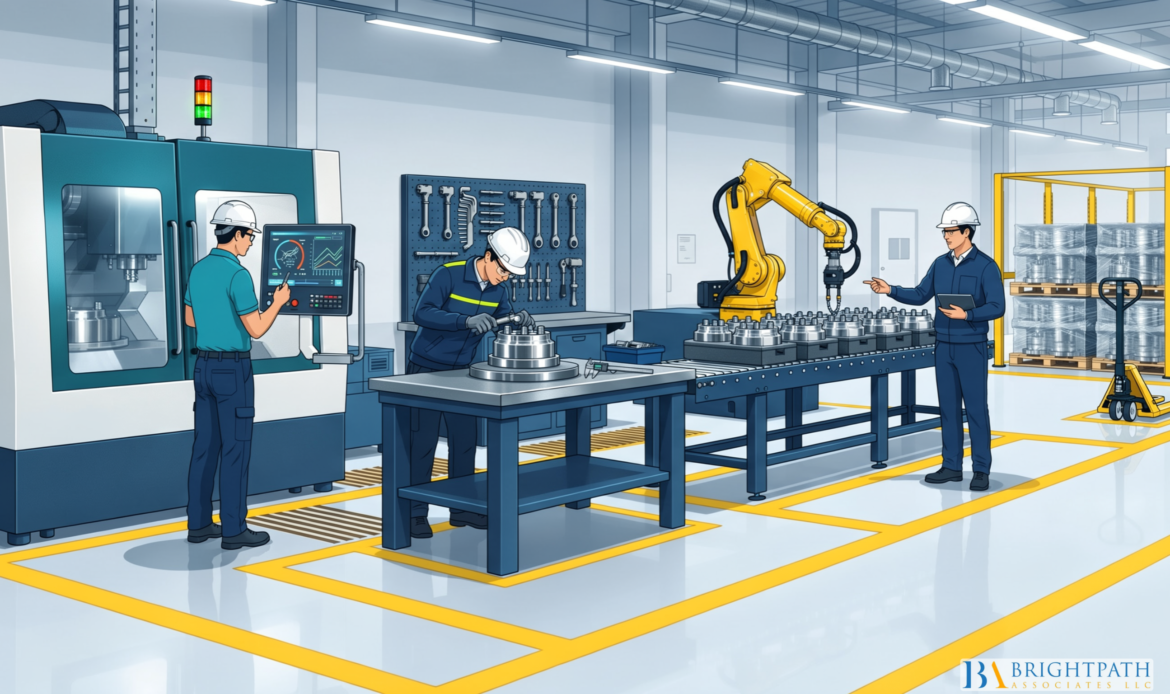
Standardizing Shop Floor: Why Process Discipline is Non-Negotiable for Growth for Machinery Industry is not simply a documentation project. For #IndustrialMachineryManufacturers, it is a capacity, quality, safety, and leadership issue. Growth becomes fragile when skilled machinists, assemblers, maintenance technicians, and supervisors rely on memory instead of controlled methods.
A shop can appear productive while variation quietly consumes margin. A missed torque value, an unverified tooling offset, an outdated drawing, or an undocumented setup adjustment may not stop production immediately. It can, however, create rework, shipment delays, warranty exposure, and avoidable pressure on already limited manufacturing talent.
Table Of Contents
• Key Takeaways
• Why Process Discipline Determines Whether Growth Holds
• What Machinery Manufacturers Should Standardize First
• How To Build Standard Work That People Can Actually Use
• Technology, Leadership, And Workforce Readiness
• Frequently Asked Questions
• Resources And Citations
Key Takeaways
• Process discipline means following a controlled, current method for critical work and escalating when that method cannot be followed.
• Standardize the controls that determine product quality, not just the sequence of operator motions.
• Start with processes that combine high safety exposure, expensive defects, frequent repetition, customer impact, or downtime risk.
• High mix, low volume production still needs standard work. The standard should define decision points, setup controls, and approval gates rather than pretend every order is identical.
• Engineering changes, training records, document control, and supervisor audits must operate as one system.
• Automation can make standard work easier to follow, but it cannot correct unclear ownership or obsolete instructions.
Why Process Discipline Determines Whether Growth Holds
Standardization Is A Growth Control, Not A Bureaucratic Exercise
#MachineryGrowth usually adds complexity before it adds stability. New product variants, used machinery rebuilds, industrial automation solutions, supplier substitutions, customer specific configurations, and new hires all increase the number of ways work can vary.
That is why process discipline matters. It is the operating habit of performing work to the approved method, recording required evidence, and stopping or escalating when actual conditions differ from the standard. It turns individual capability into organizational capability.
A Standard Operating Procedure, or SOP, describes the approved process at a broad level. A work instruction goes deeper, showing the detailed task steps, measurements, photos, settings, tooling, acceptance criteria, and safety precautions. Standard work connects those documents to the real production sequence, staffing conditions, and cycle expectations.
For a precision machining operation, for example, “load part and run program” is not enough. The work must clarify which fixture is approved, which program revision applies, how the first piece is inspected, which dimensions are critical to quality, what happens when a probe result is outside tolerance, and who can authorize an adjustment.
This is not an argument for treating experienced employees as interchangeable. Skilled employees remain essential. The point is different: expertise should improve the standard, not remain trapped in one person’s memory.
The Cost Of Variation Is Larger Than Scrap
Scrap is visible. The full cost of variation is usually not.
When a process drifts, the result may include rework labor, overtime, expedited freight, missed delivery dates, excess inspection, engineering interruptions, delayed invoicing, warranty risk, and lost machine availability. A supervisor may solve each issue in isolation, while the business absorbs the combined cost across operations, customer service, and finance.
A 2023 metal mechanic case study provides a useful, though not universal, illustration. Its combined intervention using process standardization, 5S, autonomous maintenance, and planned maintenance reported defects declining from 9.91% to 2.43%. It also reported standard time declining from 135.17 minutes to 95.45 minutes, while OEE increased from 53.0% to 69.30%. Those results come from one studied setting, not a forecast for US machinery manufacturers, but the published metal mechanic intervention shows how quality, organization, and equipment reliability can reinforce one another.
For executives, the practical question is not, “Can standardization improve performance?” The better question is, “Which variation is currently costing us the most capacity and management attention?”
Safety Procedures Are Part Of Operating Discipline
Machinery maintenance cannot be separated from shop floor standardization. OSHA requires employers to document and use energy control procedures covering shutdown, isolation, stored energy, and verification before applicable servicing and maintenance work begins. The agency’s lockout and tagout guidance also makes clear that responsibilities for applying, removing, and transferring devices must be explicit.
This matters operationally as well as legally. A maintenance technician cannot be expected to make consistent decisions when equipment status, energy sources, handoff rules, or restart authorization are unclear. The standard must state the condition required before work begins and the evidence required before equipment returns to production.
What Machinery Manufacturers Should Standardize First
Use Risk Rather Than Convenience To Set Priorities
Many companies begin with the easiest process to document. That can create activity without reducing meaningful risk. We recommend a risk based sequence instead.
Use the following criteria to rank candidate processes. A process should move toward the top of the list when it scores high in several categories.
| Decision Criterion | What To Examine | Why It Matters |
|---|---|---|
| Safety severity | Energy exposure, guarding, lifting, chemicals, pinch points | A weak method can harm people and disrupt operations |
| Defect cost | Scrap value, rework hours, warranty exposure | Expensive errors justify deeper controls |
| Customer impact | Fit, function, delivery, certification requirements | Failure may affect acceptance and future orders |
| Frequency | Daily repetitions, setup volume, staffing turnover | Repeated variation multiplies quickly |
| Downtime exposure | Reliance on a bottleneck asset or specialized tool | Inconsistent work can constrain total capacity |
| Knowledge concentration | Dependence on one expert or supervisor | The business becomes vulnerable to absence or turnover |
Start with safety critical servicing, bottleneck machine setups, first piece approval, final assembly controls, and inspection steps tied to critical #CustomerRequirements. Avoid trying to document every low risk activity at once. That approach often overwhelms supervisors and makes controlled documents harder to maintain.
Control Points Matter More Than Task Narratives
A task sequence tells someone what to do. A control plan tells the organization what must not vary.
For machinery production, standard work should identify critical to quality characteristics at the point where they can be controlled. Examples include torque values, spindle speed and feed parameters, tooling offsets, weld settings, bearing preload, software version, pressure test limits, serial number capture, and final calibration results.
Consider a gear housing assembly. The operator may follow the correct assembly sequence but still produce an unacceptable unit if a fastener is torqued with the wrong tool setting, a seal lot is not verified, or a measurement checkpoint is skipped. The instruction needs an explicit control point, an acceptance range, a measurement method, a record requirement, and a reaction plan.
A practical control statement might read: “Verify first piece bore diameter using calibrated gauge X. Record result on traveler. If result is outside specified tolerance, stop production, identify affected parts since the last accepted check, and notify the production lead.” That is process discipline in operational terms.
High Mix Production Needs Configurable Standards
High mix, low volume machinery work often creates resistance to standardization. Leaders may argue that every build is different. Sometimes that is true at the product level. It does not mean every decision must be improvised.
The right model is modular standardization. Standardize recurring elements such as job release, drawing verification, material identification, fixture setup, machine warmup, first piece inspection, nonconformance handling, and final documentation. Then create product specific work packages for the unique dimensions, routing, components, or acceptance tests.
Do not copy a repetitive automotive line model into an engineered to order environment. A custom assembly may require expert judgment. The standard should define when judgment is needed, what information must be checked, who owns approval, and when work must pause. It should not force employees to follow a fictional one size fits all sequence.
How To Build Standard Work That People Can Actually Use
Build From The Work, Not From A Conference Room
The best document format is the one employees can use at the point of work. Drafting procedures away from the floor often produces instructions that omit tool access, inspection timing, awkward lifting conditions, or real setup constraints.
Build each critical instruction with the employees who perform and support the task. That group should normally include the operator or technician, supervisor, quality representative, maintenance input when relevant, and engineering ownership for product requirements.
A strong machine or assembly instruction usually includes:
• Purpose and scope
• Required training or authorization
• Current drawing, program, and revision reference
• Required tools, fixtures, materials, and personal protective equipment
• Critical safety controls and energy isolation requirements
• Step sequence with photos, diagrams, or visual cues where useful
• Critical to quality values, inspection gates, and records
• Clear acceptance criteria and first piece approval requirements
• Deviation, stop work, and escalation rules
• Revision number, effective date, and approval owner
Machine specific procedures should not ignore basic safeguards. Harvard Environmental Health and Safety states that machine shop SOPs should be based on manufacturer recommendations and cover machine specific hazards and safe use. Its machine shop safety guidance is a useful reminder that safe work requirements must be tied to the actual equipment, not generic shop language.
Document Control Is An Operational Requirement
An obsolete instruction on a workstation is not a paperwork problem. It is an uncontrolled production condition.
Every controlled instruction needs a clear owner, revision status, effective date, approval route, and defined distribution method. When engineering changes a drawing, material, fixture, software revision, route, or inspection requirement, the related shop floor documents must be reviewed before the change reaches production.
A workable change process has five decisions:
- Identify every affected instruction, control plan, training record, program, and inspection form.
- Confirm whether existing work in process can continue, requires rework, or must be placed on hold.
- Obtain authorization from the functions accountable for design, quality, operations, and safety as applicable.
- Remove or clearly invalidate obsolete versions at points of use.
- Train affected employees and verify understanding before the revised method becomes effective.
#DigitalWorkInstructions can simplify this control, but only if access is reliable on the floor. A tablet that loses connectivity or forces workers through excessive screens may drive employees back to printed notes. Fair warning: technology that adds friction will not create discipline.
Design Escalation Into The Standard
Operators should never have to choose between meeting the schedule and silently bypassing a requirement. Every critical process needs a defined response when the standard cannot be followed.
The trigger may be a missing material certificate, incorrect fixture, failed gauge check, damaged tool, unavailable program revision, unexpected machine condition, or unclear drawing. The response should state whether to stop work, segregate material, notify a role, open a nonconformance record, or request engineering review.
This is where visual management can help. An andon light, digital alert, hold tag, or clearly marked quality review location makes abnormal conditions visible. The goal is not to punish reporting. The goal is to prevent a small deviation from becoming a batch wide problem.
Technology, Leadership, And Workforce Readiness
Automation Should Reinforce The Standard
#IndustrialAutomationSolutions can reduce manual variation, capture production data, and guide employees through complex sequences. Barcode scanning can verify material and routing. Connected torque tools can record final values. Manufacturing execution systems can present the right revision of a work instruction. Machine monitoring can identify recurring downtime patterns that deserve a maintenance response.
Still, automation only helps when the underlying process is defined. Automating an unclear handoff simply makes confusion move faster.
For leaders assessing investments, begin with a process question: What decision, check, or record is currently inconsistent? If the answer is unclear, perform Value Stream Mapping and observe the work before selecting technology. The discussion of industrial automation trends and challenges is relevant here because automation and workforce design must be considered together.
NASA’s shop procedure offers a practical physical control example. It addresses defining controlled work areas through measures such as doors, walls, floor tape, or other boundaries, and requires stationary equipment to be securely anchored. The NASA machine and fabrication shop procedure illustrates how physical conditions can support a disciplined operating environment.
Measure Leading Indicators, Not Just Failures
Scrap rate, customer returns, injury rates, and OEE matter. They are also lagging indicators. By the time they worsen, the process has already failed.
A balanced process discipline scorecard should include leading measures that show whether controls are being sustained.
| Leading Indicator | Executive Question |
|---|---|
| Instruction currency | Are current revisions available where work occurs? |
| Training completion | Are authorized employees trained before assignment? |
| First pass yield | Does work meet requirements without rework? |
| First piece approval adherence | Are setup risks being caught before full production? |
| Audit conformance | Are critical controls followed during routine checks? |
| Deviation closure time | Are abnormal conditions resolved before repetition? |
| Reaction plan execution | Did teams respond as the control plan required? |
Layered process audits are useful when they are short and focused. A supervisor, manager, and senior leader can each verify a small number of high risk controls on a recurring basis. Avoid turning audits into broad fault finding exercises. If every observation leads to blame, people will hide problems instead of escalating them.
Process Discipline Changes Leadership Requirements
As US machinery manufacturers pursue manufacturing efficiency, executive roles increasingly require more than commercial judgment or technical knowledge. Operations leaders need the ability to connect engineering change management, maintenance, quality systems, workforce training, and production planning. Quality leaders need enough operational authority to challenge unsafe or uncontrolled work. Plant managers need to translate KPIs into daily behaviors.
These requirements can complicate hiring. A candidate may have led a large, stable production environment but have limited experience with high mix production, aging equipment, used machinery refurbishment, or small company resource constraints. Conversely, a technically credible leader may not have built a management system that survives growth.
We suggest that hiring teams define the operating system the leader must strengthen before opening a search. The brief should specify the critical processes, the state of document control, the quality and delivery risks, available management layers, and expected decision rights. That makes interviews more useful than a broad search for “manufacturing leadership experience.”
For organizations building the management bench behind those leaders, strategies for fostering manufacturing innovation should include the discipline to convert ideas into repeatable methods. Innovation without controlled deployment can add variation rather than create value.
The Practical Executive Response
The work is not to produce more binders. It is to make the right work easier to do than the wrong work.
Start with one high risk value stream. Establish the current condition, map decisions and handoffs, define critical controls, test instructions with the people who use them, and run a short PDCA cycle. Then expand only after the process is stable enough to sustain.
#LeadershipHiring should follow the same logic. Assess whether the organization needs a turnaround operator, a quality systems builder, a maintenance reliability leader, an automation capable engineering executive, or a general manager who can integrate those functions. Driving business growth in mechanical engineering depends on matching growth goals to that operational reality.
Frequently Asked Questions
What Does Shop Floor Standardization Mean In The Machinery Industry?
It means defining and controlling the approved method for critical shop floor work, including setup, operation, inspection, maintenance, documentation, and escalation. In machinery manufacturing, it must include product specific requirements such as torque values, machining parameters, inspection points, and traceability records.
Which Processes Should A Machinery Shop Standardize First?
Start with work that has high safety risk, expensive defects, bottleneck equipment exposure, major customer impact, frequent repetition, or reliance on one employee’s knowledge. Lockout and tagout procedures, first piece inspection, critical machine setups, and final assembly controls are common priorities.
How Is Standard Work Different From An SOP?
An SOP describes the approved process and responsibilities. Standard work translates that process into the best known current method at the point of work, including sequence, timing, conditions, and controls. A work instruction is usually more detailed and task specific than either.
How Can High Mix, Low Volume Manufacturers Standardize Work?
Standardize repeatable decisions and controls, not every product detail. Use modular instructions for common activities such as job release, setup verification, inspection, changeovers, and deviation handling. Add product specific work packages for unique dimensions, components, testing, or routing.
How Should Operators Respond When They Cannot Follow The Standard?
The instruction should state the response in advance. Depending on the risk, the employee may stop work, place material on hold, identify affected units, notify a supervisor or quality representative, and open a deviation or nonconformance record. Silent workarounds should never be the default response.
What Metrics Show Whether Process Discipline Is Improving?
Use both results and leading indicators. Track first pass yield, rework, scrap, OEE, and on time delivery alongside instruction currency, #TrainingAuthorization, first piece approval adherence, audit findings, deviation closure time, and reaction plan completion.
When Does Standardization Become Excessive Bureaucracy?
It becomes excessive when controls add steps without reducing safety, quality, cost, or delivery risk. A low risk activity may need a visual cue or simple checklist, while a high risk maintenance task needs detailed controlled procedures. The depth of the standard should match the consequence of variation.
Resources And Citations
• OSHA — The Control of Hazardous Energy (Lockout/Tagout)
• OSHA — Common Programs Required by the OSHA Standards
• Harvard Environmental Health and Safety — Machine Shops
• ACM Digital Library — Reduction of the Rate of Defective Products in a Metal-Mechanic Company
• NASA — Standard Operating Procedures for Machine and Fabrication Shops
• BrightPath Associates resource: https://brightpathassociates.com/driving-business-growth-in-the-mechanical-engineering-sector/
Find your next leadership role in Industrial Automation Industry today!
Stay informed with the latest insights on Industrial Automation Industry!