
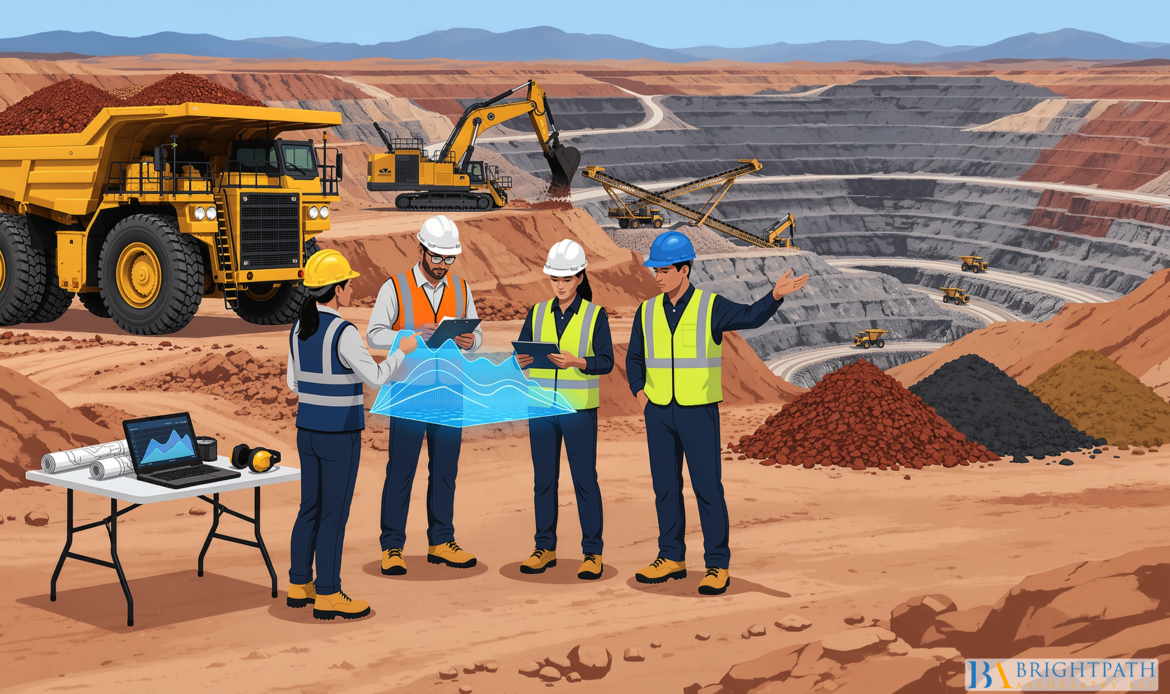
#MetalPrices can rise for years while a mining or processing business still loses flexibility. Higher benchmark prices may be offset by energy, freight, treatment charges, labor, recovery rates, financing costs, or delayed equipment. That is why Market Forecasting for SMEs: How to Anticipate Supercycle Fluctuations for Metal and Mining Industry should not begin with a single price target. It should begin with a practical question: what would a change in market conditions do to our cash margin, capital plan, and leadership capacity?
For small and midsize businesses, forecasting is less about predicting one exact copper, gold, lithium, nickel, or iron ore price. It is about making decisions early enough to preserve cash, avoid poorly timed expansion, and staff critical roles before market pressure makes hiring harder.
Table Of Contents
- Build A Forecast That Supports Decisions
- Test Whether A Price Rise Is Structural
- Turn Forecasts Into Operating And Talent Decisions
- Key Takeaways
- FAQ Section
- Resources And Citations
Build A Forecast That Supports Decisions
Separate Price Forecasting From Cash Margin Forecasting
A commodity forecast answers, “What may happen to the benchmark price?” A business forecast must answer, “Can the company fund operations, meet obligations, and invest if that price occurs?” These are related but different models.
A copper producer, for example, may see a stronger exchange price while receiving a lower realized price because of concentrate quality, penalties, treatment terms, or transport costs. A gold operation may benefit from higher revenue but face higher diesel, contractor, and sustaining capital costs. A metal processor may gain from volume growth while working capital expands faster than cash collections.
Use a cash margin bridge rather than relying on the headline metal price alone.
| Forecast Element | What It Measures | Why It Matters To SMEs |
|---|---|---|
| Benchmark price | Market reference price for the metal | Sets the starting revenue assumption |
| Realized price | Net price after quality, contract, treatment, and transport adjustments | Shows actual revenue per unit |
| Unit cash cost | Energy, labor, consumables, processing, logistics, and site costs | Tests operating resilience |
| Cash margin | Realized price less cash cost | Indicates whether production creates usable cash |
| Liquidity need | Timing of payroll, debt, inventory, and capital spending | Reveals whether a profitable plan can still run out of cash |
This distinction matters most during volatile periods. A business that forecasts only the metal price can mistake a favorable market for a favorable operating position. We recommend putting the cash margin bridge at the center of monthly management reporting, not in an appendix to the annual budget.
Use Three Forecast Horizons
One forecast cannot serve weekly liquidity decisions and multiyear mine development decisions equally well. A practical SME approach uses three connected horizons.
- Near term: 0 to 13 weeks. Track receivables, payable dates, payroll, inventory, shipments, hedges, power costs, and debt service. This is a cash control forecast.
- Operating term: 12 to 24 months. Use this horizon for budget revisions, staffing levels, contractor commitments, maintenance, and purchase decisions. It should include production volumes, recovery assumptions, labor plans, and cost escalation.
- Strategic term: 3 to 10 years. Use scenarios rather than false precision. This horizon informs mine plans, processing capacity, acquisitions, equipment replacement, permitting strategy, and leadership succession.
The World Bank notes that industrial commodity forecasting can combine futures, time series, multivariate, and machine learning approaches, while external variables and forecast combinations can improve performance in some settings. Its review also highlights the need to account for structural breaks rather than assuming historical relationships will hold indefinitely. World Bank research on industrial commodity forecasting methods supports this blended approach.
For an SME, the implication is simple: do not spend heavily trying to build one “perfect” predictive model. Build a repeatable system that connects the right information to the right decision.
Start With A Minimum Viable Data Set
Incomplete data is common in smaller mining and metals organizations. That is not a reason to delay forecasting. It is a reason to make data limits visible.
A workable first version should collect the following inputs by month, and weekly where cash exposure requires it:
• Benchmark price and futures curve for the main commodity
• Realized price by customer, grade, product form, and contract adjustment
• Production, recovery, throughput, ore grade, inventory, and shipment volume
• Energy, fuel, labor, freight, treatment, refining, and maintenance costs
• Working capital timing, debt service, capital commitments, and hedge positions
• External indicators such as industrial production, exchange rates, visible inventories, and major supply disruptions
A spreadsheet can be sufficient at the beginning if ownership is clear. Finance should own cash and margin assumptions. Operations should own production and cost drivers. Commercial leaders should own contracts and realized price adjustments. The chief executive or board should approve scenarios and trigger rules.
#DataQuality improves when it has a named owner. Without that accountability, forecasting often becomes a finance exercise disconnected from site conditions and commercial terms.
Test Whether A Price Rise Is Structural
Do Not Label Every Rally A Supercycle
A supercycle is a long period in which structural shifts in demand, supply, investment, technology, or policy influence commodity markets. It is not merely a strong quarter or a shortage caused by a temporary disruption.
Historical patterns offer context but not certainty. EY reports that prior commodity supercycle upswings have lasted about 5 to 17 years, with peaks roughly 10% to 33% above trend in the periods examined. EY also cautions that the group of commodities benefiting can change during each phase. EY’s analysis of changing commodity supercycle patterns is useful precisely because it discourages broad assumptions that every metal will rise together.
A temporary price spike may come from weather, shipping constraints, short covering, inventory restocking, or a single policy announcement. A stronger supercycle case requires evidence that demand, supply, and capital constraints are changing together.
Use A Structural Test Before Committing Capital
Executives should assess whether the price move survives several questions before approving expansion, acquisitions, or large equipment orders.
| Test | Evidence To Review | What A Weak Result May Mean |
|---|---|---|
| Demand durability | End market orders, infrastructure spending, industrial output, technology adoption | Demand may be cyclical rather than structural |
| Supply response | New mine timelines, project financing, permitting, refinery capacity, scrap availability | High prices may attract supply faster than expected |
| Inventory position | Exchange stocks, customer inventory, warehouse trends, shipment delays | The market may be experiencing short term restocking |
| Cost pressure | Power, labor, fuel, reagents, freight, and capital cost trends | Revenue gains may not convert into margin gains |
| Contract quality | Customer commitments, pricing formulas, volume flexibility, payment terms | The company may not capture the benchmark price increase |
A useful discipline is to require every capital proposal to show three cases:
- A base case using conservative price and operating assumptions.
- An upside case reflecting sustained demand and stronger realized prices.
- A downside case combining lower prices with higher operating costs, delayed production, or weaker recoveries.
If a project works only in the upside case, it is not yet a supercycle investment thesis. It is a price bet.
Watch For Structural Breaks And Byproduct Risk
Historical models can fail when market relationships change. A structural break may occur after a major policy shift, a new processing technology, a trade restriction, an unexpected closure, or a demand change that alters material intensity. A model that was accurate before the break can become misleading because it is averaging conditions that no longer exist.
Forecast governance should include a quarterly review asking:
• Has the relationship between price and industrial output changed?
• Have customer contracts, treatment charges, or freight conditions changed?
• Has a policy decision altered supply access or demand incentives?
• Are forecast errors repeating in one direction?
Byproduct exposure deserves separate treatment. A critical mineral can depend on production at a much larger base metal operation. Deloitte’s 2026 outlook notes that United States availability of some critical minerals can be affected when they are produced as byproducts or coproducts and larger base metal operations reduce output. Deloitte’s 2026 mining and metals outlook on byproduct supply exposure supports the need to model principal and secondary commodities separately.
For example, a company may view a secondary mineral as a useful revenue credit. But if the main mine reduces output because its primary metal margin contracts, that byproduct supply can disappear even when demand for the secondary mineral remains strong.
Global trade and metal prices can also reshape assumptions around routes, customer demand, currency exposure, and input availability. Those factors belong in scenarios, not just in an annual market commentary.
Turn Forecasts Into Operating And Talent Decisions
Convert Scenarios Into Trigger Rules
Forecasts become useful when they change a decision before the business is forced to react. Rather than declaring that prices are “good” or “weak,” set trigger rules tied to cash margin and risk capacity.
Possible rules include:
• Delay discretionary capital spending if downside cash margin falls below the company’s approved threshold for two consecutive forecast updates.
• Review hedge coverage when protected production volume no longer matches expected output, debt requirements, or customer commitments.
• Freeze noncritical hiring if liquidity falls below the board approved minimum cash buffer.
• Accelerate maintenance, workforce training, or high return debottlenecking only when the base case supports funding without relying on the upside scenario.
These are proposed governance practices, not universal industry thresholds. The correct trigger depends on orebody quality, contract structure, debt covenants, working capital needs, and the company’s tolerance for earnings volatility.
Fair warning: hedging is not a substitute for a weak operating model. It can reduce exposure to adverse price movements, but it can also limit participation in an upswing and create obligations if production falls short. Match hedge volumes to realistic #ProductionForecasts, not optimistic capacity figures.
Forecasting Changes Executive Role Requirements
A suspected supercycle often creates an immediate leadership problem. A company may need to increase production, improve recoveries, negotiate better commercial terms, secure permits, deploy mining technology, or manage a larger capital plan at the same time. Those tasks rarely sit neatly within one executive role.
For mining executive search, the question is not simply whether a candidate has worked in the sector. It is whether the individual can lead through the business conditions the forecast reveals.
| Forecast Signal | Leadership Requirement | Hiring Risk If Missed |
|---|---|---|
| Margin compression | Finance leader with cost control, liquidity, and lender communication capability | Delayed action on cash preservation |
| Capacity expansion | Operations or project executive with mine planning, metallurgy, and execution discipline | Cost overruns and schedule slippage |
| Complex customer terms | Commercial leader who understands realized price, quality, and contract risk | Revenue leakage despite higher benchmark prices |
| Technology investment | Executive able to assess data quality, automation, and operating return | Expensive systems with little decision value |
| Regulatory or supply disruption | Leader with policy, permitting, procurement, or risk management depth | Slow response to external constraints |
Specialized searches can be difficult because the needed executive may require a combination of mining operations, metal processing, finance, technology, and stakeholder management. Conventional recruiting may generate applicants with broad leadership credentials but limited familiarity with ore extraction, recovery performance, concentrate economics, or mine site risk.
The business cost of a prolonged vacancy is often indirect. A missing technical leader may delay a recovery improvement program. A vacant finance role may weaken rolling cash forecasts. A missing commercial executive may leave contract terms unexamined during a period of sharp price movement. None of these outcomes are guaranteed, but they are credible risks to test when planning leadership succession.
Emerging mineral markets and mining growth provides useful context for leaders assessing how regional risks and new mineral demand can affect growth assumptions. The practical hiring implication is to define the market risks an executive must manage before drafting the job description.
Build A Lean Forecasting Operating Rhythm
A small company does not need a large analytics department to improve decisions. It needs a disciplined cadence.
- Weekly: Review liquidity, shipments, production variance, benchmark prices, hedge positions, and urgent operating exceptions.
- Monthly: Refresh realized price, cash margin, cost drivers, forecast accuracy, and the 12 month operating outlook.
- Quarterly: Challenge the strategic assumptions, identify structural breaks, update scenarios, and test capital and leadership plans.
- After a major event: Rebuild assumptions after a material policy change, supply outage, weather event, financing change, or operating disruption.
Simple models should remain in place even if the company later adds predictive analytics. Research from McGill University identifies methods ranging from moving averages and exponential smoothing to ARIMA, GARCH, and neural networks in mineral price forecasting. McGill research on mineral commodity price forecasting methods shows the range of available techniques. The right method depends on clean data, decision horizon, and the cost of being wrong.
#MachineLearning may be appropriate when a company has consistent data and a clear short term question. It is less useful when the core challenge is incomplete operational data, an unpriced contract adjustment, or a long term investment decision driven by permitting and geology. In those cases, scenario analysis and management judgment may carry more value than a complex model.
Technology should earn its place by improving a decision. Maximizing mining tech ROI is relevant when leaders are deciding whether data systems, automation, or predictive tools will improve cash margin visibility rather than simply add reporting volume.
Key Takeaways
• A metal price forecast is not enough. SMEs should forecast realized price, unit cash cost, cash margin, and liquidity together.
• Use separate near term, operating term, and strategic forecasts because weekly cash decisions and multiyear capital decisions require different assumptions.
• Treat a supercycle as a hypothesis to test, not a label to justify expansion.
• Review structural breaks when forecast errors repeat or when policy, supply, customer terms, or technology changes the market relationship.
• Model byproducts separately because secondary mineral supply can depend on decisions made at larger base metal operations.
• Link scenarios to trigger rules for hiring, hedging, capital spending, maintenance, and executive succession.
• Define executive requirements from the company’s actual forecast risks, including metallurgy, cash control, commercial terms, mining technology, and sustainable mining obligations.
FAQ Section
What Is A Metals And Mining Supercycle?
A metals and mining supercycle is a prolonged period in which structural changes in demand, supply, investment, technology, or policy influence commodity prices. It differs from a normal price cycle because the underlying drivers may persist across several years. It should still be treated as a scenario, not a certainty.
How Is A Supercycle Different From A Normal Commodity Price Cycle?
A normal cycle can result from inventory changes, seasonal demand, currency movements, short term supply disruptions, or financial market activity. A supercycle generally requires more durable evidence, such as long lived demand growth, limited supply response, and sustained investment constraints. A price rally alone does not prove either condition.
What Data Should A Small Mining Company Collect Before Building A Forecast?
Start with benchmark and realized prices, production volumes, grade, recovery, inventory, shipment timing, energy, labor, freight, treatment charges, debt obligations, and capital commitments. Add a limited set of external indicators that clearly relate to the company’s commodity and customers. Reliable inputs matter more than a long data list.
Should An SME Use Futures Prices, Historical Prices, Supply And Demand Data, Or All Three?
Use all three where available, but give each a defined role. Futures can reflect current market expectations. Historical data can establish ranges and volatility. Supply and demand data can explain why #MarketConditions may change. Combining methods reduces dependence on one flawed assumption.
Is ARIMA Or Machine Learning Practical For A Small Mining Business?
It can be, but only when the business has enough clean, consistent data and a specific forecasting objective. ARIMA may be practical for structured historical series. Machine learning may help with short term signals when many reliable variables exist. Neither approach replaces scenario testing of mine plans, costs, contracts, or cash flow.
How Can A Company Forecast Margins When Energy And Freight Costs Are Volatile?
Model those inputs separately rather than embedding one annual inflation percentage in the budget. Create base, upside, and downside cost cases. Tie the cases to observable drivers such as power contracts, diesel exposure, freight routes, labor agreements, and maintenance requirements. Then test whether margin remains positive under the downside case.
When Should A Miner Hedge Production During A Suspected Supercycle?
Consider hedging when protecting a defined amount of cash flow is more valuable than retaining full upside exposure. The decision should account for debt service, production confidence, hedge liquidity, contract terms, and counterparty risk. Avoid hedging volumes that the business may not produce.
What Should A Company Do When Its Historical Forecast Model Stops Working?
Treat repeated forecast errors as a management signal. Check for structural breaks in policy, demand, supply, contract terms, operating performance, or currency relationships. Recalibrate the model, reduce reliance on historical averages, and use wider scenario ranges until the new conditions become clearer.
Resources And Citations
• World Bank + Forecasting Industrial Commodity Prices: https://openknowledge.worldbank.org/server/api/core/bitstreams/835bf2df-f6eb-4890-83f1-f7f03035f157/content
• McKinsey & Company + Data mining for miners: Using analytics for short-term price movement forecasting: https://www.mckinsey.com/~/media/McKinsey/Industries/Metals%20and%20Mining/Our%20Insights/Data%20mining%20for%20miners%20Using%20analytics%20for%20short-term%20price%20movement%20forecasting/Data-mining-for-miners-Using-analytics-for-short-term-price-movement-forecasting.ashx
• EY + Are the current uptrends in metals pointing to a supercycle?: https://www.ey.com/en_ca/insights/energy-resources/are-the-current-uptrends-in-metals-pointing-to-a-supercycle
• Deloitte + 2026 Mining and Metals Industry Outlook: https://www.deloitte.com/us/en/insights/industry/mining-metals/mining-and-metals-industry-outlook.html
• McGill University + Mineral Commodity Price Forecasting through Time: https://escholarship.mcgill.ca/downloads/qz20sz83c?locale=en
• BrightPath Associates: Global Trade and Metal Prices Reshaping Strategic Planning: https://brightpathassociates.com/global-trade-and-metal-prices-reshaping-strategic-planning/
Find your next leadership role in Mining & Metals Industry today!
Stay informed with the latest insights on Mining & Metals Industry!