
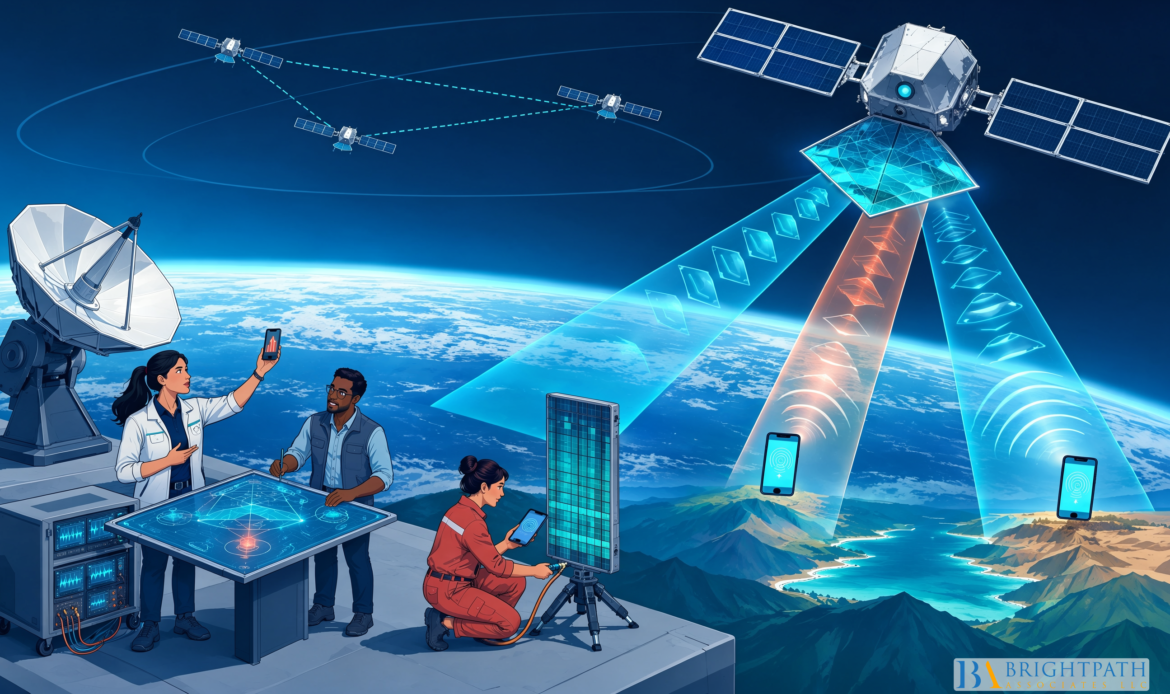
Why Direct-to-Device Connectivity Is New Space Tech Battlefield for Defense & Space Industry is not mainly a story about sending text messages from remote areas. It is a contest over who controls the communications layer between #TerrestrialCellularNetworks, Low Earth Orbit satellites, spectrum rights, handset ecosystems, and defense operations. For executives, the business question is becoming equally clear: can the company build leadership teams capable of operating across all of those layers?
Table Of Contents
- What Direct-to-Device Connectivity Changes
- Where Defense Value Ends and Risk Begins
- Key Takeaways
- Frequently Asked Questions
- Resources and Citations
What Direct-to-Device Connectivity Changes
Direct-to-device connectivity, often called D2D, links an ordinary mobile phone or Internet of Things device to a satellite without requiring a dedicated satellite terminal. That distinction matters. A satellite phone and a fielded military SATCOM terminal were built for satellite access. D2D seeks to extend cellular-style connectivity to devices that already exist in large numbers.
For defense and space leaders, the strategic promise is not simply coverage. It is the ability to add a communications path when cell towers are absent, damaged, overloaded, or outside the operating area. The more difficult question is whether that path can be trusted, prioritized, secured, and sustained during a crisis.
D2D Is a Layered Communications Capability
We should avoid treating D2D as a replacement for protected tactical SATCOM. It is better understood as a complementary layer in a broader communications architecture.
A resilient force may use protected #MilitarySatellite communications for classified command traffic, tactical radios for local unit communications, terrestrial networks where available, and D2D for lower-rate tasks such as status reporting, logistics visibility, sensor alerts, location sharing, and emergency coordination. Each service class has different technical requirements.
| Service Class | Typical Operational Need | D2D Suitability | Core Limitation |
|---|---|---|---|
| Emergency messaging | Short alerts and check-ins | High | Requires network access and satellite visibility |
| Low-rate IoT | Asset status, sensors, logistics tracking | High | Capacity and power limits still apply |
| Voice | Coordination and limited calls | Possible | More demanding than text and sensor traffic |
| Broadband data | Video, maps, large files, applications | Conditional | Requires substantial payload, spectrum, and capacity |
| Classified command traffic | Protected mission systems | Limited without specialized architecture | Commercial D2D is not automatically accredited for this role |
This service-class distinction is easy to overlook. Messaging may work at a time when video cannot. A sensor fleet may remain useful when a broad user base cannot be served at the same performance level. During congestion or disruption, graceful degradation matters more than a headline peak speed. Can the service preserve essential text, position, and alert functions after broadband capacity falls away?
The Federal Communications Commission’s 2025 6G working group report describes D2D development through Low Earth Orbit constellations, hybrid satellite-terrestrial networks, 5G Non-Terrestrial Network integration, and the need for FCC and FAA coordination. The FCC’s 2025 6G working group report makes clear that D2D is not simply an add-on to cellular service. It is part of a larger regulatory, spectrum, and infrastructure problem.
The Real Competition Is Across Bottleneck Layers
Space competition is often described in terms of satellite counts or launch cadence. Those matter, but D2D competition has more bottlenecks than launch capacity alone. A company can have capable satellites and still struggle without spectrum access, carrier partnerships, compatible handsets, gateways, authentication systems, or sufficient constellation capacity.
The critical layers include:
• Satellite payloads and constellation design: Large phased-array antennas, orbit design, beam management, and available capacity determine what service can be delivered.
• Spectrum rights and coexistence: Satellite-to-phone services must coexist with terrestrial mobile users and other satellite systems without harmful interference.
• Mobile network operator integration: Carriers provide subscriber identity, numbering, roaming arrangements, authentication, billing, and many of the handoff functions that make D2D usable at scale.
• Handset and application support: “Standard phone” does not mean every phone, operating system, application, and band configuration will deliver the same experience.
• Government access and assurance: Defense buyers need contractual priority, cyber controls, service continuity, and clarity about who has authority over the network during a contingency.
This is why a mobile network operator partnership can be as strategic as a launch contract. It also explains why leadership requirements are broadening. A chief technology officer with deep satellite experience may not be enough if the organization lacks executives who understand spectrum policy, carrier relationships, cyber risk, defense acquisition, and operational integration.
The same leadership tension appears in adjacent launch and manufacturing decisions. Companies examining strategies for innovation in space launch vehicles should recognize that launch is only one enabler in a D2D system. The commercial value is created when orbit, spectrum, devices, and network operations function together.
Service Models Are Starting to Separate
D2D competitors are not all pursuing the same service class. That is commercially important and operationally important.
AST SpaceMobile states that its system is designed to connect directly to standard phones, reports voice, video, and 5G demonstrations, including a reported peak data speed of 98.9 Mbps, and reports a June 2025 defense-use demonstration with Fairwinds Technologies and the Defense Innovation Unit. These are meaningful milestones, but the AST SpaceMobile capability and demonstration disclosures should not be read as independent proof of sustained combat performance, availability under attack, or military accreditation.
A useful comparison comes from the market strategies rather than marketing language. The Neuberger Berman analysis of D2D service approaches contrasts Starlink and T-Mobile’s reported messaging-oriented service with AST SpaceMobile’s stated ambitions for voice, video, messaging, and broadband. A messaging-first model may reach commercial utility faster because it has lower link-budget and capacity demands. A broadband-focused model may create a larger long-term market, but it must solve a harder payload, spectrum, and scaling problem.
That difference should shape executive decisions. If a company’s near-term defense offering is logistics tracking or PNT-enabled sensor reporting, it may not need to wait for consumer-grade broadband from space. If its plan relies on moving high-volume imagery, simulation data, or full-motion video through D2D, leaders should be more skeptical about capacity assumptions.
Where Defense Value Ends and Risk Begins
D2D can strengthen resilience, but commercial availability and military suitability are not the same thing. Defense organizations operate with requirements that are often stricter than those of #ConsumerNetworks: assured access, sovereign control, secure identity, survivability under interference, auditability, and recovery procedures when a network is degraded.
Ordinary Devices Create a Logistics Advantage and a Security Burden
The logistical appeal is real. If personnel, contractors, vehicles, and distributed sensors can use existing phones or embedded IoT devices, an organization may reduce the burden of issuing, charging, maintaining, training on, and tracking specialized terminals. In dispersed operations, fewer unique devices can simplify sustainment.
But ordinary devices also increase the attack surface. A smartphone is not merely a radio. It is an endpoint with an operating system, applications, identity credentials, wireless interfaces, update dependencies, and user behavior risks. A D2D link can be encrypted while the device itself remains compromised.
Security review should therefore separate several questions:
- Link security: Is traffic encrypted in transit, and how are keys managed?
- Device security: Is the phone or IoT endpoint managed, patched, authenticated, and capable of remote response?
- Network security: How are identities provisioned, roaming handled, gateways protected, and logs retained?
- Mission security: Does metadata expose location, activity patterns, unit composition, or supply movement?
- Resilience security: What happens when jamming, spoofing, interference, cyberattack, or physical gateway loss occurs?
Fair warning: public evidence remains limited on independent anti-jam, anti-spoofing, interception, and cyber resilience testing for commercial D2D systems. Executives should not infer those capabilities from consumer demonstrations. A prudent procurement path uses operational test criteria, not assumptions.
Spectrum Is Both a Policy Issue and an Operational Constraint
#SpectrumCoordination sounds like a regulatory matter until service is needed during a disruption. Then it becomes an operational constraint. Satellite signals, terrestrial cellular use, and other space systems must share finite bands and avoid interference. A system that works in a controlled demonstration may face different conditions in dense urban areas, during major emergencies, or near heavily used spectrum.
The FCC’s work on D2D and 5G Non-Terrestrial Networks shows why coordination reaches beyond communications policy. It involves terrestrial carriers, satellite operators, launch and aviation considerations, and federal agencies. Defense and space companies need leaders who can translate technical constraints into program risk, contract requirements, and customer commitments.
This is one reason the talent market is difficult. The most valuable executive candidates may combine aerospace engineering judgment with commercial telecom experience, Space Regulatory fluency, Space Cybersecurity knowledge, and a credible record in government programs. Those profiles are scarce because these domains developed as separate career tracks.
Procurement Must Test Assured Access, Not Just Technical Demos
A defense buyer should ask a direct question: who gets service when everybody needs it? Assured access means more than a service-level agreement. It includes technical capacity, contractual priority, user authentication, network controls, and clear escalation authority.
Consider a disaster-response scenario where commercial subscribers, emergency agencies, contractors, and military support units are all trying to connect through the same satellite beams. A D2D service may be available in principle, yet a unit’s traffic may compete with thousands of other users. If emergency text gets through but sensor data is delayed, the system has not necessarily failed. It may have degraded in a way that was expected and planned for. If no priority model exists, however, mission owners cannot rely on that outcome.
Kratos frames D2D as a complement to military communications for logistics, IoT, situational awareness, and contested-environment operations. That defense-focused assessment of D2D applications aligns with a disciplined adoption model: use D2D first where lower-bandwidth continuity adds value, rather than forcing it into every mission communications role.
The Executive Hiring Challenge Is an Integration Challenge
For small and mid-sized companies in #DefenseSpaceSystems, Space Electronics, defense manufacturing, Space Robotics, or Defense Simulation, a prolonged leadership vacancy can create more than a reporting gap. It can slow partner negotiations, weaken security governance, delay product-market decisions, and leave technical teams without a clear authority for tradeoffs.
The executive search problem is not simply finding a satellite executive. It is defining the role precisely enough to attract someone who can manage the interfaces.
A board or founder assessing a D2D-related leadership role should establish the following before beginning a search:
| Leadership Need | What To Test For | When It Matters Most |
|---|---|---|
| Product and systems leadership | Ability to connect payload, device, software, and gateway requirements | When building an integrated D2D offering |
| Spectrum and regulatory leadership | FCC process awareness, coexistence discipline, partner coordination | When market access depends on licensed spectrum or carrier relationships |
| Cybersecurity leadership | Endpoint, identity, supply-chain, and incident response governance | When devices carry sensitive operational data |
| Government growth leadership | Contracting, compliance, mission-user translation | When selling into defense or dual-use programs |
| Operations leadership | Manufacturing, launch, supplier, and service reliability tradeoffs | When moving from prototype to scaled service |
Conventional hiring can struggle when the job description lists every requirement as mandatory. That approach narrows the candidate pool to near-zero. We would instead separate non-negotiable mission requirements from capabilities that can be supported by the broader leadership team, advisors, or functional hires.
For example, a startup building a D2D sensor service may need a chief executive or president with defense acquisition credibility and partnership discipline. It may not need that person to be the deepest radio-frequency engineer. Conversely, a company designing payload electronics may need a technical leader with systems authority while adding commercial carrier expertise through a business-development executive.
This is where careful executive search can be justified: not as a generic recruiting service, but as a structured way to map adjacent talent pools, test for transferable expertise, assess leadership capacity under uncertainty, and reduce the risk of an ill-defined hire. The broader key trends shaping the space industry reinforce why companies must plan for cross-functional leadership rather than isolated technical excellence.
Key Takeaways
• D2D is a communications layer, not a universal replacement for military SATCOM. Its near-term defense value is strongest in messaging, low-rate IoT, logistics, location, and situational-awareness use cases.
• Service class determines feasibility. Text, sensor traffic, voice, and broadband make very different demands on satellites, spectrum, power, and payload capacity.
• The competitive battlefield extends beyond satellites. Spectrum, mobile network operator integration, handset compatibility, gateways, launch cadence, and government access rights can each become a bottleneck.
• Commercial demonstrations should not be confused with combat readiness. Independent public evidence remains limited on contested-environment performance, anti-jam capabilities, cyber resilience, and assured military access.
• Leadership teams need integrated expertise. D2D programs bring together space technology, telecom, cybersecurity, regulatory policy, defense acquisition, and operational execution.
• Hiring should begin with the operating model. Define which requirements must sit in one executive role and which can be distributed across the leadership team. This reduces the risk of searching for an unrealistic “unicorn” candidate.
The strategic connection between technology and leadership is central to the critical role of defense R&D innovations. Innovation programs need leaders who can convert technical promise into secure, testable, supportable systems.
Frequently Asked Questions
What Exactly Is Direct-to-Device Satellite Connectivity?
D2D is an architecture that enables a satellite to communicate with a standard mobile phone or IoT device rather than a dedicated satellite terminal. Actual capability depends on the device, satellite geometry, supported frequency bands, service plan, network integration, and available capacity.
How Is D2D Different From a Satellite Phone or Starlink Dish?
A satellite phone is purpose-built for satellite links. A Starlink dish is a dedicated broadband terminal. D2D aims to use ordinary phones or embedded devices, often through a mobile carrier partnership. That convenience can reduce equipment burden, but it can also mean lower available bandwidth and more dependence on cellular-network integration.
Can Soldiers Use Ordinary Smartphones to Communicate Directly With Satellites?
Potentially, for supported services and approved devices. That does not mean an ordinary phone is appropriate for classified communications or every tactical mission. Military use requires device management, authentication, cyber controls, operational procedures, and a clear understanding of what traffic is permitted.
What Can D2D Support Today?
The answer varies by provider and deployment. Messaging and location-related functions generally require less capacity than voice, video, or #BroadbandApplications. Providers have reported different service ambitions, but public demonstrations do not establish a uniform operational standard across the market.
Can D2D Work When Cell Towers Are Destroyed or Unavailable?
It can provide an alternate path when terrestrial coverage is absent or disrupted, provided the user can reach a satellite and the satellite network, gateways, and service authorization remain available. It is not guaranteed continuity under every condition, especially during interference, capacity congestion, or cyber disruption.
Is D2D Secure Enough for Military Communications?
It may be suitable for some unclassified or controlled operational uses if the device, identity, network, and mission-data risks are properly managed. It should not be assumed to meet requirements for protected or classified communications without explicit authorization, testing, and accreditation.
Why Does Spectrum Coordination Matter So Much?
D2D services share radio-frequency resources with terrestrial cellular systems and other satellite users. Poor coordination can lead to interference, unreliable service, regulatory delays, and operational restrictions. #SpectrumStrategy is therefore a business, engineering, and mission-readiness issue.
What Should Defense Buyers Evaluate Before Adopting a D2D Service?
Buyers should test the specific mission service class, handset compatibility, coverage conditions, priority access, cyber architecture, data handling, gateway dependencies, degraded-mode behavior, support model, and contractual rights during a crisis. The right choice may be a limited pilot for logistics or sensors rather than a broad replacement of existing communications systems.
Resources and Citations
- Federal Communications Commission + FCC TAC 6G Working Group Report 2025: https://www.fcc.gov/sites/default/files/FCC-TAC-6G-Working-Group-Report-2025-Final.pdf
- AST SpaceMobile + Frequently Asked Questions: https://ast-science.com/faqs/?
- Kratos Space + From Smartphones to the Battlefield: The Next Front for Satellite Direct-to-Device: https://www.kratosspace.com/constellations/topic/defense-security/page/7
- Neuberger Berman + Connecting the Unconnected: The Direct-to-Device Satellite Revolution: https://www.nb.com/insights/market-signals-connecting-the-unconnected-the-direct-to-device-satellite-revolution
- SES Space & Defense + LEO Relay Service: https://sessd.com/leo-relay-services/
- BrightPath Associates, Space Industry Resource: https://brightpathassociates.com/expanding-universe-key-trends-shaping-the-space-industry/
Find your next leadership role in Defense and Space Industry today!
Stay informed with the latest insights on Defense and Space Industry!