
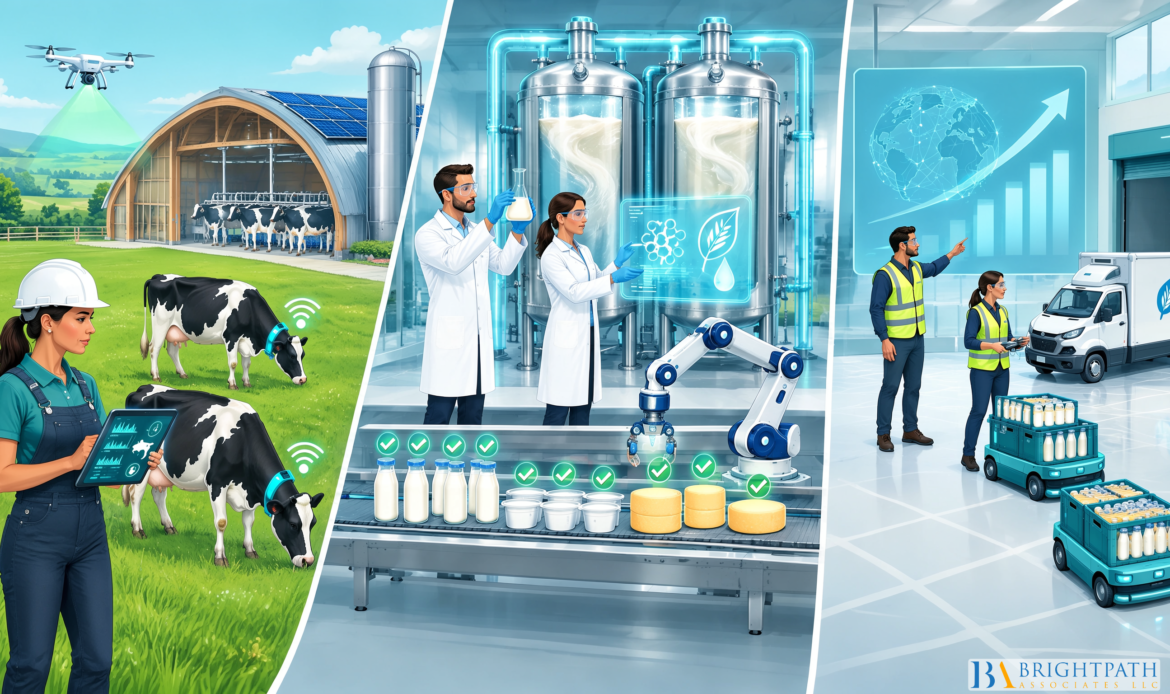
The American #DairySector is undergoing a profound structural transformation. As market dynamics shift between 2026 and 2035, industry executives face a complex operating environment defined by rising milk yields, rapid farm consolidation, evolving consumer preferences, and technological disruption. While raw milk production capacity continues to climb, processing infrastructure, labor supply, and market demand are re-aligning in unexpected ways. Success in the coming decade will not belong simply to the largest producers, but to organizations that master capital efficiency, market positioning, and strategic executive leadership.
At BrightPath Associates, we analyze industry trends to help business leaders navigate structural change and build resilient, high-performing organizations. Understanding the next decade of dairy requires looking beyond top-line production forecasts. Executives must deconstruct raw milk growth into regional processing capabilities, evaluate margin logic across product categories, and prepare their leadership teams for an increasingly automated, data-driven supply chain.
Table of Contents
• Key Takeaways
• The Production and Processing Bottleneck Map
• Category Economics and Value Capture Strategies
• Technological Disruptors: Precision Fermentation and Automation
• Export Dependency, Supply Chains, and E-Commerce
• Executive Talent and Leadership Requirements for 2030
• Frequently Asked Questions
• Resources and Citations
Key Takeaways
• Yield-Driven Production Growth: U.S. milk production is projected to reach approximately 243.7 billion pounds by 2030, driven almost entirely by higher milk yield per cow rather than expanded herd sizes.
• Processing Capacity Bottlenecks: Planned capital investments exceeding $15 billion are reshaping processing capability, but regional imbalances in transport, storage, and wastewater infrastructure present major operational bottlenecks.
• Margin Migration to High-Protein Components: Value creation is shifting rapidly away from fluid milk toward high-protein, lactose-free, and ultra-filtered dairy products alongside concentrated whey and butterfat.
• Dual-Threat Alternative Proteins: Precision fermentation poses a specific ingredient-level disruption for isolated proteins, requiring conventional dairy leaders to articulate clear quality, functional, and processing advantages.
• Leadership Talent Deficits: Technical and executive talent shortages in automated processing, digital operations, and strategic financial planning represent a primary operational vulnerability for mid-sized processors.
The Production and Processing Bottleneck Map
Milk Yield Expansion and Farm Consolidation Dynamics
Raw milk volume in the United States continues to expand despite a declining total number of dairy farms. According to Ohio State University Extension’s summary of USDA projections, U.S. milk production is projected to grow from 225.9 billion pounds in 2024 to nearly 243.7 billion pounds by 2030. Over the same period, average milk yield per cow is projected to increase from 24,177 pounds to 25,607 pounds.
This growth trajectory is built on advancements in herd genetics, precision nutrition, and sophisticated milk production technologies. However, economic scale pressures mean smaller operations continue to exit the market or consolidate into larger enterprises. This concentration alters local milk supply sheds. Larger farms demand consistent, high-volume off-take, altering how raw milk is gathered, pooled, and routed to #ProcessingFacilities.
Regional Processing Bottlenecks and Infrastructure Limits
While milk output per cow increases, regional processing capacity often lags behind farm production. According to industry reporting by Food Processing, dairy processors have committed over $15 billion to new and expanded plant projects across 23 states through 2030. Yet, adding capacity is not simply a matter of pouring concrete and installing stainless steel tanks.
Processors routinely run into severe regional constraints:
- Wastewater Treatment Constraints: Expanding a milk intake facility from two million to four million pounds per day requires significant industrial wastewater handling, often exceeding local municipal utility limits.
- Cold-Chain Logistics and Hauling Deficits: Milk haulers face persistent driver shortages and rising fleet maintenance costs, creating localized bottlenecks during seasonal peak production windows.
- Utility and Power Grid Reliability: Modern automated processing plants require heavy electricity draw and natural gas access, which can strain rural energy infrastructure.
[ Farm Milk Production Growth ]
│
▼
[ Regional Milk Assembly & Transport ] ◄── (Bottleneck: Hauler & Driver Shortages)
│
▼
[ Intake & Storage Facilities ] ◄── (Bottleneck: Peak Season Surge Storage)
│
▼
[ High-Value Processing & Filtration ] ◄── (Bottleneck: Wastewater & Energy Grid Limits)
│
▼
[ Finished Product Logistics & Export ]
The Capital Allocation Imperative for Processing Infrastructure
For #StrategicLeadershipTeams, overcoming regional processing bottlenecks requires dynamic capital allocation. Investing heavily in expanding raw intake without securing downstream processing flexibility leaves facilities vulnerable to milk dumping or heavy discounting during spring flushes. Executives must evaluate plant design through the lens of multi-product output flexibility, ensuring assets can shift between cheese, butterfat, and dried protein powders based on prevailing market pricing.
When evaluating multi-decade capital equipment investments, enterprise leaders often examine cross-industry operational frameworks, such as navigating the glass market key trends shaping the next decade, to understand how heavy manufacturing sectors balance raw material surges against capital depreciation risks.
| Capability Focus Area | Operational Challenge | Strategic Mitigation Strategy | Capital Requirement | Risk Horizon |
|---|---|---|---|---|
| Raw Milk Intake & Storage | Peak volume surges outstripping siloing capacity | Investment in regional balancing facilities & automated scheduling | High | Short-Term (1-3 yrs) |
| Wastewater Treatment | Environmental limits on plant throughput expansion | On-site anaerobic digestion & water recovery systems | Medium to High | Mid-Term (3-5 yrs) |
| Flex Processing Lines | Demand shifts between cheese, powder, and liquid lines | Modular filtration and multi-format pasteurization loops | High | Long-Term (5-10 yrs) |
| Automated Material Handling | Labor scarcity in cold-storage and warehouse staging | Automated guided vehicles (AGVs) & robotic palletizing | Medium | Short-Term (1-3 yrs) |
Category Economics and Value Capture Strategies
Fluid Milk Decline Versus High-Protein Solubles
Per-capita fluid milk consumption in the United States has experienced a multi-decade decline, a pattern expected to continue through 2030. Consumers are increasingly replacing traditional beverage milk with specialized functional drinks, plant-based alternatives, or high-protein dairy beverages. Consequently, enterprise value creation has decoupled from fluid volume sales.
Growth strategies now center on component processing. Modern dairy product development prioritizes isolating milk’s high-value components: whey protein isolates, micellar casein, milk mineral complexes, and specialized fats. Processors that convert raw skim milk into high-value nutrition ingredients generate significantly higher gross margins per hundredweight than traditional fluid bottling plants.
Cheese, Butter, and Whey Margin Logic
Cheese and butterfat remain core structural pillars of domestic commercial demand. However, the profitability of a modern cheese facility is tied directly to its co-product utilization. A plant that views whey as a waste stream operates at an extreme competitive disadvantage compared to one that processes raw whey into ultra-filtered whey protein concentrate (WPC80) or isolate (WPI90).
Executives analyzing component economics must balance three core operational vectors:
• Fat Optimization: Directing butterfat into retail butter, cream cheese, or high-fat specialty cheeses based on spot market returns.
• Protein Fractionation: Utilizing advanced membrane filtration to extract native proteins for sports nutrition and clinical health markets.
• Lactose Recovery: Concentrating and drying lactose for export markets or pharmaceutical applications to maximize solids recovery.
Understanding these market shifts is critical for mid-sized processors. Executives seeking deep market analysis can review our insights on analyzing 2026 dairy protein market trends and export opportunities to align product development cycles with global ingredient demand.
Ultra-Filtered Milk and Segment Innovation Strategies
Ultra-filtered milk represents one of the fastest-growing liquid dairy categories. By passing milk through fine membranes, processors remove water and lactose while concentrating natural protein and calcium. This yields a product line with higher protein density, lower sugar, and lactose-free attributes that directly address modern consumer health preferences.
For mid-sized processors, entering the ultra-filtered space requires significant technological investment in membrane systems, ultra-high temperature (UHT) processing, and aseptic packaging lines. However, the premium pricing achieved by ultra-filtered fluid products provides a proven pathway to offset rising raw milk assembly and #DistributionExpenses.
Technological Disruptors: Precision Fermentation and Automation
Component-Level Exposure and Dual-Threat Analysis
Food technology innovations are altering the competitive dynamic for dairy product manufacturing. According to research published in Food Science of Animal Resources, precision fermentation leverages genetically engineered microorganisms to produce milk-identical proteins such as beta-lactoglobulin and casein without traditional animal husbandry.
While cellular agriculture and precision fermentation face ongoing cost-parity challenges for high-volume commercial scaling, their primary disruptive threat lies in isolated ingredient markets. Industrial bakeries, snack food makers, and nutritional supplement brands can utilize fermented proteins as functional replacements for dry whey and powdered milk solids.
[ Dairy Sector Competitive Threat Matrix ]
Component Market Vulnerability:
High Exposure │ Whey Powders, Nonfat Dry Milk, Industrial Casein
│ (High threat from precision fermentation ingredients)
│
Medium Exposure│ Standard Processed Cheese, Retail Skim Milk
│ (Moderate threat from plant-based & blended formats)
│
Low Exposure │ Aged Natural Cheeses, Butterfat, Ultra-Filtered Fluid Milk
│ (Low threat due to complex flavor, matrix, & functionality)
────────────────┴──────────────────────────────────────────────────────────
Low Complexity High Complexity
Product Functionality
To counter component displacement, conventional processors must emphasize the holistic nutritional profile, complex fat matrix, and culinary attributes of natural dairy. Furthermore, investments in sustainable dairy farming practices provide a structural narrative that precision-fermented components struggle to replicate in consumer-facing retail branding.
Dairy Automation Technologies and Digital Transformation
#LaborShortages in rural processing corridors have accelerated the adoption of dairy automation technologies. Modern dairy manufacturing plants rely heavily on digital systems to maintain operational continuity and continuous quality verification.
Key areas of technological integration include:
• Automated Intake Sampling: Robotic sensors and rapid mass spectrometers test incoming raw milk tankers for antibiotics, temperature compliance, and component ratios in real time, reducing bay dwell time by over 40%.
• Predictive Maintenance for CIP (Clean-In-Place) Systems: Digital flow meters and conductivity sensors monitor automated sanitation loops, optimizing chemical usage and reducing wash downtime between product runs.
• AI-Driven Yield Optimization: Advanced process-control algorithms dynamically adjust membrane pressures and thermal pasteurization settings to maintain exact cheese-yield formulas despite batch-to-batch variations in raw milk solids.
Implementing these automated control systems requires high-level technical expertise. Senior operations teams must blend traditional food science knowledge with industrial software management, cybersecurity awareness, and automated systems engineering.
Sustainable Dairy Farming Practices and Methane Mitigation
Environmental sustainability has evolved from a corporate communications initiative into a operational standard enforced by financial institutions, retail customers, and regulatory bodies. Measuring and reducing Scope 3 carbon emissions across the supply chain is now mandatory for market leaders.
At the farm level, methane mitigation strategies include installing anaerobic digesters that convert animal waste into renewable natural gas (RNG), adopting precision feed additives that diminish enteric fermentation emissions, and implementing advanced nutrient management plans. Processors that proactively integrate sustainable sourcing models into their brand architecture secure preferential positioning with major national grocery chains and food-service distributors.
Organizations evaluating corporate ESG integration and organizational alignment can examine strategic insights on sustainability and leadership in dairy industry to align environmental targets with long-term enterprise value creation.
Export Dependency, Supply Chains, and E-Commerce
Skim-Solids Export Dependencies and International Trade Risks
The U.S. dairy industry relies heavily on international markets to balance domestic supply and demand. Ohio State University Extension notes that by 2030, U.S. dairy exports are projected to equal 4.0% of milk production on a milk-fat-equivalent basis and 22.6% on a skim-solids-equivalent basis.
This high concentration of skim-solids exports—primarily nonfat dry milk, skim milk powder, whey products, and lactose—exposes U.S. processors to international trade policy, exchange rate fluctuations, and foreign port congestion. When international powder demand softens, domestic spot prices for raw skim milk drop sharply, compressing processor margins overnight.
To manage international market risk, commercial teams must:
- Establish long-term supply contracts with multi-national food manufacturers in growth regions across Southeast Asia and Latin America.
- Upgrade drying facilities to yield higher-grade, specialized nutritional powders rather than standard commodity nonfat dry milk.
- Diversify product portfolios to ensure domestic market channels can absorb temporary export disruptions.
Dairy Supply Chain Integration and Logistics Automation
Maintaining cold-chain integrity across complex, international dairy supply chains requires advanced digital tracking. Internet-of-Things (IoT) temperature sensors and real-time GPS tracking allow supply chain leaders to monitor refrigerated containers from processing plant loading docks to overseas destination ports.
Furthermore, #SupplyChainLeaders are restructuring inventory management strategies. Instead of holding vast reserves of finished commodity cheese in centralized cold storage, processors are leveraging predictive analytics to align production runs directly with retail pull signals, reducing working capital requirements and minimizing product spoilage risks.
Direct-to-Consumer Pathways and Dairy E-Commerce Models
While bulk commercial supply chains dominate total volume, dairy e-commerce is emerging as a profitable channel for specialized, value-added products. Premium artisanal cheeses, specialty butter products, and direct-to-consumer high-protein functional beverages have built sustainable e-commerce fulfillment models.
Successful dairy e-commerce requires specialized packaging engineering. Processors must utilize eco-friendly, thermally insulated shippers and phase-change gel packs capable of maintaining product temperatures below 40°F during standard 48-hour parcel transport windows. Though direct-to-consumer sales represent a minor percentage of total milk volume, the direct consumer relationships and higher gross profit margins provide valuable brand equity and market testing platforms.
Executive Talent and Leadership Requirements for 2030
Technical Workforce Gaps in Automated Processing Operations
As processors install advanced dairy automation technologies and automated membrane filtration loops, the core skill sets required in manufacturing facilities are changing dramatically. Traditional manual plant operational roles are rapidly being superseded by technical positions demanding expertise in robotics, programmable logic controllers (PLCs), sanitary design engineering, and automated sanitation validation.
Mid-sized dairy organizations face severe competition from general food processing, pharmaceutical, and technology sectors for this specialized talent. A vacancy in a critical role—such as a plant automation manager or senior continuous-improvement engineer—can halt plant expansion projects, trigger prolonged operational downtime, or compromise product safety compliance.
[ Historical Operations Talent Model ] [ Modern 2030 Executive Talent Model ]
┌──────────────────────────────────────┐ ┌──────────────────────────────────────┐
│ • Focus on Manual Processing │ │ • Cross-Discipline Data Analytics │
│ • Direct Labor Supervision │ ───► │ • Automated Systems & PLC Engineering│
│ • Traditional Quality Assurance │ │ • Scope 3 ESG & Sustainability Governance
│ • Reactive Plant Maintenance │ │ • Dynamic Margin & Capital Management│
└──────────────────────────────────────┘ └──────────────────────────────────────┘
C-Suite Requirements for Digital Transformation and Sustainability
To maintain market leadership over the next decade, executive boards and C-suite leadership must possess a broader set of competencies than previous generations of dairy leadership. Presidents, Chief Operating Officers, and Chief Supply Chain Officers must synthesize complex operational variables into clear strategic roadmaps.
Key executive competencies for the next decade include:
• Digital Transformation Leadership: Ability to evaluate, implement, and scale industrial automation, enterprise resource planning (ERP) platforms, and AI-driven yield optimization software.
• Capital Expenditure Governance: Capacity to evaluate complex, multi-year facility expansion projects against fluctuating commodity market dynamics and return-on-invested-capital (ROIC) targets.
• ESG and Regulatory Strategy: Deep understanding of carbon accounting metrics, climate reporting regulations, and farm-to-fork traceability protocols required by global commercial partners.
Dairy Industry Executive Search and Risk Mitigation in Leadership Vacancies
Finding #ExecutiveLeadership capable of steering a mid-sized dairy processor through market volatility represents a strategic imperative. Traditional recruitment channels frequently fail when searching for candidates who possess both specialized food science knowledge and advanced corporate leadership capabilities.
Prolonged executive vacancies in key positions create direct enterprise risks:
• Strategic Project Delays: A six-month vacancy in a Chief Technology Officer or VP of Operations role can freeze major capital expansion projects, costing millions in lost market opportunities.
• Operational Margin Erosion: Ineffective operational leadership can lead to lower plant yields, poor milk component utilization, and elevated product scrap rates.
• Loss of Competitive Advantage: Delayed adoption of automation or sustainability initiatives allows key market competitors to capture market share in premium categories.
Engaging a specialized executive search firm provides middle-market dairy companies with access to passive, highly qualified executive talent. Through rigorous candidate assessment methodologies, dairy industry executive search ensures that incoming leadership possesses the precise blend of technical expertise, strategic vision, and cultural fit required to drive sustainable growth across the next decade.
Frequently Asked Questions
What will the U.S. dairy industry look like by 2030 or 2035?
By 2030 and beyond, the U.S. dairy industry will feature higher total milk production concentrated across fewer, larger dairy farms. Production will be driven primarily by gains in milk yield per cow rather than expanded herd numbers. Processing facilities will become larger, highly automated, and strategically located near major transportation corridors and raw milk sheds, with product portfolios focused heavily on high-protein solids, specialized cheeses, and functional ingredients.
Will U.S. milk production grow even as the number of dairy farms declines?
Yes. U.S. milk production is projected to grow consistently despite farm consolidation. Advancements in bovine genetics, precision herd nutrition, automated milking systems, and data-driven herd management allow remaining farms to produce significantly more milk per animal, offsetting the decline in total farm numbers.
Which dairy categories have the strongest growth prospects over the next decade?
High-protein components, ultra-filtered milk products, specialized cheeses, butterfat, and lactose-free dairy formats hold the strongest growth prospects. Traditional fluid beverage milk will likely continue its structural per-capita decline, shifting processor investments toward fractionation technologies and functional nutritional products.
How serious is the competitive threat from precision fermentation and cell-based dairy?
Precision fermentation presents a targeted threat primarily to isolated dairy ingredient markets, such as dry whey powders, industrial proteins, and processed ingredient solids. However, conventional dairy retains a strong competitive advantage in whole foods, natural aged cheeses, fresh butterfat, and affordable, large-scale consumer nutrition due to sensory complexity and high production costs for cell-based substitutes.
How are labor shortages impacting dairy plant operations?
Labor scarcity in rural processing regions has forced dairy processors to accelerate investments in plant automation, robotics, and digital process controls. Key areas of automation include raw milk intake testing, Clean-In-Place (CIP) sanitation systems, automated packaging, and warehouse #MaterialHandling.
Why are exports critical for U.S. dairy processors?
International markets absorb a large share of U.S. skim milk solids, particularly nonfat dry milk, whey proteins, and lactose. With domestic liquid milk consumption declining, exports provide an essential demand outlet that balances national milk production and stabilizes farm-level raw milk prices.
What key leadership roles are most in demand for modern dairy companies?
Modern dairy processors actively seek operational and corporate executives with strong backgrounds in industrial automation, enterprise resource planning, sustainable supply chain management, and high-value ingredient commercialization. Cross-functional leaders who combine food technology understanding with disciplined financial management are in particularly high demand.
Resources and Citations
• Ohio State University Extension — USDA Projects Dairy Production to 2030
• Food Processing — Dairy Processors Push to Keep Up with Demand
• Food Science of Animal Resources — Biotechnology Approaches to Dairy Alternatives Through Precision Fermentation and Cellular Agriculture
•BrightPath Associates — Dairy market trends and growth strategies: https://brightpathassociates.com/dairy-market-trends-reshape-industry-growth-strategies/
Find your next leadership role in Dairy Industry today!