
Introduction
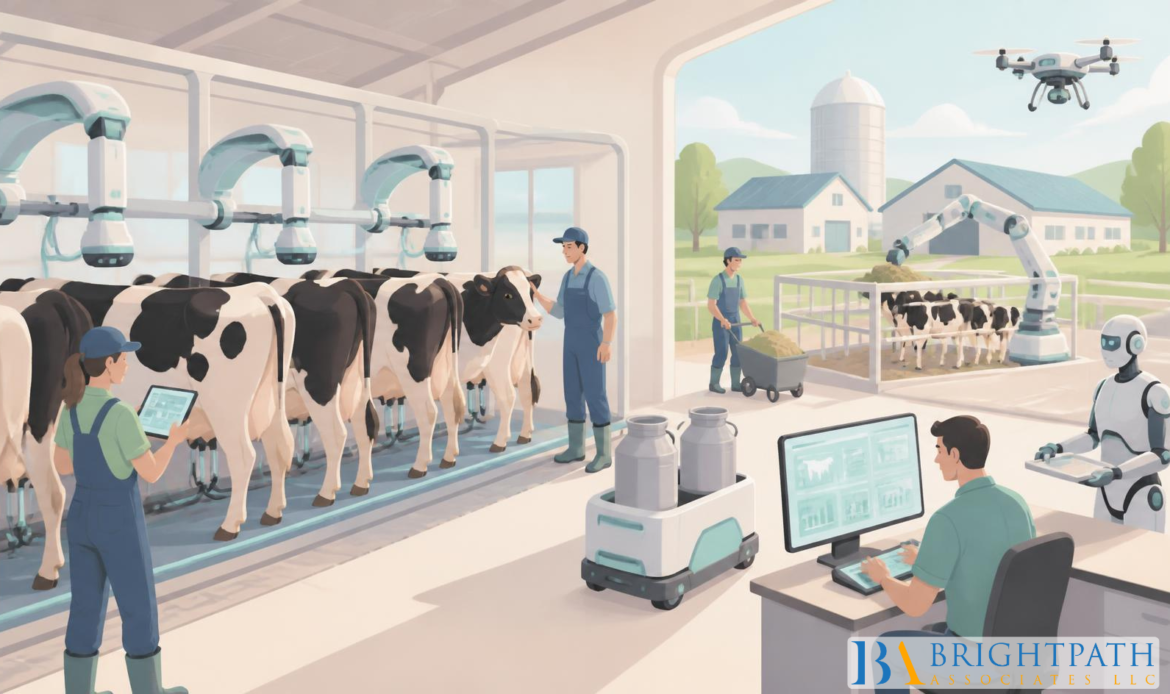
The #DairyIndustry is entering a new era in which artificial intelligence (AI), robotics, and human expertise are increasingly working together to reshape farm operations. Modern dairy farms are adopting advanced technologies to improve productivity, maintain milk quality, manage animal health, and address persistent labor shortages. As consumer expectations rise and operational costs increase, dairy producers must find innovative ways to balance automation with the practical knowledge and experience of their workforce.
The integration of AI and robotics is changing how farmers approach feeding, milking, cleaning, breeding, and herd management. Automated systems can collect information continuously, identify emerging problems, and perform repetitive tasks with greater consistency. However, technology alone cannot replace the judgment, adaptability, and animal-handling skills that experienced dairy workers bring to daily operations.
This transformation extends beyond individual farms. It influences Dairy product development, Milk production technologies, Food technology, and the broader dairy supply chain. Businesses must also rethink workforce planning, employee training, and leadership requirements to remain competitive. The future of dairy farming will depend on combining intelligent machines with capable people, ensuring that technological progress strengthens both operational performance and animal welfare.
Artificial intelligence is becoming an important tool for improving decision-making on modern dairy farms. AI-enabled systems can analyze information collected from wearable sensors, automated milking equipment, feeding systems, cameras, and environmental monitoring devices. By identifying patterns in this information, these systems can help farmers recognize changes in animal behavior, production levels, and overall herd performance.
For example, monitoring systems may identify changes in rumination, movement, or feeding behavior that indicate potential health problems. Early alerts allow farm managers to investigate concerns before they develop into more serious conditions. AI can also support reproductive management by helping identify suitable breeding windows and highlighting animals that require additional attention.
These applications can reduce the time employees spend manually monitoring every animal. However, reliable results depend on data quality, appropriate system configuration, and human verification. AI-generated alerts should guide decisions rather than replace veterinary expertise or experienced farm management.
As dairy operations become more data-driven, employees must develop the skills needed to interpret system outputs, investigate unusual results, and apply practical knowledge. The value of AI therefore comes not only from automation but also from its ability to help people make better-informed decisions.
Robotics and the Evolution of Daily Farm Operations
Robotics is changing the physical nature of dairy work by automating repetitive and labor-intensive activities. Robotic milking systems, automated feed pushers, manure removal equipment, and specialized cleaning solutions can reduce manual workloads while improving operational consistency.
Robotic milking systems allow eligible cows to enter milking units according to established management protocols. These systems can collect information about milk yield, milking frequency, and selected milk-quality indicators. Farm employees can use this information to monitor performance, identify irregularities, and organize follow-up activities.
Automated feeding equipment can distribute feed according to programmed schedules, while robotic cleaning systems help maintain hygiene in designated areas. Depending on the farm’s layout and equipment, automation may also improve the consistency of routine tasks and reduce employees’ exposure to physically demanding work.
Nevertheless, robotic systems require investment, maintenance, training, and appropriate infrastructure. Equipment failures, sensor malfunctions, and connectivity problems can interrupt operations if contingency plans are inadequate.
The future workforce must therefore include employees who understand both dairy production and basic technical troubleshooting. Human oversight remains essential for ensuring that automated systems operate safely and respond appropriately to changing farm conditions.
Dairy automation technologies are increasingly becoming central to farm productivity strategies. These technologies help coordinate milking, feeding, cleaning, cooling, and monitoring activities, allowing farms to standardize processes and improve the use of available labor.
Automation can be particularly valuable for farms facing recruitment difficulties or high employee turnover. By reducing repetitive manual tasks, it can help existing employees manage larger workloads without relying exclusively on additional physical labor. However, automation does not automatically eliminate staffing requirements. Instead, it often changes the number and type of skills required.
Employees may spend less time performing routine activities and more time supervising equipment, analyzing operational information, maintaining machinery, and responding to exceptions. Farm managers must redesign responsibilities accordingly rather than simply introducing new equipment into existing workflows.
Effective implementation begins with understanding the farm’s actual operational challenges. Producers should evaluate equipment costs, expected productivity improvements, maintenance availability, training requirements, and the reliability of supporting infrastructure.
When introduced strategically, automation can improve consistency and labor efficiency while creating opportunities for employees to develop more technical and decision-oriented responsibilities.
The Human Element: Why Skilled Dairy Workers Still Matter
Despite rapid technological advancement, the human element remains fundamental to successful dairy farming. Animals can behave unpredictably, environmental conditions can change rapidly, and equipment readings may not always explain the complete situation. Experienced workers can recognize subtle signs of discomfort, unusual behavior, poor appetite, or changes in herd dynamics that automated systems may overlook.
#HumanJudgment is particularly important when interpreting information that requires context. A sensor may identify reduced movement, but an experienced employee must determine whether the change relates to illness, heat stress, injury, environmental conditions, or another factor requiring investigation.
Employees also play an essential role in maintaining animal welfare. Appropriate handling, timely intervention, observation, and consistent care influence the health and comfort of the herd. Automated systems can support these responsibilities, but they cannot independently replace the full range of human interactions required in dairy management.
Moreover, successful farms depend on communication, teamwork, accountability, and problem-solving. Workers must coordinate activities across milking, feeding, animal care, maintenance, and quality control.
The most effective dairy operations will therefore treat technology as a tool that strengthens human capability rather than as a substitute for all human involvement.
Advances in Milk production technologies are helping dairy farms improve efficiency while maintaining consistent production standards. Modern milking systems can monitor individual animal performance, record milking activity, and identify certain irregularities that require further assessment.
When integrated with cooling, storage, and quality-monitoring processes, these systems can help farms maintain better operational control. Timely cooling, equipment sanitation, and appropriate milk handling remain essential for preserving quality and reducing contamination risks.
Automation can improve process consistency, but reliable milk production still depends on disciplined operating procedures and trained employees. Workers must understand cleaning protocols, equipment inspection, milk segregation requirements, and the importance of promptly reporting abnormalities.
Digital monitoring can also support traceability by connecting production information with herd records and collection activities. This creates opportunities for better communication between farms, processors, and other supply chain participants.
As technology advances, dairy employees will increasingly need a combination of practical production knowledge and digital literacy. Understanding how automated equipment works, what its alerts mean, and when manual intervention is necessary will become an important part of professional competence.
Food Technology and Data-Driven Dairy Product Development
The influence of AI and automation extends beyond the farm into processing, quality management, and Dairy product development. Food technology is enabling dairy businesses to improve product consistency, strengthen traceability, optimize processing parameters, and respond to changing consumer preferences.
Information collected during milk production can help processors understand variations in raw milk characteristics and plan appropriate quality-control procedures. When data systems are integrated effectively, they can support better coordination between farms and processing facilities.
AI-assisted analysis may also help businesses identify production patterns, evaluate consumer demand, and support the development of new dairy products. However, product formulation, food safety validation, and quality approval still require appropriate scientific expertise and regulatory oversight.
The connection between farm-level data and processing operations can become especially valuable when businesses seek to reduce waste and improve resource utilization. Better visibility into production conditions may help identify inefficiencies before they create larger downstream problems.
Employees working across these functions must understand how their responsibilities influence the quality and commercial value of dairy products. This encourages a more integrated approach to workforce development, linking animal care, production technology, processing requirements, and consumer expectations.
Sustainable dairy farming practices increasingly depend on efficient resource management, responsible animal care, and measurable environmental performance. AI and robotics can contribute to these objectives by helping farms monitor feed consumption, manage manure, optimize water use, and identify operational inefficiencies.
Precision feeding systems may support more accurate ration distribution, while monitoring technologies can help farm managers assess resource use and identify opportunities to reduce waste. Automated manure handling and cleaning systems may also improve consistency in waste management, depending on the farm’s infrastructure.
These technologies can support sustainability goals, but their environmental benefits depend on implementation. Robotic equipment consumes energy, digital systems require resources, and manufacturing and maintaining advanced machinery also have environmental implications.
Human oversight is therefore necessary to evaluate whether technological investments produce meaningful improvements. Farm managers must consider energy consumption, maintenance needs, animal welfare, and overall resource efficiency rather than assuming that automation is automatically sustainable.
Combining operational data with practical agricultural knowledge allows producers to make more balanced decisions. This approach can improve resilience while supporting responsible long-term farm management.
Dairy Industry Digital Transformation and Workforce Reskilling
Dairy industry #DigitalTransformation involves more than installing connected equipment. It requires changes in workplace processes, employee responsibilities, management practices, and organizational culture.
As digital systems become more common, dairy workers need training in data interpretation, equipment monitoring, digital recordkeeping, and basic troubleshooting. Supervisors may also need to develop stronger analytical skills to evaluate performance indicators and translate technical information into operational decisions.
Reskilling is especially important for experienced employees who understand animal care but have limited exposure to digital tools. Their practical expertise remains valuable, and training should build on this foundation rather than treating technology as a replacement for traditional knowledge.
Employers can introduce structured training programs that combine hands-on demonstrations, supervised equipment operation, and scenario-based problem-solving. Equipment suppliers can also contribute through technical instruction and maintenance support.
Successful transformation requires employee participation. When workers understand why a technology is being introduced and how it can improve their working conditions, they are more likely to adopt it effectively. Clear communication and opportunities for feedback can reduce resistance and reveal practical problems that managers might otherwise overlook.
Modern dairy operations increasingly depend on coordination between farms, collection centers, processors, distributors, retailers, and service providers. Dairy supply chain management can benefit from digital records, automated monitoring, and improved information sharing across these interconnected activities.
Farm-level production data can help processors estimate incoming milk volumes and coordinate collection schedules. Traceability systems can support the identification of production batches, while temperature monitoring can help stakeholders detect conditions that may compromise product quality during transportation and storage.
These capabilities can improve planning, reduce avoidable delays, and strengthen accountability. However, effective supply chain integration requires accurate data, reliable connectivity, compatible systems, and clearly defined responsibilities.
Human coordination remains essential when disruptions occur. Employees must respond to equipment failures, transport delays, quality concerns, and sudden changes in demand. Technology can provide earlier warnings and better information, but people remain responsible for coordinating practical responses.
A connected dairy supply chain therefore combines automated information flows with skilled professionals who can interpret problems, communicate across organizations, and protect product integrity.
Dairy E-Commerce and Changing Commercial Requirements
Dairy e-commerce is creating new opportunities for producers, processors, and retailers to reach customers through digital ordering systems, subscription services, and direct-to-consumer channels. These business models can improve market access, but they also create additional demands involving inventory planning, order fulfillment, product freshness, and delivery coordination.
AI-driven forecasting may help businesses estimate demand and manage production schedules. Digital platforms can also provide information about purchasing patterns, customer preferences, and regional demand variations.
However, dairy products often have specific temperature-control and shelf-life requirements. Businesses must ensure that digital sales growth is supported by reliable cold-chain infrastructure, appropriate packaging, and effective distribution processes.
The growth of online channels also changes workforce requirements. Employees may need skills in digital order management, inventory coordination, customer service, and logistics planning.
For dairy businesses, technology-driven commercial expansion works best when integrated with farm production capacity and supply chain capabilities. This alignment helps ensure that increased demand does not compromise quality, operational efficiency, or customer confidence.
#DairyIndustry growth strategies increasingly require leaders to balance technology investment, workforce development, financial performance, and sustainable production. Decisions about robotics and AI should be based on measurable business needs rather than the assumption that the newest technology will always deliver the greatest benefit.
Leaders must evaluate the cost of equipment, financing requirements, expected labor savings, maintenance expenses, productivity gains, and potential operational risks. They must also assess whether employees have the skills and support needed to operate new systems effectively.
A strong growth strategy integrates farm operations, processing requirements, distribution networks, and customer expectations. It also establishes clear performance measures, such as equipment reliability, milk quality, animal health indicators, labor efficiency, and resource consumption.
Leadership is especially important during periods of organizational change. Managers must communicate expectations, provide training, and ensure that employees have opportunities to contribute to implementation decisions.
When technology investment is supported by realistic planning and effective leadership, dairy businesses can improve productivity while building a more adaptable workforce.
Dairy Industry Executive Search and Executive Search Recruitment
As modern dairy farms become more technology-intensive, recruitment requirements are evolving. Dairy industry executive search is increasingly important for identifying leaders who understand agricultural operations, automation, digital systems, and commercial strategy.
Businesses may need farm managers, operations directors, automation specialists, supply chain leaders, and technology-focused executives who can connect technical investment with practical production objectives. These professionals must often manage multidisciplinary teams while balancing animal welfare, financial performance, and sustainability.
#ExecutiveSearchRecruitment can help organizations identify candidates with the combination of leadership experience, agricultural knowledge, and technological understanding needed for this transition. Recruitment assessments should examine not only technical qualifications but also change management, employee development, operational problem-solving, and strategic decision-making.
However, hiring capable leaders is only one part of workforce planning. Organizations must also invest in frontline employee training, retention, succession planning, and internal career development. Experienced dairy workers should have opportunities to progress into supervisory, technical, or specialist positions.
By aligning recruitment with long-term business objectives, dairy companies can create stronger leadership pipelines and develop workforces capable of adapting to future technological demands.
Conclusion
The future of labor on modern dairy farms will be shaped by the interaction of AI, robotics, digital systems, and human expertise. Automation can reduce repetitive workloads, improve monitoring, and strengthen production consistency, while artificial intelligence can help farm managers make more informed decisions.
Nevertheless, animal welfare, practical judgment, equipment oversight, and effective teamwork remain essential. The greatest benefits emerge when technology supports skilled employees and gives them better tools to perform their responsibilities.
From Milk production technologies and Dairy automation technologies to Food technology, Dairy product development, and Dairy supply chain management, digital capabilities are transforming the entire dairy value chain. Dairy e-commerce and sustainability initiatives are creating additional opportunities, while Dairy industry growth strategies increasingly depend on workforce adaptability and effective leadership.
Ultimately, successful Dairy industry digital transformation requires investment in both machines and people. Through thoughtful implementation, continuous reskilling, and strategic Executive Search Recruitment, dairy businesses can build operations that are more productive, resilient, and sustainable while preserving the human expertise that remains central to responsible dairy farming.
Find your next leadership role in Dairy Industry today!