
Introduction
The #GlassManufacturingIndustry plays a critical role in construction, automotive production, packaging, renewable energy, and modern infrastructure. However, large-scale glass facilities face increasing pressure to reduce energy consumption, minimize emissions, improve resource efficiency, and maintain consistent product quality. High-temperature melting processes, substantial raw material requirements, and energy-intensive production cycles make sustainability a major operational priority. For manufacturers seeking long-term competitiveness, sustainable transformation must extend beyond environmental compliance to become an integral part of industrial strategy.
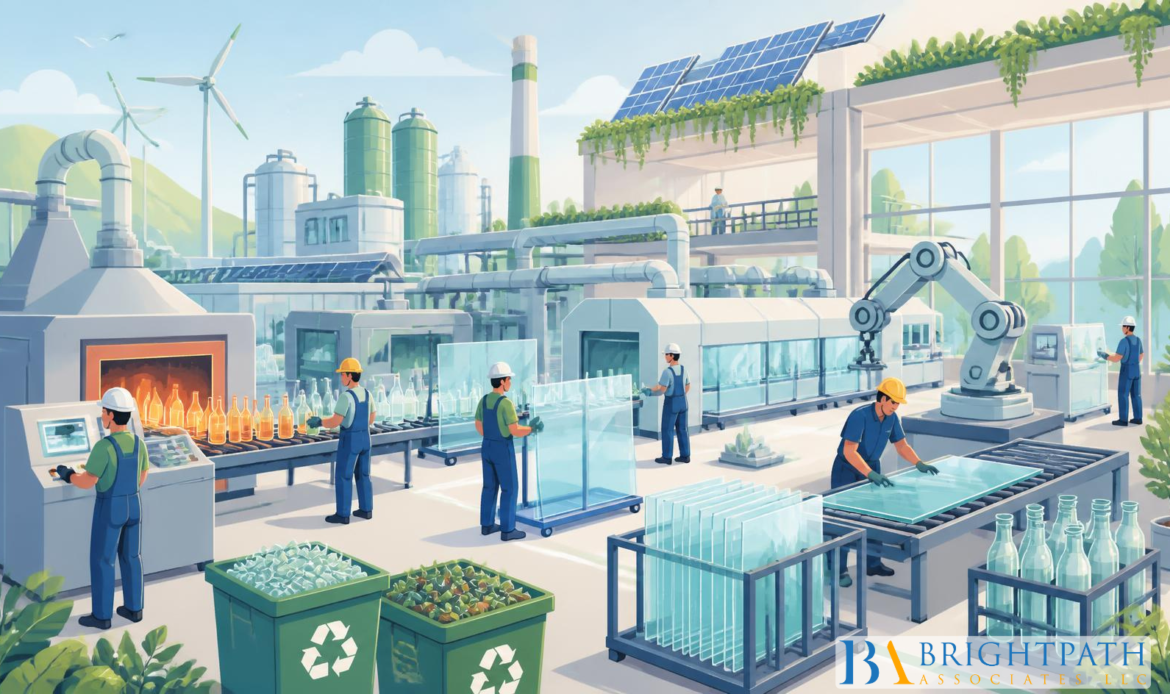
Consider a large-scale glass manufacturing facility undertaking a comprehensive sustainability initiative to improve production efficiency, reduce waste, and strengthen environmental performance. The facility’s transformation illustrates how process optimization, energy management, material recovery, workforce development, and technological innovation can work together to create a more responsible manufacturing operation.
This illustrative success story examines the strategies a glass manufacturer can adopt to improve operational performance while supporting broader developments in sustainable industrial production. It also explores how Glass industry innovation, Sustainable building materials, and effective leadership can contribute to a more resilient manufacturing model.
Glass production involves several energy-intensive stages, including raw material preparation, batch mixing, melting, forming, annealing, finishing, and quality inspection. Each stage influences the facility’s overall energy consumption, production efficiency, and environmental footprint.
Melting furnaces represent one of the most demanding parts of the process because they must maintain high temperatures to transform raw materials into molten glass. Poor furnace efficiency, inconsistent combustion, heat losses, and production interruptions can increase fuel consumption and operating costs. Additional energy is required for material handling, compressed air, cooling systems, and other supporting equipment.
Waste generation creates another challenge. Defective products, damaged glass, off-specification batches, and packaging materials can increase disposal costs and reduce material efficiency. Although clean glass cullet can often be recycled into production, its suitability depends on glass composition, contamination levels, color requirements, and the specifications of the manufacturing process.
The facility must also manage water consumption, air emissions, dust, and workplace safety. These requirements become more complex as production volumes increase and customer expectations evolve.
A successful sustainability strategy therefore requires a comprehensive assessment of the manufacturing process. Rather than addressing individual environmental concerns separately, the organization must understand how energy, materials, equipment, and workforce practices interact across the entire facility.
Establishing a Clear Sustainability Roadmap
The first step in the facility’s transformation is establishing a measurable sustainability roadmap. Management begins by reviewing energy consumption, raw material utilization, production losses, emissions, water usage, equipment reliability, and waste generation.
This baseline assessment identifies the areas where operational improvements can deliver the greatest benefits. For example, excessive furnace energy consumption may indicate opportunities for improved insulation, combustion optimization, or better process control. High rejection rates may point toward inconsistent forming conditions, temperature variations, or equipment calibration problems.
The organization then establishes realistic improvement objectives and assigns responsibility for achieving them. Engineering teams focus on equipment performance, production managers oversee process consistency, environmental specialists monitor compliance, and procurement teams evaluate sustainable material options.
Performance indicators help management measure progress over time. Energy consumption per tonne of finished glass, cullet utilization, product rejection rates, water intensity, and unplanned downtime provide useful insights into operational performance.
The roadmap should also account for production requirements and financial constraints. Major equipment upgrades may require substantial capital investment, while procedural improvements and preventive maintenance can often deliver benefits more quickly.
By linking environmental objectives with operational and financial performance, the facility establishes a practical framework for continuous improvement rather than treating sustainability as a separate reporting exercise.
Energy efficiency becomes a central pillar of the facility’s sustainability initiative because melting and forming operations require substantial thermal energy. Improving furnace performance can reduce fuel consumption, lower operating costs, and decrease emissions associated with energy use.
The engineering team begins by evaluating furnace insulation, combustion conditions, heat recovery opportunities, and temperature control practices. Improved insulation reduces heat losses, while appropriate burner maintenance and combustion control help maintain efficient operating conditions.
Where technically and economically suitable, waste heat recovery systems can capture thermal energy from exhaust gases and use it to preheat combustion air or support other facility operations. These systems reduce the amount of additional energy required to maintain production temperatures.
Process monitoring also plays an important role. Temperature sensors, flow meters, and control systems provide information that helps operators identify abnormal conditions and make informed adjustments. Consistent process control can reduce unnecessary energy consumption while maintaining the properties required for finished glass products.
Equipment maintenance supports these improvements by preventing deterioration in furnace performance and reducing unplanned interruptions. Because glass furnaces often operate continuously over extended periods, maintenance planning must account for operating conditions, equipment life cycles, and scheduled production shutdowns.
Energy efficiency measures should be evaluated through verified operational data. The facility can compare energy consumption before and after improvements while accounting for production volume, product mix, and other relevant operating variables.
Strengthening Material Recovery and Waste Reduction
#MaterialEfficiency is another important component of sustainable glass manufacturing. Producing glass requires carefully controlled combinations of silica sand, soda ash, limestone, and other ingredients. Inefficient handling, inaccurate batching, and production defects can increase raw material consumption and create avoidable waste.
The facility introduces tighter control over raw material storage, weighing, batching, and mixing. Automated weighing systems and regular equipment calibration help maintain accurate batch composition. Improved material handling also reduces spillage and contamination during transfer operations.
A structured cullet recovery program captures suitable rejected glass and production offcuts for reuse. Reintroducing clean, compatible cullet into the melting process can reduce demand for virgin raw materials and, under appropriate operating conditions, lower energy requirements.
However, recycled glass must meet the technical specifications of the product being manufactured. Contaminants, incompatible glass types, ceramics, metals, and other unwanted materials can affect product quality or damage equipment. The facility therefore establishes sorting, inspection, and contamination-control procedures before recovered material returns to production.
Waste audits help identify additional opportunities to improve efficiency. Packaging waste, damaged pallets, maintenance materials, and other operational by-products can be assessed for prevention, reuse, or appropriate recycling.
Through better material control and recovery, the manufacturer can reduce disposal requirements while improving resource utilization and production consistency.
Glass industry innovation increasingly involves digital technologies that improve process visibility, equipment reliability, and production control. The facility strengthens its monitoring capabilities by integrating production data, equipment performance information, and quality records into a more coordinated operational environment.
Digital monitoring allows engineers to observe temperature variations, energy consumption, production throughput, and defect patterns. When these data streams are analyzed together, teams can identify relationships that may not be apparent through isolated inspections.
For example, recurring product defects may correspond with temperature fluctuations or changes in forming equipment performance. Identifying these relationships helps engineers investigate root causes and implement corrective actions before losses increase.
Predictive maintenance provides additional benefits by using equipment condition information to identify developing faults. Monitoring vibration, temperature, and other relevant parameters can help maintenance teams prioritize inspections and reduce unexpected equipment failures.
Automation can also improve consistency in batching, forming, inspection, and material handling. Automated inspection systems may identify visible defects and dimensional variations more consistently, although their effectiveness depends on appropriate configuration, verification, and maintenance.
Digital transformation should be accompanied by employee training, data governance, and cybersecurity controls. The facility must ensure that workers understand how to interpret system information and respond appropriately to operational alerts.
By combining engineering expertise with reliable digital information, the manufacturer creates a stronger foundation for efficient and consistent production.
Water Management and Environmental Performance
Although glass manufacturing is particularly energy-intensive, water management also contributes to environmental performance. Facilities may use water for cooling, equipment cleaning, dust suppression, and supporting industrial processes. Poorly managed systems can increase consumption, wastewater generation, and operating expenses.
The facility begins by mapping water use across production and support operations. This assessment helps identify leakage, unnecessary consumption, and opportunities to improve cooling-system efficiency.
Where suitable, recirculating cooling systems can reduce the demand for fresh water. Water treatment and reuse may also be introduced when quality requirements, contamination risks, and process conditions permit. Monitoring flow rates and reviewing water balances help verify whether these measures deliver the intended results.
Environmental management extends to emissions and dust control. Appropriate filtration, equipment maintenance, material enclosure, and handling procedures can help control particulate emissions associated with raw material processing.
The organization also evaluates its environmental obligations and maintains appropriate monitoring and reporting procedures. Compliance requirements must be incorporated into operating instructions, maintenance schedules, and management reviews.
These measures demonstrate that sustainable manufacturing involves a coordinated approach to energy, water, emissions, and resource management rather than a narrow focus on one environmental indicator.
Glass manufacturers supply products that influence the energy performance, durability, and environmental characteristics of buildings. Insulating glass units, coated architectural glass, and other specialized products can support improved building performance when designed and installed appropriately.
The facility evaluates opportunities to expand its capabilities in products that meet growing demand for Sustainable building materials. This requires close collaboration between production engineers, product development teams, architects, construction companies, and customers.
Manufacturing quality remains essential. Products intended for energy-efficient buildings must satisfy relevant technical specifications, durability requirements, and applicable safety standards. Sustainability claims should be supported by credible product information and appropriate assessments rather than relying solely on general environmental messaging.
The wider construction sector is also examining the environmental performance of concrete, cement, ceramics, and other materials. Concrete industry trends increasingly include resource efficiency, recycled inputs, lower-carbon binders, and improved production processes. These developments create opportunities for glass manufacturers to collaborate with other materials producers on compatible recovery systems and broader circular manufacturing initiatives.
For example, certain carefully controlled glass waste streams may be suitable for specific secondary applications, subject to technical validation and applicable standards. Such opportunities require evaluation of material chemistry, particle characteristics, performance requirements, and long-term durability.
By understanding the needs of construction customers, the facility can connect its sustainability improvements with evolving market demand while maintaining strict product-quality controls.
Connecting Glass Manufacturing with Concrete and Ceramic Industry Developments
#IndustrialSustainability often benefits from collaboration across materials sectors. Glass, concrete, cement, and ceramic manufacturers share challenges related to thermal processing, raw material consumption, emissions, equipment reliability, and waste management.
Advanced concrete technology is creating opportunities to improve material performance, reduce resource intensity, and evaluate alternative constituents. Similarly, Cement industry sustainability initiatives increasingly examine lower-emission production methods, alternative fuels, and supplementary cementitious materials.
However, the use of glass-derived materials in concrete or cement applications requires technical assessment. Particle size, chemical composition, alkali-silica reaction potential, and intended application can influence performance. Waste glass should not be treated as a universally suitable replacement for conventional construction materials without testing and compliance with relevant specifications.
Advanced ceramic manufacturing provides another useful point of comparison. Ceramic production often involves precise temperature control, specialized material formulations, and quality-sensitive thermal processes. Lessons from process monitoring, heat management, and defect reduction may offer insights applicable to glass production, even though the materials and manufacturing requirements differ.
Ceramic industry growth also reflects demand from specialized applications, including electronics, healthcare, energy systems, and advanced engineering. Understanding these developments can help industrial materials manufacturers identify shared technology requirements and potential collaboration opportunities.
Cross-sector learning encourages a broader approach to sustainability in which manufacturers evaluate resource efficiency, waste recovery, and process innovation across interconnected industrial value chains.
The success of the facility’s sustainability program depends on employees who can translate strategic objectives into practical operational improvements. Engineers, furnace specialists, automation technicians, maintenance professionals, environmental managers, and production supervisors all contribute to performance.
Construction materials recruitment becomes important when manufacturers need specialized capabilities in process engineering, energy management, materials science, environmental compliance, and industrial automation. Recruiting qualified professionals can help organizations introduce new technologies, improve maintenance strategies, and establish measurable sustainability programs.
#ExecutiveSearchRecruitment is particularly valuable when a facility needs senior leaders capable of coordinating engineering, production, sustainability, and commercial functions. These leaders must understand capital investment decisions, operational risks, workforce development, and the relationship between environmental performance and business competitiveness.
Recruitment alone, however, cannot replace internal knowledge development. The facility invests in employee training, technical documentation, cross-functional problem-solving, and structured improvement initiatives. Operators are encouraged to identify inefficiencies and participate in evaluating practical solutions.
Clear communication helps employees understand why sustainability changes are being introduced and how their responsibilities contribute to the wider objectives. Training also ensures that new operating procedures are applied consistently and that equipment upgrades are used effectively.
By combining experienced leadership with continuous workforce development, the manufacturer builds the organizational capabilities required to sustain improvements over the long term.
Measuring Results and Establishing Continuous Improvement
A successful sustainability initiative requires reliable evidence of progress. The facility evaluates its performance through energy intensity, material recovery rates, water consumption, product rejection levels, emissions indicators, and equipment availability.
These indicators allow management to determine whether operational changes are producing meaningful improvements. Results should be compared against a clearly defined baseline and adjusted for relevant changes in production volume, product specifications, and operating conditions.
Financial analysis is also necessary. Energy savings, reduced material losses, lower waste-handling expenses, and improved equipment reliability can contribute to the business case for sustainability investments. Capital expenditure should be evaluated against expected benefits, implementation risks, equipment life cycles, and maintenance requirements.
The facility conducts regular reviews to identify gaps and prioritize additional improvements. Lessons from equipment failures, process trials, and quality investigations are documented and shared across relevant teams.
Independent verification or recognized environmental management practices may strengthen reporting credibility, particularly when sustainability performance is communicated to customers, investors, or other stakeholders.
Continuous improvement ensures that sustainability remains an ongoing operational responsibility rather than a temporary project. As technologies and customer expectations evolve, the facility can update its objectives and refine its approach using measurable performance data.
Conclusion
The transformation of a large-scale glass facility demonstrates how sustainability can become an integral part of industrial performance. By improving energy efficiency, strengthening material recovery, adopting digital monitoring, optimizing water use, and developing employee capabilities, manufacturers can address environmental challenges while supporting reliable production.
#GlassIndustry innovation creates opportunities to improve process control and develop products aligned with demand for Sustainable building materials. At the same time, developments in Advanced ceramic manufacturing, Advanced concrete technology, and Cement industry sustainability demonstrate the value of cross-sector collaboration and responsible material management.
Achieving these outcomes requires realistic investment planning, technical validation, effective leadership, and a commitment to continuous improvement. Construction materials recruitment and Executive Search Recruitment can help secure the expertise needed to manage this transformation, while employee training ensures that improvements become part of everyday operations.
Ultimately, a sustainable glass facility is built through the integration of technology, materials, people, and disciplined management. Organizations that embed these principles into their production strategies can strengthen operational resilience, improve resource efficiency, and position themselves for long-term competitiveness in an increasingly sustainability-focused industrial economy.
Find your next leadership role in Glass, Ceramic, Concrete Industry today!
Stay informed with the latest insights on Glass, Ceramic, Concrete Industry!