
Introduction
The #PackagingIndustry plays a critical role in global manufacturing, food processing, pharmaceuticals, consumer goods, and logistics. However, increasing production demands, changing workforce expectations, and persistent recruitment challenges are placing significant pressure on packaging operations. One of the industry’s most pressing concerns is the Packaging industry labor shortage, which affects production capacity, operational efficiency, product quality, and delivery performance. While manufacturers often respond by increasing recruitment efforts or investing in automation, improving workplace ergonomics offers another practical solution for attracting and retaining employees.
Ergonomic packaging design focuses on developing products, packaging materials, workstations, and production processes that reduce physical strain and make tasks safer and more comfortable. By considering how employees lift, handle, assemble, inspect, and transport packaged products, manufacturers can create working environments that support employee well-being without compromising productivity.
The connection between ergonomic design and workforce retention is becoming increasingly important as companies compete for skilled workers. Employees are more likely to remain in workplaces where physical demands are manageable, equipment is accessible, and safety is treated as an operational priority. Integrating ergonomics with packaging innovation, digital technologies, and workforce planning can help businesses establish a more resilient and sustainable operating model.
The Packaging industry labor shortage is influenced by several interconnected factors, including an aging workforce, competition for technical talent, demanding production schedules, and the physical nature of many packaging jobs. Employees working in packaging facilities may repeatedly lift containers, move cartons, operate sealing equipment, inspect products, or perform repetitive assembly tasks. When these activities involve awkward postures, excessive force, or insufficient recovery time, they can contribute to fatigue and musculoskeletal discomfort.
Physically demanding working conditions may also affect employee satisfaction and increase absenteeism. When workers experience persistent discomfort or believe that workplace risks are not being addressed, they may seek employment in industries offering more manageable working conditions. High turnover creates additional costs through recruitment, onboarding, training, and reduced productivity during workforce transitions.
Manufacturers must therefore look beyond short-term hiring solutions and examine the workplace factors contributing to employee dissatisfaction. Improving ergonomics can help reduce unnecessary physical demands, strengthen workplace safety, and make packaging roles more sustainable over the long term.
A comprehensive approach should combine ergonomic assessments, employee feedback, appropriate equipment selection, and continuous improvement. Rather than expecting workers to adapt to poorly designed processes, businesses should redesign tasks and work environments around human capabilities.
The Fundamentals of Ergonomic Packaging Design
Ergonomic packaging design involves evaluating the relationship between packaging characteristics, handling requirements, equipment configuration, and employee movement. Packaging formats that are unnecessarily heavy, difficult to grip, unstable, or awkward to position can increase physical demands throughout manufacturing, warehousing, and distribution.
For example, containers with poorly positioned handles may require employees to adopt uncomfortable wrist positions. Oversized cartons can make lifting difficult, while unstable loads may increase the risk of sudden movements during transportation. Packaging that requires excessive force to open, close, seal, or assemble can also create repetitive strain.
Manufacturers can address these issues by optimizing package dimensions, reducing unnecessary material weight, improving grip surfaces, and designing containers that remain stable during handling. Standardized package sizes and appropriate lifting points can make repetitive tasks easier to perform consistently.
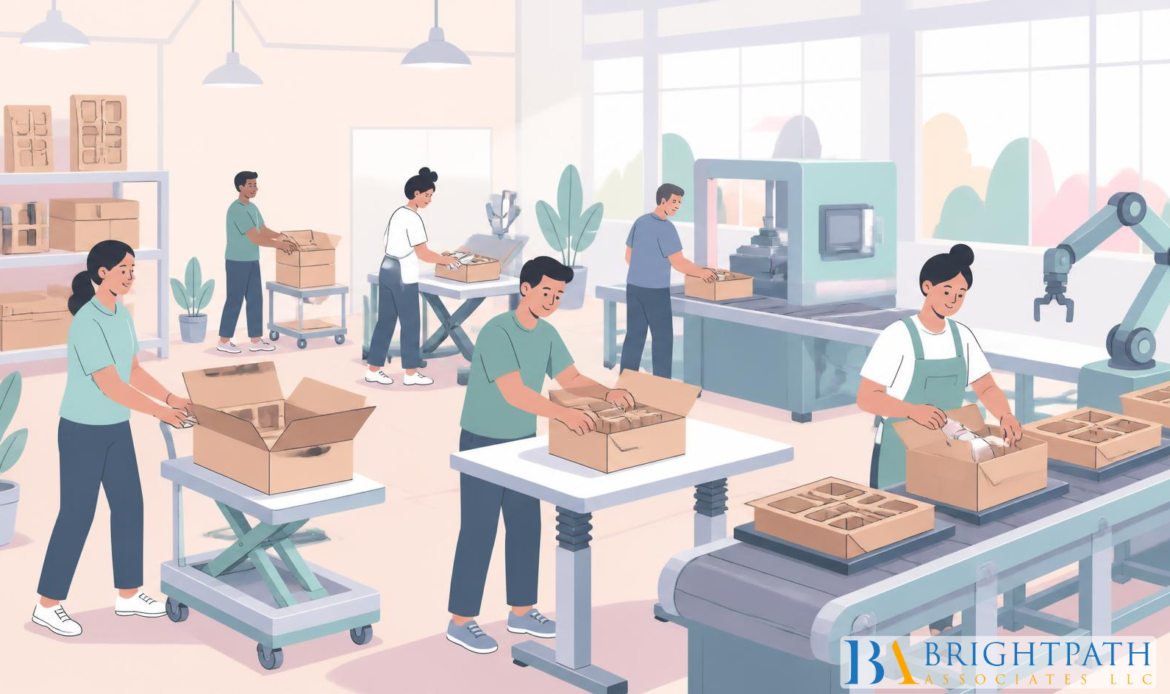
Workstation design is equally important. Frequently used materials should be positioned within comfortable reach, work surfaces should accommodate different employee heights, and lifting activities should be minimized wherever practical. Adjustable tables, mechanical lifting aids, and appropriately configured conveyors can reduce bending, twisting, and repetitive manual handling.
Effective ergonomics is not simply about making packaging lighter. It involves evaluating the complete interaction between the employee, the package, the equipment, and the production process.
Packaging machinery optimization is an important part of reducing physical workload in manufacturing facilities. Employees often spend considerable time loading containers, feeding materials, positioning cartons, clearing minor jams, and transferring finished products between production stages. When equipment is poorly configured, these tasks can require unnecessary reaching, repetitive movements, and manual force.
Manufacturers can improve working conditions by evaluating machine height, control-panel placement, conveyor alignment, access points, and the frequency of manual interventions. Equipment should be configured so operators can complete routine tasks without repeatedly bending, stretching, or adopting uncomfortable postures.
Automation can also reduce exposure to repetitive handling. Automated case packing, robotic palletizing, carton forming, and conveyor-based product transfers can take over selected tasks that involve sustained physical effort. However, automation must be designed carefully because poorly planned systems can introduce new risks, including awkward maintenance access, difficult changeovers, and excessive monitoring demands.
Packaging machinery optimization should therefore consider both production performance and employee experience. Maintenance accessibility, emergency-stop placement, safe machine guarding, and straightforward changeover procedures are important design considerations.
When employees can operate and maintain equipment safely and comfortably, manufacturers can reduce unnecessary physical strain while improving production consistency. These improvements can also support better onboarding because well-designed equipment is generally easier to understand and operate.
Packaging Industry Digital Transformation and Workforce Ergonomics
Packaging industry digital transformation provides manufacturers with new opportunities to identify ergonomic problems and improve workplace conditions. Sensors, connected machinery, production monitoring systems, and digital workflow tools can help organizations understand how employees interact with equipment and where physical demands are concentrated.
For example, production data may reveal that workers repeatedly intervene at a particular packaging station because of frequent equipment stoppages. A detailed investigation could identify an underlying issue with material feeding, conveyor timing, or packaging alignment. Resolving the technical problem may reduce both production interruptions and the number of repetitive manual interventions required from employees.
#DigitalWork instructions can also improve task consistency by providing clear guidance for equipment setup, material handling, and routine inspections. Where appropriate, visual instructions and guided workflows can help new employees learn safe working methods more quickly.
Wearable technology and motion-monitoring tools may provide additional insights into physical workload, but their use requires careful consideration of privacy, transparency, and employee consent. Data should support workplace improvements rather than become a mechanism for excessive individual surveillance.
The most effective digital transformation strategies combine operational data with employee feedback. Technology can identify patterns, but workers often provide essential context about discomfort, difficult movements, and recurring practical challenges. Combining these perspectives enables manufacturers to make better-informed ergonomic decisions.
Predictive analytics packaging can help manufacturers anticipate operational problems by examining historical production data, equipment performance, order volumes, staffing levels, and maintenance patterns. When used responsibly, predictive methods can also support better ergonomic planning by identifying periods when workloads are likely to become unusually demanding.
For instance, seasonal production peaks may increase the volume of manual carton handling, pallet preparation, and repetitive packaging activities. Forecasting these periods allows managers to plan staffing, schedule appropriate breaks, redistribute workloads, and ensure that mechanical handling equipment is available when needed.
Predictive maintenance can further reduce the risk of equipment failures that force employees to perform unexpected manual tasks. When machinery operates reliably, workers are less likely to face rushed interventions, repeated jam clearing, or prolonged periods of physically demanding rework.
Organizations can also analyze incident reports, near misses, absenteeism patterns, and employee feedback to identify workstations that may require ergonomic assessment. Such information should be interpreted carefully because absenteeism and turnover have many possible causes, and predictive models cannot independently establish why an employee experiences discomfort or leaves a position.
By combining predictive analytics with practical workplace assessments, packaging manufacturers can move from reactive problem-solving toward preventive workforce management.
Improving Retention Through Employee-Centered Workplace Design
Workforce retention depends on more than salary and career opportunities. Employees also consider workplace safety, workload predictability, supervisory support, and the extent to which employers respond to their concerns. Ergonomic improvements can strengthen these factors by demonstrating that management takes employee well-being seriously.
A successful ergonomic program begins with direct employee involvement. Workers should have opportunities to identify difficult tasks, report discomfort, and suggest improvements based on their daily experience. Supervisors can use structured discussions and workplace observations to identify recurring challenges that may not appear in production reports.
Manufacturers should also provide training on safe lifting, correct equipment use, and early reporting of workplace discomfort. Training, however, cannot compensate for inherently unsafe task design. Where excessive force or repetitive handling is built into a process, employers should prioritize engineering controls and process redesign rather than relying exclusively on employees to change their behavior.
Regular reviews can help determine whether ergonomic changes are improving comfort and usability. Employee feedback, injury trends, absenteeism, turnover, and task performance can provide complementary indicators of progress.
When ergonomic improvements are supported by effective communication, fair workloads, and opportunities for development, they can contribute to a workplace culture that encourages employees to remain with the organization.
Sustainability has become a major priority for packaging manufacturers as customers and regulators increasingly focus on material efficiency, waste reduction, recyclability, and environmental performance. Sustainable packaging certifications can help organizations demonstrate that particular materials, products, or manufacturing practices meet defined environmental requirements.
However, environmental performance and ergonomic performance are not automatically aligned. A lightweight package may reduce transport emissions but still be difficult to grip. A recyclable material may require different sealing conditions or additional handling steps. Reusable packaging may support waste reduction while introducing extra cleaning, inspection, and return-handling responsibilities.
Manufacturers should therefore evaluate sustainability and ergonomics together. Packaging assessments should consider material weight, package dimensions, handling requirements, production compatibility, durability, and end-of-life management.
Sustainable design can create ergonomic benefits when it reduces unnecessary material, simplifies assembly, or improves package handling. Nevertheless, these benefits must be verified through practical testing rather than assumed from environmental claims alone.
Organizations should also ensure that certification requirements and sustainability objectives are communicated clearly to production teams. Employees need to understand how new materials affect equipment settings, handling procedures, and quality checks.
Integrating human-centered design with sustainability initiatives helps manufacturers develop packaging solutions that support environmental objectives without creating avoidable physical demands for the workforce.
Circular Economy Packaging and Bioplastic Packaging Development
Circular economy packaging aims to keep materials in productive use through strategies such as reuse, recycling, repair, and improved resource efficiency. These approaches can influence packaging design, manufacturing workflows, logistics systems, and the physical tasks performed by employees.
Reusable containers, for example, may require reverse logistics, sorting, cleaning, inspection, and repeated handling. Their design should account for weight when empty and full, grip accessibility, stacking stability, and ease of movement through cleaning and production facilities.
#BioplasticPackaging development introduces additional considerations because different materials may have distinct processing characteristics, strength profiles, temperature tolerances, and handling requirements. Manufacturers must evaluate whether new materials are compatible with existing machinery and whether changes in forming, sealing, or cutting operations affect employee workload.
Packaging designers should involve production operators, equipment specialists, and logistics teams during material trials. This collaborative process helps identify practical issues before new packaging formats are introduced at scale.
Circular economy packaging can support more efficient resource use, but successful implementation requires careful coordination across design, production, distribution, and recovery operations. Incorporating ergonomic assessments into this process ensures that environmental improvements do not inadvertently increase manual handling demands or make packaging tasks more difficult.
Supply chain resilience packaging involves developing packaging systems that maintain product protection and operational continuity despite disruptions in materials, transportation, labor availability, or production capacity. Ergonomic design contributes to resilience by making packaging easier to handle, reducing unnecessary manual interventions, and supporting consistent work practices across facilities.
Standardized packaging dimensions, stable pallet configurations, and appropriately designed containers can simplify storage, transportation, and loading activities. These improvements may also reduce the physical demands associated with moving products through warehouses and distribution centers.
Packaging manufacturers should work closely with material suppliers, equipment providers, logistics partners, and customers to evaluate how design changes affect the entire supply chain. A packaging format that performs well on a production line may create difficulties during manual unloading or downstream product replenishment.
Supply chain resilience also depends on having a workforce capable of responding to changing production requirements. Cross-training employees, documenting safe handling procedures, and designing adaptable workstations can help organizations manage temporary staffing shortages without relying excessively on a limited number of experienced workers.
By combining ergonomic design with operational planning, manufacturers can strengthen continuity while improving working conditions across the packaging value chain.
Strategic Recruitment and Packaging Equipment Executive Search
Although ergonomic improvements can help retain existing employees, packaging manufacturers must also ensure that they have the leadership and technical expertise needed to implement long-term workforce strategies. Engineers, industrial designers, maintenance specialists, automation experts, and operations managers all contribute to developing safer and more efficient packaging environments.
Packaging executive search helps organizations identify senior professionals who understand manufacturing performance, equipment investment, workforce development, and operational improvement. These leaders can guide ergonomic initiatives, coordinate cross-functional teams, and ensure that employee well-being is considered during equipment selection and facility planning.
Packaging equipment executive search is particularly relevant when manufacturers need specialists with experience in machinery design, automation integration, packaging-line optimization, or maintenance strategy. Such professionals can help evaluate equipment not only for throughput and reliability but also for accessibility, usability, and safe operation.
#ExecutiveSearchRecruitment can further support workforce planning by identifying leaders who combine technical knowledge with the ability to build effective teams and improve employee engagement. Recruitment strategies should consider candidates’ experience in continuous improvement, safety leadership, and change management alongside their engineering qualifications.
The objective is to build a leadership structure capable of connecting ergonomic design, operational excellence, and talent retention within a unified business strategy.
To understand the effectiveness of ergonomic initiatives, manufacturers should establish measurable performance indicators before implementing major changes. Relevant measures include reported ergonomic concerns, recordable injuries, absenteeism, employee turnover, manual handling frequency, production interruptions, and time required to train new operators.
Organizations should also examine whether redesigned packaging reduces the force needed for handling, improves access to materials, or decreases the frequency of awkward movements. Employee feedback and structured ergonomic assessments can help determine whether the changes produce meaningful improvements in actual working conditions.
Financial analysis should consider both implementation costs and potential long-term benefits. Equipment modifications, workstation redesign, training, and new packaging materials may require investment, but they should be evaluated alongside possible reductions in turnover, injury-related expenses, rework, and operational disruption.
Results should be reviewed over time because workforce retention is influenced by many factors beyond ergonomics. Changes in compensation, management practices, scheduling, and local labor market conditions can also affect employee decisions.
A continuous improvement approach enables manufacturers to refine workplace design, prioritize the most significant risks, and demonstrate the operational value of investing in employee well-being.
Conclusion
Addressing labor shortages requires packaging manufacturers to look beyond recruitment and consider how the design of products, equipment, and workstations influences employees’ daily experiences. Ergonomic packaging design offers a practical way to reduce unnecessary physical demands, improve workplace usability, and create conditions that support long-term workforce retention.
By combining packaging machinery optimization, Packaging industry digital transformation, predictive analytics, sustainable material selection, and structured workforce planning, businesses can strengthen both employee well-being and production performance. Integrating ergonomic considerations into circular economy initiatives and supply chain planning further ensures that improvements remain effective throughout the packaging lifecycle.
At the same time, strategic hiring and Packaging executive search can help organizations secure the technical and leadership capabilities required to implement these changes successfully.
Ultimately, a resilient packaging operation depends on more than machinery, materials, and production capacity. It depends on people who can perform their work safely, develop their skills, and see a future within the organization. Manufacturers that treat ergonomics as a strategic investment rather than a secondary safety measure will be better positioned to improve retention, manage labor challenges, and achieve sustainable industrial growth.
Find your next leadership role in Packaging and Containers Industry today!
Stay informed with the latest insights on Packaging and Containers Industry!