
Introduction
Modern manufacturing operates in an environment where supply chain disruptions, fluctuating customer demand, equipment failures, labor shortages, and changing regulatory requirements can rapidly affect #BusinessPerformance. Industrial organizations must respond to these challenges without compromising productivity, quality, safety, or profitability. Traditional planning methods often rely on historical data and static assumptions, making it difficult for leaders to anticipate how interconnected operations will behave under unexpected conditions. Digital twins are emerging as a powerful solution to this challenge by allowing manufacturers to simulate scenarios, evaluate potential risks, and test operational agility before disruptions occur.
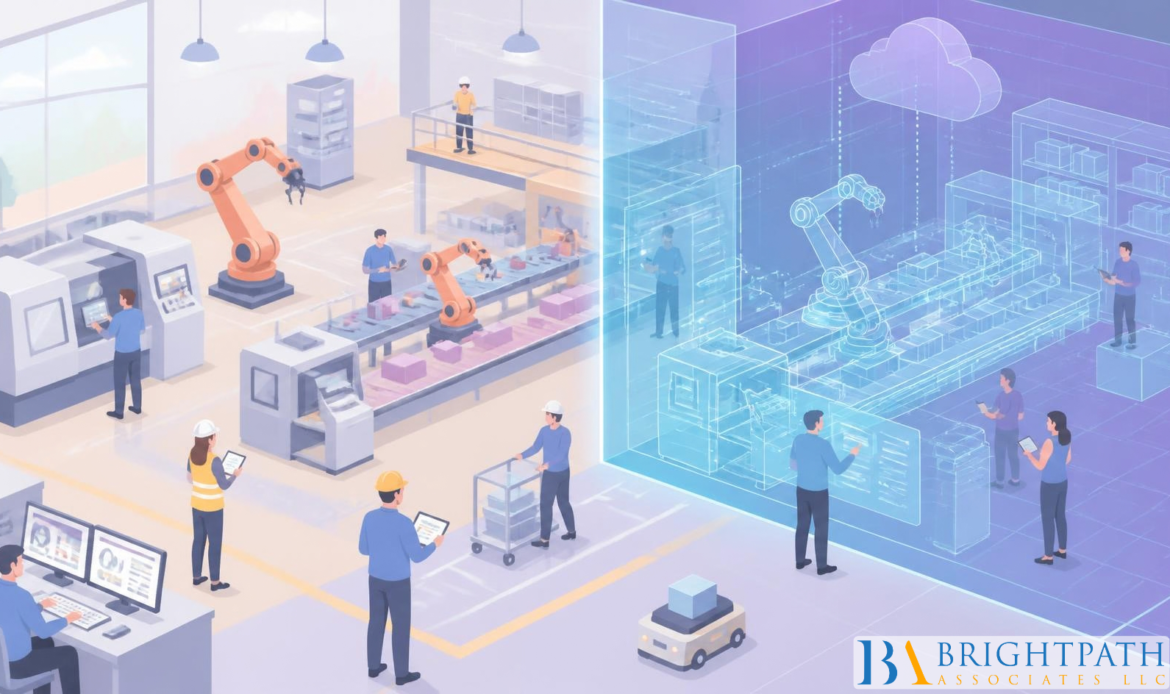
A digital twin is a virtual representation of a physical asset, production line, facility, or entire industrial process. It uses operational data, engineering models, and analytical tools to reflect how its real-world counterpart performs. Manufacturers can use these virtual environments to evaluate equipment changes, simulate production bottlenecks, and assess alternative operating strategies without immediately changing physical operations.
As Industrial automation becomes more sophisticated, digital twins are increasingly valuable for connecting operational technology with strategic decision-making. They help businesses understand not only what is happening on the factory floor but also how different decisions might influence future outcomes. For industrial leaders, this capability creates an opportunity to move from reactive problem-solving toward proactive resilience.
Digital twins extend beyond conventional computer-aided design models and basic simulations. While traditional engineering models often describe how a machine should operate under predefined conditions, a digital twin can incorporate information from actual operations to improve its representation of real-world performance.
Sensors, programmable logic controllers, manufacturing execution systems, and SCADA systems can supply data about equipment status, cycle times, temperature, pressure, energy consumption, and production output. When appropriately integrated, these data streams help maintain a more accurate understanding of operational conditions.
Within Industrial automation, digital twins can represent individual machines, robotic workstations, assembly lines, warehouses, and complete manufacturing facilities. Engineers can use them to test different operating parameters, investigate potential failures, and evaluate proposed changes before implementation.
For example, a manufacturer planning to increase production volume can simulate how additional demand might affect machine utilization, material movement, and downstream packaging operations. The analysis may reveal that a particular workstation would become a bottleneck long before the proposed change reaches the factory floor.
This predictive capability helps manufacturers make better-informed decisions while reducing the risks associated with physical experimentation. Digital twins do not eliminate uncertainty, but they provide a structured environment for understanding possible outcomes and preparing appropriate responses.
Scenario Modeling: Testing Agility Before Disruption
Scenario modeling is one of the most valuable applications of digital twin technology. It involves creating alternative operating conditions and evaluating how a production system might respond to each situation. Instead of waiting for a disruption to expose weaknesses, manufacturers can investigate vulnerabilities in advance.
Consider a factory that depends on a critical component supplied by a single external vendor. A digital twin can help planners model the consequences of delayed deliveries, reduced inventory, and alternative sourcing arrangements. By comparing these scenarios, managers can identify the production schedules and inventory strategies most likely to maintain continuity.
Similar simulations can examine sudden increases in customer orders, unplanned equipment downtime, energy price fluctuations, and temporary workforce shortages. Leaders can assess which production lines require additional capacity, where backup resources should be positioned, and how quickly operations could recover.
Effective scenario modeling also considers interactions between different variables. A supplier delay might initially appear manageable, but its impact could become more serious when combined with limited warehouse capacity and a maintenance shutdown. Digital twins can help reveal these interconnected risks.
The objective is not to predict every possible disruption. Instead, manufacturers use scenario modeling to develop practical response options, understand operational limits, and improve their ability to adapt when actual conditions differ from expectations.
Manufacturing automation has traditionally focused on improving consistency, reducing repetitive manual work, and increasing production speed. Digital twins expand these benefits by helping engineers evaluate how automated equipment will perform under different operating conditions.
Manufacturing automation systems can generate substantial quantities of operational information, but the value of that information depends on how effectively it is interpreted. A digital twin can connect equipment performance data with production targets, maintenance requirements, and resource constraints to support more comprehensive analysis.
For instance, manufacturers can simulate different conveyor speeds, robotic cycle times, and machine operating sequences to determine whether a production line can achieve higher output without creating quality problems. They can also evaluate how equipment modifications may affect energy consumption, product changeover times, and maintenance intervals.
Automation solutions manufacturing providers increasingly have opportunities to integrate digital twins into equipment design, commissioning, and ongoing optimization services. Instead of delivering machinery that meets only its initial specifications, suppliers can help customers understand how equipment might behave as production requirements evolve.
This approach supports better collaboration between equipment manufacturers, systems integrators, plant managers, and engineering teams. By testing changes virtually before implementing them physically, organizations can reduce commissioning risks, improve operational consistency, and make more confident investment decisions.
The Role of PLC Programming Service and Control Systems
Programmable logic controllers are central to many automated manufacturing operations. They execute predefined control logic, coordinate machinery, and respond to inputs from sensors and other devices. Because PLC behavior directly affects equipment performance, validating control logic is an important part of digital twin implementation.
A PLC programming service can support this process by developing, reviewing, and testing control sequences against simulated operating conditions. Engineers can evaluate how a controller responds to sensor changes, equipment faults, emergency conditions, and variations in production requirements before deploying modifications to physical equipment.
For example, a packaging line may require a revised sequence to accommodate different product sizes. Engineers can test the proposed logic in a virtual environment to identify timing conflicts, unexpected machine states, and possible interruptions before the change is introduced into production.
#ControlSystems must also coordinate multiple machines and safety-related functions. Digital twin models can help teams investigate interactions between equipment, validate expected sequences, and improve their understanding of complex production behavior.
However, simulation should complement rather than replace formal engineering validation, hardware-in-the-loop testing where appropriate, and established safety procedures. Virtual models may not capture every physical condition, and errors in the model itself can produce misleading results.
By combining simulation with disciplined control engineering, manufacturers can improve commissioning quality, reduce avoidable downtime, and introduce operational changes with greater confidence.
Robotics integration has become increasingly important as manufacturers seek greater flexibility, repeatability, and throughput. Yet introducing robots into an existing production environment can create challenges involving workspace constraints, cycle-time coordination, material handling, and worker safety.
Digital twins allow engineers to evaluate robotic configurations before equipment is installed. They can simulate robot trajectories, identify potential collisions, analyze reach limitations, and determine whether multiple robotic workstations can operate efficiently within a shared production area.
Scenario modeling also helps manufacturers evaluate alternative layouts and production sequences. A company introducing a new product may discover that a revised robotic path or workstation arrangement improves throughput without requiring additional floor space.
Industrial machine vision adds another layer of intelligence to these environments. Vision systems can inspect products, detect defects, verify component positions, and guide robotic picking operations. Digital twins can help engineers evaluate how changes in camera placement, lighting assumptions, inspection thresholds, and production speeds might affect system performance.
For example, a manufacturer can model how increased conveyor speed could influence inspection timing and defect detection opportunities. The results can guide decisions about camera configuration, processing capacity, and line synchronization.
Nevertheless, simulated performance must be validated against real-world materials, lighting conditions, mechanical tolerances, and actual operating speeds. Combining Robotics integration with realistic simulation and physical testing helps manufacturers develop more reliable automation systems while limiting implementation risks.
SCADA Systems and Real-Time Operational Visibility
#SupervisoryControl and data acquisition platforms provide visibility into industrial processes by collecting information from equipment, controllers, and remote devices. SCADA systems commonly support monitoring, alarms, data visualization, and supervisory control across production facilities and infrastructure.
When integrated appropriately with a digital twin, SCADA data can help virtual models reflect current operating conditions more accurately. This creates opportunities to compare actual performance with expected behavior and investigate developing problems before they cause major disruption.
For instance, a digital twin may indicate that a machine’s temperature, vibration, or cycle time is gradually moving away from its expected operating range. Plant engineers can investigate the discrepancy and determine whether it reflects normal variation, an emerging mechanical problem, or an issue with the model or sensor.
Operational visibility also improves scenario planning. Managers can use historical and current production data to establish realistic assumptions for simulations, making their results more relevant to actual factory conditions.
However, connecting digital twins with SCADA systems requires careful attention to cybersecurity, access permissions, network segmentation, and data integrity. Operational technology environments often contain critical equipment that must remain reliable and secure.
Manufacturers should therefore design integrations according to established security practices and avoid exposing control networks unnecessarily. When implemented responsibly, digital twins and SCADA systems can work together to strengthen situational awareness and support faster, more informed operational decisions.
Industrial resilience depends on more than maintaining individual machines. A factory may have highly reliable equipment but still experience substantial disruption because of missing materials, transportation delays, insufficient labor, or limited production capacity.
Digital twins can help organizations examine these dependencies across their manufacturing networks. By modeling inventory levels, supplier lead times, production schedules, and distribution constraints, planners can evaluate how disruptions might spread through the business.
For example, a manufacturer can simulate the temporary loss of a key supplier and compare alternative responses, including reallocating available materials, adjusting production priorities, or qualifying a secondary source. These simulations help managers understand which products and customers are likely to be affected first.
Manufacturers can also test recovery strategies following equipment failures. A virtual model may show whether another production line can absorb additional volume, whether overtime would restore output quickly enough, or whether a revised schedule would create downstream bottlenecks.
These insights support business continuity planning by translating broad risk assessments into operationally meaningful decisions. Rather than relying entirely on emergency procedures developed after previous incidents, organizations can continuously refine their response strategies through structured experimentation.
The greatest value emerges when scenario modeling becomes a regular management activity. By revisiting assumptions as market conditions, supplier relationships, and equipment capabilities change, businesses can maintain more adaptable operations.
Overcoming Challenges in Digital Twin Implementation
Despite their potential, digital twins require careful planning, reliable information, and sustained organizational commitment. Developing a detailed virtual representation of a complex factory can demand significant investment in sensors, software, engineering resources, and systems integration.
Data quality is a particularly important challenge. Inconsistent sensor readings, outdated equipment specifications, and incomplete maintenance records can reduce the accuracy of simulations. Organizations should establish clear data ownership, validation procedures, and processes for updating models as physical operations change.
Another challenge involves model complexity. A highly detailed digital twin may require substantial computing resources and specialist expertise, while a simplified model may overlook important interactions. Manufacturers must select an appropriate level of detail according to the decisions they intend to support.
Integration with legacy equipment can also be difficult, especially where machines use different communication protocols or lack modern connectivity. A phased approach often provides a more manageable path, beginning with a critical machine or production line before expanding to broader operations.
Finally, organizations must ensure that employees understand the limitations of simulated results. Digital twins generate insights based on assumptions, data, and model behavior; they do not guarantee that real-world outcomes will match predictions exactly.
Establishing realistic performance measures, validating results against physical operations, and assigning clear responsibilities helps manufacturers build confidence in the technology while avoiding unrealistic expectations.
Successful digital twin programs require collaboration among operations leaders, controls engineers, data specialists, cybersecurity professionals, and manufacturing executives. These responsibilities create growing demand for professionals who can connect industrial engineering knowledge with digital transformation strategy.
Industrial automation executive search can help manufacturers identify leaders capable of managing this combination of technical and commercial priorities. Senior candidates may need experience in manufacturing operations, industrial software, automation architecture, robotics, systems integration, and organizational change.
The broader demand for Automation jobs also reflects the changing skills required across industrial businesses. PLC engineers, robotics specialists, industrial data analysts, machine vision engineers, and control systems experts may increasingly contribute to digital twin projects and scenario modeling initiatives.
#ExecutiveSearchRecruitment becomes particularly valuable when organizations need leadership talent that understands both traditional industrial operations and emerging digital capabilities. Candidates should be evaluated on their ability to translate technology into measurable business outcomes, build multidisciplinary teams, and establish responsible implementation practices.
Beyond technical knowledge, effective leaders must communicate clearly with employees, manage investment priorities, and encourage collaboration across departments. They should also recognize that digital transformation requires workforce development, not simply the introduction of new software.
By recruiting leaders who combine operational credibility with strategic vision, manufacturers can build the capabilities required to use digital twins effectively and sustain their benefits over time.
Conclusion
Digital twins are changing how manufacturers prepare for disruption by providing virtual environments in which operational decisions can be evaluated before they affect physical production. Through scenario modeling, businesses can examine equipment failures, supply chain interruptions, changing demand, and alternative production strategies while identifying weaknesses that traditional planning methods may overlook.
The integration of Industrial automation, Robotics integration, Industrial machine vision, SCADA systems, and advanced Control systems can make these simulations more closely aligned with actual operating conditions. When supported by reliable data, disciplined engineering, and appropriate cybersecurity measures, digital twins can improve operational visibility and strengthen decision-making.
However, technology alone cannot create organizational agility. Manufacturers also need skilled employees, effective cross-functional collaboration, and leaders who understand how digital capabilities support business objectives. Strategic Industrial automation executive search and Executive Search Recruitment can help organizations secure the expertise necessary to manage this transformation.
Ultimately, the value of digital twins lies in their ability to help manufacturers learn before disruption occurs. Organizations that consistently test assumptions, evaluate alternatives, and refine their response strategies will be better prepared to navigate uncertainty, protect productivity, and build a more resilient industrial future.
Find your next leadership role in Farming Industry today!