
Introduction
#AgricultureIndustry is entering a transformative era in which autonomous machinery, artificial intelligence, robotics, and data-driven decision-making are reshaping traditional farming practices. As global food demand increases and environmental pressures intensify, agricultural businesses must find new ways to improve productivity while protecting natural resources. The integration of advanced Agricultural technology is becoming essential for organizations seeking to strengthen operational efficiency, improve profitability, and maintain long-term competitiveness.
However, technological progress alone cannot guarantee success. The real challenge lies in creating a working relationship between intelligent machines and human expertise. Modern agricultural leaders must understand how to deploy automation effectively while empowering employees to make informed decisions, solve complex problems, and adapt to changing operational requirements. This balance is particularly important for businesses involved in Food production, equipment manufacturing, agricultural distribution, and large-scale farming operations.
Leadership in the age of autonomy requires a combination of technical understanding, strategic thinking, workforce development, and environmental responsibility. Organizations that successfully combine these capabilities can establish more resilient operations and build a foundation for sustainable growth.
Traditional agriculture has always depended on human judgment, physical labor, and experience accumulated over generations. Although these elements remain valuable, modern farming increasingly relies on connected equipment, predictive analytics, automated irrigation, autonomous tractors, and intelligent monitoring systems. These technologies allow agricultural businesses to collect information continuously and make decisions with greater speed and precision.
For example, autonomous machinery can perform repetitive field operations, while sensors monitor soil moisture, nutrient availability, and changing weather conditions. Artificial intelligence can analyze these data points to identify patterns and recommend adjustments. Such developments are making Precision agriculture more accessible and commercially valuable.
Nevertheless, technology should support human decision-making rather than eliminate the need for it. Agricultural leaders must determine which processes benefit most from automation, how new systems will integrate with existing operations, and where human intervention remains essential. Equipment failures, unexpected weather events, and changing market conditions still require practical judgment and contextual understanding.
Successful leaders therefore approach Agricultural innovation as an organizational transformation rather than a simple equipment upgrade. They evaluate technological investments according to measurable business outcomes, operational reliability, employee readiness, and environmental performance.
Balancing Human Expertise with Machine Intelligence
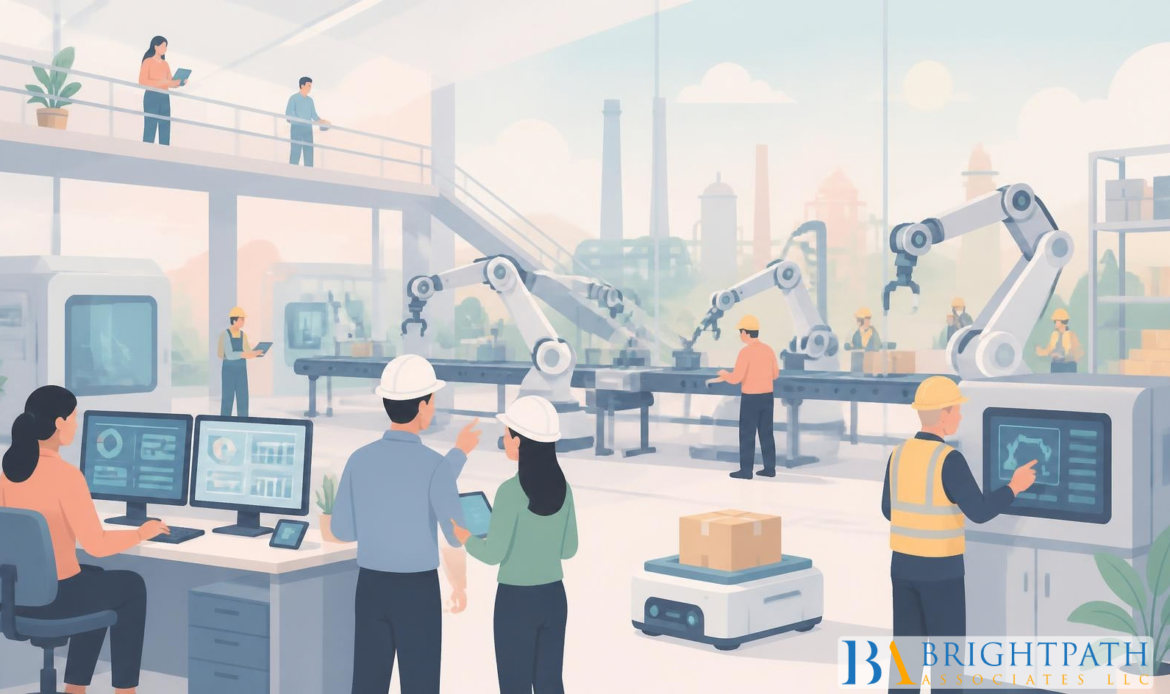
The relationship between humans and autonomous systems is becoming a defining factor in agricultural competitiveness. Machines can process large volumes of information, identify patterns, and perform repetitive activities consistently. Human employees contribute creativity, adaptability, communication, ethical judgment, and the ability to understand circumstances that may fall outside predefined algorithms.
Combining these capabilities creates opportunities for stronger operational performance. For instance, a farm management team can use automated monitoring systems to identify declining crop health while experienced agronomists investigate the underlying causes and determine the most appropriate response. Similarly, automated harvesting equipment can improve consistency, while skilled operators oversee safety, quality, and maintenance.
Leadership must establish clear responsibilities between automated systems and human teams. Employees should understand which decisions machines can make independently, which require human approval, and how to respond when systems produce unexpected results. Without these guidelines, automation can create confusion, reduce accountability, and undermine confidence among workers.
An effective leadership strategy treats machines as tools that extend human capabilities. By establishing transparent procedures and encouraging collaboration, agricultural organizations can improve productivity without losing the practical knowledge and experience that make their operations effective.
Digital Farming is changing how agricultural businesses plan production, manage resources, and evaluate performance. Connected sensors, satellite imagery, drones, predictive models, and integrated software platforms provide valuable insights into field conditions and operational requirements. These tools enable businesses to move beyond reactive management toward more proactive planning.
Farm management software plays an increasingly important role in this transformation. Modern platforms can centralize information about planting schedules, equipment utilization, irrigation, labor allocation, input costs, and harvest forecasts. When managers have access to reliable information, they can identify inefficiencies earlier and allocate resources more effectively.
However, collecting data is not the same as using it successfully. Leaders must ensure that information is accurate, relevant, accessible, and understandable to employees. Poor-quality data or disconnected systems can lead to incorrect recommendations and unnecessary expenditure.
Agricultural executives should also establish appropriate data governance practices, including cybersecurity protections, access controls, and clear policies governing the use of operational information. As farms become more digitally connected, protecting commercially sensitive information and maintaining reliable systems become essential responsibilities.
The objective is to build a culture in which technology supports informed decisions at every organizational level. When employees understand how digital insights relate to their daily responsibilities, digital transformation becomes a practical business advantage rather than an isolated technical initiative.
Sustainable Farming and Environmental Responsibility
The growing adoption of autonomous systems creates significant opportunities to strengthen #SustainableFarmingPractices. Precision application equipment can reduce unnecessary fertilizer and pesticide use, while automated irrigation systems can deliver water according to crop requirements. Soil monitoring technologies can help farmers identify areas requiring intervention instead of treating entire fields uniformly.
These capabilities support Agricultural sustainability by improving resource efficiency and reducing avoidable waste. They can also contribute to better soil management, lower operating costs, and more consistent production outcomes.
Nevertheless, automation does not automatically make farming sustainable. Advanced machinery requires energy, maintenance, and financial investment. Poorly designed technology strategies may encourage excessive resource consumption or create additional environmental pressures. Leaders must therefore evaluate both the immediate operational benefits and the broader environmental consequences of technological adoption.
Organic farming businesses face additional considerations because they must maintain compliance with applicable certification requirements and production standards. Digital monitoring, traceability systems, and precision equipment can support these operations, but technological decisions must remain consistent with the principles and requirements governing organic production.
Effective leadership connects environmental objectives with business strategy. By establishing measurable targets for water use, soil health, energy consumption, and input efficiency, agricultural organizations can make sustainability an operational priority rather than simply a marketing message.
The impact of autonomous technology extends beyond the farm. Food production depends on coordinated activities involving cultivation, harvesting, storage, processing, transportation, and distribution. Inefficiencies at any stage can increase costs, create waste, and affect product quality.
Intelligent automation can strengthen coordination throughout this value chain. Automated sorting systems can improve consistency in processing facilities, while sensors can monitor storage conditions and identify temperature variations. Predictive maintenance systems can detect potential equipment failures before they disrupt production schedules.
For agricultural businesses supplying food manufacturers and retailers, these improvements can increase traceability and strengthen confidence in product quality. Data collected during cultivation and harvesting can also help downstream partners plan procurement and manage inventory more accurately.
Leadership is essential because these benefits depend on cooperation across departments and organizations. Farm managers, equipment operators, logistics teams, quality specialists, and technology providers must work toward shared performance objectives.
Organizations should therefore establish common reporting standards, clearly defined responsibilities, and effective communication channels. When autonomous systems operate within a coordinated business strategy, they can support more reliable Food production while helping organizations respond to changing customer expectations and supply chain pressures.
Developing a Workforce Ready for the Autonomous Age
One of the most significant challenges associated with agricultural automation is workforce adaptation. Employees may worry that autonomous machinery will eliminate established roles or reduce the value of their practical experience. If leaders ignore these concerns, resistance can slow implementation and weaken employee engagement.
Forward-thinking organizations recognize that automation changes #JobResponsibilities rather than removing the need for capable people altogether. Traditional equipment operators may develop skills in remote monitoring, diagnostics, data interpretation, and preventive maintenance. Farm supervisors may increasingly combine agronomic knowledge with digital planning and performance analysis.
Training programs should reflect these changing requirements. Practical demonstrations, supervised equipment operation, digital literacy workshops, and partnerships with technical institutions can help employees build confidence with new systems.
Leaders must also communicate honestly about how technology will affect individual roles. Employees should have opportunities to ask questions, contribute operational insights, and participate in implementation decisions. Their experience can reveal practical problems that technology developers or senior managers may overlook.
A successful transition depends on continuous learning. By investing in employee development, agricultural organizations can improve adoption rates, retain valuable institutional knowledge, and create a workforce capable of operating effectively alongside autonomous systems.
Adopting autonomous machinery and digital platforms requires careful financial planning. Equipment purchases, software subscriptions, employee training, connectivity infrastructure, and ongoing maintenance can create substantial costs, particularly for smaller agricultural businesses.
Sustainable agriculture investment should therefore be guided by a clear understanding of expected returns and operational priorities. Leaders must consider whether a technology addresses a genuine business problem, whether its benefits can be measured, and whether the organization has the skills and infrastructure required to use it effectively.
A phased implementation strategy can reduce financial risk. Businesses may begin with pilot projects involving precision irrigation, automated equipment monitoring, or digital inventory management. Performance can then be assessed before the organization commits to wider deployment.
Evaluation should include more than immediate cost savings. Relevant measures may include productivity per acre, water consumption, equipment downtime, labor efficiency, crop quality, waste reduction, and long-term resilience.
Leaders must also consider the needs of smaller farms, where access to capital and technical support may be limited. Shared machinery services, cooperative purchasing, equipment leasing, and technology partnerships can make innovation more accessible without requiring every business to purchase expensive systems independently.
Disciplined investment allows organizations to pursue technological progress while protecting financial stability and supporting long-term Agricultural sustainability.
Executive Leadership and the Importance of Specialized Recruitment
Managing autonomous agricultural operations requires leaders who can connect agricultural expertise with digital transformation, financial management, and workforce strategy. Traditional industry experience remains valuable, but senior executives increasingly need to understand automation, data governance, supply chain integration, and technology-driven business models.
Organizations may require chief operating officers who can improve operational efficiency, technology leaders who can oversee connected systems, and sustainability executives who can integrate environmental priorities into commercial planning. Agricultural equipment manufacturers and food processors may also need leaders with experience in robotics, industrial automation, and predictive analytics.
This growing demand highlights the importance of Executive Search Recruitment in the agricultural sector. Specialized recruitment partners can help organizations identify senior professionals who understand both the technical possibilities and the human implications of autonomous operations.
An effective executive search process should evaluate more than a candidate’s familiarity with emerging technologies. Leadership capability, change management, communication, financial discipline, and experience developing cross-functional teams are equally important. Candidates must demonstrate an ability to translate technological opportunities into practical business outcomes.
Organizations should also prioritize leaders who understand the realities of agricultural production, including seasonal demand, unpredictable weather, commodity price fluctuations, and regulatory requirements. Combining industry knowledge with digital expertise can help businesses implement technology without losing sight of their operational priorities.
#StrategicRecruitment ultimately strengthens an organization’s ability to manage change, develop talent, and build a leadership team prepared for an increasingly automated agricultural economy.
Despite its potential, autonomous agriculture presents several challenges. Connectivity limitations, equipment compatibility, cybersecurity threats, high implementation costs, and shortages of specialized technical skills can prevent businesses from realizing the expected benefits.
Leaders must address these barriers through careful planning and realistic expectations. Before investing in complex systems, organizations should assess infrastructure readiness, evaluate supplier reliability, and establish procedures for technical support. Interoperability should be a major consideration because equipment and software from different providers may not communicate effectively.
Another important challenge is accountability. When an automated system makes an incorrect recommendation or experiences a malfunction, employees need clear procedures for investigation, correction, and escalation. Organizations should maintain appropriate human oversight, document important decisions, and test critical systems regularly.
Ethical leadership also requires attention to employment opportunities, responsible data use, and equitable access to innovation. Technological progress should not be evaluated exclusively through short-term productivity gains. Its effects on employees, local communities, suppliers, and environmental resources deserve consideration.
By anticipating these challenges, agricultural leaders can develop implementation strategies that emphasize reliability, transparency, safety, and continuous improvement.
The Future of Leadership in Autonomous Agriculture
The next phase of agricultural development will likely involve increasingly connected farms, smarter machinery, advanced predictive analytics, and more integrated food supply chains. Artificial intelligence may help managers anticipate crop stress, optimize resource allocation, and identify operational risks before they become costly problems.
However, the most successful organizations will not necessarily be those that automate the greatest number of activities. They will be those that use technology strategically, develop capable employees, and establish a culture of responsible innovation.
Leaders must remain adaptable as technology, customer expectations, environmental conditions, and market requirements evolve. They should encourage experimentation while maintaining clear standards for safety, performance, and accountability.
Agricultural businesses that combine human judgment with machine intelligence can strengthen productivity, improve resource efficiency, and respond more effectively to global food challenges. The objective is not to choose between people and machines, but to create systems in which each contributes its strongest capabilities.
Conclusion
Leadership in the age of autonomy represents a fundamental shift in how agricultural organizations operate, compete, and create value. Agricultural technology, Precision agriculture, Digital Farming, and intelligent automation offer powerful opportunities to improve productivity and strengthen operational resilience. Their long-term success, however, depends on effective leadership, workforce development, disciplined investment, and environmental responsibility.
By integrating Sustainable farming practices with digital capabilities, businesses can improve resource utilization while supporting dependable Food production. Investments in Farm management software, employee training, and responsible Agricultural innovation can further strengthen decision-making and operational performance.
Equally important, organizations must recruit leaders who understand the relationship between technology, people, and commercial outcomes. Strategic #ExecutiveSearchRecruitment can help identify the expertise required to navigate this transition and build resilient agricultural enterprises.
The future of agriculture will be shaped not simply by how intelligently machines operate, but by how effectively people guide them. Organizations that establish this harmony will be better positioned to achieve sustainable growth, strengthen competitiveness, and contribute to a more productive and environmentally responsible global food system.
Find your next leadership role in Farming Industry today!