
Introduction
The beverage industry operates in a highly competitive environment where production speed, product quality, resource efficiency, and operating costs directly influence profitability. Among these factors, #EnergyConsumption has become an increasingly important concern. Beverage plants require substantial amounts of electricity and thermal energy for processing, refrigeration, bottling, filling, pasteurization, water treatment, compressed air, packaging, and warehouse operations. As energy prices fluctuate and sustainability expectations increase, manufacturers are looking for more flexible ways to manage their power infrastructure.
One emerging approach is Energy as a Service (EaaS), a business model that allows beverage manufacturers to access energy infrastructure and optimization services without necessarily owning and managing every component themselves. Instead of treating energy simply as a utility expense, EaaS transforms it into a managed operational service focused on efficiency, reliability, predictability, and sustainability.
The concept becomes particularly powerful when combined with industrial automation, digital monitoring, advanced control systems, and data-driven manufacturing. By integrating energy management with production operations, beverage plants can create smarter facilities capable of continuously adjusting energy consumption according to production requirements.
Understanding Energy as a Service for Beverage Plants
Traditional beverage manufacturing facilities typically purchase electricity and fuel from utility providers while investing their own capital in boilers, chillers, compressors, refrigeration equipment, generators, solar systems, and electrical infrastructure. The manufacturer remains responsible for maintenance, upgrades, operational optimization, and energy efficiency improvements.
Energy as a Service changes this structure. Under an EaaS model, a specialized energy provider may finance, install, operate, maintain, and optimize energy assets for the manufacturing facility. The beverage company then pays according to an agreed service arrangement, which may be based on energy consumption, availability, performance, or other contractual terms.
This approach can reduce the upfront capital burden associated with modernizing energy infrastructure. More importantly, it can bring specialized technical expertise into facilities that may not have dedicated energy engineering teams.
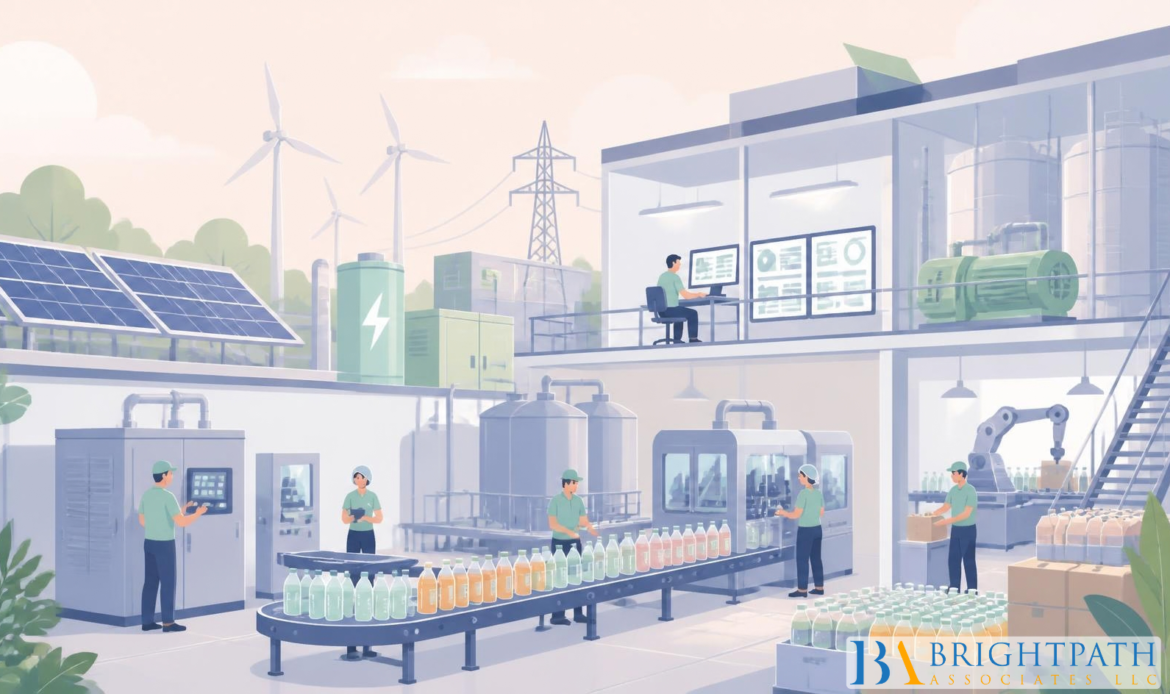
For beverage manufacturers, this model can encompass renewable energy generation, battery storage, high-efficiency refrigeration, compressed-air optimization, heating systems, energy monitoring platforms, and automated demand management.
Beverage production has several characteristics that make energy optimization particularly valuable. Production facilities often operate continuously or across multiple shifts, creating substantial and predictable energy demand. Refrigeration and cooling systems may operate around the clock, while bottling and packaging lines require consistent electrical power.
Processes such as pasteurization and cleaning-in-place systems can also create significant thermal and electrical loads. At the same time, production schedules can change based on seasonal demand, product launches, promotional campaigns, and supply-chain requirements.
An EaaS provider can use operational data to understand these consumption patterns and identify opportunities to reduce unnecessary energy use. When integrated with SCADA systems, production-management platforms, and automated control technologies, energy consumption can become an actively managed component of manufacturing operations rather than a fixed overhead.
Integrating Industrial Automation With Energy Management
The future of energy optimization in beverage manufacturing will increasingly depend on the connection between energy infrastructure and production automation. Modern #IndustrialAutomation enables equipment to respond dynamically to operating conditions, production schedules, and energy availability.
For example, a beverage plant can automatically adjust refrigeration loads when production demand changes. Compressors can operate according to real-time requirements rather than running continuously at maximum capacity. Pumps, motors, conveyors, and packaging equipment can be coordinated to avoid unnecessary idle operation.
These capabilities require sophisticated control systems that connect machines, sensors, energy meters, and supervisory software. Automation engineers can design control strategies that balance production requirements with energy efficiency without compromising product quality or throughput.
This is where automation solutions manufacturing becomes increasingly important. Instead of implementing automation exclusively to increase production speed, manufacturers can use automation to optimize the entire energy-performance equation.
The Role of PLC Programming in Smart Energy Operations
Programmable logic controllers are central to many beverage production environments. A professional PLC programming service can help manufacturers develop control logic that responds to real-time production and energy conditions.
For instance, PLCs can control motors, pumps, valves, compressors, conveyors, and refrigeration equipment according to defined operating parameters. Advanced programming can also enable equipment sequencing that minimizes simultaneous peak loads.
A beverage plant might schedule energy-intensive operations to avoid unnecessary demand peaks or automatically reduce noncritical equipment during periods of high electricity demand. PLC-based control can make these strategies reliable and repeatable.
The value of PLC programming extends beyond individual machines. When PLCs communicate with SCADA platforms and higher-level manufacturing systems, plant operators can gain greater visibility into how production decisions influence energy consumption.
Energy optimization cannot be effective without accurate information. SCADA systems provide an important foundation by collecting and displaying real-time data from industrial equipment and processes.
In a beverage plant, SCADA platforms can monitor electricity consumption, temperatures, pressures, flow rates, equipment status, refrigeration performance, compressed-air demand, and other operating parameters. Historical data can then be analyzed to identify unusual consumption patterns or inefficient equipment.
Real-time visualization allows plant managers to understand where energy is being consumed and when. This creates an opportunity to establish energy-performance benchmarks for production lines and individual processes.
When EaaS providers integrate SCADA data with energy management platforms, manufacturers can move from reactive maintenance toward predictive and proactive energy management.
Robotics is another important element in modern beverage manufacturing. Robotics integration can improve productivity, consistency, safety, and material handling while also contributing to energy optimization.
Robotic palletizing, packaging, case handling, and warehouse operations can be programmed to operate according to production demand. Rather than keeping every automated system continuously active, intelligent scheduling can coordinate robotic equipment with upstream and downstream processes.
Energy-efficient robotic systems can also communicate with plant control platforms, allowing manufacturers to identify the energy cost associated with specific production activities. Over time, this information can support better production planning and equipment selection.
The combination of robotics, industrial controls, and EaaS creates an environment where energy performance becomes part of the broader automation strategy.
Industrial Machine Vision for Smarter Production
#IndustrialMachineVision is commonly associated with quality inspection, packaging verification, labeling, and defect detection. However, its role can also support energy-efficient production.
Vision systems can identify product or packaging issues early, reducing waste and preventing unnecessary processing. Detecting defective bottles, incorrect labels, damaged packaging, or filling inconsistencies can prevent entire batches from moving further through energy-intensive processes.
When machine vision is integrated with automation systems, production lines can automatically respond to detected quality problems. This helps manufacturers reduce material waste, downtime, reprocessing, and the associated energy consumption.
The broader objective is not simply to consume less energy but to ensure that every unit of energy contributes effectively to productive output.
Energy as a Service can also enable beverage plants to adopt renewable power without making all infrastructure investments independently. Solar photovoltaic systems are particularly attractive for facilities with large rooftops, warehouses, and extensive operating hours.
A service provider may finance and maintain the renewable energy installation while the manufacturer pays for the energy generated under a contractual arrangement. Battery storage can further improve flexibility by storing electricity during lower-cost periods and supplying power when demand increases.
For beverage plants, distributed energy systems can also improve resilience. Reliable backup power is critical because unexpected outages can disrupt production, compromise temperature-sensitive products, and create significant financial losses.
Predictive Maintenance and Energy Performance
Energy efficiency is closely connected to equipment condition. A poorly maintained compressor, pump, motor, or refrigeration system may consume substantially more energy while delivering lower performance.
Modern automation platforms can combine equipment data with predictive analytics to identify potential problems before they become major failures. Abnormal vibration, temperature, pressure, or power consumption can indicate developing equipment issues.
This approach allows maintenance teams to intervene before failures occur. It also ensures that energy-intensive assets operate closer to their designed efficiency levels.
For EaaS providers, predictive maintenance becomes an important part of delivering measurable performance rather than simply supplying energy.
The transformation toward intelligent energy management is creating demand for professionals who understand both manufacturing and digital technologies. Beverage companies increasingly require engineers and managers with expertise in automation, controls, energy systems, data analytics, and industrial software.
This is increasing demand for specialized automation jobs across manufacturing organizations. Engineers with PLC, SCADA, robotics, instrumentation, and controls experience can play an important role in implementing EaaS strategies.
At the leadership level, organizations may require specialists capable of connecting energy strategy with manufacturing objectives. This is where industrial automation executive search can become valuable. Finding leaders who understand both operational technology and business strategy can accelerate digital transformation initiatives.
Specialized #ExecutiveSearchRecruitment can help beverage manufacturers identify senior engineering, operations, automation, and technology professionals capable of managing increasingly complex industrial environments.
The Strategic Value of Automation Talent
Technology alone cannot transform a beverage plant. Successful EaaS implementation requires people who can evaluate processes, interpret data, manage technology providers, and align energy investments with business objectives.
Leaders must understand how energy efficiency affects production economics, maintenance strategies, sustainability objectives, and customer requirements. They must also be capable of managing cross-functional teams involving engineering, operations, IT, procurement, finance, and external energy providers.
As industrial environments become more connected, the competition for experienced technical leaders is likely to intensify. Companies that build strong automation and engineering teams will be better positioned to capitalize on energy-service models.
The future beverage plant will increasingly operate as an interconnected ecosystem where production equipment, energy infrastructure, automation platforms, and digital analytics communicate continuously.
Instead of simply purchasing electricity, manufacturers may increasingly purchase guaranteed energy performance, equipment availability, efficiency improvements, and infrastructure services. EaaS can shift energy management from a capital-intensive responsibility into a performance-oriented operating model.
Artificial intelligence, predictive analytics, smart sensors, advanced SCADA platforms, robotics, and connected control systems will further expand these possibilities. Automated systems will be capable of identifying changes in production demand and adjusting energy consumption accordingly.
The result could be a beverage manufacturing environment where energy decisions are made in real time based on production requirements, market conditions, equipment health, and sustainability targets.
Conclusion
Energy as a Service represents more than an alternative way to purchase power. For beverage manufacturers, it can become a strategic pathway toward more efficient, resilient, and digitally connected operations.
When combined with #ManufacturingAutomation, PLC technologies, SCADA systems, robotics integration, machine vision, and advanced control systems, EaaS can help beverage plants understand and optimize energy consumption at a much deeper level.
However, technology investment must be matched by the right talent. Skilled engineers, automation specialists, plant leaders, and technology executives are essential to turning sophisticated energy models into measurable business outcomes.
For beverage manufacturers preparing for the next phase of industrial transformation, the question is no longer simply how much energy a facility consumes. The more important question is how intelligently that energy is used. Companies that combine innovative energy models with advanced automation and strategic talent acquisition can transform energy from a major operating expense into a source of efficiency, resilience, and competitive advantage.
Find your next leadership role in Industrial Automation Industry today!
Stay informed with the latest insights on Industrial Automation Industry!