
Introduction
Waste collection has traditionally been managed through fixed routes, predetermined schedules, driver experience, and manual coordination. While these methods can provide #PredictableService, they are not always efficient. Collection vehicles may travel routes with partially filled containers, encounter unexpected traffic, make unnecessary stops, or operate according to schedules that no longer reflect actual waste-generation patterns.
Lean Management 2.0 represents a broader evolution of traditional lean principles. Instead of focusing solely on eliminating obvious operational waste, organizations can combine lean thinking with automation, connected sensors, data analytics, artificial intelligence, and digital fleet-management systems.
For waste collection organizations, this creates an opportunity to redesign routes around real-time conditions rather than assumptions. The objective is not simply to reduce miles driven. It is to improve fleet utilization, reduce fuel and energy consumption, increase service reliability, and create a more sustainable operating model.
This transformation also connects waste management with the broader movement toward Clean energy, Green technology, and Renewable energy innovation.
Traditional lean management focuses on identifying activities that do not create value and removing unnecessary steps from a process. In waste collection, this might involve reducing empty vehicle travel, minimizing unnecessary handling, improving scheduling, and optimizing depot operations.
Lean Management 2.0 adds digital intelligence to these principles.
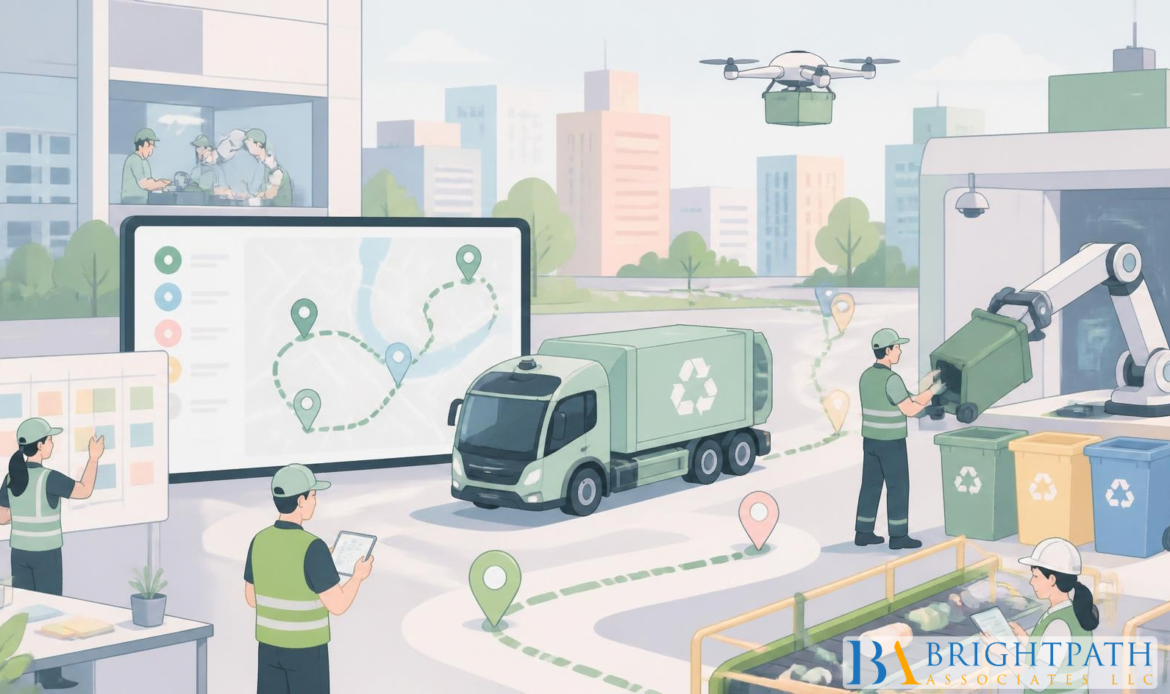
Connected containers can communicate when they require collection. GPS systems can track vehicles in real time. Route-optimization platforms can analyze traffic and collection requirements. Automated dispatch systems can adjust schedules as conditions change.
Instead of creating a route once and following it throughout the day, operators can continuously optimize routes based on new information.
The result is a more responsive waste-management system.
Smart Collection Routes and Automation
Automation can fundamentally change how collection routes are designed.
Traditional routes often depend on historical assumptions. A particular neighborhood may receive collection service every Tuesday because that schedule has always been used. However, waste generation may vary significantly by season, weather, commercial activity, holidays, and population patterns.
Smart collection systems use sensors and historical data to determine when containers are likely to require service.
This reduces unnecessary collection trips and allows vehicles to prioritize locations where service is actually required.
The resulting route can be shorter, more predictable, and more closely aligned with real demand.
Waste collection is increasingly connected to energy transition strategies. Fleets that traditionally depend on diesel are gradually being complemented or replaced by electric, hybrid, and alternative-fuel vehicles.
This creates new opportunities for Renewable energy innovation.
Electric waste-collection vehicles can potentially be charged using renewable electricity generated through solar or wind systems. Waste-management facilities can also integrate energy storage to manage charging demand.
This creates an interconnected system in which waste collection, transportation, and energy management become part of the same operational strategy.
The transition requires careful planning because vehicle range, charging infrastructure, route length, payload, weather conditions, and collection frequency all influence fleet performance.
Sustainable Energy Solutions for Waste Fleets
The transition toward Sustainable energy solutions is particularly important for organizations managing large fleets.
Electric collection vehicles may offer advantages in urban environments because they can reduce tailpipe emissions and potentially lower certain operating and maintenance costs.
However, electrification must be evaluated through the complete operating cycle. Fleets require charging infrastructure, appropriate electrical capacity, energy-management systems, and carefully designed schedules.
Automation can help coordinate these requirements.
A digital platform can match vehicle assignments with available charging capacity, route requirements, battery levels, and operational priorities.
This allows fleet managers to treat energy availability as part of route optimization rather than as a separate issue.
The growth of #RenewableEnergyTechnology can further support automated waste collection.
Solar installations at depots can generate electricity for vehicle charging, buildings, lighting, and equipment. Battery storage can help balance energy demand and improve the utilization of renewable generation.
Wind energy can also contribute to large-scale energy strategies in regions with appropriate resources.
The important point is that renewable energy should not be treated as an isolated sustainability project. It can become part of a broader operational ecosystem connecting energy generation, storage, fleet charging, and collection scheduling.
The Wind energy industry is expanding the availability of renewable electricity in many markets. For waste-management organizations, increased access to renewable power can support fleet electrification and facility decarbonization.
Long-term electricity procurement agreements can potentially provide greater predictability in energy costs while supporting sustainability goals.
However, the economics depend on regional electricity markets, infrastructure availability, fleet requirements, and renewable-generation conditions.
Waste operators therefore need to consider energy strategy alongside transportation strategy.
The future waste-management depot may increasingly operate as both a logistics center and an energy-management facility.
Environmental Management Systems and Operational Control
Automation can also strengthen Environmental management systems by creating more accurate records of operational performance.
Organizations can monitor fuel consumption, vehicle emissions, electricity use, route efficiency, waste volumes, and other environmental indicators.
This information can support environmental reporting and help organizations identify opportunities for improvement.
Instead of relying on occasional measurements, companies can establish continuous monitoring systems.
Such visibility can also improve accountability. Fleet managers can identify which routes, vehicles, or facilities consume the most resources and prioritize corrective actions.
Waste-management companies operate within increasingly complex regulatory environments. Environmental regulations may govern emissions, waste transportation, disposal practices, fuel consumption, noise, vehicle operation, and environmental reporting.
Automation can help organizations maintain more consistent records and demonstrate compliance.
Digital systems can automatically collect data associated with vehicle activity, collection volumes, operating hours, and environmental performance.
This can reduce administrative workloads while improving the accuracy of compliance information.
As environmental requirements become more data-intensive, automated reporting capabilities may become increasingly valuable.
The economics of renewable energy and fleet electrification are an important consideration for Lean Management 2.0.
An organization should evaluate total lifecycle costs rather than focusing only on vehicle purchase prices or electricity rates.
Fuel savings, maintenance requirements, vehicle utilization, battery performance, charging infrastructure, route efficiency, energy prices, and potential incentives can all influence the financial outcome.
Renewable energy economics therefore needs to be considered alongside logistics economics.
A highly efficient route can reduce the energy required per collection. A renewable-powered depot can reduce dependence on conventional electricity. An optimized charging schedule can potentially reduce peak energy costs.
When these improvements are combined, the business case for clean transportation can become stronger.
Automation as a Source of Clean Energy Efficiency
Automation itself does not automatically create sustainability. Its value comes from using information to eliminate unnecessary activity.
For example, a sensor that identifies a nearly empty container may prevent an unnecessary collection trip. A route-optimization system can reduce vehicle mileage. Predictive maintenance can prevent inefficient equipment operation. Automated charging management can reduce energy waste.
These improvements contribute to #CleanEnergy objectives because they reduce the amount of energy required to deliver the same service.
The core principle is simple: the most sustainable mile is often the mile that does not need to be driven.
The concept of Green technology extends beyond electric vehicles.
It includes smart containers, route-optimization platforms, low-energy sorting equipment, renewable-powered facilities, energy storage, digital monitoring systems, automated maintenance, and advanced recycling technologies.
When these technologies are connected, waste-management companies can create integrated operating systems rather than isolated technology projects.
A smart container can generate data. The data can influence route planning. Route planning can determine vehicle requirements. Vehicle requirements can influence charging schedules. Energy systems can then optimize electricity consumption.
This is the essence of Lean Management 2.0: connecting individual efficiency improvements into a coordinated operational model.
Predictive Maintenance and Fleet Efficiency
Vehicle maintenance is another important area for automation.
Predictive maintenance systems can analyze vehicle data to identify developing problems before they become major failures. This can reduce unexpected downtime and improve fleet availability.
A vehicle with mechanical or electrical problems may also operate less efficiently. Identifying these issues early can therefore provide both reliability and energy benefits.
For electric vehicles, monitoring battery health, charging performance, thermal conditions, and energy consumption becomes particularly important.
Digital maintenance systems can integrate these indicators into fleet-management platforms.
The transition toward automated waste collection will change workforce requirements rather than simply eliminating jobs.
Traditional driving and collection roles will increasingly coexist with technicians, data analysts, fleet electrification specialists, automation engineers, energy managers, and software professionals.
This transformation is contributing to the growth of #RenewableEnergyJobs and related clean-technology careers.
Employees will need new skills to operate digital systems, interpret performance data, maintain electric vehicles, manage charging infrastructure, and support environmental compliance.
Organizations that invest in workforce development can make the transition more effectively.
Leadership Requirements for the Automated Waste Industry
Technology implementation requires strong leadership because automation affects operations, capital planning, workforce development, environmental performance, and customer service simultaneously.
Executives must understand both the operational realities of waste collection and the opportunities created by digital and clean-energy technologies.
They must also evaluate whether technology investments produce measurable improvements rather than simply adding complexity.
This is where #ExecutiveSearchRecruitment can become important. Waste-management and environmental organizations may require senior leaders with experience in fleet transformation, sustainability, automation, energy management, and operational strategy.
The most effective leaders will be capable of connecting technology investment with measurable business outcomes.
Lean Management 2.0 should not be viewed as a one-time technology implementation. It is a continuous improvement framework.
Once automated systems begin generating operational data, organizations can continually refine their routes, fleet utilization, energy consumption, maintenance schedules, and workforce allocation.
A route that is optimal today may not remain optimal next year. Population changes, new commercial customers, electric vehicle adoption, traffic patterns, and waste-generation behavior can all alter operating requirements.
Continuous data analysis allows the system to evolve.
The future waste-collection system will likely combine smart containers, autonomous or semi-autonomous technologies, connected vehicles, predictive analytics, electric fleets, renewable power, and automated dispatch.
Waste collection will increasingly resemble a dynamic logistics network rather than a fixed transportation schedule.
Artificial intelligence could eventually predict collection demand before containers reach capacity. Fleet systems could automatically assign vehicles according to battery status and route requirements. Renewable-energy systems could coordinate charging with electricity availability.
These technologies can create a more flexible, responsive, and sustainable waste-management model.
Conclusion: From Route Optimization to Intelligent Resource Management
Lean Management 2.0 represents an important evolution in waste collection. Traditional lean principles remain valuable, but automation and digital connectivity provide the ability to apply those principles continuously and dynamically.
Smart routing can reduce unnecessary mileage. Predictive maintenance can improve vehicle reliability. Electric fleets can reduce dependence on fossil fuels. Renewable energy systems can support charging infrastructure. Environmental management platforms can improve compliance and sustainability reporting.
The broader opportunity lies in connecting these technologies into one integrated operating system.
For waste-management organizations, the objective should not simply be to collect waste more efficiently. It should be to build a system that uses fewer resources while delivering better service.
The convergence of Renewable energy technology, environmental management, smart logistics, and Green technology is making that goal increasingly achievable. Organizations that combine technological investment with the right workforce and leadership will be better positioned to manage the transition.
Ultimately, the next generation of waste collection will be defined not by how many trucks operate or how many routes are completed, but by how intelligently every vehicle, energy unit, employee, and operational decision is coordinated.