
Introduction
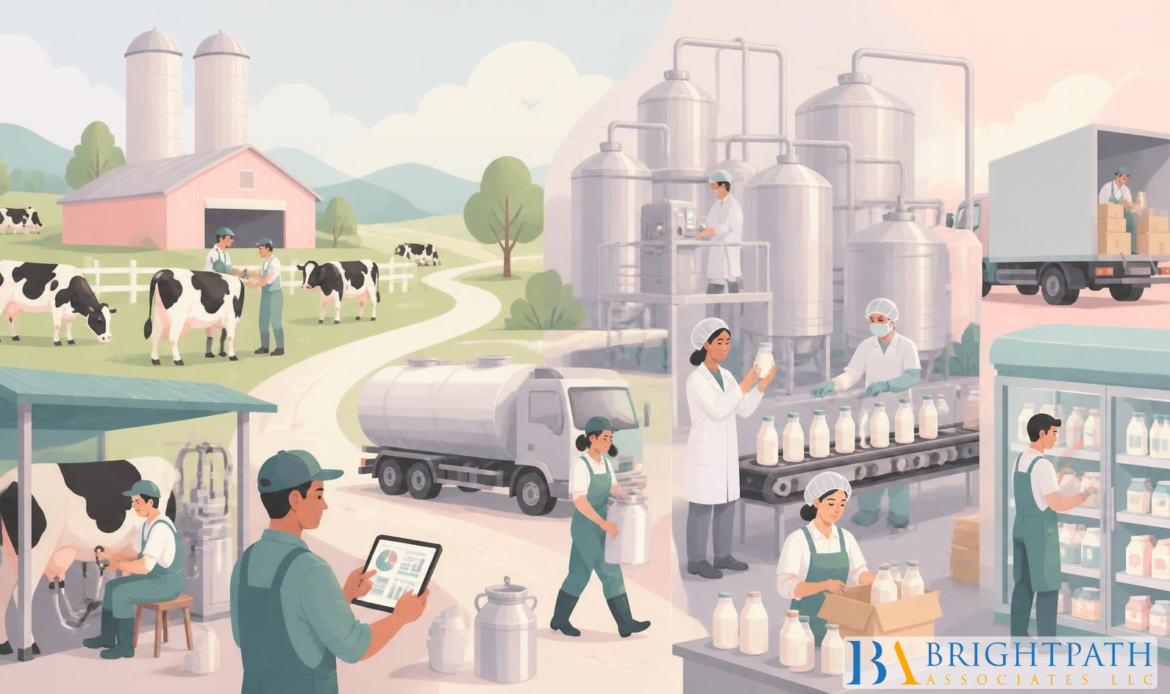
Profitability in the #DairySector is entering a period of structural change. Mid-sized dairy enterprises face a complex combination of rising input costs, changing consumer expectations, labor shortages, supply chain disruptions, regulatory requirements, and increasing competition from both large processors and specialized food brands. Maintaining profitability over the next decade will require more than increasing milk volumes. Dairy companies will need to rethink how they produce, process, distribute, market, and commercialize dairy products.
A 10-year roadmap provides mid-sized enterprises with an opportunity to move from short-term cost management toward long-term operational resilience. The objective should be to build a dairy business capable of adapting to changes in technology, consumer behavior, environmental expectations, and market conditions.
The future of dairy profitability will increasingly depend on the integration of Dairy product development, advanced production systems, digital supply chains, automation, sustainability, and strategic leadership. Companies that begin building these capabilities today can establish stronger foundations for growth throughout the next decade.
Traditional dairy profitability has largely depended on managing milk production costs, maintaining processing efficiency, and securing reliable distribution channels. While these fundamentals remain important, modern dairy enterprises operate in a much more interconnected environment.
Consumers are increasingly interested in nutrition, convenience, traceability, sustainability, and product quality. Retailers expect consistent supply and competitive pricing, while foodservice customers may require specialized products and reliable delivery schedules.
This creates opportunities for mid-sized companies to differentiate themselves through specialized products and operational flexibility. Instead of competing solely on commodity milk prices, businesses can develop higher-value product categories and create stronger relationships with consumers and commercial customers.
Long-term profitability will therefore depend on developing a business model that combines operational efficiency with innovation.
The first stage of a 10-year roadmap should focus on establishing operational discipline. Before investing heavily in new technology, dairy companies need accurate information about production costs, equipment utilization, labor productivity, product margins, inventory levels, and supply chain performance.
Management should evaluate each major product category based on its actual contribution to profitability. Some products may generate strong revenue but provide limited margins because of high processing, packaging, transportation, or promotional costs.
This period should also involve investment in employee training and process standardization. Companies need reliable procedures for production, quality assurance, maintenance, inventory management, and customer fulfillment.
At the farm level, improving herd health, feed efficiency, breeding management, and production consistency can establish a stronger foundation for future growth.
Investing in Milk Production Technologies
Technology will become increasingly important to dairy profitability. Modern Milk production technologies can improve productivity, animal monitoring, resource utilization, and decision-making.
Sensors and connected monitoring systems can provide information about animal health, feeding behavior, milk yield, and environmental conditions. Data-driven systems can help farmers identify potential health issues earlier and improve resource allocation.
For mid-sized enterprises, technology investments should be evaluated based on measurable operational outcomes. The goal should not be to adopt every available technology but to identify solutions that address specific production challenges.
Over time, these systems can create a more data-driven production environment in which management decisions are supported by real-time information rather than relying exclusively on historical assumptions.
Years Three to Five: Accelerating Dairy Automation
Once operational fundamentals are established, companies can move toward broader automation. Dairy automation technologies can transform processing facilities by reducing repetitive manual activities, improving consistency, and increasing production visibility.
Automated filling, packaging, cleaning, quality monitoring, material handling, and inventory systems can reduce process variation while improving throughput. Automation can also help address labor shortages by allowing employees to focus on higher-value responsibilities.
However, automation should be viewed as a workforce transformation rather than simply an equipment purchase. Employees must be trained to operate, monitor, troubleshoot, and maintain increasingly sophisticated systems.
This creates demand for workers with mechanical, technical, data, and process-management capabilities.
Product innovation will be one of the most important drivers of long-term profitability. #DairyProductDevelopment can help companies move beyond traditional commodity categories and capture higher-value market segments.
Mid-sized enterprises can explore products designed around changing consumer preferences, including convenient formats, functional nutrition, premium products, specialized formulations, and value-added dairy offerings.
Successful product development requires collaboration between food scientists, production teams, marketing professionals, supply chain managers, and commercial leaders.
Investment in Food technology can further support innovation by enabling companies to improve formulations, extend shelf life, optimize processing, and develop differentiated products.
The objective should be to create products that offer both consumer value and sustainable margins.
Years Five to Seven: Building Sustainable Growth
Sustainability will become increasingly connected to profitability. Consumers, retailers, regulators, investors, and business partners are placing greater emphasis on environmental performance.
Adopting Sustainable dairy farming practices can help companies reduce resource consumption while strengthening long-term resilience. Improvements in water management, feed efficiency, energy utilization, manure management, animal welfare, and waste reduction can contribute to both environmental performance and cost control.
Sustainability initiatives should therefore be integrated into operational strategy rather than treated as separate corporate programs.
Dairy companies that can demonstrate measurable sustainability improvements may also strengthen relationships with retailers and consumers while preparing for future regulatory expectations.
A profitable dairy business requires more than efficient production. Dairy supply chain management will become increasingly important as companies manage volatile transportation costs, packaging requirements, ingredient availability, inventory levels, and customer expectations.
Digital supply chain platforms can provide greater visibility into raw material movement, production schedules, inventory positions, and customer orders. Improved forecasting can help companies reduce waste and prevent shortages.
Mid-sized enterprises should also evaluate supplier diversification. Overdependence on a limited number of suppliers can create significant risks when disruptions occur.
The goal should be to build a supply chain that is flexible enough to respond to market changes without creating excessive inventory or unnecessary costs.
Consumer purchasing behavior is changing rapidly, creating opportunities for dairy businesses to establish direct digital relationships with customers. Dairy e-commerce can provide an additional sales channel while generating valuable information about consumer preferences.
Digital commerce can support direct-to-consumer products, subscription models, specialty offerings, and regional market expansion. It can also help companies test new products without relying entirely on traditional retail distribution.
However, successful e-commerce requires more than launching an online storefront. Companies must consider packaging, cold-chain logistics, customer service, delivery economics, digital marketing, and inventory management.
For mid-sized enterprises, e-commerce can become particularly valuable when used to complement existing retail and foodservice channels rather than replacing them.
Dairy Industry Digital Transformation
By the later stages of the 10-year roadmap, digital capabilities should become integrated across the enterprise. Dairy industry #DigitalTransformation can connect farm operations, processing facilities, supply chains, customer relationships, financial systems, and management decision-making.
A connected digital environment can provide executives with greater visibility into business performance. Managers can monitor production efficiency, product profitability, inventory, sales, equipment performance, and supply chain conditions through integrated data platforms.
Artificial intelligence and predictive analytics may further improve demand forecasting, equipment maintenance, quality management, and resource planning.
The key is to avoid creating isolated technology systems. Digital transformation should connect different areas of the organization around shared information and strategic objectives.
Technology alone will not create sustainable profitability. Companies also need clearly defined Dairy industry growth strategies.
Mid-sized enterprises should determine which markets offer the strongest long-term opportunities and align investments accordingly. Some businesses may benefit from geographic expansion, while others may find stronger opportunities through premium products, foodservice partnerships, private-label manufacturing, or specialized dairy categories.
Strategic partnerships can also help companies access technology, distribution networks, specialized expertise, and new customers without requiring every capability to be developed internally.
Growth should be disciplined. Expanding revenue without maintaining adequate margins, operational capacity, and working capital can weaken rather than strengthen the business.
Leadership as a Competitive Advantage
The transformation of the dairy sector will increase demand for leaders who understand both traditional dairy operations and emerging technologies. This makes Dairy industry executive search increasingly important for mid-sized enterprises.
Future dairy executives must be capable of managing production economics while also understanding automation, digital transformation, sustainability, product innovation, and changing consumer markets.
Leadership teams should also prioritize succession planning. A 10-year roadmap requires continuity, and organizations cannot depend entirely on a small number of experienced executives.
#ExecutiveSearchRecruitment can help dairy enterprises identify leaders with the combination of operational experience, strategic thinking, technological awareness, and commercial expertise required for long-term transformation.
By the end of the 10-year roadmap, successful mid-sized dairy enterprises should operate as integrated, data-driven businesses. Farm production, processing, product development, supply chain operations, sales, and customer engagement should work together rather than functioning as isolated departments.
The most successful companies will likely have diversified product portfolios, stronger digital capabilities, automated production processes, more resilient supply chains, and measurable sustainability programs.
They will also have developed a workforce capable of operating increasingly advanced technologies while maintaining the practical knowledge required to manage dairy operations effectively.
Profitability will no longer depend on a single factor such as milk volume or commodity pricing. Instead, it will result from the combined strength of operational efficiency, innovation, technology, sustainability, market positioning, and leadership.
Conclusion
The next decade presents both significant challenges and substantial opportunities for mid-sized dairy enterprises. Rising costs, labor pressures, changing consumer expectations, technology adoption, and sustainability requirements will reshape the competitive landscape.
Companies that approach these changes strategically can build stronger and more adaptable businesses. The roadmap begins with operational discipline, progresses through automation and product innovation, strengthens sustainability and supply chain capabilities, and ultimately develops an integrated digital enterprise.
The future of dairy profitability will belong to organizations that can combine agricultural expertise with technology, consumer insight, operational excellence, and strategic leadership. By investing deliberately over the next 10 years in Milk production technologies, Dairy automation technologies, Dairy product development, Dairy e-commerce, and Dairy industry digital transformation, mid-sized enterprises can move beyond short-term cost management and build durable competitive advantages.
Ultimately, profitability will come from creating a dairy business that is more efficient, innovative, sustainable, digitally connected, and capable of adapting to whatever the next decade brings.
Find your next leadership role in Dairy Industry today!