
Introduction
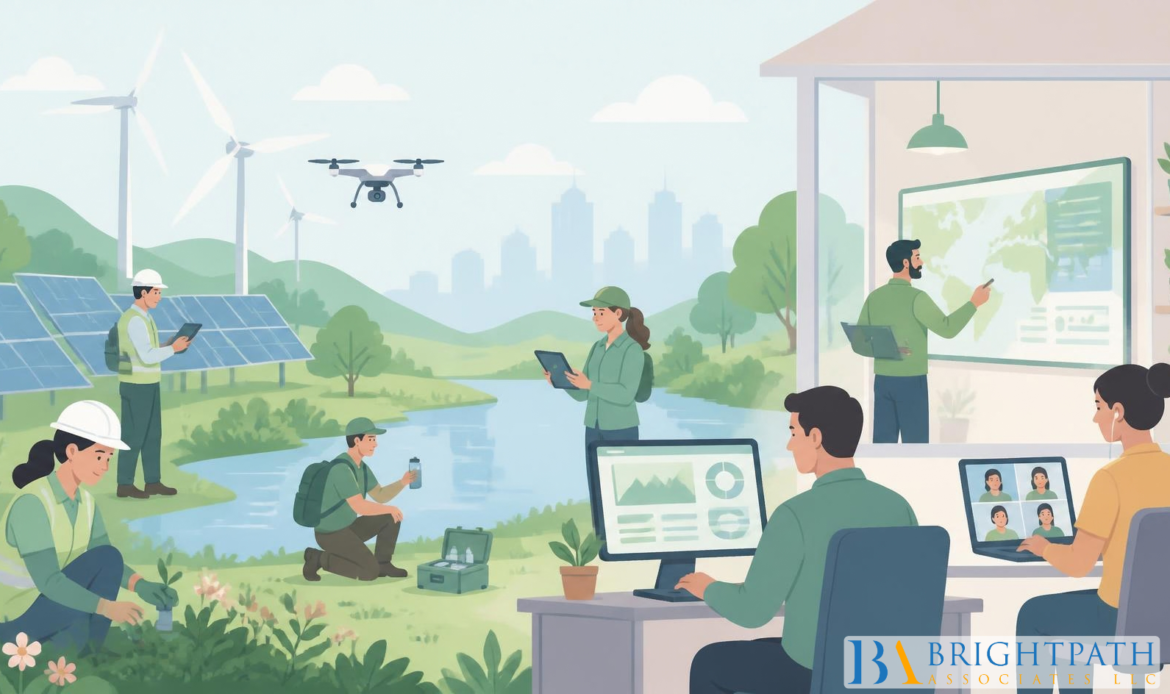
The #EnvironmentalSector is entering a new phase of workforce transformation. Environmental organizations have traditionally depended heavily on field professionals, engineers, scientists, technicians, inspectors, and operational specialists who work directly with physical infrastructure and natural environments. Today, however, advanced technology is changing how these professionals collect information, manage projects, monitor environmental conditions, and make operational decisions.
The emergence of connected sensors, artificial intelligence, data analytics, automation, remote monitoring, and digital reporting systems is creating a hybrid workforce that combines field expertise with technological capabilities. This transformation is particularly important for companies operating across environmental services, where employees increasingly need to understand both physical environmental processes and digital systems.
The future environmental workforce will therefore not be defined exclusively by either technical or field expertise. Instead, organizations will increasingly depend on professionals who can connect the two disciplines and translate technology into practical environmental outcomes.
Environmental work has always required employees to operate across different environments. Field technicians may collect water samples, inspect industrial facilities, monitor air quality, or assess contaminated locations. Engineers and scientists then analyze the information and determine appropriate responses.
Technology is now bringing these activities closer together. Digital monitoring equipment can collect environmental information continuously, while cloud-based systems allow managers and technical specialists to review information remotely. Artificial intelligence can help identify patterns that may not be immediately visible through traditional inspection methods.
This creates a hybrid model in which field employees remain essential but increasingly interact with digital platforms and automated systems. At the same time, technology professionals must understand environmental operations to ensure that digital solutions address real-world requirements.
For the environmental industry, this convergence represents both an opportunity and a workforce challenge.
The Growing Role of Environmental Innovation
Environmental innovation is no longer limited to developing new equipment or treatment technologies. It increasingly includes new approaches to workforce management, data collection, compliance, and operational decision-making.
Companies are adopting digital platforms that allow employees to monitor projects remotely, automate reporting, analyze environmental measurements, and identify potential risks earlier. These capabilities can improve efficiency while reducing unnecessary field visits and administrative workloads.
However, innovation does not eliminate the need for experienced environmental professionals. Technology still requires people who understand sampling procedures, environmental regulations, engineering principles, ecological conditions, and operational realities.
The most effective organizations will therefore use innovation to augment human expertise rather than simply attempting to replace it.
A hybrid workforce requires close collaboration between field professionals and technology specialists. A technician working at a wastewater facility, for example, may use connected equipment to monitor treatment performance. Data can then be transmitted to engineers or environmental managers who analyze the information remotely.
This model allows organizations to identify abnormal conditions more quickly. Instead of waiting for periodic inspections, managers can receive continuous information and determine whether intervention is required.
Similar applications are emerging across air pollution control, industrial emissions monitoring, waste management, environmental remediation, and resource conservation.
The field professional remains responsible for understanding the physical environment, while digital tools provide greater visibility and analytical capabilities. Together, these capabilities create a more responsive environmental operation.
Technology and the Future of Air Pollution Control
Air quality management provides a strong example of how environmental labor is changing. Traditional monitoring programs often relied on scheduled sampling and manual reporting. Modern monitoring technologies can provide more frequent or continuous information about emissions and air quality conditions.
Organizations involved in #AirPollutionControl can use sensors, automated monitoring systems, data analytics, and digital dashboards to identify trends and potential compliance issues.
This transformation changes the skills required from employees. Environmental technicians increasingly need to understand digital instruments and data platforms, while data specialists need sufficient environmental knowledge to interpret information correctly.
The workforce therefore becomes more interdisciplinary. Companies that successfully integrate these capabilities can improve environmental monitoring while strengthening operational decision-making.
The same transformation is occurring in water treatment. Treatment facilities are becoming increasingly automated, with sensors and control systems monitoring parameters such as flow rates, chemical conditions, water quality, and equipment performance.
Digital tools can help operators detect changes and respond before problems become major operational failures. Predictive analytics can also support maintenance planning by identifying equipment conditions associated with potential failures.
However, automation does not eliminate the need for experienced operators. Water treatment processes can be affected by changing environmental conditions, equipment limitations, regulatory requirements, and unexpected operational events.
The future workforce will therefore combine operational experience with digital literacy. Employees must understand both the physical treatment process and the technology used to monitor and control it.
Environmental Compliance in a Data-Driven Era
Regulatory requirements remain one of the most important drivers of environmental workforce transformation. Environmental compliance increasingly depends on accurate data, consistent reporting, documentation, and timely responses.
Digital systems can simplify these processes by automatically collecting information, maintaining records, generating reports, and identifying potential deviations from established requirements.
However, compliance decisions cannot rely exclusively on automated systems. Environmental professionals must understand regulations and evaluate whether the available data accurately reflects operational conditions.
As regulatory frameworks become more data-intensive, organizations will increasingly seek employees who combine environmental knowledge with analytical capabilities.
The growth of clean technology and green technology is creating additional workforce requirements across the environmental sector. Renewable energy systems, energy-efficiency technologies, advanced waste management, emissions reduction systems, and resource-efficient manufacturing processes require employees with increasingly specialized knowledge.
Organizations adopting these technologies need professionals who can evaluate environmental performance while understanding technological limitations and commercial requirements.
This creates opportunities for engineers, scientists, technicians, project managers, data analysts, and technology specialists. At the leadership level, companies also need executives capable of connecting environmental objectives with business strategy.
The challenge is not simply finding people who understand technology or sustainability individually. It is finding leaders who can integrate both perspectives.
Reskilling the Existing Environmental Workforce
Recruiting new employees is only one part of preparing for the future. Environmental organizations also need to reskill their existing workforce.
Experienced field employees possess valuable institutional knowledge that cannot easily be replaced by technology. They understand local environmental conditions, equipment behavior, operational challenges, and customer requirements.
Providing these employees with digital training can help organizations preserve this knowledge while improving technological capabilities. Training programs can introduce workers to data platforms, remote monitoring systems, digital reporting tools, sensor technologies, and analytical applications.
This approach can also reduce resistance to technological change. Employees are more likely to embrace new systems when they understand how those systems improve their work rather than threaten their positions.
Managing a hybrid workforce requires a different leadership approach. Environmental executives must understand how field operations and digital teams interact and where communication gaps may emerge.
A technology team may prioritize automation and data integration, while field employees may prioritize reliability, usability, and practical operational requirements. Without effective leadership, these priorities can become disconnected.
#EnvironmentalLeaders therefore need to establish common objectives. Technology should be evaluated according to its ability to improve safety, compliance, efficiency, environmental performance, and decision-making.
This is where Environmental executive search becomes increasingly important. Organizations need leadership professionals who understand environmental markets while also recognizing the strategic value of digital transformation.
The Role of Executive Search Recruitment in Environmental Labor
As environmental companies evolve, their talent requirements are becoming more specialized. Traditional hiring approaches may not always identify leaders with the combination of environmental expertise, technological understanding, and business strategy required for modern operations.
#ExecutiveSearchRecruitment can help organizations identify leadership talent with cross-functional capabilities. The ideal executive may have experience managing environmental operations while also overseeing technology adoption, regulatory strategy, workforce development, and business growth.
Leadership teams must also consider cultural adaptability. The future environmental workforce will include field technicians, engineers, scientists, technology specialists, analysts, and remote professionals. Effective executives must be capable of bringing these different groups together around common objectives.
Workforce planning should become an integral component of environmental sustainability strategies. Companies often focus on reducing emissions, conserving resources, and improving operational performance while overlooking the people required to achieve those goals.
A sustainable workforce strategy considers current capabilities, future technology requirements, employee development, leadership succession, and changing regulatory expectations.
Organizations should identify which roles are likely to become more technology-intensive and determine how employees can transition into those responsibilities. They should also evaluate which human skills will remain difficult to automate, including judgment, communication, field assessment, relationship management, and complex problem-solving.
The result is a workforce strategy designed around long-term organizational resilience.
The future of the environmental industry will likely be defined by deeper integration between people, technology, and environmental objectives. Field operations will remain essential, but digital systems will increasingly influence how those operations are planned, monitored, and managed.
Artificial intelligence, remote sensors, automation, predictive analytics, and connected equipment will continue to expand across environmental applications. Organizations that invest only in technology without developing the workforce needed to operate it may struggle to realize its full value.
Conversely, companies that combine experienced environmental professionals with digital capabilities can create a workforce that is more adaptable and responsive.
The strongest environmental organizations will not view field workers and technology professionals as separate groups. They will build integrated teams in which each discipline strengthens the other.
Conclusion
The environmental workforce is moving toward a hybrid model in which field expertise and technology become increasingly interconnected. From water treatment and air pollution control to environmental monitoring, compliance, clean technology, and sustainability initiatives, digital transformation is changing the skills organizations require.
The objective should not be to replace human expertise with technology. Instead, environmental organizations should use technology to amplify the knowledge, judgment, and capabilities of their people.
Companies that invest in reskilling, cross-functional collaboration, digital infrastructure, and strategic leadership will be better positioned to manage this transition. As environmental challenges become more complex, the ability to combine human expertise with technological innovation will become a defining competitive advantage.
Ultimately, the future of environmental labor will belong to organizations capable of creating a workforce that is both technologically capable and environmentally informed. Through effective Environmental executive search, workforce development, and strategic Executive Search Recruitment, companies can build leadership teams capable of guiding this transformation while maintaining a strong commitment to environmental sustainability.
Find your next leadership role in Environmental Services Industry today!
Stay informed with the latest insights on Environmental Services Industry!