
Introduction
Manufacturing has entered a new phase of digital transformation in which production efficiency depends not only on advanced machinery but also on how quickly organizations can adapt their workflows. Across the #IndustrialMachineryIndustry, manufacturers are increasingly turning toward low-code technologies to simplify process automation, improve operational visibility, and empower employees who do not have traditional software development backgrounds.
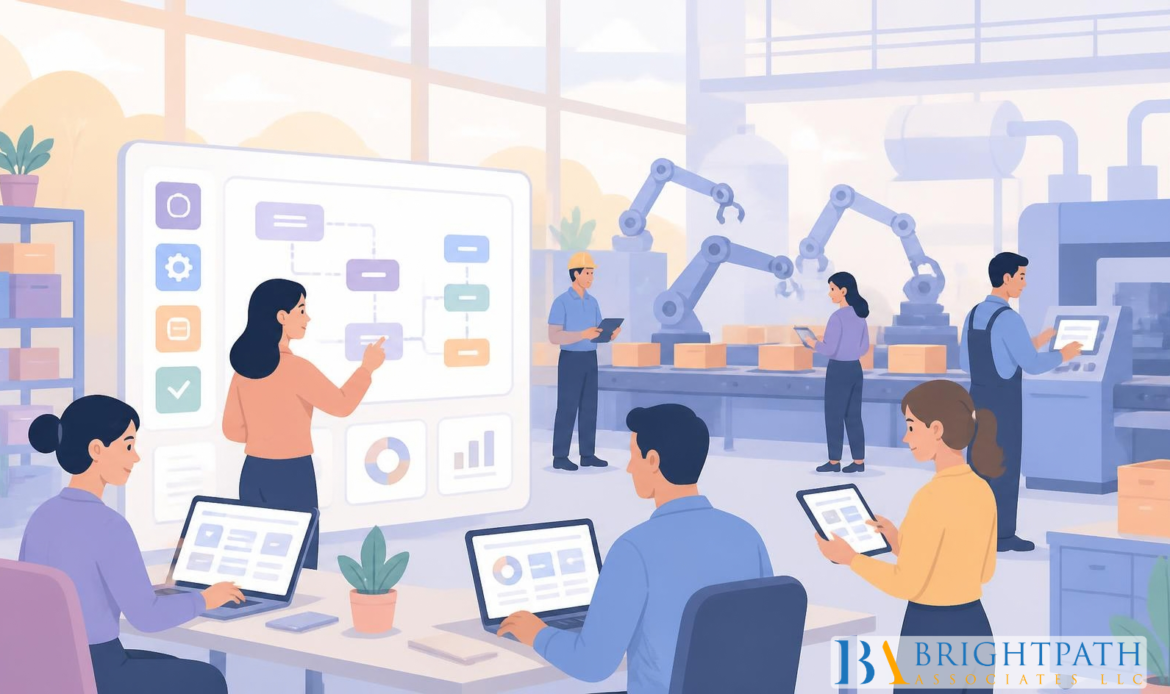
Low-code platforms allow users to build applications, automate repetitive processes, connect data sources, and develop workflow solutions through visual interfaces and configurable components. Instead of depending entirely on specialized programmers, production supervisors, maintenance teams, quality professionals, and other operational employees can participate directly in digital improvement initiatives.
For US machinery manufacturers, this shift is particularly important as companies face increasing pressure to improve productivity while controlling labor costs, addressing skills shortages, and modernizing aging production infrastructure. Low-code technology can bridge the gap between operational expertise and digital capabilities, helping organizations turn employee knowledge into practical workflow improvements.
Traditional manufacturing software implementations can require significant development time, technical expertise, and financial investment. A production team may identify an inefficient approval process or recurring maintenance issue, but implementing a digital solution often requires waiting for an IT department or external software developer.
Low-code platforms change this dynamic. Employees familiar with production operations can create or modify workflows using visual tools rather than writing extensive programming code. This enables organizations to respond more rapidly to operational problems.
For companies managing complex industrial machinery, this capability can have a direct effect on productivity. Manufacturing environments generate large amounts of information from machines, sensors, inspections, inventory systems, maintenance records, and production schedules. Low-code applications can help transform this information into actionable workflows without requiring every operational improvement to become a major IT project.
The result is a more collaborative approach to digital transformation in which technology supports employees rather than replacing their operational expertise.
Empowering Non-Tech Employees on the Production Floor
One of the most significant advantages of low-code platforms is their ability to give non-technical employees greater control over workflow improvement. Production supervisors understand where delays occur, maintenance technicians know which equipment problems repeatedly interrupt operations, and quality teams understand the causes of recurring defects.
Historically, these employees have often had to communicate improvement requirements to technical teams and wait for applications to be developed. Low-code technology allows them to become active participants in the development process.
A supervisor, for example, could create a digital workflow for production issue reporting. Instead of relying on paper forms or informal communication, operators could submit an issue through a digital interface. The system could automatically notify the appropriate supervisor, assign responsibility, record the resolution, and create a searchable history of recurring problems.
This approach improves communication while allowing employees closest to the process to contribute directly to manufacturing efficiency.
Low-code technology does not necessarily operate independently from existing manufacturing systems. Its value increases when it can interact with equipment, enterprise applications, databases, and industrial automation solutions.
Modern factories may already use programmable logic controllers, manufacturing execution systems, enterprise resource planning platforms, computerized maintenance management systems, and industrial sensors. Connecting all these systems can be complex, particularly when they were introduced at different times.
Low-code platforms can provide an integration layer that enables employees to build practical applications around existing infrastructure. A company could create a dashboard that combines production information with machine status, maintenance alerts, inventory data, and quality results.
Rather than replacing existing systems, low-code applications can help organizations make those systems more accessible and useful to operational teams.
Improving Machinery Maintenance Through Digital Workflows
Maintenance represents one of the areas where low-code technology can deliver measurable operational benefits. Unexpected equipment failures can disrupt production schedules, increase repair costs, and reduce employee productivity.
Traditional maintenance processes may rely on spreadsheets, paper forms, emails, or disconnected systems. Low-code applications can create automated maintenance workflows that help teams track equipment conditions, service schedules, repair requests, and replacement parts.
For example, when an operator reports unusual machine behavior, a low-code application can automatically generate a maintenance request. The appropriate technician can receive the notification, review equipment history, document the repair, and close the task digitally.
Such workflows can also support preventive maintenance. Scheduled inspections can trigger automatic reminders, while equipment data can be used to identify recurring issues. Over time, these capabilities can help organizations move from reactive repairs toward more structured #MachineryMaintenance strategies.
Supporting Precision Machining and Quality Control
The impact of low-code technology extends beyond administrative workflows. In environments focused on precision machining, small variations in process conditions can have significant consequences for product quality and production costs.
Low-code platforms can help connect inspection information with production processes. Quality personnel can create digital inspection forms, automatically route nonconformance reports, and track corrective actions without requiring a custom software application for every process.
For example, if a component fails a dimensional inspection, the workflow can automatically notify the responsible production team, record the affected batch, initiate a corrective-action process, and track the resolution.
This improves traceability while reducing the administrative burden associated with quality management. It also gives managers greater visibility into recurring production issues.
The manufacturing sector continues to face workforce challenges involving skills shortages, workforce aging, and competition for technically capable employees. At the same time, organizations need workers who can operate increasingly sophisticated production systems.
Low-code technology can help address some of these challenges by simplifying digital interaction. Employees do not necessarily need to become professional programmers to participate in automation initiatives.
This does not mean technical expertise becomes unnecessary. Instead, organizations can create multidisciplinary teams in which manufacturing employees understand processes while IT and engineering professionals provide governance, architecture, security, and technical guidance.
This model can also make certain manufacturing jobs more attractive by giving employees opportunities to participate in digital transformation and continuous improvement.
Creating Opportunities for Used Machinery and Legacy Equipment
Modernization does not always mean replacing every piece of equipment. Many manufacturers continue to operate older machines because they remain productive, reliable, or financially practical. Used machinery can provide significant value, particularly for companies seeking to expand production without making large capital investments.
However, older equipment may lack the connectivity of modern industrial systems. Low-code platforms can help manufacturers build digital workflows around legacy equipment without immediately replacing the underlying machinery.
For example, operators can use digital interfaces to record machine conditions, production output, inspection results, or downtime events. This creates useful operational data even when the equipment itself does not provide sophisticated connectivity.
Consequently, low-code technology can become part of a broader modernization strategy that combines existing machinery with newer digital capabilities.
Manufacturers naturally evaluate technology investments based on their expected return. Large-scale digital transformation projects can require substantial spending on software, infrastructure, consulting, and specialized personnel.
Low-code platforms can reduce some development costs by shortening application development cycles and allowing internal employees to address smaller workflow problems themselves. This can make digital transformation more accessible to organizations with limited technology budgets.
Companies evaluating #MachineryFinancing can also consider digital workflow capabilities as part of their broader investment strategy. Purchasing new equipment without improving the surrounding operational processes may limit the potential return on that investment.
A more integrated approach considers machinery, software, workforce capabilities, and process design together. The objective is not simply to acquire new technology but to increase the value generated by the entire production system.
Managing Risks and Governance
Despite its advantages, low-code technology should not be treated as a solution without risks. When employees create applications independently, organizations can potentially develop disconnected systems, inconsistent data structures, security vulnerabilities, or poorly governed workflows.
Manufacturers therefore need clear governance policies. IT departments should establish standards for security, data management, application access, integration, and compliance.
Employees should also receive appropriate training. Low-code platforms may be easier to use than traditional programming environments, but effective application design still requires an understanding of business processes, data quality, user permissions, and operational requirements.
The most successful organizations will balance employee autonomy with centralized governance.
The low-code revolution also changes the skills manufacturers should seek when hiring future employees. Organizations increasingly need people who understand both operational processes and digital technologies.
This shift has implications for talent acquisition and #ExecutiveSearchRecruitment. Manufacturing leaders must identify executives and managers capable of connecting technology investment with measurable operational outcomes.
The strongest leaders will understand that digital transformation is not simply an IT initiative. It requires collaboration among production, engineering, maintenance, quality, finance, human resources, and technology teams.
As low-code adoption expands, leadership teams will need to create cultures where employees are encouraged to identify inefficiencies, experiment with workflow improvements, and use data to support decision-making.
The Future of the Industrial Machinery Industry
The future of the industrial machinery industry will increasingly involve collaboration between advanced equipment and accessible digital technologies. Artificial intelligence, robotics, connected sensors, predictive analytics, and industrial automation will continue to expand across manufacturing environments.
Low-code platforms can provide an important bridge between these technologies and the employees responsible for using them. Instead of waiting months for software development projects, organizations can respond to operational requirements more rapidly.
The greatest opportunity may not come from automating every process. It may come from giving employees the tools to identify which processes should be automated and then enabling them to participate in building those solutions.
Conclusion: Turning Operational Knowledge Into Digital Advantage
The low-code revolution represents a significant shift in how manufacturers approach digital transformation. By allowing non-technical employees to participate in application development and workflow automation, manufacturers can reduce bottlenecks, improve communication, and accelerate continuous improvement.
For US machinery manufacturers, the technology offers an opportunity to modernize operations while making better use of existing employees, equipment, and data. From precision machining and machinery maintenance to quality management and production planning, low-code applications can support a wide range of operational requirements.
Ultimately, successful digital transformation depends on more than sophisticated technology. It requires organizations to combine industrial expertise, technology, leadership, and workforce development. Companies that empower employees to turn their operational knowledge into digital solutions will be better positioned to improve #ManufacturingEfficiency, manage changing workforce demands, and compete in an increasingly technology-driven industrial economy.
Find your next leadership role in Machinery Industry today!
Stay informed with the latest insights on Machinery Industry!