
Introduction
The global #BatteryIndustry is reshaping the strategic importance of minerals such as lithium, nickel, cobalt, manganese, graphite, and other critical materials. As demand for energy storage, electric mobility, renewable power infrastructure, and advanced electronics continues to influence industrial investment, companies across the battery metal value chain are examining how they can secure reliable access to resources and improve control over production.
Vertical integration has emerged as one approach for managing these challenges. Instead of focusing exclusively on a single stage of the value chain, companies may seek greater involvement across activities ranging from exploration and Ore extraction to Metal processing, refining, precursor production, and downstream manufacturing. The objective is to create stronger connections between resource availability, processing capacity, quality control, cost management, and customer requirements.
However, vertical integration is not simply a matter of acquiring assets. It requires substantial capital, technical expertise, operational capabilities, regulatory knowledge, infrastructure, and experienced leadership. Companies considering this strategy must therefore assess whether their organizational capabilities are strong enough to manage a much broader industrial footprint.
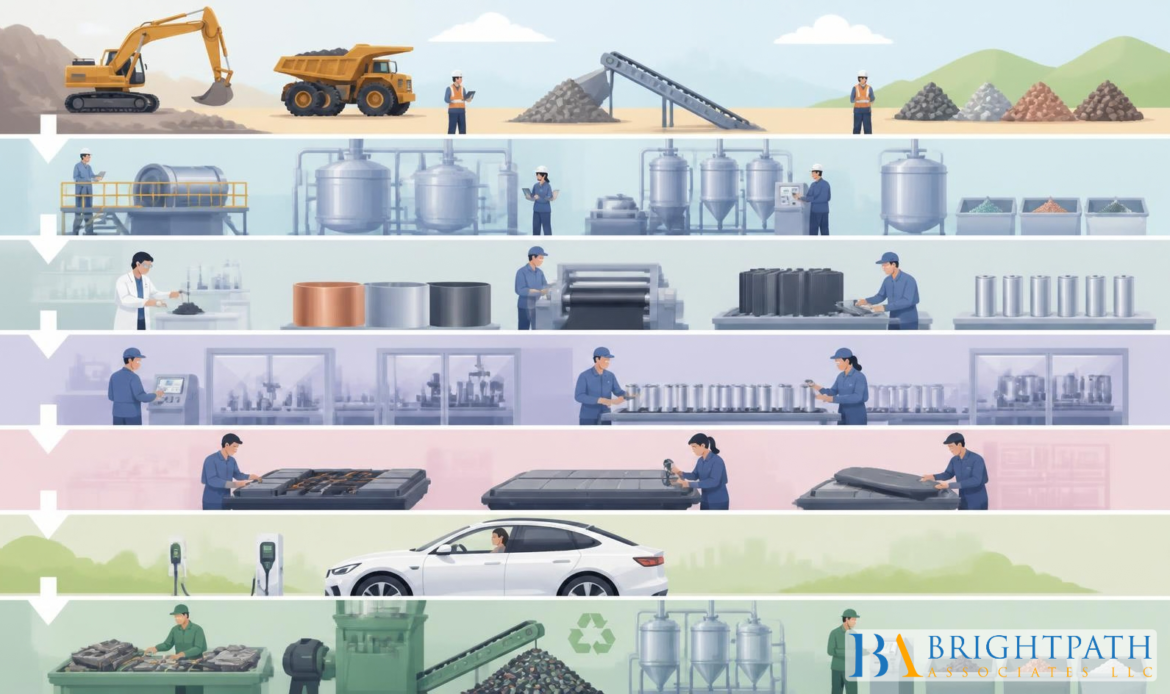
The battery metal value chain consists of multiple interconnected stages. It begins with geological exploration and resource development, followed by mining and Ore extraction. Extracted material must then undergo concentration, Metal processing, refining, and potentially chemical conversion before becoming suitable for battery applications.
Historically, these stages have often involved different companies operating under separate commercial arrangements. Vertical integration seeks to connect some or all of these activities under common ownership, long-term contractual relationships, or coordinated strategic partnerships.
For a mining company, integration may involve moving downstream into refining or battery-material production. For a chemical or battery manufacturer, it may mean investing upstream in mining assets or securing direct control over mineral resources.
The attractiveness of the model depends on factors such as resource quality, processing economics, technology requirements, market conditions, infrastructure, and regulatory environments.
Metals Industry Trends Driving Integration
Several Metals industry trends are influencing corporate interest in greater value-chain control. Demand for battery materials is closely connected to electric vehicles, grid-scale energy storage, consumer electronics, and industrial electrification.
At the same time, companies face uncertainty surrounding commodity prices, geopolitical relationships, transportation networks, environmental requirements, and access to strategic minerals.
These conditions have encouraged businesses to examine supply security more closely. A manufacturer dependent on external suppliers may face challenges if raw-material availability changes unexpectedly. An integrated company may have greater visibility into upstream production and processing capacity.
However, integration does not eliminate market risks. Commodity prices can still fluctuate, mines can encounter operational problems, processing economics can change, and technological developments can alter material demand.
Ore extraction is the foundation of the battery metal value chain. The economic viability of downstream operations depends heavily on the quality, quantity, accessibility, and consistency of the underlying resource.
Modern extraction projects require extensive geological analysis, environmental assessment, infrastructure planning, and capital investment. Companies must understand not only the quantity of metal contained in an ore body but also the characteristics that affect processing costs.
For vertically integrated companies, upstream performance has direct implications for downstream facilities. Variations in ore grade, mineralogy, impurities, and production volumes can affect concentration and refining processes.
This makes coordination between mining operations and processing facilities particularly important. Integrated organizations need systems that allow geological, operational, metallurgical, and commercial teams to work from shared information.
Metallurgy and Processing Complexity
Metallurgy plays a central role in determining whether a mineral resource can be converted economically into a usable battery material. Different ore bodies can require very different processing approaches depending on their mineral composition and impurity profiles.
For companies pursuing vertical integration, metallurgical expertise becomes essential. A successful mining operation does not automatically guarantee an economically successful refining or processing business.
Engineers and metallurgists must evaluate recovery rates, energy consumption, reagent requirements, waste generation, equipment performance, and product specifications. They must also determine whether existing technologies can process the available material effectively.
The connection between mining and metallurgy therefore becomes a strategic capability rather than simply a technical function.
#MetalProcessing can represent one of the most technically demanding stages of the value chain. Companies must convert mined or concentrated material into products that meet precise industrial specifications.
Battery manufacturers require consistent chemical and physical characteristics because material quality can influence battery performance, safety, durability, and manufacturing efficiency.
Vertical integration can provide greater control over these characteristics. A company with ownership or direct influence across mining and processing may be able to coordinate production specifications more closely with downstream requirements.
However, processing facilities often require significant investment and specialized infrastructure. Companies must therefore evaluate whether the expected benefits of integration justify the additional capital and operational complexity.
Sustainable Mining as a Strategic Requirement
Environmental performance is becoming increasingly important throughout the battery metal sector. Sustainable mining involves reducing environmental impacts while maintaining economically viable resource production.
Companies must consider water consumption, energy use, land disturbance, biodiversity, tailings management, emissions, waste handling, and relationships with surrounding communities.
Vertical integration can create opportunities for stronger environmental coordination. A company controlling multiple stages of the value chain may be able to track material flows and environmental performance more comprehensively.
However, integration can also increase responsibility. A company that expands across the value chain becomes responsible for a wider range of environmental and operational activities. Effective governance and transparent reporting therefore become essential.
Mining technology is transforming how companies identify resources, operate mines, monitor equipment, and manage production. Automation, remote operations, advanced sensors, artificial intelligence, digital twins, and data analytics can improve operational visibility and efficiency.
For vertically integrated organizations, digital technology can connect mine operations with processing facilities and downstream planning. Production information can be used to coordinate processing schedules, maintenance activities, inventory requirements, and customer commitments.
Technology can also support predictive maintenance. Equipment data can help identify potential failures before they cause major production disruptions.
The challenge is that technology integration requires investment in digital infrastructure and skilled personnel. Companies must ensure that technology initiatives are connected to measurable operational objectives rather than implemented as isolated projects.
Mining Innovation and New Business Models
#MiningInnovation is extending beyond equipment and extraction methods. Companies are exploring new approaches to resource development, processing efficiency, waste utilization, automation, water management, and environmental monitoring.
Innovation can make previously marginal resources more commercially attractive. Advances in processing technologies may improve recovery rates or enable companies to process materials that were historically difficult to exploit.
For vertically integrated businesses, innovation can have effects across multiple stages. Improvements in extraction may influence processing requirements, while improvements in refining may change which resources are economically attractive.
This interconnected nature makes innovation management particularly important for companies operating across the value chain.
Mining policy can significantly influence vertical integration decisions. Governments may introduce regulations affecting mineral exploration, mine development, environmental standards, processing requirements, exports, taxation, local employment, and strategic-resource security.
Companies therefore need strong regulatory capabilities before expanding into new jurisdictions or downstream activities.
Policy environments can also influence investment incentives. Governments may encourage domestic processing or value addition in an effort to capture more economic activity within their borders.
Organizations evaluating vertical integration should therefore consider not only current regulations but also the possibility of regulatory changes over the life of a major project.
Managing Capital and Operational Risk
Vertical integration can potentially improve supply visibility, but it also concentrates capital and operational exposure. A company that owns mining, processing, and downstream assets may become exposed to risks at every stage of the value chain.
A mine may experience production delays while a processing plant operates below capacity. Conversely, a processing facility may be ready to operate while upstream production falls short of requirements.
Mining companies must therefore develop comprehensive risk-management systems covering geological uncertainty, commodity prices, operational reliability, technology performance, environmental obligations, and regulatory changes.
Scenario planning becomes particularly valuable. Companies can model different combinations of mineral prices, production volumes, processing costs, and customer demand before committing significant capital.
Vertical integration also changes workforce requirements. Companies that historically focused on mining may suddenly need expertise in refining, chemical processing, logistics, downstream manufacturing, technology, commercial strategy, and regulatory affairs.
This creates significant talent-management challenges. Specialized professionals with experience across multiple stages of the battery-material value chain can be difficult to identify.
Mining executive search can help organizations recruit senior leaders with the technical and commercial experience required to manage complex mining operations and integration programs.
Similarly, mining and metals recruiters can support companies seeking professionals across engineering, metallurgy, operations, project development, supply chain, technology, and corporate leadership.
The Importance of Executive Search Recruitment
As companies expand across the battery metal value chain, leadership becomes increasingly important. Executives must understand the interdependence between resource development, processing economics, technology, sustainability, regulation, and market demand.
#ExecutiveSearchRecruitment can help organizations identify leaders capable of managing this complexity. The most relevant candidates may come from different parts of the industrial ecosystem, including mining companies, processing organizations, engineering firms, technology providers, and battery-material producers.
Leadership teams must also be capable of managing organizational change. Vertical integration can bring together employees with very different operational cultures and technical backgrounds. Successful integration therefore requires strong communication, governance, and strategic coordination.
Before pursuing vertical integration, companies need to evaluate their capabilities across the entire proposed value chain. Resource quality alone is not sufficient. Management teams must understand whether they possess the technical expertise, capital strength, infrastructure, technology, workforce, regulatory capabilities, and commercial relationships required for successful expansion.
The organization should also assess whether integration solves a clearly identified strategic problem. Securing supply, improving quality control, reducing transaction risks, developing new markets, and strengthening customer relationships can all provide potential rationales.
At the same time, companies should recognize the trade-offs. Vertical integration can increase capital requirements, management complexity, operational exposure, and regulatory responsibility.
Building a Resilient Battery Metal Strategy
The battery metal sector is evolving rapidly as demand, technology, policy, and sustainability requirements interact. Vertical integration can provide organizations with greater control over critical stages of the value chain, but its success depends on careful strategic planning.
Companies must connect Ore extraction with Metallurgy, Metal processing, technology, logistics, sustainability, and downstream market requirements. They must also monitor Metals industry trends and adapt to changing Mining policy environments.
The organizations best prepared for this transition will be those that treat integration as a long-term capability-building exercise rather than simply an asset-acquisition strategy.
Conclusion
Vertical integration in the battery metal value chain offers companies an opportunity to strengthen coordination between mining, processing, refining, and downstream markets. However, it also introduces new technical, financial, environmental, regulatory, and organizational responsibilities.
Sustainable mining, advanced Mining technology, Metallurgy, efficient Ore extraction, and modern Metal processing must work together if integrated operations are to deliver their intended value. #MiningInnovation can create new opportunities, while careful attention to Mining policy and market conditions can help organizations manage external risks.
Talent will remain a decisive factor throughout this transformation. Mining executive search and mining and metals recruiters can help companies identify leaders and specialists capable of operating across increasingly interconnected industrial environments. Through targeted Executive Search Recruitment, organizations can strengthen the leadership capabilities needed to manage complex integration programs.
Ultimately, readiness for vertical integration depends on whether a company can connect resources, technology, processing expertise, capital, sustainability practices, and people into one coherent operating strategy. As the battery economy continues to develop, that ability to coordinate across the value chain will become an increasingly important component of long-term industrial competitiveness.
Find your next leadership role in Mining & Metals Industry today!
Stay informed with the latest insights on Mining & Metals Industry!