
Introduction
The journey from #FarmProduction to retail shelves has become increasingly complex as agricultural businesses, food processors, distributors, and retailers manage larger volumes, tighter delivery schedules, changing consumer expectations, and stricter quality requirements. Traditionally, each stage of the agricultural supply chain operated through separate systems, spreadsheets, manual records, and disconnected databases. While these approaches may have worked for smaller operations, they create significant inefficiencies when supply chains expand across multiple farms, processing facilities, warehouses, distributors, and retail locations.
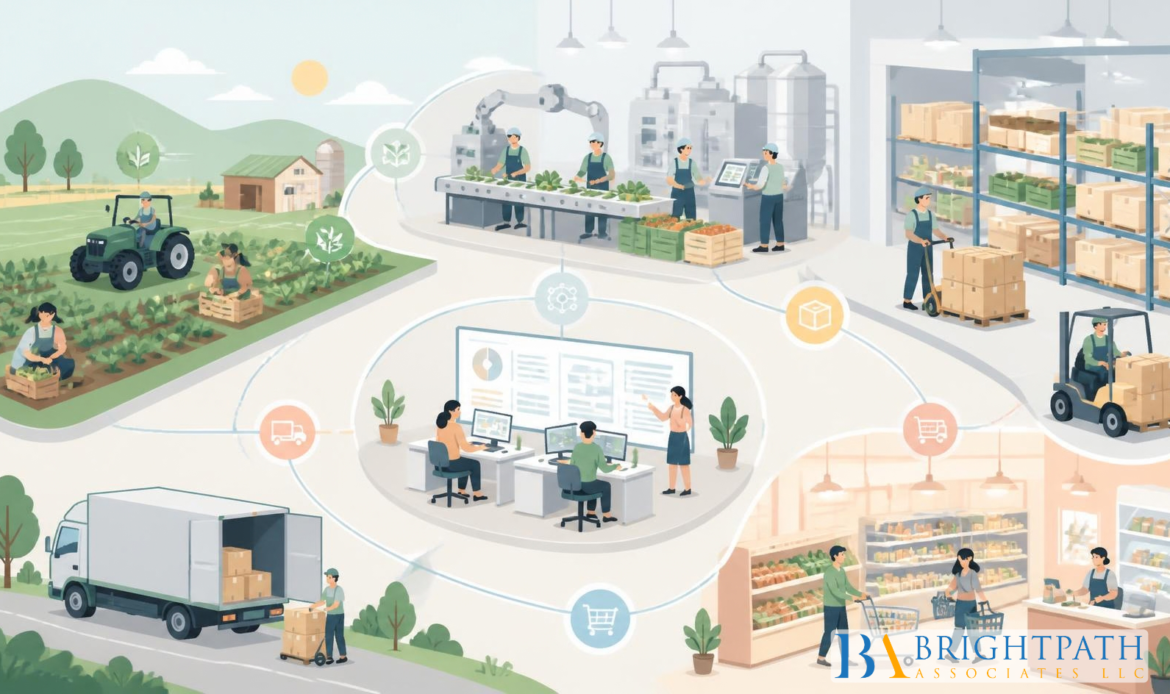
Integrated Enterprise Resource Planning (ERP) systems are transforming this landscape by connecting operational, financial, production, inventory, procurement, logistics, and sales information within a unified digital environment. Instead of treating farming, processing, warehousing, and distribution as independent activities, an integrated ERP enables organizations to view the entire farm-to-shelf journey as one interconnected process.
The value of ERP integration extends beyond administrative efficiency. Modern agricultural and food-processing operations are increasingly adopting Industrial automation, connected equipment, real-time monitoring, and data-driven decision-making. When these technologies are connected with ERP platforms, organizations can improve production visibility, reduce waste, strengthen traceability, and respond more effectively to market demand.
An integrated ERP establishes a centralized information framework across the farm-to-shelf ecosystem. Agricultural businesses can use the system to manage crop planning, input procurement, labor requirements, harvesting schedules, storage capacity, transportation, processing, and sales.
For example, information about expected harvest volumes can be connected directly to processing and distribution plans. If a particular crop is expected to produce a lower yield, processors and distributors can adjust procurement and production schedules earlier. Similarly, inventory information from warehouses can provide retailers with better visibility into available products and expected replenishment timelines.
This level of connectivity reduces the information gaps that frequently occur between agricultural producers, processors, logistics providers, and retailers. Instead of relying on delayed reports, decision-makers can work from shared operational information. ERP integration therefore becomes an important foundation for building a more responsive and transparent agricultural supply chain.
Improving Production Efficiency With Industrial Automation
Agricultural processing facilities increasingly depend on Industrial automation to maintain consistent production while controlling operating costs. Automated sorting, grading, packaging, material handling, and processing equipment can perform repetitive activities with greater consistency than manual processes.
However, automation delivers its greatest value when equipment data can be connected to broader business systems. An ERP platform can receive production information from automated machinery and use that information to update inventory, production records, maintenance schedules, and operational reports.
This creates a connection between physical production and business management. A processing facility, for example, can monitor how much raw material has entered production, how much finished product has been generated, and how much inventory remains available for distribution. Managers can then make decisions based on actual production conditions rather than assumptions.
The growing adoption of Automation solutions manufacturing is changing how food and agricultural processing organizations approach operational technology. Automated systems can control production processes, monitor equipment performance, and reduce manual intervention. Yet isolated automation can create another form of data fragmentation if production information remains separate from procurement, inventory, and financial systems.
ERP integration addresses this problem by connecting operational technology with enterprise-level processes. Production data can influence inventory records, procurement requirements, costing, and fulfillment planning. This allows organizations to coordinate production with actual business demand.
The result is a more synchronized operation in which manufacturing activities are no longer managed independently from supply chain requirements. Companies can identify production bottlenecks, evaluate resource utilization, and make adjustments before operational problems affect downstream customers.
The Role of PLC Programming Service in Connected Processing
#ProgrammableLogicControllers (PLCs) are central to many automated agricultural and food-processing environments. They control equipment such as conveyors, pumps, motors, sorting machines, packaging lines, and processing systems.
A professional PLC programming service can help organizations configure automation equipment so that machines perform specific production functions accurately and reliably. When PLC-based systems are connected to ERP and supervisory platforms, operational data can move beyond the factory floor and contribute to broader business intelligence.
For example, production counts, machine status, cycle times, and process conditions can be captured from connected equipment. This information can help managers understand production performance while enabling maintenance teams to identify potential equipment issues.
The integration of PLCs with enterprise systems also supports more structured maintenance planning. Instead of relying exclusively on fixed maintenance intervals, organizations can increasingly consider actual equipment utilization and operating conditions when scheduling maintenance activities.
Robotics is becoming increasingly relevant to agricultural processing, warehousing, packaging, and distribution. Robotics integration can support activities such as palletizing, packaging, sorting, picking, material movement, and repetitive handling.
When robotic systems operate alongside ERP platforms, organizations can coordinate automated physical activities with inventory and fulfillment requirements. A warehouse robot, for example, may move products according to digitally generated instructions based on current inventory and customer orders.
This integration can help reduce unnecessary movement, improve order accuracy, and increase warehouse throughput. It also allows businesses to scale operations without depending entirely on proportional increases in manual labor.
The importance of robotics becomes particularly apparent during seasonal demand fluctuations. Agricultural supply chains frequently experience periods of intense activity around harvests, holidays, or promotional campaigns. Integrated automation can provide additional operational capacity while maintaining consistent processes.
SCADA Systems and Real-Time Operational Visibility
SCADA systems provide another important layer of digital connectivity. Supervisory Control and Data Acquisition platforms enable organizations to monitor and control industrial processes using information collected from connected equipment and sensors.
In agricultural processing environments, SCADA can provide visibility into production lines, temperature conditions, equipment status, energy consumption, pressure levels, and other operational variables. When information from SCADA systems is connected to ERP platforms, organizations gain a broader view of how physical operations influence inventory, production planning, maintenance, and costs.
Real-time visibility can also improve response times. If an abnormal operating condition is detected, production personnel can investigate the issue before it develops into a larger disruption. This is particularly valuable in food processing, where equipment failures or environmental deviations can result in product loss.
Quality control is a critical component of the farm-to-shelf journey. Products must often be inspected for size, color, defects, packaging accuracy, labeling, and other characteristics before reaching consumers.
Industrial machine vision provides automated inspection capabilities that can complement human quality-control processes. Cameras and vision algorithms can identify product characteristics at high production speeds, making them valuable in sorting, grading, packaging, and inspection operations.
When machine-vision information is connected to ERP systems, quality results can become part of broader production and traceability records. Businesses can analyze quality trends by product batch, supplier, production line, or processing period.
This creates stronger traceability throughout the supply chain. If a quality issue emerges, organizations can more efficiently identify the affected batch and determine where the products originated and where they were distributed.
Control Systems and Manufacturing Automation
#ControlSystems provide the operational foundation for many automated processing environments. They regulate equipment and processes while maintaining defined operating parameters. When integrated with Manufacturing automation, these systems can help organizations improve consistency, productivity, and process control.
ERP platforms complement these technologies by managing the business information surrounding production. The control system may determine how a machine operates, while the ERP determines what needs to be produced, when it needs to be produced, how much material is available, and where the finished goods need to go.
This separation of responsibilities creates a connected operational architecture. Machine-level technologies manage physical processes, while enterprise systems coordinate business requirements. Together, they create a more efficient farm-to-shelf ecosystem.
Inventory represents one of the most challenging aspects of agricultural supply chains because many products are perishable. Excess inventory can result in spoilage and financial losses, while insufficient inventory can lead to missed sales and customer dissatisfaction.
Integrated ERP systems help organizations synchronize procurement, production, storage, and distribution. Real-time inventory information can show businesses how much raw material and finished product is available across different locations.
Demand information can then be connected to production planning. If demand increases, production schedules can be adjusted accordingly. If demand decreases, organizations can reduce unnecessary production and avoid building excessive inventory.
This approach supports more efficient resource utilization while reducing the risk of waste. For agricultural and food businesses, better inventory visibility can have a direct impact on profitability.
Building a Data-Driven Supply Chain
The long-term value of ERP integration lies in the ability to transform operational data into actionable business intelligence. Data from farms, processing plants, warehouses, transportation operations, and retail channels can be analyzed to identify patterns and inefficiencies.
Organizations can evaluate production costs, supplier performance, equipment utilization, inventory turnover, delivery performance, and product demand. These insights support more informed planning and help management identify opportunities for continuous improvement.
ERP systems can also create stronger collaboration between departments. Procurement teams can see production requirements, production managers can understand demand forecasts, finance teams can monitor operational costs, and logistics teams can coordinate shipments using shared information.
Technology transformation requires organizations to rethink their approach to workforce development. The integration of ERP platforms with automation creates demand for professionals who understand both business processes and industrial technology.
Organizations increasingly require specialists in PLC programming, robotics, SCADA, machine vision, control systems, data integration, and manufacturing software. As a result, Automation jobs are evolving beyond traditional equipment-maintenance roles toward multidisciplinary positions involving digital systems and industrial data.
Recruiting these professionals can be challenging because the required skill sets are often highly specialized. Companies need employees who can understand production environments while also working with modern digital infrastructure.
This is where Executive search industrial automation can become strategically important. Specialized recruitment approaches can help organizations identify leadership and technical professionals capable of managing automation programs, digital transformation initiatives, and complex industrial technology environments.
The Importance of Executive Search Recruitment
Successful ERP and automation transformation requires more than technology investments. Organizations need leaders who can align digital systems with operational objectives, manage organizational change, and develop long-term technology strategies.
#ExecutiveSearchRecruitment can support this process by helping agricultural, manufacturing, food-processing, and logistics organizations identify experienced professionals for critical leadership positions. Candidates may need expertise in ERP implementation, Industrial automation, supply chain management, manufacturing technology, data analytics, and operational transformation.
Leadership becomes particularly important when organizations integrate multiple technologies. ERP platforms, SCADA systems, PLCs, robotics, machine vision, and control systems must operate within a coordinated technology strategy rather than as disconnected investments.
Integrated ERP systems are redefining how organizations manage the movement of agricultural products from production to consumers. By connecting farm operations, processing facilities, warehouses, distribution networks, and retail demand, businesses can gain greater visibility across the entire supply chain.
The integration of Industrial automation, Robotics integration, Industrial machine vision, SCADA systems, and Manufacturing automation further strengthens this model by connecting physical operations with digital business processes. PLC-based equipment and Control systems provide operational control, while ERP platforms provide enterprise-level coordination.
As agricultural supply chains become more technology-driven, organizations that successfully integrate their operational and business systems can improve visibility, reduce waste, strengthen traceability, and respond more efficiently to changing market conditions. At the same time, investment in specialized talent through Executive search industrial automation and Executive Search Recruitment will remain essential for managing increasingly sophisticated technology environments.
The future of the farm-to-shelf journey is therefore not simply about automating individual processes. It is about creating an interconnected ecosystem in which agricultural production, manufacturing, inventory, logistics, quality, technology, and business strategy work together. Integrated ERP systems provide the digital backbone for that transformation, enabling organizations to build more responsive, data-driven, and operationally resilient supply chains.
Find your next leadership role in Industrial Automation Industry today!
Stay informed with the latest insights on Industrial Automation Industry!