
Introduction
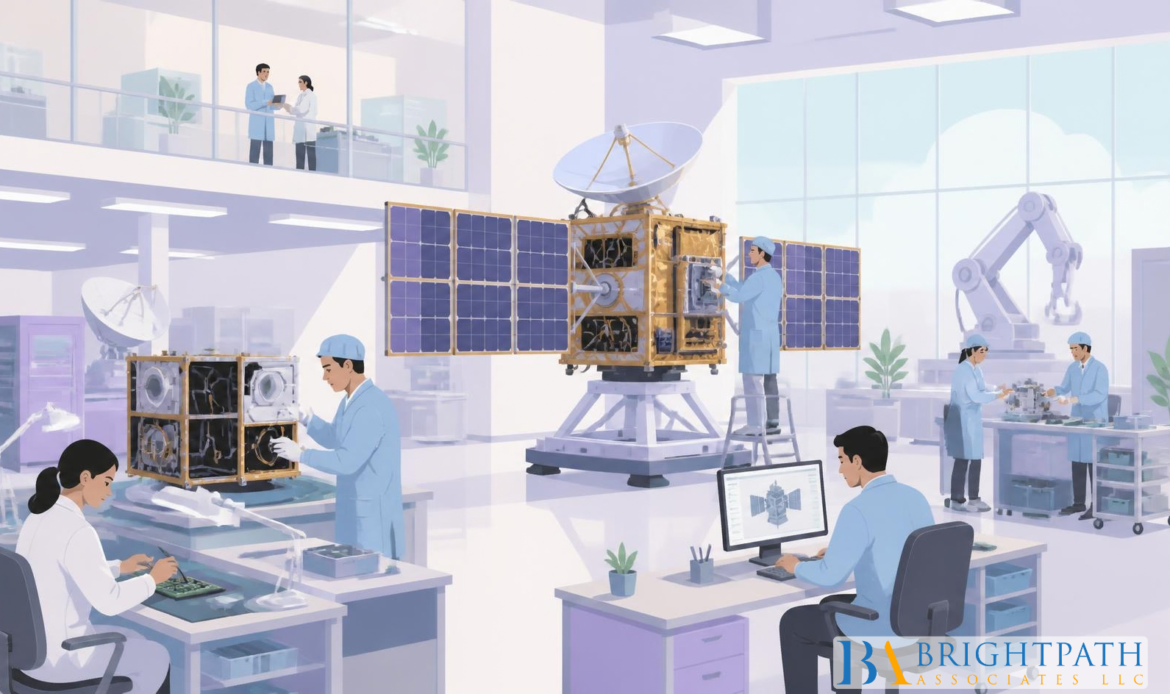
The #SatelliteIndustry is undergoing a significant transformation as governments, commercial organizations, research institutions, and defense stakeholders seek greater access to space capabilities. Historically, satellite manufacturing was dominated by a relatively small number of large aerospace organizations because of high development costs, complex engineering requirements, and extensive regulatory obligations. Advances in electronics, software, materials, manufacturing automation, and launch services are changing that landscape.
Independent small and medium-sized enterprises are increasingly able to participate in specialized segments of the satellite value chain. Rather than attempting to manufacture complete spacecraft independently, SMEs can focus on components, subsystems, software, payload technologies, propulsion systems, communications equipment, robotics, testing, or specialized manufacturing services.
This shift creates opportunities for companies that can combine technical specialization with disciplined quality management and an understanding of increasingly complex regulatory and security requirements. Sovereign satellite manufacturing is consequently becoming not only a government capability but also a potential industrial ecosystem involving specialized private-sector suppliers.
Sovereign satellite manufacturing generally refers to developing and producing space capabilities within a nation’s domestic industrial and technological ecosystem. The concept can involve spacecraft, components, electronics, software, ground systems, testing infrastructure, and associated services.
For governments, domestic capabilities can provide greater control over strategically important technologies and supply chains. For SMEs, this can create opportunities to become specialized suppliers within national aerospace programs.
The most realistic opportunity for many independent SMEs lies in developing highly specialized capabilities rather than attempting to compete with large prime contractors across the entire spacecraft lifecycle. A company might specialize in thermal systems, power electronics, communication modules, satellite structures, onboard computing, testing equipment, or mission software.
The Influence of Defense Space Policy
Defense Space Policy increasingly recognizes space as an important domain for communications, navigation, observation, early warning, intelligence, and other national-security functions. Policy decisions can influence government procurement priorities, domestic manufacturing programs, research funding, and industrial partnerships.
For SMEs, understanding policy direction is important because government requirements can shape future markets. Organizations that monitor procurement frameworks, technology priorities, industrial-development initiatives, and domestic-content requirements can identify areas where specialized capabilities may be needed.
However, policy-driven markets can also involve lengthy procurement cycles and demanding qualification requirements. SMEs therefore need financial planning that accounts for the time required to move from technology development to production contracts.
Defense Space Systems encompass a wide range of technologies, including communications satellites, surveillance platforms, navigation capabilities, missile-warning systems, space-domain awareness infrastructure, and supporting ground systems.
Independent SMEs can participate by supplying subsystems or technologies rather than building entire spacecraft. Specialized components can become strategically important when governments seek to reduce dependence on foreign suppliers.
Companies with strong engineering capabilities may develop products designed for integration into larger platforms. This approach allows SMEs to participate in complex programs while focusing resources on areas where they possess specialized expertise.
Qualification and reliability remain critical. Defense customers generally require evidence that components can perform under demanding environmental and operational conditions.
Growth of Space Electronics
#SpaceElectronics represents one of the most accessible areas for specialized aerospace SMEs. Satellites require power-management systems, processors, sensors, communication electronics, control systems, memory, interfaces, and other electronic components.
The increasing use of small satellites and distributed constellations can create demand for compact, efficient, and reliable electronics. SMEs with expertise in embedded systems, radiation-tolerant design, power electronics, and miniaturized components can potentially serve both commercial and government markets.
The challenge is that space electronics must meet environmental requirements that differ substantially from ordinary commercial electronics. Radiation exposure, vibration, thermal cycling, vacuum conditions, and long operational lifetimes can influence component selection and design.
As satellites become increasingly connected, Space Cybersecurity has become an important consideration across the entire space ecosystem. Satellites communicate with ground stations, mission-control systems, data networks, and sometimes other spacecraft.
Cybersecurity requirements therefore need to be incorporated into spacecraft architecture from the beginning rather than added after development. SMEs developing satellite electronics or software may need to demonstrate secure communications, authentication, access controls, secure updates, and appropriate protection of sensitive information.
Cybersecurity can also become a commercial differentiator. Organizations that develop secure-by-design products may be better positioned to participate in missions where data integrity and system resilience are important requirements.
Expanding Applications of Space Robotics
Space Robotics is another emerging area where SMEs can contribute specialized capabilities. Robotic technologies can support inspection, servicing, assembly, debris-management activities, scientific research, and planetary exploration.
Robotic systems require sophisticated combinations of mechanical engineering, sensors, control software, communications, and autonomous decision-making. Smaller companies can potentially specialize in individual subsystems rather than developing complete robotic platforms.
The long-term growth of in-space servicing and manufacturing could create additional opportunities for companies capable of producing robotic mechanisms designed for operation in extreme environments.
Several #AerospaceIndustry trends are influencing the competitive environment for independent satellite manufacturers. Smaller satellites, reusable launch systems, commercial launch services, software-defined spacecraft, advanced electronics, artificial intelligence, and constellation-based architectures are changing traditional development models.
The growing availability of commercial launch services has also reduced certain barriers to accessing orbit. SMEs can increasingly design products around standardized spacecraft platforms and commercially available components where appropriate.
However, increasing competition means technical differentiation is essential. Companies need to identify specialized capabilities that solve meaningful customer problems rather than entering crowded markets without a clear value proposition.
Developing space technologies can require substantial investment before commercial revenue begins. Space Venture Capital can provide financing for companies developing advanced satellite components, software, robotics, electronics, and manufacturing technologies.
For SMEs, attracting investment generally requires more than a technically impressive prototype. Investors may also evaluate market demand, intellectual property, manufacturing scalability, customer relationships, regulatory requirements, team capabilities, and the path to recurring revenue.
Companies should therefore develop financial strategies that reflect the long development timelines associated with aerospace products. Government research programs, strategic partnerships, commercial contracts, venture financing, and private investment can potentially form part of a diversified funding model.
Space Regulatory requirements are an essential consideration for independent manufacturers. Satellite companies may need to address licensing, spectrum coordination, export controls, technology-transfer rules, environmental requirements, launch regulations, and national-security considerations depending on the nature of their activities and jurisdiction.
Regulatory planning should begin early in product development. Waiting until a product is technically complete before evaluating regulatory requirements can create costly delays.
SMEs should establish internal processes for compliance and work with appropriately qualified legal, regulatory, and technical professionals when necessary. Regulatory readiness can also influence the attractiveness of a company to government and commercial customers.
The Importance of Defense Manufacturing Capability
Defense manufacturing requires a combination of engineering precision, quality management, secure supply chains, testing, documentation, and production discipline. Satellite components intended for defense applications may require more extensive qualification and traceability than ordinary commercial products.
SMEs entering this market should consider their ability to produce consistently at increasing volumes. A successful prototype does not automatically translate into a reliable production capability.
Manufacturing systems should therefore be designed with quality control and scalability in mind. Automated inspection, digital production records, environmental testing, and supply-chain monitoring can help organizations establish repeatable manufacturing processes.
#DefenseSimulation can support satellite and aerospace development by allowing engineers to evaluate system behavior before physical production. Simulation can be used to model structural loads, thermal conditions, communications performance, mission scenarios, and other system characteristics.
For SMEs, simulation can reduce certain development costs by identifying design issues earlier. Digital engineering can also support collaboration between manufacturers, integrators, and government customers.
Simulation does not replace physical testing, particularly when products must operate under demanding space conditions. Instead, it complements physical validation by helping engineers understand potential failure modes and optimize designs before committing to expensive hardware.
Building Domestic Supply Chains
Sovereign manufacturing depends not only on final assembly but also on access to critical components and materials. SMEs can strengthen domestic supply chains by developing specialized manufacturing capabilities in areas where dependence on external suppliers creates strategic vulnerabilities.
This may include advanced electronics, precision components, sensors, materials, communication systems, testing equipment, and software.
Supply-chain visibility is particularly important for defense-related manufacturing because disruptions can affect program schedules and operational readiness. Companies should therefore evaluate supplier reliability, component availability, qualification status, and alternative sourcing options.
Independent SMEs do not necessarily need to develop every capability internally. Collaboration can allow companies to combine specialized technologies into complete solutions.
An electronics company, for example, could work with a robotics specialist, software developer, structural manufacturer, and testing provider to participate in a larger aerospace program.
Such ecosystems can make it easier for smaller organizations to compete for complex contracts while maintaining specialization. Strong partnership structures should establish responsibilities for intellectual property, quality assurance, cybersecurity, regulatory compliance, and commercial terms.
Advanced satellite manufacturing requires highly specialized technical and managerial talent. Engineers may need expertise in aerospace systems, electronics, robotics, software, materials, thermal engineering, communications, or manufacturing.
Leadership requirements are equally complex. Senior executives need to understand technology development, government procurement, supply chains, regulatory environments, manufacturing economics, and commercial strategy.
#ExecutiveSearchRecruitment can help aerospace SMEs identify leaders with experience across these interconnected areas. Building a multidisciplinary leadership team can be particularly important for companies transitioning from research and development into commercial or government production.
Scaling From Prototype to Production
One of the greatest challenges for independent aerospace SMEs is moving from successful prototypes to repeatable production. Prototype development often involves highly customized engineering and manual processes. Commercial or defense production requires consistency, documentation, quality systems, and predictable delivery.
Companies should plan manufacturing scalability from the beginning. Standardized designs, modular architectures, automated production processes, supplier qualification, and digital quality systems can help reduce the difficulties associated with scaling.
Production planning should also account for testing and qualification requirements. Aerospace customers typically require confidence that every production unit meets defined performance standards.
The Future of Independent Satellite Manufacturing
The future satellite manufacturing ecosystem is likely to become increasingly distributed. Large aerospace organizations will continue to play important roles as system integrators and prime contractors, while specialized SMEs can provide critical components, technologies, and services.
Advances in electronics, robotics, automation, artificial intelligence, digital engineering, and materials may continue lowering certain barriers to entry. At the same time, cybersecurity, regulatory requirements, reliability standards, and supply-chain security will remain important considerations.
Independent manufacturers that combine technical specialization with disciplined business execution can potentially become valuable participants in national and commercial space ecosystems.
Conclusion
Sovereign satellite manufacturing presents a range of opportunities for independent SMEs willing to develop specialized technical and manufacturing capabilities. The market extends beyond complete spacecraft to Defense Space Systems, Space Electronics, Space Robotics, cybersecurity technologies, testing, simulation, software, and precision manufacturing.
Understanding #DefenseSpacePolicy, Space Regulatory requirements, and Aerospace industry trends can help organizations identify relevant market opportunities. At the same time, Space Venture Capital and strategic partnerships can provide pathways for financing and scaling technology development.
The successful growth of independent satellite manufacturers will ultimately depend on engineering quality, manufacturing discipline, regulatory readiness, secure supply chains, and specialized talent. Executive Search Recruitment can support this development by helping organizations build leadership teams capable of navigating the technical, commercial, and operational complexity of the space sector.
As governments and commercial organizations seek resilient and increasingly domestic space capabilities, specialized SMEs can become important contributors to the broader sovereign satellite manufacturing ecosystem. Their strongest opportunity lies in combining focused technical expertise with scalable production and long-term strategic partnerships.
Find your next leadership role in Defense and Space Industry today!
Stay informed with the latest insights on Defense and Space Industry!