
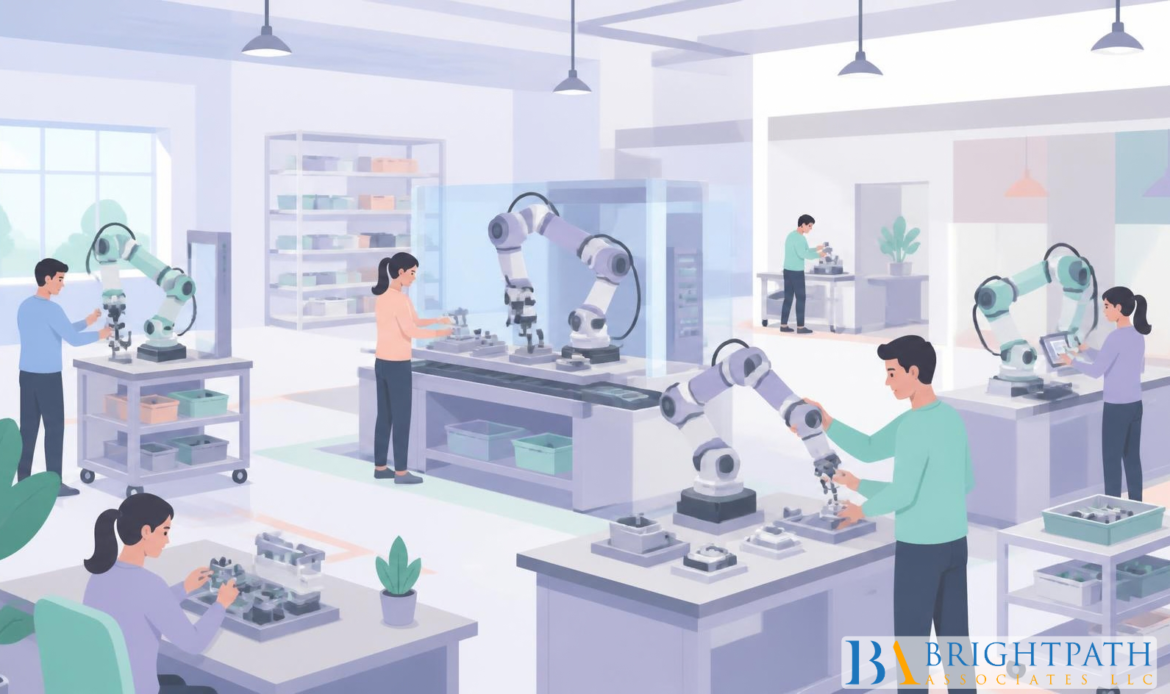
[Bethany, Connecticut – 25 September 2026] — BrightPath Associates has highlighted the growing role of flexible robotics in helping machinery manufacturers respond to high-mix, low-volume production requirements while improving manufacturing efficiency and operational agility. The latest industry analysis examines how adaptable robotic systems can support US Machinery manufacturers facing changing customer specifications, shorter production runs, skilled-labor constraints, and increasing pressure to achieve measurable returns from Industrial automation solutions.
Flexible Robotics Addresses Changing Production Demands
High-mix, low-volume manufacturing creates a distinct challenge for industrial organizations. Unlike high-volume production environments where equipment can be dedicated to one product, machinery manufacturers often need to switch between different components, specifications, materials, and production requirements. Traditional automation can become difficult to justify when frequent changeovers reduce equipment utilization.
Flexible robotics provides another approach by allowing manufacturers to reconfigure automation for different tasks and product requirements. According to BrightPath Associates’ analysis, the value of flexible robotics is closely connected to adaptability: manufacturers can deploy robotic systems for multiple applications rather than designing every automation investment around a single production process.
This capability is particularly relevant to the Industrial machinery industry, where customers increasingly expect customized equipment and components without accepting long lead times or inconsistent quality. Flexible automation can support applications such as machine tending, material handling, inspection, assembly, and packaging while allowing manufacturers to respond to changing production schedules.
Building a Stronger ROI Case for Automation
For C-Suite executives, the question is not simply whether robotics can automate a task. The larger consideration is whether an automation investment can generate measurable business value across changing production conditions. Flexible systems can strengthen the business case by allowing one robotic platform to support multiple processes and product configurations.
The latest BrightPath Associates article, ROI of Flexible Robotics for High-Mix, Low-Volume Production Demands, explores this relationship between flexibility and return on investment. The analysis emphasizes that manufacturers should evaluate automation based on factors such as utilization, changeover requirements, labor availability, production consistency, and long-term scalability rather than considering the initial equipment price alone.
For US Machinery manufacturers, this approach can also influence decisions involving Precision machining, Industrial automation solutions, and Manufacturing efficiency. Flexible robotic systems can complement existing machinery rather than requiring manufacturers to redesign entire production environments. This can make automation programs easier to introduce in stages and align with specific operational priorities.
Connecting Robotics With Workforce and Maintenance
The expansion of robotics does not eliminate the need for skilled employees. Instead, it changes the skills required within manufacturing operations. As robotic systems become more capable, companies need employees who can program, monitor, troubleshoot, maintain, and optimize automated equipment. This creates opportunities for workers with expertise in robotics, controls, engineering, data analysis, and equipment maintenance.
For executives managing Manufacturing jobs and workforce planning, the transition reinforces the importance of specialized recruitment. Executive search recruitment can help organizations identify leaders who understand both industrial operations and technology adoption. At the same time, companies may need technicians and engineers who can integrate robotics with existing production systems.
Maintenance is another important consideration. Machinery maintenance programs must evolve as manufacturers introduce robotic cells, sensors, controllers, and connected equipment. Preventive and predictive maintenance strategies can help organizations monitor equipment conditions and reduce unexpected interruptions. When robotics, maintenance data, and production planning are considered together, automation can become part of a broader operational improvement strategy.
Supporting Long-Term Machinery Industry Growth
Flexible automation also has implications beyond individual production lines. The Machinery Industry is operating in an environment shaped by labor availability, technology investment, supply-chain changes, customer customization, and competitive pressure. Manufacturers evaluating new equipment must balance automation investments with other financial decisions, including Machinery financing, equipment replacement, and the use of Used machinery.
A flexible robotics strategy can provide a pathway for manufacturers to modernize gradually. Instead of treating automation as a single large-scale transformation, executives can identify production bottlenecks and deploy adaptable robotic solutions where they can address measurable needs. Over time, lessons from these projects can guide additional investments and help create a more connected manufacturing environment.
The analysis also demonstrates why Industrial machinery companies should consider technology investments as part of a broader business strategy. Automation decisions can influence workforce planning, production capacity, maintenance requirements, product quality, customer responsiveness, and capital allocation. When these areas are aligned, robotics can contribute to greater operational resilience and sustained Manufacturing efficiency.
About BrightPath Associates
BrightPath Associates is an executive recruitment and talent solutions firm serving organizations across multiple industries. The company helps businesses identify leadership and specialized professionals who can support operational performance, innovation, growth, and long-term workforce strategies. BrightPath Associates’ mission is to connect organizations with the talent needed to navigate evolving business requirements and build stronger teams.
Media Contact:
Name: Corporate Communications Team
Company: BrightPath Associates
Email: media@brightpathassociates.com
Website: https://brightpathassociates.com