
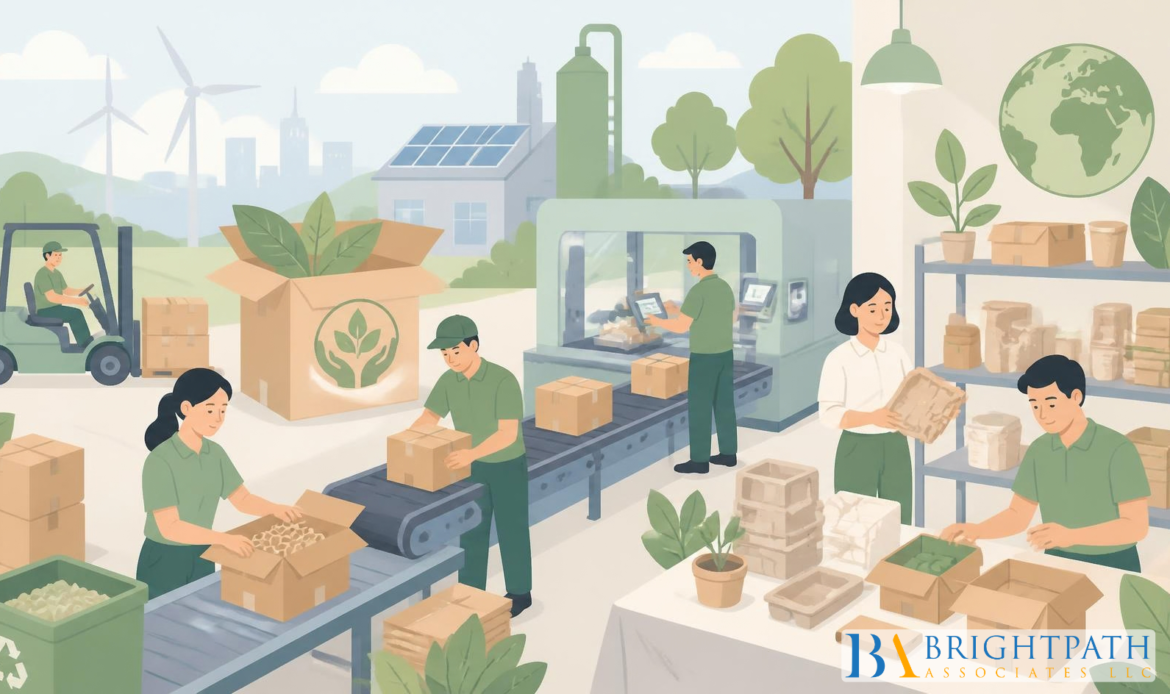
[Bethany, Connecticut – 25 September 2026] — BrightPath Associates has highlighted the growing importance of sustainable packaging for companies across the building material sector, where product protection, cost control, environmental responsibility, and Environmental ESG objectives increasingly intersect. The latest industry insight examines how manufacturers and distributors of Construction materials, Building supplies, concrete products, lumber, and related materials can rethink packaging design, material selection, recycling, and logistics while maintaining product quality and operational efficiency.
Packaging Becomes a Strategic Business Issue
Packaging has traditionally been viewed as a practical requirement for protecting products during storage and transportation. For building material companies, however, packaging decisions can influence material waste, transportation efficiency, operating costs, customer expectations, and sustainability performance. Products such as construction components, concrete-related materials, lumber products, and building supplies may require packaging that provides protection against moisture, impact, contamination, and handling damage.
The latest BrightPath Associates analysis, “Balancing Product Protection with Environmental ESG Goals,” explores how companies can approach this challenge without treating sustainability and product protection as competing priorities. Instead, packaging can become part of a broader operational strategy that connects environmental goals with procurement, manufacturing, distribution, and customer requirements.
For C-Suite executives, this shift has strategic implications. Packaging decisions can affect the company’s environmental footprint while also influencing costs and supply chain performance. As organizations respond to evolving Building regulations, customer expectations, and sustainability commitments, executives are increasingly examining whether packaging materials can be reduced, reused, recycled, or redesigned without increasing product damage.
Balancing Protection With Sustainable Construction
A sustainable packaging strategy begins with understanding the complete lifecycle of packaging materials. Companies can examine how much material is used, whether packaging can be recovered after delivery, and whether alternative materials can provide similar protection. This approach is particularly relevant to Sustainable construction, where manufacturers, contractors, developers, and distributors increasingly consider the environmental impact of materials throughout the project lifecycle.
Material recycling can also become an important part of this strategy. Packaging that is easier to separate, collect, and recycle can help reduce waste sent to landfills. Companies can also work with suppliers to explore recycled-content materials or packaging formats designed for repeated use. However, these changes need to be evaluated against product protection requirements, transportation conditions, storage environments, and total costs.
The article emphasizes that sustainability should not be approached as a simple packaging replacement exercise. Instead, businesses can assess packaging as part of their broader supply chain and operational systems. This can help companies identify opportunities to reduce unnecessary material use while protecting products and maintaining customer satisfaction.
Implications Across the Building Material Sector
The packaging challenge extends across several segments of the sector. In Concrete production, packaging and handling practices can influence material protection, transportation efficiency, and waste. In the Lumber industry, packaging may need to address moisture, handling, bundling, and transportation requirements. Manufacturers of other Construction materials and Building supplies face similar challenges as they balance durability, cost, environmental performance, and logistics.
Advances in Building technology may also help companies collect better information about packaging performance. Digital tracking, supply chain analytics, and connected systems can help businesses understand where packaging is being damaged, discarded, or unnecessarily overused. This data can support more informed decisions about packaging design and procurement.
These developments also connect with Construction economics. Rising input costs, transportation expenses, changing regulations, and sustainability requirements can make packaging efficiency increasingly relevant to profitability. Companies that understand their packaging costs and environmental impact can make more informed decisions about suppliers, materials, logistics, and process improvements.
Leadership and Talent Will Shape ESG Progress
Successful Environmental ESG initiatives require more than new materials or packaging designs. They also require leaders who can connect sustainability objectives with commercial priorities. Executives must consider procurement, manufacturing, logistics, finance, compliance, customer expectations, and long-term business strategy when evaluating packaging changes.
This creates a growing role for executive search recruitment within the building material sector. Organizations may need leaders with experience in sustainability, supply chain management, manufacturing technology, procurement, and regulatory compliance. At the same time, continued investment in sustainable operations can influence Construction jobs by creating demand for professionals with expertise in environmental management, materials science, recycling, technology, and supply chain optimization.
BrightPath Associates’ analysis, Balancing Product Protection with Environmental ESG Goals, provides additional insight into how companies can evaluate packaging decisions while balancing protection, environmental objectives, and business performance. For organizations examining broader workforce and industry priorities, BrightPath Associates also provides resources focused on the Building Material Industry.
About BrightPath Associates
BrightPath Associates is an executive recruitment and talent solutions firm that helps organizations identify leadership and specialized professionals needed to support sustainable growth. The company works with businesses across industries, providing recruitment and talent solutions aligned with evolving business, technology, and workforce requirements. Its mission is to connect organizations with capable professionals and help businesses build stronger teams for long-term success.
Media Contact:
Name: Corporate Communications Team
Company: BrightPath Associates
Email: media@brightpathassociates.com
Website: https://brightpathassociates.com