
Introduction
Small #TextileMills operate in an industry where margins, delivery schedules, material availability, quality consistency, and customer expectations are closely connected. From fiber procurement and yarn production to weaving, processing, inventory management, and order fulfillment, every stage depends on accurate information. Yet many small and medium-sized textile businesses continue to rely on spreadsheets, paper-based records, disconnected software, and manual communication between departments.
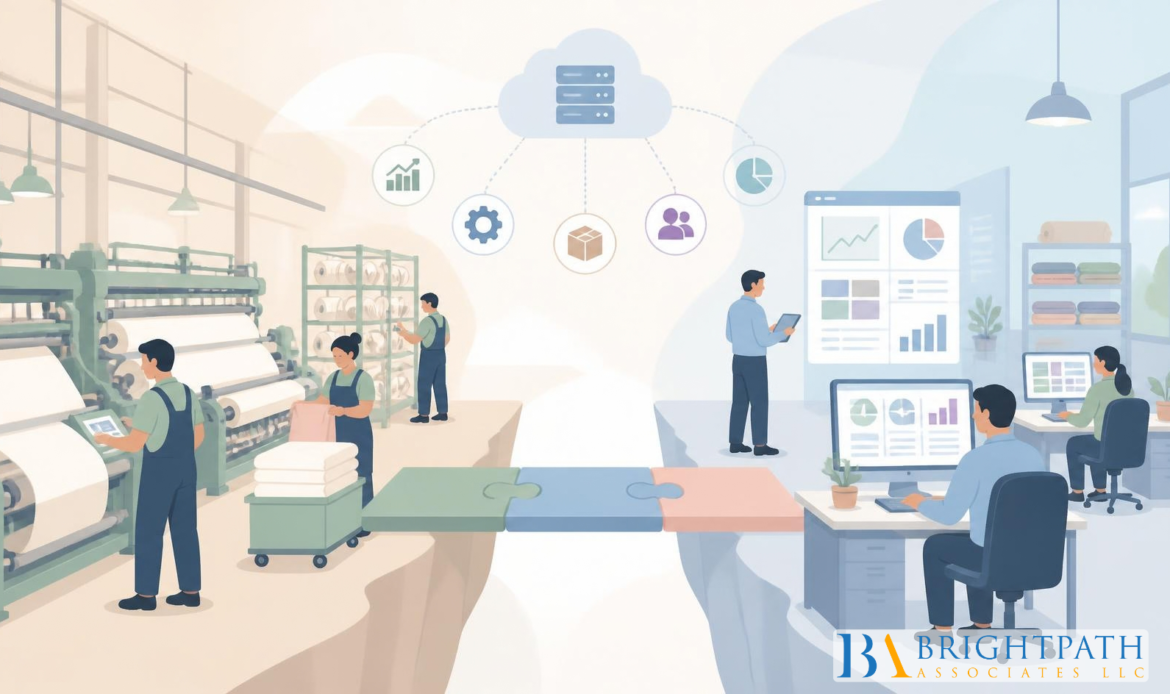
Enterprise Resource Planning (ERP) systems can address this fragmentation by bringing financial, procurement, production, inventory, sales, maintenance, and workforce information into a connected digital environment. However, implementing an ERP system in a small textile mill is not simply a matter of purchasing software. It requires process redesign, employee adoption, data preparation, technology integration, and a clear understanding of the mill’s operational priorities.
The opportunity is significant because modern ERP platforms can help small manufacturers gain visibility without requiring the same technology infrastructure as large textile corporations. When implemented strategically, ERP can strengthen the Textile supply chain, improve production planning, support Textile industry data analytics, and create a foundation for more advanced digital manufacturing.
A textile mill is essentially a network of interconnected processes. Procurement decisions influence inventory levels. Inventory affects production scheduling. Production influences delivery commitments. Delivery performance affects customer relationships and cash flow.
When information remains separated across departments, managers may struggle to obtain a reliable view of operations. A purchasing team may maintain one inventory record while production uses another. Sales teams may promise delivery dates without complete visibility into manufacturing capacity. Finance departments may receive production information only after significant delays.
An ERP system creates a common information environment. Instead of maintaining isolated records, departments can work with shared data and standardized processes.
For small textile mills, this visibility can be particularly valuable because limited management resources make manual coordination expensive. ERP integration can reduce repetitive administrative work while allowing managers to spend more time on production improvement, customer relationships, and Textile business strategic planning.
Understanding the Textile Supply Chain
The Textile supply chain includes multiple stages that must operate in coordination. Raw materials such as cotton, synthetic fibers, dyes, chemicals, packaging materials, and other inputs must be purchased and tracked. Production then converts these materials into intermediate or finished products, which must be inspected, stored, and delivered.
Textile production also involves considerable variability. Different customers may require different yarn counts, fabric constructions, colors, finishes, widths, weights, or quality specifications. Production schedules must therefore account for machine capacity, material availability, changeover requirements, labor, and customer deadlines.
An ERP system can connect these variables. Procurement data can feed inventory planning, while sales orders can influence production schedules. Quality information can be associated with specific batches, lots, machines, or suppliers.
This creates a more transparent operating environment in which managers can identify bottlenecks before they become major disruptions.
Small textile mills should avoid selecting an ERP system simply because it offers the largest number of features. The appropriate solution should match the organization’s size, operational complexity, budget, workforce capabilities, and future growth plans.
A modular implementation can often be more practical than attempting to digitize every business function simultaneously. Core modules may initially focus on inventory, purchasing, production planning, sales, and finance. Additional capabilities can be introduced as employees become comfortable with the system.
Cloud-based ERP platforms can reduce the need for extensive internal hardware infrastructure, while industry-specific systems may offer textile-oriented functionality. The decision should depend on operational requirements rather than technology trends alone.
Management should also evaluate integration capabilities. The ERP should be able to communicate with existing accounting platforms, production equipment, warehouse systems, quality applications, and other important technologies.
Preparing Data Before Implementation
#DataQuality is one of the most important factors in ERP implementation. A sophisticated system cannot produce reliable information if the data entered into it is incomplete, inconsistent, or inaccurate.
Small textile mills may have multiple names for the same material or product. Supplier records may contain duplicate entries, while inventory quantities may differ between physical stock and spreadsheets. Product specifications may also be stored in different formats.
Before implementation, businesses should establish standardized master data for materials, products, suppliers, customers, machines, processes, and inventory locations.
Historical data should also be reviewed before migration. Not every old record needs to be transferred into the new ERP environment. Retaining unnecessary or unreliable information can increase system complexity without adding meaningful value.
Production integration is where ERP can generate significant operational benefits for textile manufacturers. Production planning can be linked with customer orders, material availability, machine capacity, and inventory requirements.
Managers can use production data to understand planned output versus actual output. Variations can then be investigated to identify equipment downtime, material problems, quality issues, or labor constraints.
ERP integration can also support better production scheduling. When a customer order is entered, the system can provide information about required materials, available inventory, production capacity, and expected completion dates.
This level of visibility supports more informed decision-making and reduces dependence on informal communication between departments.
Using Textile Industry Data Analytics
ERP systems generate large quantities of operational information. However, data becomes valuable only when organizations use it to make better decisions.
Textile industry data analytics can help managers examine production efficiency, inventory turnover, procurement costs, order profitability, machine utilization, quality performance, and delivery reliability.
For example, managers can analyze recurring production delays and determine whether they are associated with particular machines, materials, product categories, or production shifts. Procurement data can reveal suppliers with repeated delivery or quality issues.
Analytics can also improve forecasting. Historical customer orders can provide insight into demand patterns, while production data can reveal capacity constraints.
For small textile mills, even relatively simple dashboards can create substantial improvements in management visibility.
ERP systems increasingly need to interact with Advanced textile manufacturing technologies. Automated production equipment, sensors, digital quality-control systems, warehouse technologies, and connected machinery can generate information that becomes more useful when integrated with enterprise-level data.
The objective is not to automate everything immediately. Instead, mills should identify processes where digital integration can provide measurable operational benefits.
Machine data can potentially provide information about production rates, downtime, energy consumption, and maintenance requirements. When connected with ERP workflows, this information can contribute to production planning and cost analysis.
This creates a pathway toward a more connected manufacturing environment without requiring small mills to adopt every emerging technology simultaneously.
Cognitive Automation in Textile Logistics
Logistics is another area where ERP integration can improve operational efficiency. Textile businesses frequently coordinate raw-material deliveries, internal movement, finished-goods storage, customer shipments, and documentation.
#CognitiveAutomation in textile logistics can support repetitive decision-making activities by using historical data and predefined business rules. Automated systems can assist with order processing, shipment documentation, inventory alerts, and scheduling.
Over time, more advanced systems can combine logistics data with customer demand, warehouse capacity, transportation availability, and production schedules.
For small businesses, the immediate objective should be reducing manual administrative effort and improving visibility rather than implementing complex automation simply for technological sophistication.
Textile industry blockchain applications are receiving attention because of growing demand for traceability and supply-chain transparency. Blockchain can potentially create tamper-resistant records documenting the movement or transformation of materials across supply-chain participants.
For small textile mills, however, blockchain should be considered carefully. The technology creates value only when multiple participants agree to use compatible systems and maintain reliable source data.
ERP should generally remain the operational foundation, while blockchain may serve specific traceability requirements where there is a clear commercial or regulatory reason to use it.
This approach prevents emerging technology from becoming an unnecessary implementation burden.
Preparing for Geopolitical and Supply Risks
Global textile industry geopolitical risks can affect raw-material availability, shipping costs, energy prices, currency movements, tariffs, and customer demand. Small mills can be particularly vulnerable because they may have limited purchasing power and fewer alternative suppliers.
ERP systems can provide visibility into supplier concentration, inventory levels, purchasing costs, and order commitments. Managers can use this information to identify areas of exposure.
For example, if a critical raw material depends heavily on a single supplier or geographic region, management can evaluate alternative sources or appropriate inventory strategies.
ERP therefore becomes more than an accounting or production tool. It can support risk management and Textile business strategic planning.
Sustainability is increasingly influencing textile manufacturing strategies. Textile industry closed-loop systems aim to reduce waste by recovering materials, reusing resources, recycling production waste, and improving resource efficiency.
ERP systems can support these initiatives by tracking material inputs, production losses, waste quantities, recycled materials, and product flows.
For example, production data can help identify where waste is generated most frequently. Procurement and inventory systems can track recycled inputs separately from conventional materials when required.
This data creates a stronger foundation for measuring sustainability performance and identifying opportunities for operational improvement.
Leadership and Workforce Readiness
ERP implementation is ultimately a business transformation project, not simply an IT installation. Employees need to understand why the system is being introduced and how it will change their daily responsibilities.
Executive leadership in textiles plays an important role in establishing priorities, allocating resources, resolving cross-functional conflicts, and maintaining implementation discipline.
Textile managers should also ensure that employees receive practical training. Production workers, warehouse teams, procurement staff, sales personnel, finance teams, and management may interact with the ERP in different ways.
Leadership should establish clear ownership for master data, system governance, process compliance, and performance measurement.
As textile manufacturing becomes increasingly digital, companies require leaders who understand both traditional manufacturing and emerging technology.
#ExecutiveSearchRecruitment can help textile organizations identify senior professionals with experience in ERP transformation, supply-chain management, manufacturing technology, data analytics, sustainability, and operational strategy.
The leadership challenge is becoming more complex because digital transformation affects almost every function of a textile business. A technology investment may fail to deliver its expected benefits if the organization lacks leaders capable of connecting technology with operational objectives.
Recruiting and developing this talent should therefore form part of the broader ERP strategy.
Managing Implementation Challenges
ERP implementation can create disruption if it is poorly planned. Small businesses may underestimate the time required for data preparation, process mapping, employee training, system testing, and post-launch support.
A phased implementation can reduce these risks. Businesses can begin with critical processes and expand the system once the initial foundation is stable.
Testing should occur before full deployment. Employees should be able to validate workflows using realistic production scenarios rather than generic demonstrations.
Management should also establish performance indicators to determine whether the ERP is delivering measurable benefits. Improvements in inventory accuracy, production visibility, order fulfillment, administrative efficiency, and reporting quality can provide evidence of progress.
Conclusion
Integrating #ERPSystems into small textile mills can bridge important gaps between production, procurement, inventory, finance, sales, and logistics. The greatest benefit comes not from software alone but from creating a connected operating model in which reliable information moves across the organization.
ERP can strengthen the Textile supply chain, support Textile industry data analytics, improve production planning, and create a foundation for Advanced textile manufacturing technologies. It can also help businesses prepare for Global textile industry geopolitical risks, improve traceability, and support Textile industry closed-loop systems.
Successful implementation requires realistic technology selection, accurate data, phased deployment, workforce training, and strong leadership. Executive leadership in textiles must ensure that digital transformation remains connected to measurable business objectives rather than becoming an isolated technology initiative.
As competition, supply-chain uncertainty, and customer expectations continue to evolve, small textile mills will increasingly need better visibility and faster decision-making. A properly implemented ERP system can provide that foundation, enabling smaller manufacturers to operate with greater coordination, resilience, and strategic clarity in a rapidly changing global textile industry.
Find your next leadership role in Textile Industry today!