
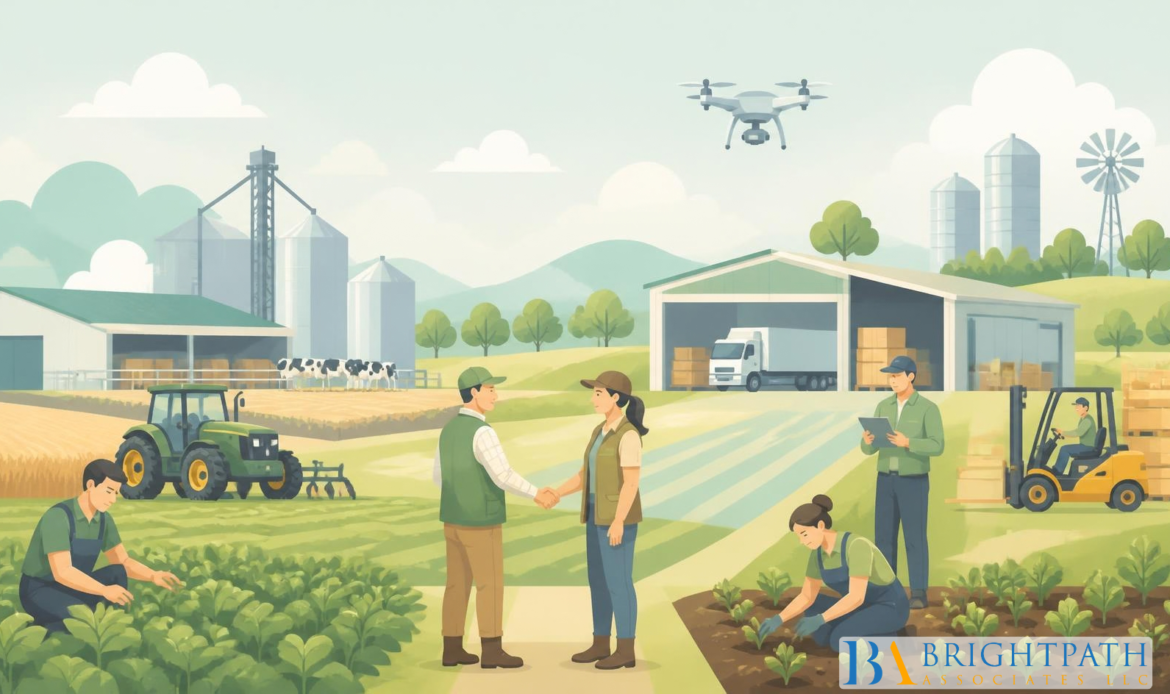
#AgricultureIndustry is entering a period of structural change. Across the United States, farms and agricultural businesses are operating within an environment shaped by rising input costs, labor shortages, changing consumer expectations, climate variability, evolving technology, and increasing competition for land and resources. At the same time, agricultural consolidation is changing the competitive landscape as larger farming operations, processors, distributors, and agribusiness organizations expand their scale.
For independent agricultural proprietors, this transformation creates a difficult strategic question: how can a smaller operation remain competitive when larger organizations can often purchase inputs at scale, invest heavily in technology, negotiate stronger commercial agreements, and distribute costs across larger production volumes?
The answer may not be to compete directly on scale. Instead, independent agricultural businesses can focus on specialization, operational efficiency, technological adoption, customer relationships, and sustainable production models. The growing availability of Agricultural technology is making some of these capabilities more accessible to smaller operators, creating opportunities to improve productivity without necessarily pursuing unlimited expansion.
Agricultural consolidation is not simply about farms becoming larger. It can affect the entire Food production ecosystem, including input suppliers, processors, distributors, retailers, logistics providers, and technology companies.
Larger organizations may benefit from purchasing power, sophisticated infrastructure, access to capital, extensive distribution networks, and specialized management teams. Independent proprietors, meanwhile, often operate with leaner resources and fewer layers of management.
However, scale does not automatically eliminate the advantages of smaller operations. Independent businesses can often make decisions more quickly, develop closer relationships with customers, experiment with specialized production methods, and respond to local market conditions.
The challenge is identifying where those advantages can create sustainable commercial value.
Instead of attempting to become the largest producer in a particular market, an independent proprietor may find greater opportunity by becoming more efficient, more specialized, or more responsive.
Technology Can Help Smaller Farms Close the Efficiency Gap
Historically, advanced agricultural technology was often associated with large farming operations because sophisticated equipment and digital systems required significant capital investment.
That landscape is changing.
Cloud-based platforms, connected sensors, mobile applications, satellite imagery, automated equipment, and data analytics are making digital capabilities increasingly accessible to smaller agricultural enterprises.
Precision agriculture provides a useful example. Farmers can use data to understand variations in soil conditions, moisture, crop health, nutrient requirements, and field performance. Instead of treating an entire field as a uniform production environment, precision systems can help farmers make more targeted decisions.
The benefit is not technology for its own sake. The objective is to use information to improve resource allocation.
For an independent proprietor, even relatively small improvements in seed use, fertilizer application, irrigation, fuel consumption, #LaborUtilization, or crop yields can influence profitability.
Precision agriculture is becoming increasingly relevant as farmers face pressure to produce more efficiently while managing environmental constraints.
GPS-guided machinery, variable-rate application systems, remote sensing, drones, soil sensors, and satellite imagery can provide information that was previously difficult or expensive to obtain.
This data can help producers identify underperforming areas, monitor crop development, detect potential problems earlier, and adjust production decisions.
For independent farmers, the strategic value lies in turning this information into practical decisions.
A farm does not become more competitive simply because it owns advanced technology. The technology must produce actionable insights and measurable improvements.
This is why agricultural businesses increasingly need individuals who understand both farming operations and digital systems.
Farm Management Software Is Becoming a Strategic Tool
The complexity of modern farming extends beyond field operations. Independent proprietors must manage purchasing, inventory, equipment maintenance, labor, financial records, compliance requirements, crop planning, sales, and customer relationships.
#FarmManagement software can bring many of these activities into a more connected environment.
Digital systems can provide greater visibility into costs and operational performance. Instead of relying entirely on handwritten records or disconnected spreadsheets, agricultural businesses can create centralized information systems that support faster decision-making.
For an independent operation, this can be particularly important because management time is often limited.
Better information can help proprietors determine which crops, customers, fields, or production activities generate the strongest returns. It can also reveal areas where costs are increasing without producing proportional value.
Sustainability is increasingly influencing agricultural decision-making. Consumers, food companies, investors, regulators, and supply-chain partners are paying greater attention to resource use, soil health, water management, emissions, biodiversity, and production practices.
Sustainable farming should therefore not be viewed exclusively as a marketing concept.
For many agricultural businesses, improving soil health, reducing unnecessary chemical applications, conserving water, and managing resources efficiently can also support long-term operational resilience.
Sustainable agriculture can become particularly relevant to independent producers seeking differentiated markets.
Organic farming represents one example of a production approach that may allow certain operators to serve customers seeking specific agricultural standards. However, organic production also involves certification requirements, market considerations, production constraints, and potentially different cost structures.
The important point is that sustainability strategies should be connected to the economics and capabilities of the individual operation.
Agricultural Innovation Does Not Always Require Massive Investment
Independent proprietors sometimes assume that remaining competitive requires purchasing the newest machinery or implementing an extensive digital transformation program.
That is not necessarily the case.
Agricultural innovation can involve incremental changes that improve productivity or reduce risk. A farmer may adopt a digital irrigation-monitoring system, improve inventory management, introduce remote crop monitoring, or use data to optimize equipment maintenance.
Small improvements can accumulate.
The most effective technology strategy is often one based on clearly defined business problems rather than technology trends.
Before investing, independent operators can ask what problem they are trying to solve. Is labor productivity too low? Are irrigation costs rising? Is equipment downtime affecting production? Is inventory difficult to track? Are crop decisions being made without sufficient field data?
The answer can determine which technology investment makes economic sense.
Investment decisions in agriculture can have long time horizons.
Land improvements, irrigation infrastructure, soil-health programs, renewable energy systems, technology platforms, and equipment can require substantial capital. Independent proprietors therefore need to consider both immediate financial returns and long-term resilience.
Sustainable agriculture investment becomes more meaningful when it supports multiple business objectives.
For example, an investment that reduces water consumption may also lower operating costs. A technology system that improves fertilizer application may support both resource efficiency and crop management. A renewable energy installation may provide long-term energy-cost benefits while supporting sustainability objectives.
The strongest investments are often those that connect environmental performance with operational economics.
Digital Farming Is Changing Management
#DigitalFarming is moving agriculture toward a more information-driven operating model.
Weather information, market data, equipment performance, field conditions, crop imagery, and financial information can increasingly be combined into integrated decision-making environments.
This creates a new management challenge.
Farm leaders need to understand how to interpret data without becoming overwhelmed by it. More information does not automatically produce better decisions.
Leadership must determine which metrics matter most and how information should influence production and investment decisions.
For independent proprietors, this can mean shifting from primarily experience-based management toward a combination of experience, technology, and measurable operational evidence.
Large agricultural organizations may have advantages in volume, but independent businesses can pursue specialization.
Specialized crops, premium products, direct-to-consumer channels, regional food systems, specialty livestock, sustainable production, or differentiated processing arrangements can create opportunities that are less dependent on commodity-scale competition.
The strategy is not necessarily about finding a niche for its own sake. It is about identifying markets where the independent operator has capabilities or relationships that larger competitors may find difficult to replicate.
Customer relationships can become an important asset.
An independent producer who understands local demand, maintains reliable quality, and communicates directly with customers may create value beyond the commodity price.
Talent Is Becoming a Competitive Differentiator
Technology and capital receive considerable attention in agricultural transformation, but talent remains central to execution.
The modern agricultural enterprise may require expertise spanning agronomy, finance, technology, supply-chain management, sustainability, sales, equipment, data analysis, and operations.
As farms become more technologically sophisticated, leadership roles are changing as well.
An executive responsible for a growing agricultural operation may need to understand digital systems, operational economics, sustainability objectives, workforce planning, and commercial strategy simultaneously.
This makes #ExecutiveSearchRecruitment increasingly relevant for agricultural organizations undergoing consolidation and technological transformation. Finding leaders with the right combination of industry knowledge and modern management capabilities can become an important component of long-term competitiveness.
Remaining independent does not mean remaining unchanged.
The agricultural businesses most capable of navigating consolidation may be those that continuously evaluate their operating models and identify opportunities to improve productivity, differentiation, and resilience.
Technology can support that process, but technology should remain connected to business objectives.
Precision agriculture can improve resource allocation. Farm management software can improve visibility. Sustainable farming can strengthen long-term resource management. Organic farming can support differentiated market strategies where economics and demand justify the approach. Digital Farming can improve decision-making by connecting operational information.
Together, these developments can help independent proprietors compete on factors beyond sheer production volume.
Conclusion
Agricultural consolidation is likely to remain an important force shaping the competitive environment. For independent proprietors, competing successfully does not necessarily require matching the scale of the largest agricultural enterprises.
Instead, resilience may come from combining operational discipline with specialization, technology, sustainable practices, customer relationships, and capable leadership.
Agricultural technology can provide new tools. Precision agriculture can improve efficiency. Farm management software can strengthen decision-making. Agricultural sustainability can support long-term resource resilience. But none of these capabilities can replace strategic thinking.
The central question for independent agricultural leaders is therefore not simply whether they can compete with larger organizations. It is where their operation can create distinctive value that scale alone cannot easily reproduce.
As food production becomes more connected, data-driven, and sustainability-focused, independent agricultural businesses have an opportunity to redefine competitiveness around agility, efficiency, innovation, and specialized expertise.
What strategies are independent agricultural businesses using to remain competitive as consolidation accelerates? Is technology changing the way your operation makes decisions, or are traditional methods still delivering the strongest results?
For agricultural organizations preparing for growth, digital transformation, operational expansion, or leadership succession, building the right management team can be just as important as investing in equipment and technology. Connecting with experienced Executive Search Recruitment professionals can help organizations identify leadership talent aligned with their next stage of development.
Find your next leadership role in Farming Industry today!