
Introduction
The #PlasticsIndustry is undergoing a significant transformation as manufacturers face increasing pressure to produce complex components faster, more consistently, and at lower cost. High-speed molding has become an important part of this transformation, particularly in automotive, electronics, medical devices, packaging, and consumer products. However, increasing production speed can introduce new quality challenges. Small dimensional variations, surface defects, material inconsistencies, and process deviations can become difficult to detect when thousands of components are produced within a short period.
Traditional quality-control methods often depend on manual inspection, sampling, and predefined process thresholds. While these approaches remain valuable, they may not provide the speed or precision required by modern molding operations. Artificial intelligence is increasingly being integrated into quality-control systems to address this accuracy gap.
AI-powered inspection can analyze images, process data, and production patterns in real time. By identifying subtle abnormalities and connecting quality outcomes with manufacturing conditions, AI can help plastics manufacturers improve consistency while reducing waste and rework. This technological shift is also influencing investment decisions, workforce requirements, supply-chain strategies, and competitive positioning across the global plastics sector.
High-speed molding increases productivity by reducing cycle times and maximizing equipment utilization. Yet faster production also means that defects can accumulate rapidly if a process begins drifting outside acceptable parameters.
A minor temperature fluctuation, pressure variation, material inconsistency, or tooling issue can affect hundreds or thousands of parts before the problem is discovered through conventional inspection. Manual inspection may identify visible defects, but it can be difficult for human inspectors to maintain consistent attention during repetitive, high-volume operations.
This creates a fundamental challenge: manufacturers must maintain inspection accuracy without slowing production.
AI addresses this challenge by analyzing production information continuously. Instead of relying exclusively on periodic checks, intelligent quality systems can monitor patterns throughout the manufacturing cycle and identify deviations as they occur.
How AI-Powered Quality Control Works
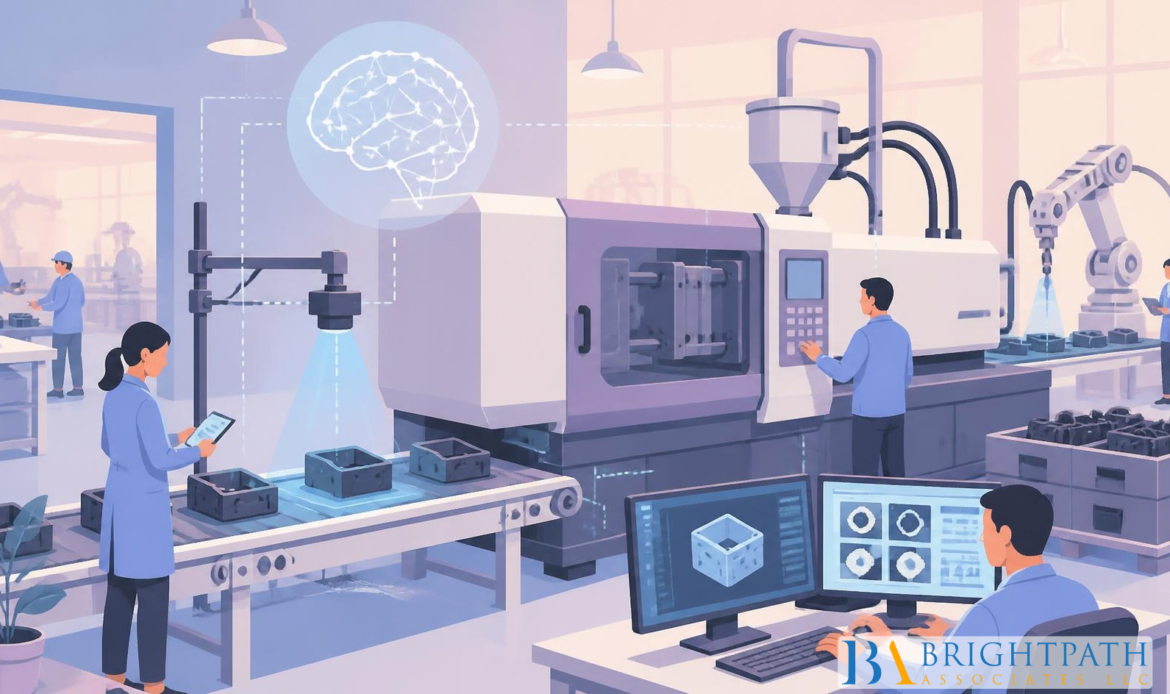
AI-powered quality control combines cameras, sensors, manufacturing data, machine-learning models, and analytical software. In molding applications, cameras can capture images of finished components while AI algorithms evaluate characteristics such as dimensions, surface appearance, color consistency, deformation, flash, cracks, and incomplete molding.
The system can compare new images with predefined quality standards and historical examples. Over time, machine-learning models can become better at distinguishing acceptable variations from genuine defects.
The value of AI extends beyond visual inspection. Manufacturing data such as injection pressure, mold temperature, cycle duration, cooling conditions, material characteristics, and machine performance can be analyzed together. This enables manufacturers to identify relationships that may not be obvious through conventional quality-control methods.
For example, an AI system may detect that a specific combination of temperature and pressure changes frequently precedes a particular molding defect. Production teams can then intervene before defective parts increase significantly.
AI-powered inspection is not necessarily about replacing human quality professionals. Instead, it can provide them with more consistent information and reduce repetitive inspection workloads.
Human expertise remains essential for determining quality standards, investigating unusual defects, validating AI results, and making operational decisions. AI can process large quantities of information rapidly, while experienced professionals provide contextual understanding.
This combination is particularly important in complex molding environments where acceptable tolerances can vary according to application and customer requirements.
The growing integration of AI is therefore creating demand for professionals who understand both manufacturing processes and digital technologies. Companies increasingly require technical specialists and strategic leaders capable of connecting manufacturing expertise with advanced analytics.
This development is also relevant to Plastics industry recruiters, who are increasingly involved in identifying professionals with hybrid capabilities across engineering, automation, analytics, quality management, and manufacturing leadership.
AI and Plastics Manufacturing Technology Investment
Implementing AI-powered quality control requires thoughtful investment in cameras, sensors, computing infrastructure, software, data management, and employee training. Manufacturers must evaluate these investments according to measurable operational requirements rather than simply adopting technology because it is considered innovative.
Plastics manufacturing technology investment is becoming increasingly connected to measurable outcomes such as reduced scrap, improved production consistency, faster defect detection, lower inspection costs, and improved equipment utilization.
The business case for AI becomes stronger when manufacturers integrate inspection technology with existing production systems. Instead of creating isolated quality-control platforms, companies can connect inspection results with production records, machine data, and enterprise systems.
This creates a broader digital manufacturing environment in which quality information can influence production planning, maintenance, material management, and customer reporting.
Quality problems are not always caused by molding equipment. Raw-material variability, transportation conditions, supplier performance, and inconsistent material specifications can also influence final product quality.
AI-powered quality systems can provide valuable data for Plastics industry #SupplyChainManagement by connecting production outcomes with material and supplier information.
If a recurring defect appears primarily when a particular material batch is used, manufacturers can investigate the supplier, material characteristics, or storage conditions. Such insights can help businesses identify risks earlier and improve supplier-management decisions.
This creates an important connection between manufacturing quality and supply-chain visibility. Rather than treating quality control as an isolated factory activity, manufacturers can view it as part of a larger network extending from raw materials to finished products.
Supporting Plastics Industry Risk Management
Manufacturing risks can emerge from equipment failures, material shortages, inconsistent suppliers, regulatory requirements, workforce shortages, and changing customer expectations. AI-enabled quality control can contribute to Plastics industry risk management by providing earlier indications of operational problems.
Predictive analytics can identify unusual patterns before they become major quality events. If machine behavior begins changing gradually, AI models can flag the deviation for investigation. Similarly, production data can reveal recurring quality problems associated with specific materials, molds, production shifts, or operating conditions.
Early detection does not eliminate risk, but it can provide manufacturers with more information and more time to respond.
This is particularly valuable in industries where defective products can result in expensive recalls, production delays, customer dissatisfaction, or regulatory complications.
Technology adoption is also influencing Plastics industry competitive analysis. Manufacturers are increasingly evaluating not only production capacity but also digital capabilities, quality consistency, sustainability performance, and responsiveness.
Companies capable of detecting defects earlier and optimizing production processes may be able to reduce material waste and improve operational efficiency. These capabilities can influence customer relationships and market positioning.
AI therefore becomes more than a quality-control tool. It can become part of broader Plastics market expansion strategies, particularly when manufacturers enter industries with demanding quality standards.
For example, suppliers serving medical, automotive, aerospace, and electronics customers may need highly reliable inspection and documentation systems. Demonstrating advanced quality capabilities can help manufacturers meet customer expectations and support expansion into specialized markets.
The Influence of Plastics Economic Trends
Investment decisions are closely connected to wider #PlasticsEconomicTrends. Energy prices, raw-material costs, labor availability, regulatory changes, sustainability expectations, and global demand can all affect manufacturing economics.
When margins become tighter, reducing scrap and improving production efficiency becomes increasingly important. AI-powered quality control can contribute by identifying defects earlier and helping manufacturers understand the causes of production losses.
However, technology adoption also requires capital and skilled personnel. Manufacturers must therefore balance immediate investment costs against potential long-term operational improvements.
This economic calculation is particularly important for small and mid-sized manufacturers that may have fewer resources for large-scale digital transformation. Scalable AI systems and phased implementation can allow companies to introduce advanced inspection capabilities without completely redesigning their manufacturing infrastructure.
AI adoption is rarely successful as a standalone initiative. It requires collaboration among machine manufacturers, software providers, material suppliers, automation specialists, data scientists, engineers, and manufacturing leaders.
This broader environment contributes to the development of a Plastics industry innovation ecosystem.
Technology providers can develop more specialized inspection models, while manufacturers provide real-world production data and operational expertise. Research institutions can contribute new analytical techniques, while material companies can provide information about polymer behavior and processing characteristics.
Such collaboration can accelerate innovation and improve the practical application of AI across molding operations.
Strategic Partnerships and Digital Transformation
The complexity of AI-powered manufacturing makes Plastics industry strategic partnerships increasingly important. A manufacturer may have extensive molding expertise but limited experience in machine learning or industrial data architecture.
Working with technology providers and engineering partners can help bridge this gap.
Strategic partnerships can also support workforce development. Employees may need training in data interpretation, AI-assisted inspection, digital maintenance, and advanced process optimization.
Organizations that combine technology investment with employee development are better positioned to integrate AI into everyday operations rather than treating it as a separate experimental project.
Technology transformation ultimately requires effective leadership. Senior executives must determine where AI can generate meaningful operational value, how investments should be prioritized, and which capabilities the organization needs to develop internally.
The growing importance of digital manufacturing is changing leadership requirements across the sector. Companies increasingly need executives who understand manufacturing economics while also recognizing the strategic implications of artificial intelligence, automation, supply-chain digitization, and data analytics.
This is one reason #ExecutiveSearchRecruitment has become relevant to technology-driven manufacturing transformation. Identifying leaders with experience across operations, technology, quality, and strategic planning can help organizations manage increasingly complex industrial environments.
The role of Plastics industry global leadership is also evolving. Companies competing across international markets must consider differences in regulations, customer expectations, technology adoption, labor availability, and supply-chain conditions.
Conclusion
AI-powered quality control is changing how high-speed molding operations approach accuracy, consistency, and production risk. By combining machine vision, process data, predictive analytics, and human expertise, manufacturers can detect defects faster and gain deeper insight into the causes behind quality problems.
The technology also has implications beyond the factory floor. It can strengthen Plastics industry supply chain management, support Plastics industry risk management, influence Plastics market expansion strategies, and shape decisions around Plastics manufacturing technology investment.
As the industry responds to changing Plastics economic trends, increasing competition, and evolving customer expectations, AI-powered quality control can become an important component of modern manufacturing strategy.
The most significant opportunity is not simply automating inspection. It is creating an intelligent manufacturing environment in which quality data continuously informs production, maintenance, supply-chain decisions, and leadership strategy. With the right technology, talent, and organizational approach, high-speed molding can move toward a more connected, responsive, and data-driven future.
Find your next leadership role in Plastics Industry today!
Stay informed with the latest insights on Plastics Industry!