
Introduction
The global #DairyIndustry is entering a period in which environmental performance is becoming increasingly connected with market access, product differentiation, supply-chain strategy, and international trade. For decades, dairy companies primarily competed around price, quality, nutrition, reliability, shelf life, and brand reputation. Today, another question is becoming increasingly important: what is the environmental footprint of the product across its entire life cycle?
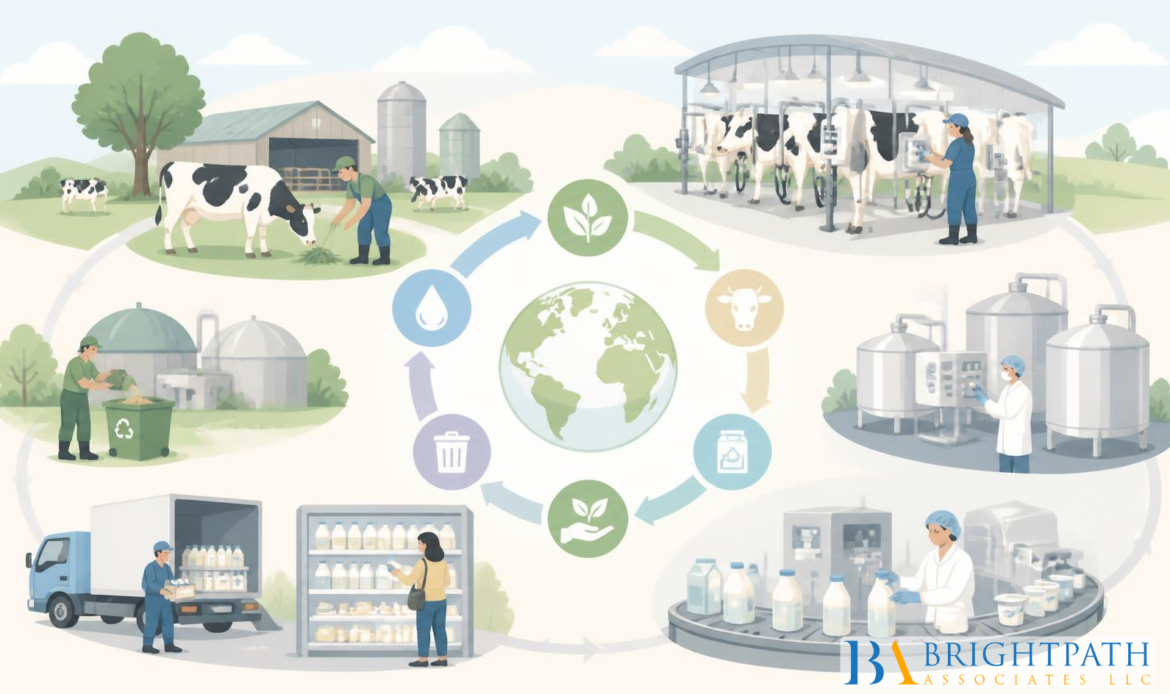
Life Cycle Assessment, commonly known as LCA, provides a structured method for answering that question. It examines environmental impacts across defined stages of a product’s life, from agricultural inputs and milk production through processing, packaging, transportation, and other relevant stages. In the dairy sector, LCA can provide a common framework for understanding emissions and other environmental impacts associated with milk and dairy products.
The International Dairy Federation has developed global guidance for dairy carbon-footprint assessment, while recent research continues to refine how emissions are measured across farms and processing operations. This growing methodological focus suggests that environmental data is moving closer to the center of dairy-sector decision-making.
As international dairy trade expands, credible environmental information could increasingly influence how products are evaluated by customers, retailers, regulators, investors, and business partners.
The Dairy Trade Is Becoming More Data-Driven
Dairy is a global industry, but most milk is still consumed domestically because fresh milk is highly perishable and contains a large proportion of water. International trade is concentrated more heavily in processed products such as milk powders, cheese, butter, and whey. The OECD-FAO Agricultural Outlook 2026–2035 projects continued growth in global dairy production and trade, with international dairy trade expected to reach 13.7 million tonnes by 2035.
As dairy products move across borders, buyers increasingly need reliable information about production, quality, traceability, and environmental performance. This creates a strong business case for standardized measurement.
LCA can help transform environmental performance from a broad sustainability claim into quantified product-level information. Instead of simply describing a product as environmentally responsible, a company can begin to understand the environmental impacts associated with producing a defined quantity of milk, cheese, butter, or another dairy product.
That shift has implications for international competitiveness.
Dairy product development is increasingly influenced by consumer expectations around nutrition, convenience, sustainability, packaging, and resource efficiency. Life Cycle Assessment can add another dimension to product-development decisions by allowing companies to examine environmental impacts before a product reaches commercial scale.
For example, a dairy manufacturer developing a new product may evaluate different processing methods, packaging materials, transportation requirements, and ingredient sources. The objective is not necessarily to select the option with the lowest impact in every category, but to understand the overall environmental consequences of each alternative.
This is important because environmental improvements in one area can sometimes create trade-offs elsewhere. Recent research examining agricultural food products found that focusing exclusively on carbon emissions can overlook other environmental impacts.
For dairy companies, this means product development needs a broader environmental perspective rather than relying on a single sustainability metric.
Milk Production Technologies Are Changing the Data Equation
The environmental profile of dairy begins at the farm. Feed production, animal productivity, enteric methane, manure management, land use, energy consumption, and farm inputs can all influence the environmental performance of milk.
#MilkProductionTechnologies are creating opportunities to collect more detailed information about these activities. Automated milking systems, animal monitoring tools, farm-management platforms, sensors, and digital decision-support systems can generate information about productivity and resource use.
The OECD-FAO Outlook notes that technology adoption, including automatic milking, real-time animal monitoring, and decision-support tools, could support further improvements in milk yields and production.
This matters for LCA because better operational data can potentially support more accurate environmental assessments. As farms become more connected, environmental measurement can move from periodic estimation toward increasingly data-supported analysis.
Sustainable dairy farming practices are becoming more important as dairy producers respond to environmental expectations. Improving feed efficiency, managing manure, reducing energy use, optimizing water consumption, improving animal productivity, and protecting soil and ecosystems can all contribute to a more resilient production system.
However, sustainability claims need credible measurement. A farm may implement a new practice that appears environmentally beneficial, but its actual impact needs to be evaluated within the broader production system.
Recent dairy LCA research has shown how productivity, herd structure, feed, manure, and energy use can influence the calculated carbon footprint of milk. One 2026 study found that productivity improvements were associated with a lower carbon footprint in the assessed production system, while also demonstrating that methodological choices such as allocation and functional units can significantly affect results.
This highlights why standardized LCA methodology matters for commercial decision-making.
Dairy Automation Technologies Can Improve Environmental Visibility
Dairy automation technologies are increasingly extending beyond automated milking. Modern dairy operations can use sensors, automated feeding, environmental monitoring, robotic systems, digital herd management, and connected farm equipment.
Automation can improve productivity and labor efficiency, but its potential environmental value also comes from better information. When systems capture detailed data about feed, energy, water, milk yield, animal health, and equipment utilization, producers can identify patterns that would be difficult to see through manual records alone.
For processors, automation can similarly improve visibility into energy consumption, refrigeration, cleaning processes, production losses, packaging, and equipment utilization.
When these data streams are connected with LCA systems, environmental performance can become more closely integrated with operational management.
Dairy supply chains involve farmers, cooperatives, processors, packaging suppliers, logistics providers, distributors, retailers, and consumers. Environmental impacts can occur at multiple points throughout this network.
Dairy supply chain management therefore needs to evolve beyond tracking product movement and inventory. Companies increasingly need to understand where environmental impacts originate and how changes at one stage influence the overall product footprint.
A processor may purchase milk from multiple suppliers operating under different production systems. Their environmental profiles may vary depending on feed, productivity, energy sources, herd characteristics, manure practices, and geographic conditions.
LCA can provide a framework for bringing these differences into a broader supply-chain analysis.
This could eventually influence supplier selection, procurement strategy, product design, and long-term sourcing relationships.
Dairy Industry Digital Transformation Is Creating New Possibilities
#DairyIndustry digital transformation is connecting farms, processing facilities, supply chains, and commercial platforms through increasingly sophisticated data systems.
Cloud platforms, Internet of Things technologies, artificial intelligence, analytics, automation, and digital traceability systems can provide the infrastructure required to collect and manage environmental information.
The challenge is ensuring that different systems can communicate effectively. If farm data, processing data, logistics information, and product records remain isolated, the value of an LCA can be limited.
The future of dairy sustainability measurement will therefore depend not only on environmental science but also on data architecture, interoperability, governance, and digital skills.
Dairy industry growth strategies have traditionally focused on expanding production, entering new markets, developing higher-value products, improving distribution, and strengthening brands.
Environmental performance is increasingly becoming another strategic consideration.
Companies entering markets with stronger sustainability expectations may need reliable environmental information to support commercial relationships. Exporters may also face different reporting requirements or customer expectations across markets.
Rather than treating LCA as a compliance exercise, dairy businesses can integrate environmental measurement into broader growth strategies. Product portfolios can be evaluated based on environmental performance, production investments can consider resource efficiency, and supplier relationships can incorporate environmental data.
The objective is not simply to reduce environmental impacts. It is to understand how environmental performance intersects with competitiveness.
The Role of Food Technology in Low-Impact Dairy Products
Food technology can influence environmental performance through processing efficiency, product formulation, preservation, packaging, ingredient utilization, and waste reduction.
Innovations in processing can potentially reduce energy and water requirements. Improved product design can increase the value obtained from milk components. Advanced preservation technologies can influence shelf life and food waste.
These developments should be assessed across the complete product system because improvements at one stage may shift environmental impacts elsewhere.
For example, a packaging material may require more resources during production but reduce food waste during distribution. A processing method may require additional energy but improve product yield. LCA provides a framework for evaluating such trade-offs.
Dairy e-commerce is changing how products reach consumers. Online grocery platforms, direct-to-consumer models, subscription services, and digital marketplaces are influencing distribution and purchasing patterns.
This creates new questions about packaging, delivery routes, cold-chain requirements, order consolidation, and last-mile logistics.
For dairy companies, environmental assessment may increasingly need to consider these new distribution models. A product’s environmental profile does not necessarily end when it leaves the processing facility.
As digital commerce expands, companies may need to evaluate how different fulfillment models affect refrigeration, transportation, packaging, and product losses.
LCA and the Future of International Dairy Competitiveness
Life Cycle Assessment could become increasingly important in international dairy trade because it creates a structured language for discussing environmental performance.
The OECD has noted that comparisons between dairy carbon-footprint studies can be difficult when system boundaries, allocation rules, emission factors, and other methodological assumptions differ. The IDF methodology was developed in part to improve consistency in dairy carbon-footprint assessment.
This consistency is important for trade. If two exporters use fundamentally different methodologies, buyers may struggle to compare their environmental claims.
Standardized approaches can therefore support greater transparency and reduce uncertainty around environmental information.
The significance extends beyond carbon. Full LCA can consider additional environmental categories, including water use, land use, eutrophication, toxicity, and biodiversity, depending on the scope of the assessment.
As environmental measurement becomes more integrated with business strategy, dairy companies will need leaders capable of connecting sustainability with operations and commercial performance.
Dairy industry executive search may increasingly focus on leaders who understand digital transformation, supply chains, food technology, environmental measurement, manufacturing, and international markets.
These executives need to communicate across traditionally separate functions. Sustainability teams need to work with procurement. Farm operations need to connect with data teams. Product development needs environmental information. Finance needs to understand the investment implications of sustainability initiatives.
This convergence creates demand for leaders with interdisciplinary capabilities.
#ExecutiveSearchRecruitment can play a role in identifying executives who understand both the technical and commercial dimensions of this transformation.
Building a Dairy Business Around Environmental Intelligence
The next stage of dairy competitiveness may depend on how effectively companies turn environmental data into operational intelligence.
An LCA should not remain a report prepared once a year for sustainability purposes. Its insights can potentially influence product development, farm management, processing efficiency, supplier selection, logistics, investment planning, and market strategy.
The strongest organizations will likely be those that connect environmental information with everyday business decisions.
This requires investment in data systems, employee capabilities, standardized methodologies, digital infrastructure, and leadership. It also requires organizations to recognize that environmental performance is not separate from business performance.
Conclusion
#LifeCycleAssessments are becoming more than environmental measurement tools. They are emerging as a framework through which dairy companies can understand the relationship between production, technology, supply chains, environmental performance, and international competitiveness.
As dairy markets expand and sustainability expectations become more sophisticated, credible environmental information can help companies make better decisions about Dairy product development, Milk production technologies, Dairy automation technologies, and Sustainable dairy farming practices.
At the same time, Dairy supply chain management and Dairy industry digital transformation will become increasingly important for collecting and connecting the information required for credible assessment. Food technology and Dairy e-commerce will add new dimensions to product and distribution decisions, while Dairy industry growth strategies will increasingly need to account for environmental performance.
Ultimately, the value of LCA lies not simply in calculating a footprint. Its greater value is helping the dairy industry understand where environmental impacts occur, where improvements are possible, and how those improvements can support resilient and competitive business models.
As environmental data becomes increasingly relevant to customers, regulators, investors, and trading partners, LCA may become one of the most important common languages connecting sustainability with global dairy commerce.
Find your next leadership role in Dairy Industry today!