
Introduction
Manufacturers are under growing pressure to improve productivity, reduce downtime, increase energy efficiency, and respond faster to changing #CustomerRequirements. At the same time, many production facilities continue to depend on machines that were installed years or even decades ago. Replacing an entire production line simply to introduce modern digital capabilities is rarely practical, particularly for small and mid-sized manufacturers operating under strict capital constraints.
The Industrial Internet of Things, or IIoT, offers an alternative approach. Instead of replacing legacy machines, manufacturers can add sensors, connectivity, analytics, and monitoring capabilities around existing equipment. This creates a digital layer capable of collecting operational data without requiring a complete mechanical or controls overhaul.
For manufacturers in the plastics sector, this approach can be particularly valuable. The plastics industry operates across highly competitive global markets where production efficiency, raw-material utilization, quality consistency, energy consumption, and equipment reliability directly affect profitability. IIoT can help manufacturers modernize these areas while preserving investments already made in machinery.
Legacy machines often remain productive long after their original control systems become outdated. Injection molding machines, extrusion systems, blow molding equipment, material handling systems, and auxiliary equipment can continue delivering commercial value despite having limited native connectivity.
The challenge is that older machines were generally designed to perform physical production tasks rather than generate detailed digital information. Their operating conditions may not be visible through modern dashboards, and important data may remain locked inside manual logs or isolated control systems.
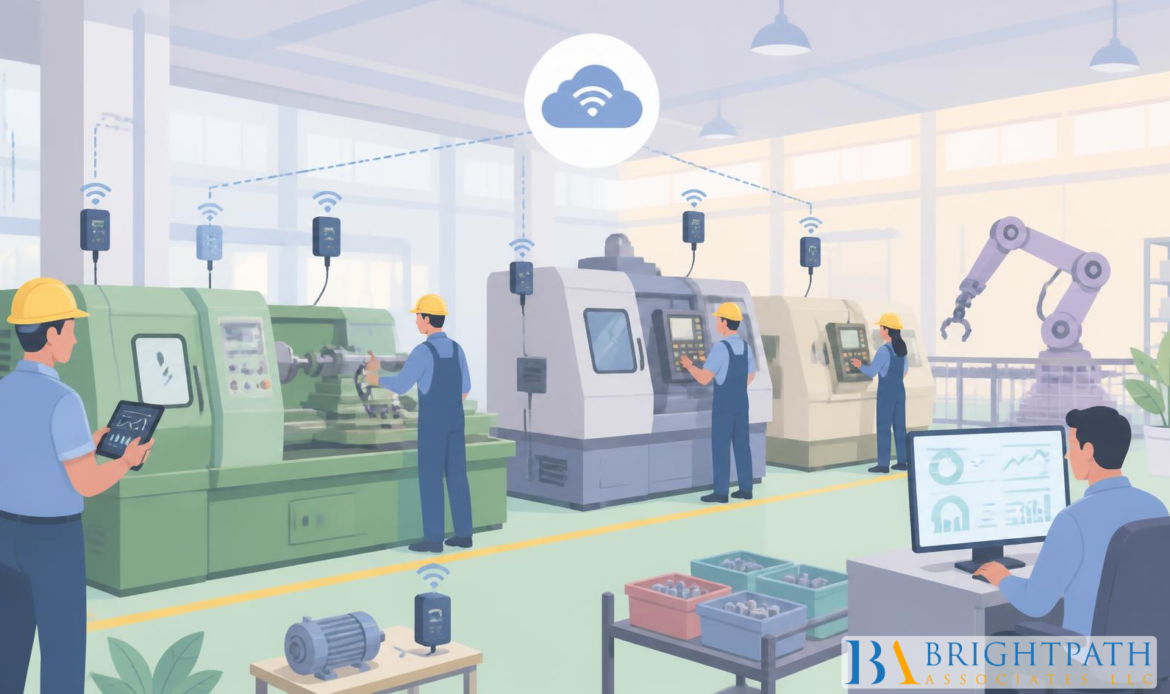
IIoT sensors provide a practical bridge between these older assets and modern digital platforms. Temperature, vibration, pressure, current, energy consumption, cycle time, and other operational parameters can be measured externally and transmitted to centralized systems.
This approach allows manufacturers to create digital visibility without immediately replacing the underlying production equipment.
The Business Case for IIoT in the Plastics Industry
The plastics manufacturing environment involves multiple variables that can influence product quality and production economics. Material properties, temperature profiles, pressure, cooling conditions, machine speed, cycle time, and equipment condition can all affect output.
When these variables are monitored continuously, manufacturers can identify relationships that are difficult to observe through manual inspection. For example, changes in machine vibration may provide an early indication of mechanical degradation, while variations in temperature or pressure may reveal process instability.
These capabilities support a broader Plastics industry competitive analysis because manufacturers can evaluate operational performance against internal benchmarks and market expectations. Instead of relying only on production volume, businesses can analyze efficiency, downtime, quality performance, and resource consumption.
The result is a more comprehensive understanding of where operational improvements can create commercial value.
Integrating IIoT into a legacy factory does not necessarily require direct modification of the machine’s original control architecture. External sensors can often be installed to capture specific operating conditions while gateways translate the collected information into formats compatible with modern software platforms.
A sensor attached to a motor, gearbox, hydraulic system, or production component can collect vibration and temperature information. Energy meters can monitor electricity consumption, while additional sensors can measure environmental conditions or process variables.
The data can then be transferred through industrial gateways to a local server or cloud-based analytics platform. This architecture creates a layer between physical machinery and digital systems.
The advantage is flexibility. Manufacturers can begin with a small number of machines, validate the value of the data, and expand the system gradually rather than committing to a large transformation project.
Turning Machine Data Into Operational Intelligence
Installing sensors is only the first step. The real value of IIoT comes from converting raw measurements into useful #OperationalIntelligence.
A manufacturing facility may generate thousands of data points every hour, but collecting information without a clear business objective can create complexity rather than value. Manufacturers should therefore identify which operational questions need to be answered.
For example, management may want to understand why a particular machine experiences repeated downtime or why energy consumption varies between similar production runs. Maintenance teams may want earlier warnings about equipment deterioration. Production managers may need better information about cycle-time variability.
Analytics platforms can organize this information and identify patterns. Over time, the system can establish normal operating conditions and flag deviations that require investigation.
IIoT can extend beyond individual machines to support broader Plastics industry supply chain management. Manufacturing performance is closely connected to raw-material availability, inventory levels, production schedules, logistics, and customer demand.
Production data can provide supply-chain teams with more accurate information about actual manufacturing capacity. If equipment availability changes, production schedules can be adjusted earlier. Similarly, better visibility into production rates can improve material planning and reduce unnecessary inventory.
This connection becomes increasingly important when plastics manufacturers operate across multiple facilities or serve customers with demanding delivery requirements. Digital information can help synchronize production and supply-chain decisions.
Rather than treating the factory as an isolated operation, manufacturers can connect shop-floor intelligence with broader supply-chain planning.
IIoT and Plastics Industry Risk Management
Manufacturing risk is often associated with major equipment failures, quality problems, supply interruptions, and unexpected production losses. IIoT can provide early indicators that help organizations identify some of these risks before they become major disruptions.
Predictive maintenance is one of the most important applications. Vibration, temperature, current, and other sensor data can reveal changes in equipment behavior. Analytics can compare current conditions with historical patterns and identify potential anomalies.
This supports Plastics industry risk management by shifting maintenance from a purely reactive model toward a more condition-based approach. Maintenance teams can investigate equipment showing unusual behavior before a failure causes extended downtime.
The same principle can apply to quality. Process deviations can be identified earlier, potentially reducing scrap and preventing large quantities of defective products from reaching later production stages.
One of the strongest arguments for IIoT is its ability to support gradual Plastics manufacturing technology investment. Manufacturers do not need to modernize every machine simultaneously.
A phased strategy allows companies to begin with critical production assets or processes where data can produce immediate operational insights. After demonstrating measurable value, the organization can expand the technology across additional machines and facilities.
This approach can make digital transformation easier to justify financially. Instead of treating modernization as a single large capital project, manufacturers can view it as a sequence of targeted investments.
It also reduces operational disruption. Existing machines can continue producing while the digital layer is introduced around them.
Responding to Plastics Economic Trends
The economics of #PlasticsManufacturing are influenced by raw-material prices, energy costs, consumer demand, regulations, international trade, and changing customer expectations. These factors can create significant uncertainty for manufacturers.
Understanding Plastics economic trends requires more than monitoring external market information. Manufacturers also need detailed knowledge of their own cost structures and operational efficiency.
IIoT can help companies understand how energy consumption, machine utilization, downtime, scrap, and production rates affect unit economics. This information can support more informed responses to market changes.
When material prices increase, for example, improving process efficiency and reducing scrap can become especially important. When demand weakens, manufacturers may need to identify which production assets can operate most efficiently at lower utilization rates.
Digital visibility makes these decisions more evidence-based.
Digital transformation becomes more powerful when it extends beyond individual machines or facilities. A broader Plastics industry innovation ecosystem can connect manufacturers with technology providers, automation specialists, software companies, equipment manufacturers, universities, and research organizations.
These relationships can accelerate the development of new applications for manufacturing data. Sensor companies may provide improved monitoring capabilities, while analytics providers can develop predictive models specifically for plastics processes.
Collaboration also allows manufacturers to share knowledge about practical implementation challenges. Because legacy equipment varies significantly between facilities, real-world experience can be valuable in determining which integration approaches are most effective.
The Role of Plastics Industry Strategic Partnerships
Plastics industry strategic partnerships can provide manufacturers with access to capabilities that may be difficult to develop internally. A company may have extensive process expertise but limited experience in industrial connectivity or data analytics.
Technology partners can help establish sensor architectures, communication systems, cybersecurity frameworks, and analytics platforms. Equipment suppliers may provide machine-specific information, while system integrators can connect multiple technologies.
Strategic partnerships can therefore reduce the complexity associated with digitizing legacy #ProductionEnvironments.
However, manufacturers should retain ownership of their transformation strategy. Technology should be selected according to measurable operational requirements rather than simply adopting digital tools because they are commercially available.
Digital maturity is increasingly becoming part of competitive positioning. Manufacturers seeking Plastics industry global leadership need to demonstrate not only production capacity but also operational efficiency, quality consistency, responsiveness, and innovation capability.
IIoT can contribute to these objectives by providing better visibility across production operations. Data can support continuous improvement programs, strengthen maintenance planning, improve quality management, and provide evidence for sustainability initiatives.
The technology itself does not create leadership. Rather, it provides manufacturers with infrastructure that can support better decision-making and faster organizational learning.
Companies that consistently convert operational data into measurable improvements can build stronger capabilities over time.
The Talent Challenge Behind Factory Digitization
Technology adoption also changes the skills required inside manufacturing organizations. Engineers and managers must increasingly understand sensors, industrial connectivity, data analytics, cybersecurity, automation, and digital platforms.
This creates new challenges for recruitment and workforce development. Organizations may need professionals who can understand both traditional manufacturing processes and emerging digital technologies.
#PlasticsIndustryRecruiters therefore face a changing talent landscape. Candidates with experience exclusively in either manufacturing or digital technology may not always possess the complete combination of skills required for IIoT transformation.
Companies may need to develop internal talent while also recruiting professionals with specialized digital expertise.
Leadership becomes particularly important when IIoT projects move beyond pilot programs. #ExecutiveSearchRecruitment can help organizations identify leaders capable of connecting technology investment with manufacturing strategy.
Digital manufacturing leaders must understand operational economics, production technology, data architecture, organizational change, and workforce requirements. They also need the ability to communicate the value of digital transformation to senior management and production teams.
For plastics manufacturers, leadership capability can determine whether IIoT remains a collection of disconnected technology projects or becomes part of a coherent manufacturing strategy.
The most effective transformation programs treat technology, people, processes, and business objectives as interconnected elements.
Conclusion
The modernization of manufacturing does not have to begin with replacing the factory. Legacy machines can remain valuable production assets while IIoT sensors create a digital layer around them.
For plastics manufacturers, this approach can improve operational visibility, support supply-chain planning, strengthen risk management, guide technology investment, and provide deeper insight into changing economic conditions. It can also contribute to a wider innovation ecosystem built around strategic partnerships and specialized technical talent.
The central lesson is that digital transformation can be incremental. Manufacturers can start with the machines and processes where better data has the greatest potential impact, prove measurable value, and expand from there.
As the plastics sector becomes increasingly data-driven, the ability to connect existing industrial assets with modern digital intelligence will become an important component of long-term competitiveness. IIoT offers manufacturers a practical path toward that future without requiring them to abandon the machinery that has supported their operations for years.
Find your next leadership role in Plastics Industry today!
Stay informed with the latest insights on Plastics Industry!